
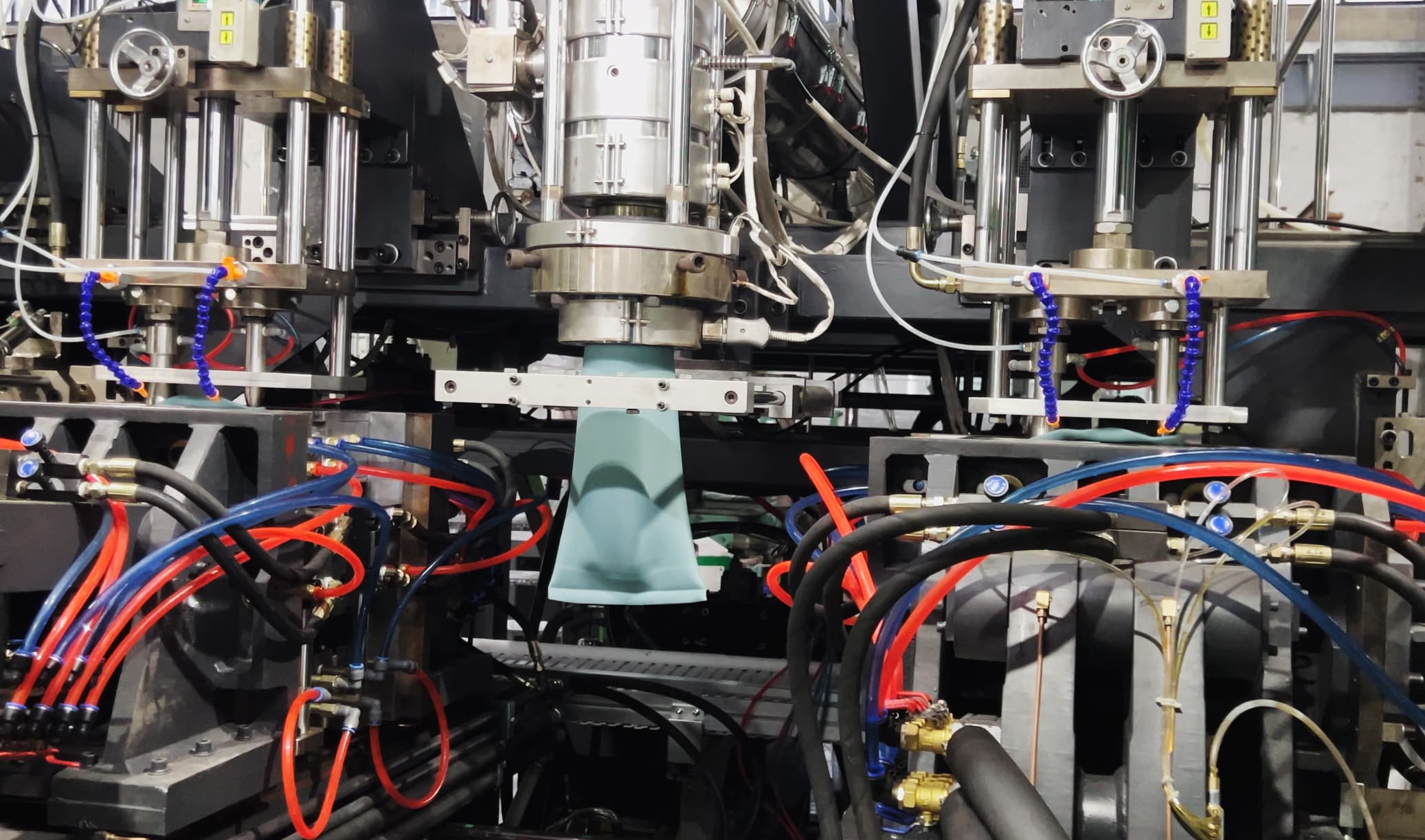
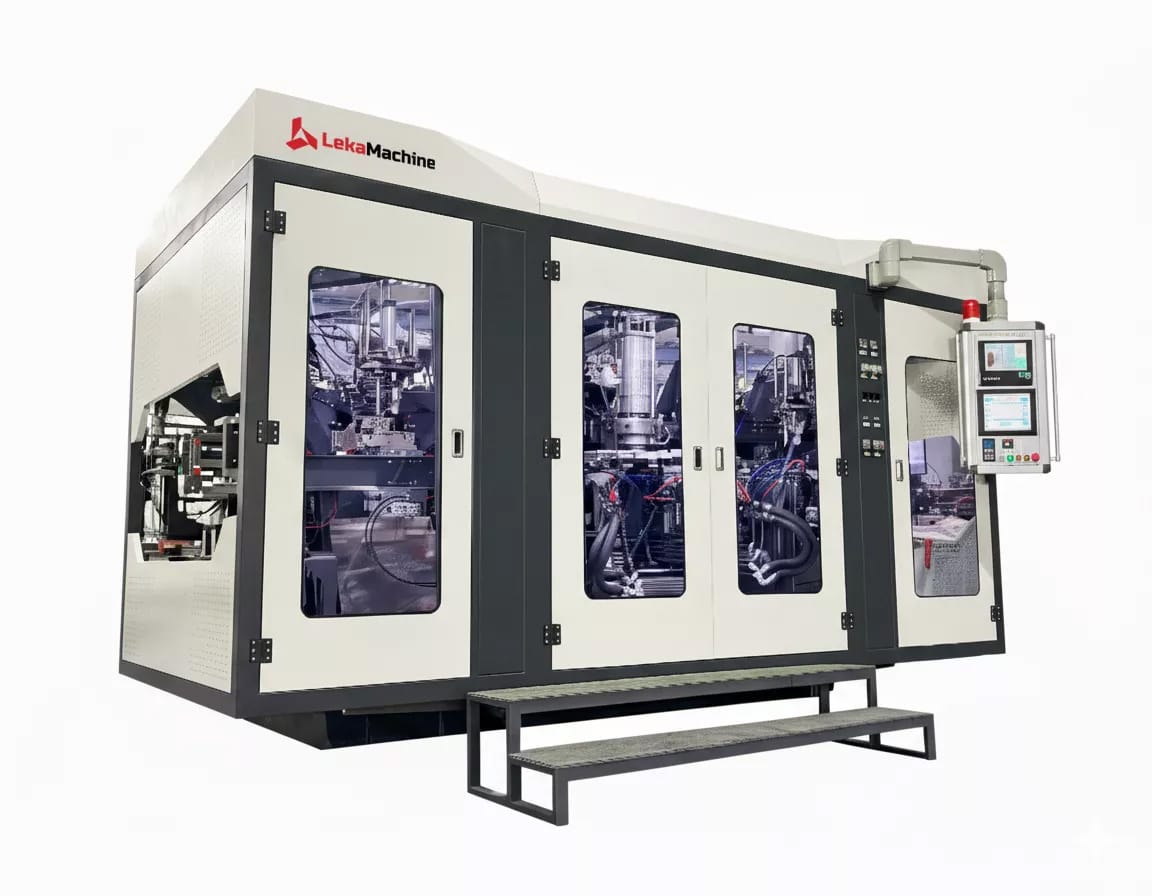
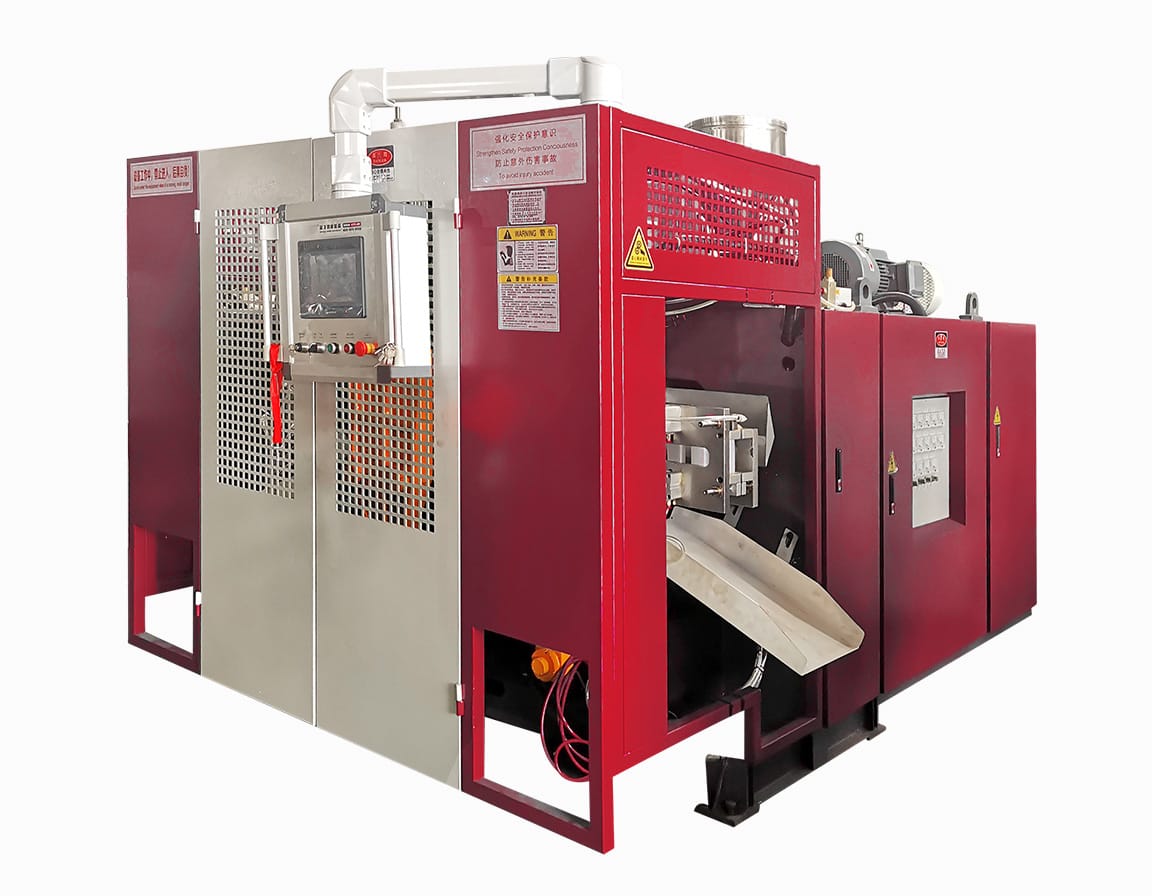
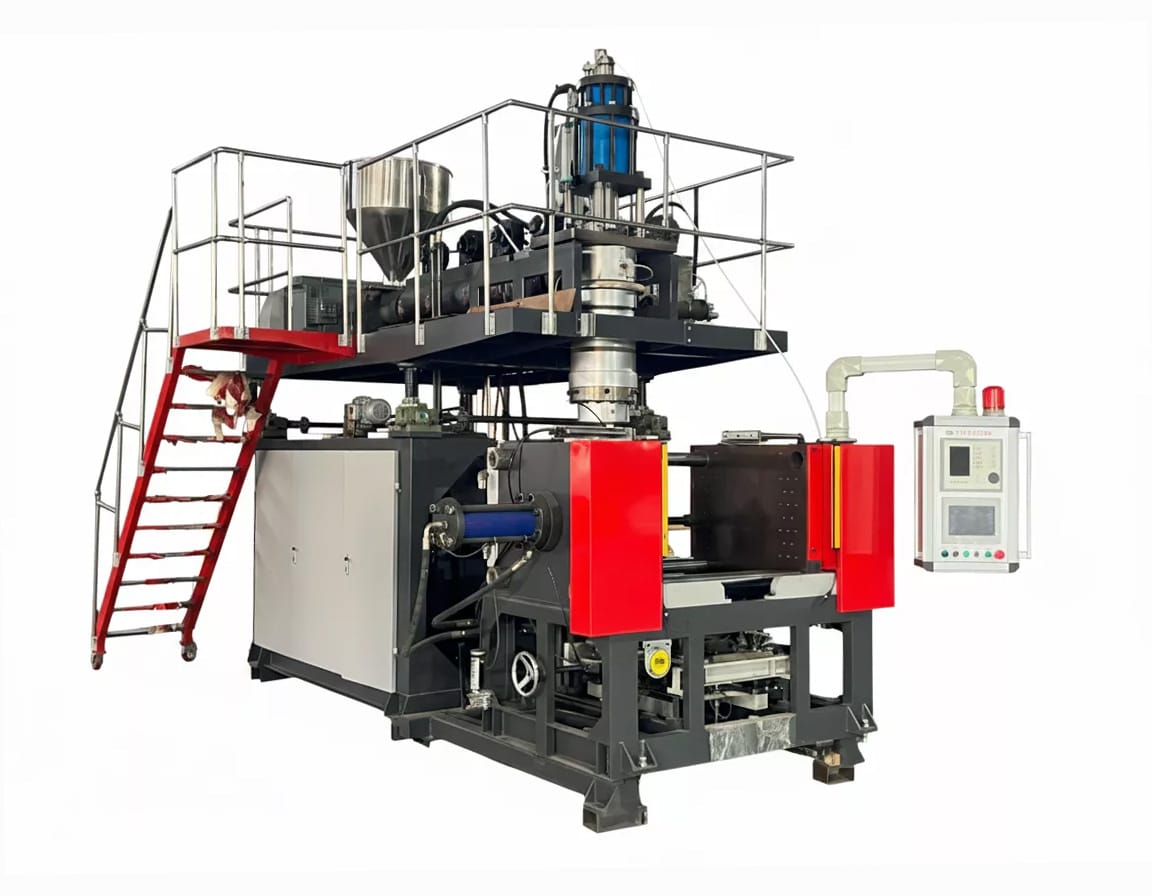
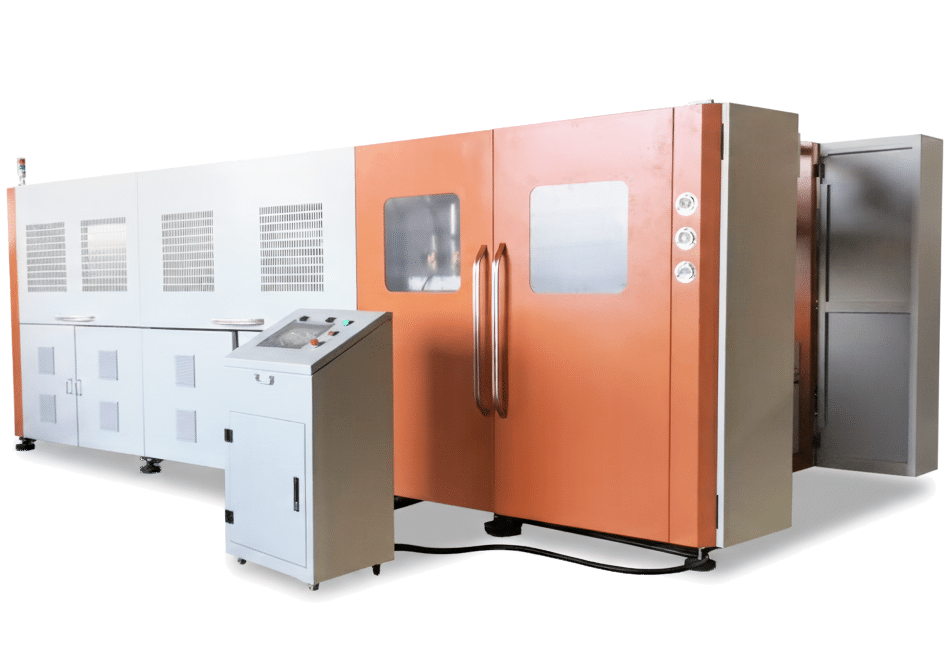
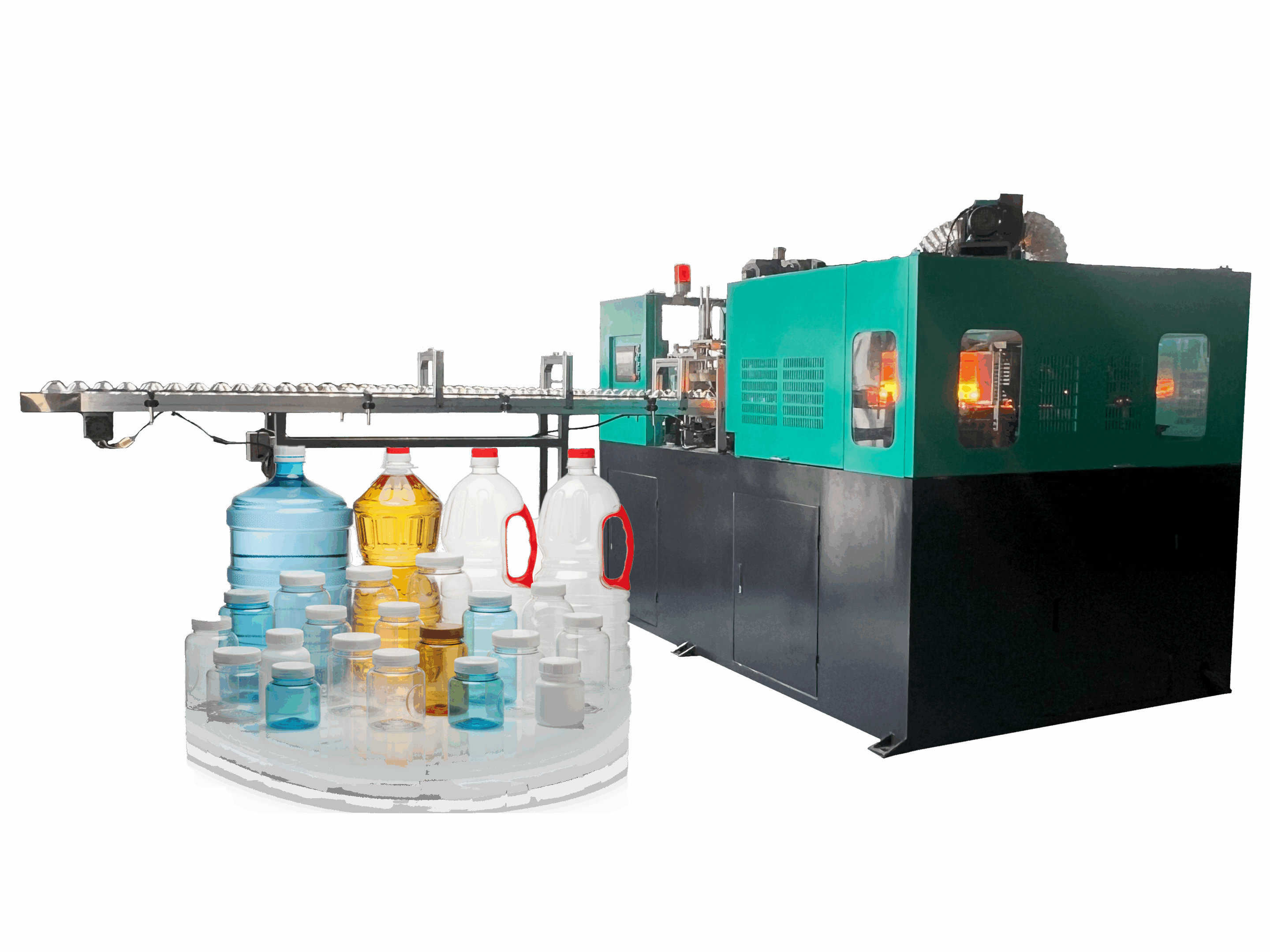
Extrusion blow molding machine setup tips that boost output fast?

At our facility, we often see clients struggling to meet delivery deadlines because their machines run slower than the theoretical speed. It is frustrating to watch profits evaporate due to sluggish cycle times and inefficient cooling. We have spent years fine-tuning parameters to help factories get more bottles out the door every hour.
To boost output quickly, focus on the cooling phase, which typically consumes up to 80% of the cycle time. Upgrading to copper-beryllium mold inserts and ensuring turbulent water flow can reduce cooling time by 20%. Additionally, optimizing the dry cycle by tuning valve acceleration ramps shaves valuable seconds off production.
Here are the specific settings and adjustments that make a real difference on the production floor.
How can I optimize my cycle time settings to increase hourly bottle production?
When we commission machines for clients, we notice that default settings often leave money on the table. You might be losing precious seconds on every bottle, leading to thousands of missed units per week.
Optimizing cycle time starts with the "dry cycle" movements. Reduce mold open/close and carriage transfer times by 0.5 seconds through proportional valve tuning. Furthermore, use "parison sag" logic to synchronize mold closing with the exact moment the parison reaches length, eliminating dead wait time completely.

To truly accelerate your hourly production, you need to look beyond the obvious cooling times and focus on the mechanics of the machine movement and air management.
Shaving Seconds off the "Dry Cycle"
While cooling is dictated by physics, the "dry cycle"—the time the machine spends moving without plastic—is dictated by your settings. Many operators leave the factory default settings for mold opening and closing speeds.
In our testing, we found that aggressive tuning of the proportional valve acceleration and deceleration ramps can save 0.2 to 0.5 seconds per cycle. This does not mean simply increasing the top speed, which can slam the mold and damage the platens. Instead, it means steepening the acceleration curve so the mold reaches top speed faster and brakes later. Over a 24-hour shift, saving 0.5 seconds on a 15-second cycle yields an extra 190 bottles per cavity.
Vacuum-Assisted Venting
Another often-overlooked area is the blowing phase. Standard setups rely on air pressure to force the plastic against the mold walls. However, air trapped inside the mold cavity creates resistance.
By applying a vacuum to the mold cavity antes and during the inflation phase, you remove this air resistance. This allows the parison to inflate faster and capture fine details (like logos or threads) without needing excessive air pressure. Lower air pressure reduces the risk of "blowouts," and the faster contact with the cold mold wall begins the cooling process sooner.
Intelligent Parison Sag Management
Parison sag is usually seen as a defect, but we treat it as a variable we can calculate.
Instead of waiting for a photo-eye sensor to trigger the mold closing, use melt strength indexing to predict the sag velocity. You can time the mold closing sequence to intercept the parison exactly as it reaches the correct length. This eliminates the "dead wait" time—usually around 0.2 to 0.4 seconds—where the machine sits idle waiting for the plastic to drop that last inch.
Cycle Time Breakdown Target
| Cycle Phase | Standard Setup | Optimized Setup | Action Item |
|---|---|---|---|
| Mold Close/Lock | 2.0s | 1.6s | Tune proportional valve ramps. |
| Blow & Cool | 10.0s | 8.0s | Use vacuum venting & CuBe inserts. |
| Exhaust | 1.0s | 0.6s | Use quick-exhaust valves. |
| Mold Open/Eject | 2.0s | 1.6s | Overlap ejection with mold opening. |
| Total Cycle | 15.0s | 11.8s | ~21% Output Increase |
What are the best parison programming techniques to reduce material waste?
We frequently test new resin formulas in our lab, and nothing hurts margins more than excessive flash or heavy bottoms. Is your scrap rate eating into your raw material budget?
Effective parison programming uses multi-point profile control to thin out low-stress areas while reinforcing corners. Implementing Parison Radial Adjustment (PRA) with deformable die rings allows for precise radial thinning. This technique often reduces part weight by over 10% and significantly shortens the cooling time required for thick sections.

Reducing waste is not just about saving plastic; it is about saving time. The thickest part of your bottle determines your cooling time. If you accidentally leave the bottom corners too thick, you must wait for them to cool, even if the rest of the bottle is ready.
PID Auto-Tune 1
The Power of Parison Radial Adjustment (PRA)
Most standard machines come with axial (vertical) parison programming. This lets you change the thickness from the top of the bottle to the bottom. However, this is often not enough for square or non-round bottles.
We recommend installing a Parison Radial Adjustment (PRA) system. This system uses a deformable die ring to change the thickness of the parison radially (around the circumference).
- O problema: On a square bottle, the corners naturally thin out as they stretch, so operators increase the overall thickness to compensate. This makes the flat panels unnecessarily heavy.
- A solução: PRA allows you to keep the parison thick only where the corners will be, and thin it out for the flat panels.
This targeted approach can reduce the overall bottle weight by 10-15%. Since the bottle contains less plastic, it holds less heat, allowing you to open the mold sooner.
hydraulic pressure 2
Mastering the "Flash" Bottleneck
Often, the cycle time is not dictated by the bottle, but by the flash (scrap) at the pinch-off areas (neck and bottom). Flash is solid plastic and is usually thicker than the bottle wall. It holds heat the longest.
If you open the mold too early, the flash stays soft and sticks to the mold or stretches, causing jams. To fix this without slowing down, we program the parison to be slightly thinner exactly at the pinch-off points—just enough to seal, but thin enough to cool quickly.
dew point 3
100-Point Profile Optimization
Modern controllers allow for 100 points of profile control. Do not settle for a simple linear slope. Use critical thinking to map your bottle’s stress points.
- Shoulders: often need reinforcement to pass drop tests.
- Label Panel: can be thinned significantly as it has structural ribs.
- Base: needs to be thick for stability but not so thick that it warps.
Common Defects and Program Fixes
| Defeito | Likely Cause | Programming Fix |
|---|---|---|
| Rocker Bottom | Base flash is too hot/thick. | Reduce parison thickness at the bottom pinch-off point; check mold cooling at base. |
| Thin Corners | Excessive stretching. | Increase master gap slightly; use PRA to add material specifically to corner radius vectors. |
| Accordion Neck | Parison collapsing under weight. | Increase melt strength or slightly thicken the upper parison profile to support the weight. |
How do I adjust mold cooling temperatures to prevent warping while running faster?
During our Factory Acceptance Tests (FAT), we often push speeds to the limit, but going too fast can warp the bottles. It is a delicate balance between speed and dimensional stability.
Factory Acceptance Tests 4
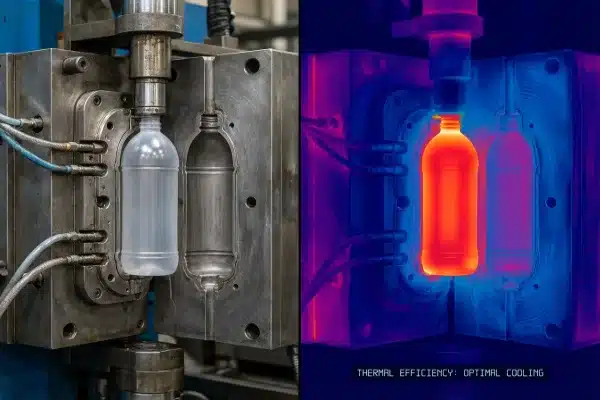
To prevent warping at high speeds, you must ensure turbulent flow within the cooling channels by verifying a Reynolds number above 4,000. Do not just lower the water temperature; install flow meters on return lines to confirm velocity exceeds 1.5 m/s, preventing insulating boundary layers that kill heat transfer.
Copper-Beryllium (CuBe) alloy inserts 5
Cooling is the "speed limit" of blow molding. You cannot cheat physics, but you can optimize how you remove heat. Many operators make the mistake of setting the chiller to near-freezing temperatures, which causes mold sweating (condensation) and surface defects, without actually speeding up the core cooling.
turbulent flow 6
The "Turbulent Flow" Requirement
The most important factor in cooling is not just temperature, but flow rate.
Imagine a lazy river vs. a rapid. In a "lazy river" (laminar flow), the water touching the mold wall heats up and stays there, creating a blanket that insulates the mold from the cold water in the middle of the pipe.
In a "rapid" (turbulent flow), the water mixes violently. Cold water is constantly smashing against the hot mold metal, scrubbing away the heat.
- Target: You need a Reynolds number > 4,000.
- Verificação: You cannot see this from the outside. You must install flow meters on the return lines. If your water velocity is below 1.5 meters per second, your chiller is working hard, but your mold is staying hot.
Copper-Beryllium (CuBe) Alloys
Steel is durable, but it is a poor conductor of heat. For high-speed production, we replace steel blocks in the "hot spots" with Copper-Beryllium (CuBe) alloy inserts.
- Onde colocá-los: The neck block and the bottom pinch-off. These areas have the most plastic (flash) and hold the most heat.
- O resultado: CuBe transfers heat up to 5 times faster than steel. This can reduce your required cooling time by 15-20%, directly increasing your bottles per hour.
Managing the Dew Point
Running a mold too cold causes condensation, which leads to "orange peel" surface defects on the bottle.
We recommend a dynamic approach:
- Measure the dew point of your factory floor.
- Set your water temperature 2°C to 3°C above that dew point.
- To run colder and faster, you must lower the humidity in the molding area using dehumidifiers or air conditioning, not just lower the chiller setpoint.
Cooling Channel Maintenance Schedule
| Componente | Frequência | Ação | Why? |
|---|---|---|---|
| Chiller Filter | Semanal | Clean/Replace | Debris slows flow rate, killing turbulence. |
| Mold Channels | Mensal | Descaling flush | 0.5mm of scale (calcium) acts like an insulator, reducing efficiency by 20%. |
| Flow Meters | Trimestral | Calibration check | Verify you are maintaining >1.5 m/s velocity. |
What preventive maintenance steps ensure my machine maintains peak performance?
We build our machines to last, but we have seen neglected equipment fail right when a big order comes in. Unexpected downtime is the single biggest killer of annual profitability.
flash (scrap) 7
Peak performance requires checking extruder screw wear annually; a gap larger than 0.5mm causes surging and forces slower run speeds. Additionally, monitor blow pin seals using digital flow meters to detect micro-leaks early. Finally, perform PID auto-tuning on heater bands whenever changing materials to prevent temperature drift.
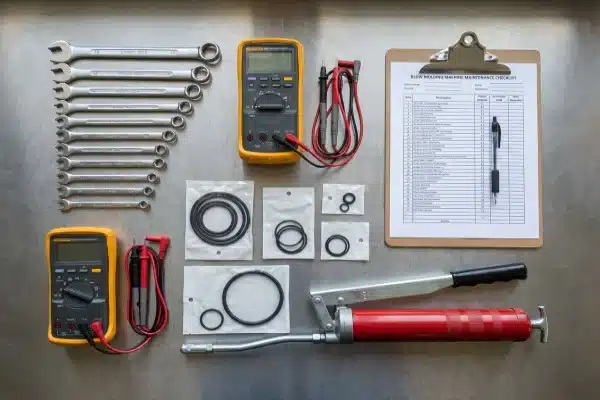
Reactive maintenance—fixing things only when they break—guarantees inconsistent output. To keep a machine running at high speed, you need to catch invisible issues that slowly drag down performance.
photo-eye sensor 9
The Hidden Killer: Screw and Barrel Wear
Operators often complain about "surging" or unstable parison lengths. They usually blame the controller or the hydraulic pressure. In our experience, the culprit is often mechanical wear.
- The Issue: Over time, the extruder screw wears down, increasing the gap between the screw and the barrel. If this gap exceeds 0.5mm, the plastic back-flows.
- O sintoma: The extruder cannot maintain constant pressure. The parison length fluctuates.
- The Consequence: To compensate, the operator has to slow down the RPM and the overall cycle time to stabilize the parison. You lose output capacity without realizing why. Check this clearance annually.
PID Auto-Tuning for Temperature Stability
Different plastic resins absorb heat differently. If you switch from HDPE to PP, or even between different grades of HDPE, the thermal characteristics change.
If you do not recalibrate, the temperature controllers (PID) will "hunt"—overshooting and undershooting the setpoint.
- A solução: Run the PID Auto-Tune function on your heater bands every time you change material types. This ensures the barrel temperature remains rock-steady, providing consistent melt viscosity and parison behavior.
Blow Pin Seal Monitoring
Air leaks are expensive. Not just in energy costs, but in process instability. A small leak at the blow pin seal means the bottle doesn’t get full pressure during the cooling phase.
- Predictive Maintenance: Install a digital flow meter on the blowing airline. Monitor the "holding phase" consumption.
- The Signal: During the holding phase, airflow should be near zero. If you see the airflow "creeping" up over weeks, you have a developing leak at the blow pin or mold parting line. You can schedule a seal replacement during a planned shutdown rather than stopping production mid-run when the seal finally blows out.
Conclusão
Optimizing an extrusion blow molding machine is not about finding one "magic button." It is about a series of small, calculated adjustments. By upgrading to turbulent cooling flows, utilizing radial parison programming, and maintaining the mechanical integrity of your screw and seals, you can push your equipment beyond its standard limits. Speed is a result of precision.
proportional valve acceleration 10
Notas de rodapé
- Explains the control loop feedback mechanism used to maintain stable temperatures. ↩︎
- Relates to the fluid power system driving the machine’s mechanical movements. ↩︎
- Defines the atmospheric temperature at which airborne water vapor condenses. ↩︎
- Refers to the standard process of verifying equipment performance before delivery. ↩︎
- Details the metal alloy chosen for its superior thermal conductivity in molds. ↩︎
- Describes the fluid motion regime required to maximize heat transfer efficiency. ↩︎
- Explains the term for excess material that must be trimmed from the molded part. ↩︎
- Defines the specialized tooling component used to shape the molten plastic profile. ↩︎
- Identifies the optical sensor technology commonly used for position detection in manufacturing. ↩︎
- Describes the type of valve used for precise control of hydraulic movement speeds. ↩︎



0 comentários