
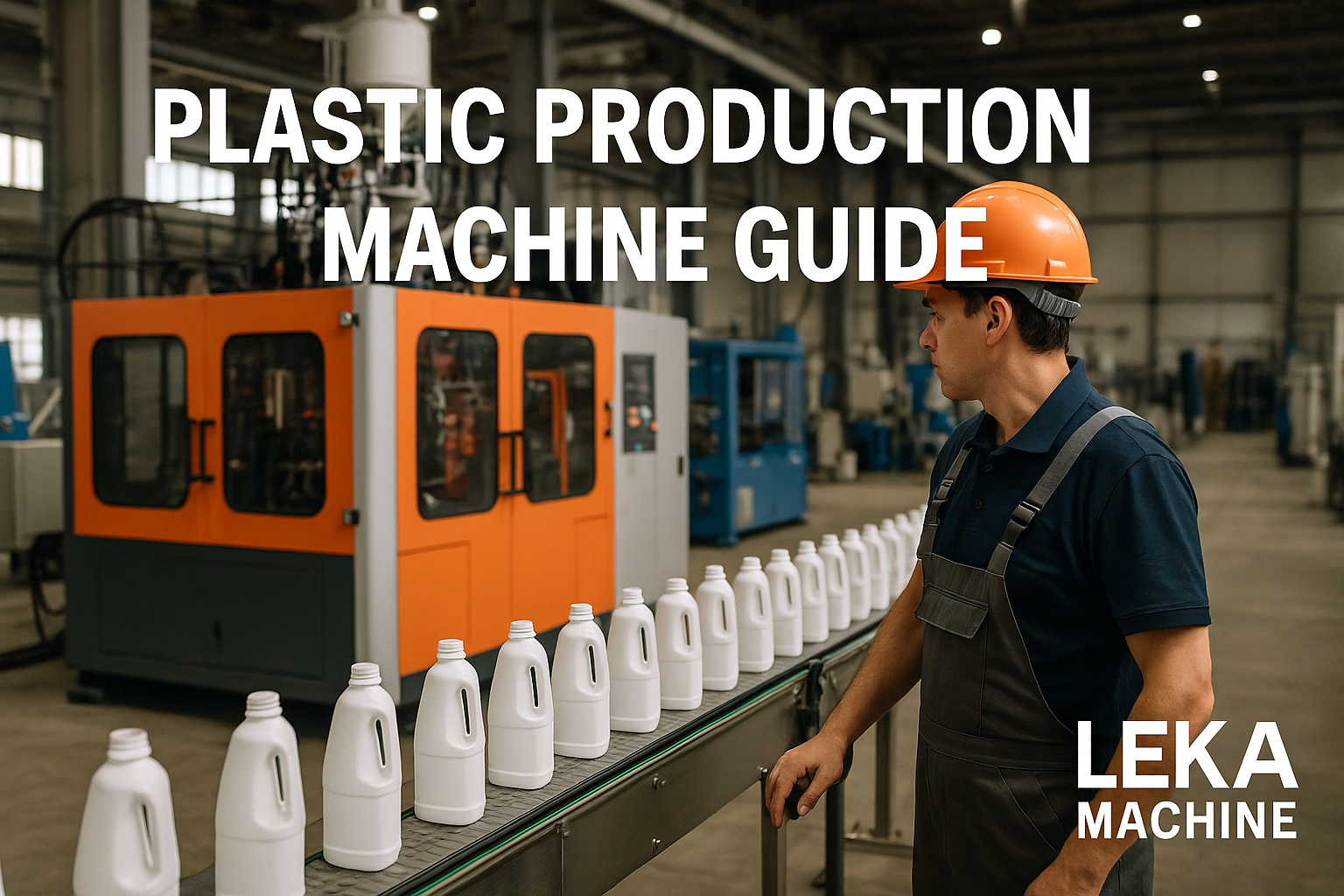
Plastic Production Machine: A Practical Guide for Bottle and Container Factories
Who Should Read This Guide
This guide is written for bottle factories, packaging manufacturers, brand owners, and investors who want better control over plastic bottle or container production. If you are producing detergent bottles, water bottles, edible oil bottles, jerry cans, chemical containers, or similar hollow plastic packaging, this guide is for you.
Many buyers search for a plastic production machine when they are actually trying to solve a larger problem. They do not just want a machine. They want a practical production solution that matches their bottle type, material, output target, and factory conditions.
That is why the real buying question is not only “What machine should I buy?” The better question is “What type of machine actually fits my bottle and production plan?”
What Is a Plastic Production Machine for Bottles and Containers
In bottle manufacturing, a plastic production machine is the main forming equipment that converts plastic raw material into finished hollow bottles or containers. For most bottle projects, this means a blow molding system rather than a general-purpose plastics machine.
The basic production route usually includes:
- Material feeding
- Melting and plasticizing
- Forming a parison or preform
- Blowing inside the mold
- Cooling and shaping
- Trimming, inspection, and transfer
For hollow packaging, the two most important machine routes are:
- Extrusion blow molding machines for many HDPE and PP bottle or container applications
- Stretch blow molding machines for most PET bottle applications
That is why this guide focuses on those two routes.
Main Machine Types for Bottle Production
Extrusion Blow Molding Machine
Extrusion blow molding starts by melting resin and extruding it into a hollow tube called a parison. A mold closes around the parison, compressed air expands it to the mold wall, and the final bottle or container is formed after cooling.
This process is usually used for HDPE and PP packaging projects that need toughness, practical performance, or more shape flexibility.
Typical products include:
- Detergent bottles
- Milk bottles
- Shampoo and body wash bottles
- Chemical containers
- Lubricant bottles
- Jerry cans
- Industrial drums and technical containers
Extrusion blow molding is usually the better choice when the package needs:
- HDPE or PP material
- Handle design
- Wider neck or non-standard geometry
- Strong chemical resistance
- Higher wall thickness or stronger practical performance
If your main products fall into those categories, your project should usually move toward the right extrusion blow molding machine solution.
Stretch Blow Molding Machine
Stretch blow molding is mainly used for PET bottles. The process starts with a PET preform. The preform is reheated, stretched, and blown into the final bottle shape. This gives PET bottles the clarity, strength, and lightweight performance expected in many beverage and food packaging applications.
This process is usually the better choice for clear PET bottle production.
Typical products include:
- Mineral water bottles
- Carbonated beverage bottles
- Juice and tea bottles
- Edible oil bottles
- Clear personal care bottles
- Other preform-based PET bottle formats
Stretch blow molding is usually the better choice when the package needs:
- Clear bottle appearance
- Strong shelf presentation
- Stable PET bottle repeatability
- Higher-speed bottle output
- Preform-based bottle production
If your project is focused on PET water bottles, beverage bottles, edible oil bottles, or clear retail packaging, your project should usually move toward the right stretch blow molding machine solution.
Other Machine Types
You may also hear about injection molding, injection-stretch-blow systems, or thermoforming equipment. These are valid technologies in the broader plastics industry, but for most bottle and hollow container projects, the main buying decision still comes down to EBM versus SBM.
How to Choose the Right Machine for Your Product
The best way to choose a machine is to begin with the product, not with the brochure.
Start with the material
Material is usually the clearest first filter.
- HDPE and PP usually lead to extrusion blow molding
- PET usually leads to stretch blow molding
Then check the bottle style
After material, look at the actual package design.
- Does the bottle need to be clear?
- Does it need a handle?
- Is it a jerry can or a drum?
- Is it a standard PET water bottle format?
- Does it need stronger chemical resistance?
Basic matching logic
| Product type | Likely material | Likely machine direction |
|---|---|---|
| Detergent bottle | HDPE | EBM |
| Milk bottle | HDPE | EBM |
| Chemical container | HDPE | EBM |
| Jerry can | HDPE / PP | EBM |
| Water bottle | PET | SBM |
| Carbonated drink bottle | PET | SBM |
| Edible oil bottle | PET | SBM |
| Clear retail bottle | PET | SBM |
If you still need a quick rule, use this one first: PET usually points to SBM, while HDPE and PP usually point to EBM.
Key Specifications Buyers Should Check
The machine name is never enough. Buyers should review the specifications that actually affect output, stability, bottle quality, and operating cost.
Output and capacity
- Real bottles per hour for the main SKU
- Single-station or double-station structure for EBM
- Number of die heads or cavities
- Realistic cycle time under stable production conditions
Container range and flexibility
- Smallest and largest bottle size the machine can run properly
- Suitability for your actual bottle weight and material
- Wall thickness control or bottle consistency capability
- Room for future SKUs
Energy and utilities
- Power consumption in real operation
- Compressed air requirements
- Cooling water requirements
- Drive system efficiency
Automation and labor
- Fully automatic or semi-automatic configuration
- Need for leak tester, conveyor, or inspection equipment
- Expected labor requirement per shift
- Ease of mold change and operator use
Control system
- User-friendly HMI
- Recipe storage
- Alarm history
- Remote support options if needed
What Really Drives Machine Cost
The cost of a plastic production machine is not only the machine price. It is a mix of capital cost and operating cost.
Main capital cost drivers
- Machine size and clamping force
- Servo, hydraulic, or electric drive structure
- Number of die heads or cavities
- Automation level
- Special options such as multilayer capability
Main operating cost drivers
- Energy consumption
- Scrap and start-up waste
- Maintenance and spare parts
- Labor requirement
- Downtime risk
Hidden costs buyers often miss
- Freight and import cost
- Installation and commissioning
- Training
- Molds and future mold additions
- Future upgrades and automation expansion
The right comparison is total cost of ownership, not only the lowest quotation.
How the Machine Fits into a Full Production Line
A bottle production machine does not work in isolation. Real output depends on the whole system around it.
Upstream support
- Material handling
- Drying for PET where required
- Mixers and dosing units
Main forming section
This is the center of the line. For EBM, die head design, parison control, and mold stability are critical. For SBM, preform heating, stretching, and blowing consistency are critical.
Downstream support
- Deflashing or trimming
- Leak testing
- Visual inspection
- Conveyors and packing support
- Possible future connection to filling or end-of-line packaging
A cleaner layout reduces labor waste, improves bottle consistency, and makes future expansion easier.
Typical Factory Scenarios
Scenario 1: Detergent factory bringing bottle production in-house
If a detergent factory wants to stop depending on outside bottle suppliers, the most common direction is an EBM line. This is especially true when the main products are HDPE detergent bottles, household containers, or 5L bottle formats.
Scenario 2: New PET water bottling project
If the project is focused on PET water bottles or beverage bottles, the correct path is usually SBM. The key questions become bottle size, output target, preform standard, and line integration with filling equipment.
Scenario 3: Cosmetic or personal care packaging project
This depends on whether the bottle needs clarity or stronger practical performance. Clear PET bottles usually move toward SBM. Opaque HDPE or PP bottles usually move toward EBM.
Factory Readiness Checklist
Before ordering a machine, make sure your factory is ready in three areas.
Technical readiness
- Enough floor space and workable layout
- Sufficient ceiling height and installation access
- Power, air, and cooling support confirmed
- Basic QC tools planned
Team and process readiness
- Main operator assigned
- Training plan prepared
- Basic SOPs for operation and maintenance
- Safety rules for the blow molding area
Financial and project readiness
- Budget range defined
- Expected payback logic reviewed
- Real demand estimated
- Timeline from order to stable production understood
Should You Go to EBM or SBM Next?
This article is a machine selection guide, so the next step should depend on your actual product direction.
If your project involves the following, go deeper into EBM:
- HDPE bottles
- PP bottles
- Detergent bottles
- Chemical containers
- Milk bottles
- Jerry cans
- Industrial drums
- Handle bottles
Explore extrusion blow molding machines
If your project involves the following, go deeper into SBM:
- PET water bottles
- Beverage bottles
- Carbonated drink bottles
- Edible oil bottles
- Preform-based PET bottle production
- Clear retail bottle packaging
Explore stretch blow molding machines
Frequently Asked Questions
How many workers do I need for one line?
Many small and medium lines can run with one main operator and one helper per shift, plus shared QC and maintenance support. The exact number depends on automation level and packing method.
Can one machine run both HDPE and PET?
In normal bottle manufacturing practice, HDPE / PP and PET usually use different machine routes. HDPE and PP usually go to EBM. PET usually goes to SBM.
How long does a mold usually last?
With correct processing and proper maintenance, a quality mold can run for a very high number of cycles before major refurbishment is needed.
What should I prepare before asking for a quotation?
You should prepare bottle photos or drawings, material type, bottle volume, bottle weight target, output target, voltage standard, and your main quality requirements.
Next Steps
If you are planning to invest in a bottle or container production machine, a clear first inquiry will save time and improve quotation quality.
What to send in your first inquiry
- Bottle drawings, sketches, or sample photos
- Material type
- Target bottle volume and weight
- Daily or yearly output target
- Country, voltage, and local standard requirements
- Preferred automation level
How LEKA can help
Based on that information, LEKA can help you judge whether your project should move toward EBM or SBM, suggest a suitable machine direction, and provide a practical starting quotation path.
Need help choosing the right bottle production machine?
Send us your bottle type, bottle volume, material, target output, and sample drawings or photos. We can help you determine whether your project should move toward extrusion blow molding or stretch blow molding, and recommend a suitable machine direction for your factory.