
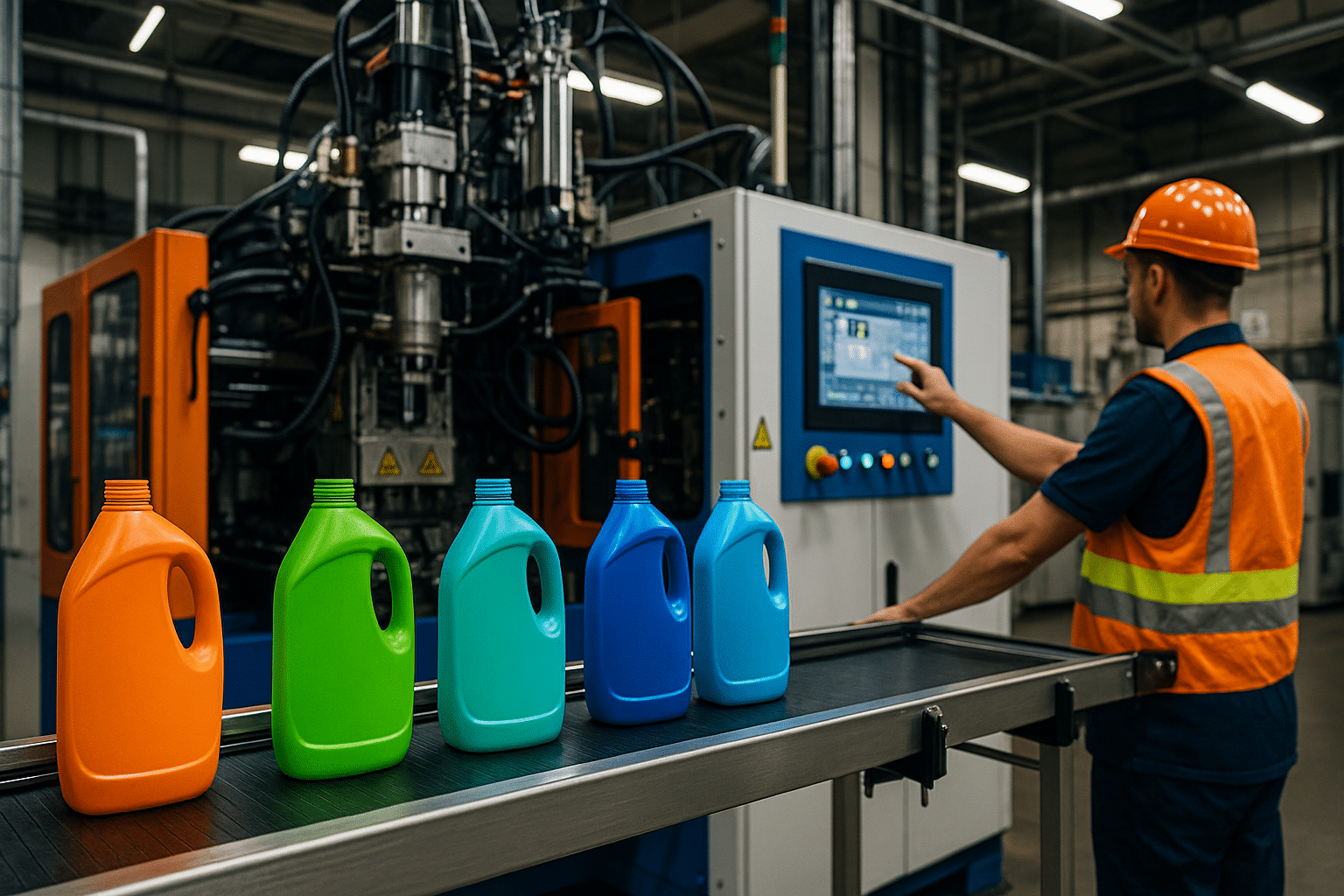
Automatic HDPE Detergent Bottle Blow Molding Machine Buyer Guide
Detergent bottle production requires more than a machine that can simply make hollow plastic containers. Buyers need stable bottle weight, reliable handle formation, clean neck finish, good output efficiency, and bottle quality that works smoothly with filling, capping, labeling, and packing later.
For most detergent bottle projects, the preferred process is extrusion blow molding with HDPE. It offers good chemical resistance, practical bottle design flexibility, and cost-efficient production for household packaging at commercial scale.
This guide explains what buyers should check before selecting an automatic HDPE detergent bottle blow molding machine, what production risks matter most, and how to match the machine to the actual bottle project.
Why HDPE Is Commonly Used for Detergent Bottles
HDPE remains the standard material for many detergent bottle applications because it balances strength, chemical resistance, low weight, and production practicality. It is especially suitable for bottles that need handles, squeezability, or non-round shapes.
Compared with other plastic options, HDPE works well for:
- Household detergent and cleaner bottles
- Liquid soap and softener bottles
- Larger handled containers
- Packaging that must resist transport and stacking stress
For detergent packaging, buyers also often care about bottle appearance, label panel stability, and how smoothly the bottle runs on downstream filling and capping lines.
What Type of Machine Is Used for HDPE Detergent Bottles?
Most HDPE detergent bottles are produced with an extrusion blow molding machine. The exact machine configuration depends on bottle size, bottle weight, handle shape, output target, and whether the project requires more automation in bottle take-out, leak testing, trimming, or conveying.
For buyers comparing equipment, the right question is not only “How big is the machine?” The more useful question is “How well does the machine match this bottle and this production target?”
What Buyers Should Prepare Before Asking for a Quotation
Machine selection becomes much easier when the buyer can provide a practical project brief. The most useful inputs are:
- Bottle volume range
- Bottle image, sample, or drawing
- Target bottle weight
- Target output per hour or per day
- Material type, including whether PCR is planned
- Neck finish requirement
- Downstream needs such as filling, capping, labeling, or packing
Without this information, quotations often become too generic and comparison between suppliers becomes less meaningful.
Main Production Steps for Detergent Bottle Blow Molding
The production process is straightforward in principle, but stable output depends on how well the machine, mold, resin, and cooling conditions are matched.
- Resin feeding and melting: HDPE pellets enter the extruder and are melted into a consistent plastic mass.
- Parison formation: The die head forms the molten plastic into a hollow tube called the parison.
- Mold closing and blowing: The mold closes and compressed air expands the parison against the cavity wall.
- Cooling and ejection: The bottle cools, holds its shape, and is released from the mold.
- Deflashing and finishing: Extra material is removed, and the bottle may continue to leak testing or downstream handling.
The better this process is controlled, the easier it becomes to maintain bottle consistency over long production runs.
Common Problems in Detergent Bottle Production
Detergent bottles may look simple, but buyers often face a few recurring production problems:
- Unstable bottle weight: affects resin cost and quality consistency
- Weak handle or shoulder area: usually linked to wall-thickness distribution
- Flash control issues: can create trimming and appearance problems
- Poor neck finish consistency: affects capping and sealing
- Slow cycle time: reduces line profitability
- Changeover inefficiency: hurts multi-SKU production flexibility
This is why machine selection should always be tied to the actual product, not only to machine catalog data.
What Features Matter Most in an Automatic Detergent Bottle Machine?
- Stable parison control: helps improve wall-thickness distribution and reduce resin waste
- Reliable clamping and mold handling: supports bottle consistency and lower flash
- Suitable automation level: useful for bottle take-out, trimming, leak testing, and conveying
- Efficient cooling design: affects cycle time and output
- Mold-change practicality: important for factories with multiple bottle formats
- Support for recycled material strategies: relevant for customers using PCR blends
For some buyers, the most important feature is not headline speed. It is the ability to maintain stable production with lower operating stress and fewer quality surprises.
How to Choose the Right Machine Direction
Different detergent bottle projects need different machine directions. A smaller bottle project with multiple SKUs may prioritize flexibility, while a high-volume detergent factory may prioritize output and automation.
At LEKA, buyers often begin by evaluating machine options based on:
- Bottle size and handle design
- Output target
- Mold cavitation
- Material strategy
- Factory utility conditions
- How much labor reduction is expected from the line
That approach usually produces a better result than comparing machine tonnage or advertised speed alone.
How This Fits into a Wider Packaging Project
Many detergent bottle factories eventually need more than molding equipment. They also need support for cap compatibility, label application, bottle packing, or broader production line planning.
If your project includes more than bottle making, it is worth planning the machinery path together with the wider packaging line solution. That reduces later mismatch between molded bottles and downstream equipment.
Conclusion
An automatic HDPE detergent bottle blow molding machine should be selected based on the real bottle project, not only on machine catalog specifications. The right choice depends on bottle size, bottle weight, handle structure, output target, material plan, and the production goals of the factory.
If you already have a detergent bottle sample, drawing, or production target, we can help review the project and recommend a more suitable machine direction.
Discuss Your Detergent Bottle Project With LEKA Machine