
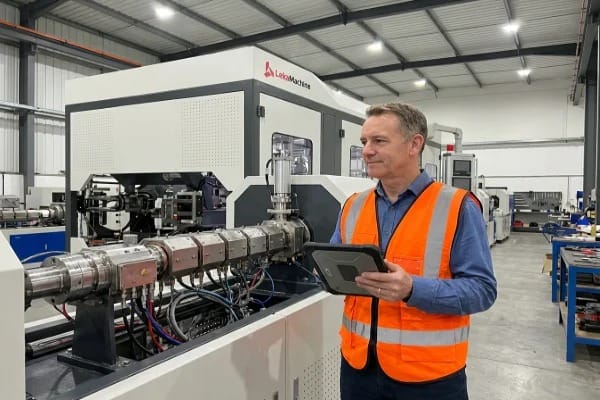
At our facility, we know that inconsistent parison temperature is one of the fastest ways to lose production stability. If you have ever dealt with temperature cycling, unstable parison formation, or uneven wall thickness, you already know the barrel heating system is at the center of extrusion performance. An unstable thermal profile increases scrap, downtime, and troubleshooting costs.
To judge whether a barrel heating system is truly precise and controllable, verify that the PLC uses auto-tuning or fuzzy PID logic, the heaters are switched by solid-state relays, the barrel has sufficient independent heating zones, active cooling is installed, and the machine includes cold-start interlocks to protect the screw and barrel.
Below is a practical inspection checklist to help you evaluate whether an all-electric or high-precision extrusion blow molding machine can maintain stable melt quality in real production.
Does the PLC use advanced PID logic to prevent temperature overshoot?
Many older systems only react after the barrel temperature has already moved away from the setpoint. On extrusion equipment with large thermal mass, that creates the familiar “sawtooth” effect: temperature overshoots, falls back, then overshoots again.
A precise system should use auto-tuning or fuzzy PID control so the PLC can adapt to the barrel’s thermal behavior. It should also use solid-state relays for fast, non-contact switching, which allows much tighter heater regulation than magnetic contactors.
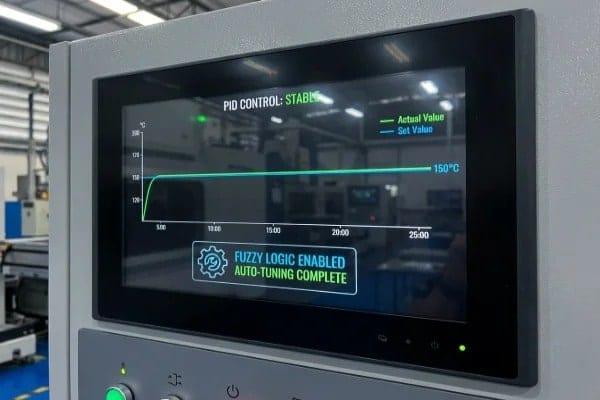
The importance of self-learning control logic
In blow molding extrusion systems, a standard fixed-parameter controller often cannot maintain a smooth heating curve once throughput changes. A self-learning controller can adjust its output logic according to how each zone actually responds, which helps keep melt temperature stable and reduces thermal shock across the screw and barrel.
When evaluating a supplier, ask whether the controller supports:
- Auto-tuning or fuzzy PID functions
- Independent control of each zone
- Stable temperature control within a narrow deviation band
- HMI access to tuning and alarm parameters
Solid state relays vs. magnetic contactors
The controller is only part of the story. The power-switching hardware matters just as much.
- Magnetic contactors: mechanical switching, slower response, audible clicking, and higher wear
- Solid-state relays: electronic switching, no moving parts, rapid pulsing, smoother temperature regulation
Comparison of switching technologies
| Feature | Solid State Relay (SSR) | Magnetic Contactor |
|---|---|---|
| Precision | High, supports millisecond pulsing | Low, slower switching response |
| Wear & Tear | Low, no mechanical contacts | High, contact wear over time |
| Temperature Stability | Excellent | Relatively poor |
| Noise | Silent | Audible clicking |
If a supplier still uses magnetic contactors for core barrel heating control on a so-called precision machine, that is a warning sign.
Are the heater bands insulated to save energy and improve safety?
In real production, temperature stability depends not only on how fast the system can heat, but also on how well it can retain and remove heat when required. A good machine should not dump excessive heat into the workshop, and operators should not be standing next to exposed hot surfaces.
High-precision machines typically use ceramic heater bands with insulation jackets. This improves energy efficiency, helps stabilize temperature, and lowers external surface temperature for safer operation.
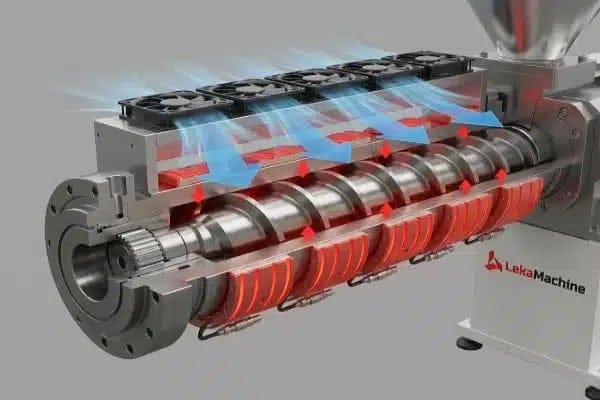
The critical role of active cooling
Once the screw is running, the material generates shear heat. At higher output, the barrel may need cooling even when the heaters are already off. If the machine cannot actively remove heat, the melt may overheat, degrade, or fluctuate in viscosity.
Check whether the machine includes:
- Cooling fans or blowers for each heating zone
- Heater band structure that supports heat dissipation
- PLC-controlled cooling instead of passive airflow only
Runaway temperature safety
Precision is not enough by itself. The system also needs fail-safe protection. For example, if a switching component fails in the “on” state, the heater may continue running without control.
Ask whether the machine uses:
- Independent over-temperature safety logic
- A secondary protection device or safety contactor
- Thermocouple fault alarms and heater shutdown logic
A proper safety loop protects the barrel, heaters, wiring, and surrounding equipment from overheating events.
Benefits of insulated heater jackets
| Benefit | Description |
|---|---|
| Energy Savings | Reduces heat loss and lowers heater power consumption |
| Startup Time | Helps the barrel reach working temperature faster |
| Safety | Reduces operator exposure to hot external surfaces |
| Process Stability | Reduces the effect of ambient airflow and workshop drafts |
How many independent heating zones are there for precise profile control?
Zone density matters. If the screw is long but the number of independently controlled zones is too low, you lose the ability to build a controlled melt profile from feed section to metering section.
A practical benchmark is one independent zone for roughly every 4 to 5 L/D of screw length, plus dedicated temperature control for the adapter, screen changer, and die head.
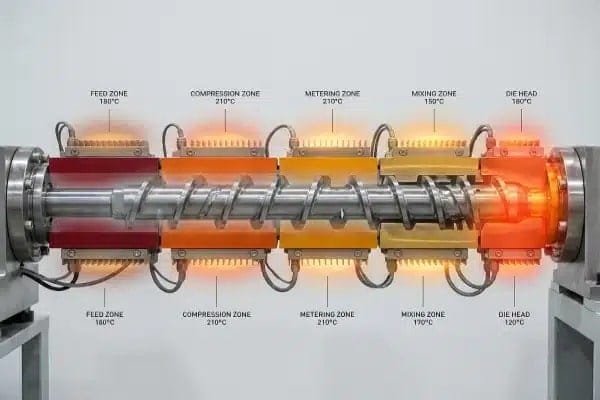
Assessing zone density
A longer screw provides more melting and homogenizing length, but only if the heating profile is controlled correctly.
- If a 24:1 or 30:1 screw has too few zones, the transition from feeding to melting to metering becomes harder to manage
- More zones allow a smoother temperature ramp and better control over melt behavior
- Separate die head and adapter zones help avoid cold spots and unstable flow into the tooling
Thermocouple installation quality
Temperature measurement quality is just as important as heater quality. Surface-only sensing is often less reliable because it reflects heater or barrel skin temperature rather than the process condition near the melt channel.
Ask whether the supplier uses properly positioned thermocouples and how the sensor installation is designed. Accurate sensing improves both control quality and fault diagnosis.
Feed throat temperature control
The feed throat is another area that should not be ignored. If it overheats, pellets may soften too early and bridge before they enter the screw.
- A precision system should have a dedicated cooling arrangement for the feed throat
- PLC-based temperature control is better than manual water adjustment
- Stable throat cooling supports more consistent feeding and startup reliability
Recommended zone configuration
| Component | Minimum Zones (Standard) | Ideal Zones (Precision) | Reason |
|---|---|---|---|
| Barrel | 3 Zones | 5+ Zones | Allows a more precise heating profile across the screw length |
| Screen Changer | 1 Zone | 1 Zone | Reduces cold spots and pressure fluctuation |
| Adapter/Neck | 1 Zone | 1 Zone | Supports stable melt transfer into the head |
| Die Head | 1 Zone | 2-4 Zones | Allows more stable head body and outlet control |
Does the system have cold-start protection to prevent screw damage?
One of the most expensive startup mistakes is rotating the screw before the barrel and internal mass are fully heat soaked. Even if the display shows target temperature, internal metal and material may still be below safe operating condition.
The machine should include a soak timer or equivalent interlock that prevents screw rotation until the barrel has remained at the setpoint for a defined period.
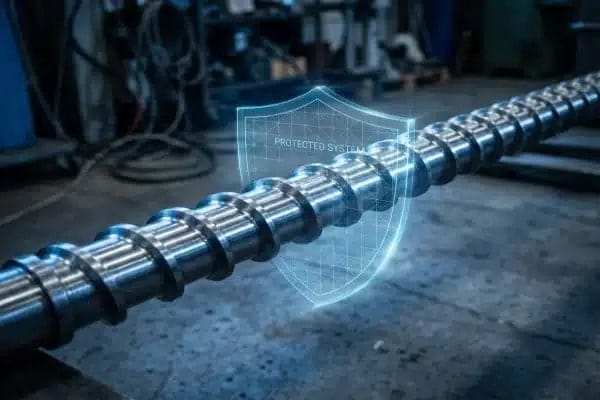
The mechanics of cold-start damage
If the screw starts too early, startup torque rises sharply. In serious cases, this can damage the screw, drive components, or material path.
- Low-temperature lockout prevents motor start below a defined temperature threshold
- Soak-time delay ensures the system is genuinely heat soaked, not just surface hot
- Sensor break protection prevents uncontrolled heating when thermocouple feedback fails
Current monitoring for maintenance
A better heating system also helps maintenance teams respond faster.
- The controller can monitor current draw for each heating zone
- If one heater band fails, the system can trigger a specific alarm instead of waiting for production defects
- This reduces downtime and helps maintenance isolate the problem faster
What to check on the HMI
When evaluating a machine, ask to see the alarms and safety screen. Check whether the system includes:
- Low temperature lockout before screw start
- Adjustable soak time before startup is allowed
- Sensor fault protection for heater shutdown or safety alarm
- Zone-level alarm display for heater or temperature abnormalities
Conclusion
To judge whether a barrel heating system is truly precise and controllable, do not rely on temperature display alone. Check the control algorithm, switching hardware, cooling design, zone density, sensing method, and interlock logic together. A machine with proper PID logic, SSR switching, active cooling, adequate zoning, and cold-start protection is far more likely to deliver stable melt quality and lower long-term operating risk.
FAQ
How can I determine if the barrel heating system of an all-electric extrusion blow molding machine is precise and controllable?
Check whether the PLC uses auto-tuning or fuzzy PID control, whether the heaters are switched by solid-state relays, whether the barrel has enough independent zones, whether active cooling is included, and whether the machine uses cold-start interlocks.
Does advanced PID logic really matter for barrel temperature control?
Yes. Advanced PID logic helps reduce overshoot and cycling, especially on systems with large thermal mass and changing production conditions.
Why are insulated heater bands important?
They improve temperature stability, reduce heat loss, lower energy consumption, and improve operator safety around the machine.
How many heating zones should a precise extrusion system have?
A useful rule of thumb is one independent zone for every 4 to 5 L/D of screw length, plus separate control for the adapter, screen changer, and die head where needed.
What is the purpose of a soak timer or cold-start interlock?
It prevents the screw from rotating before the barrel and internal mass are fully heat soaked, reducing the risk of screw damage and startup failure.