
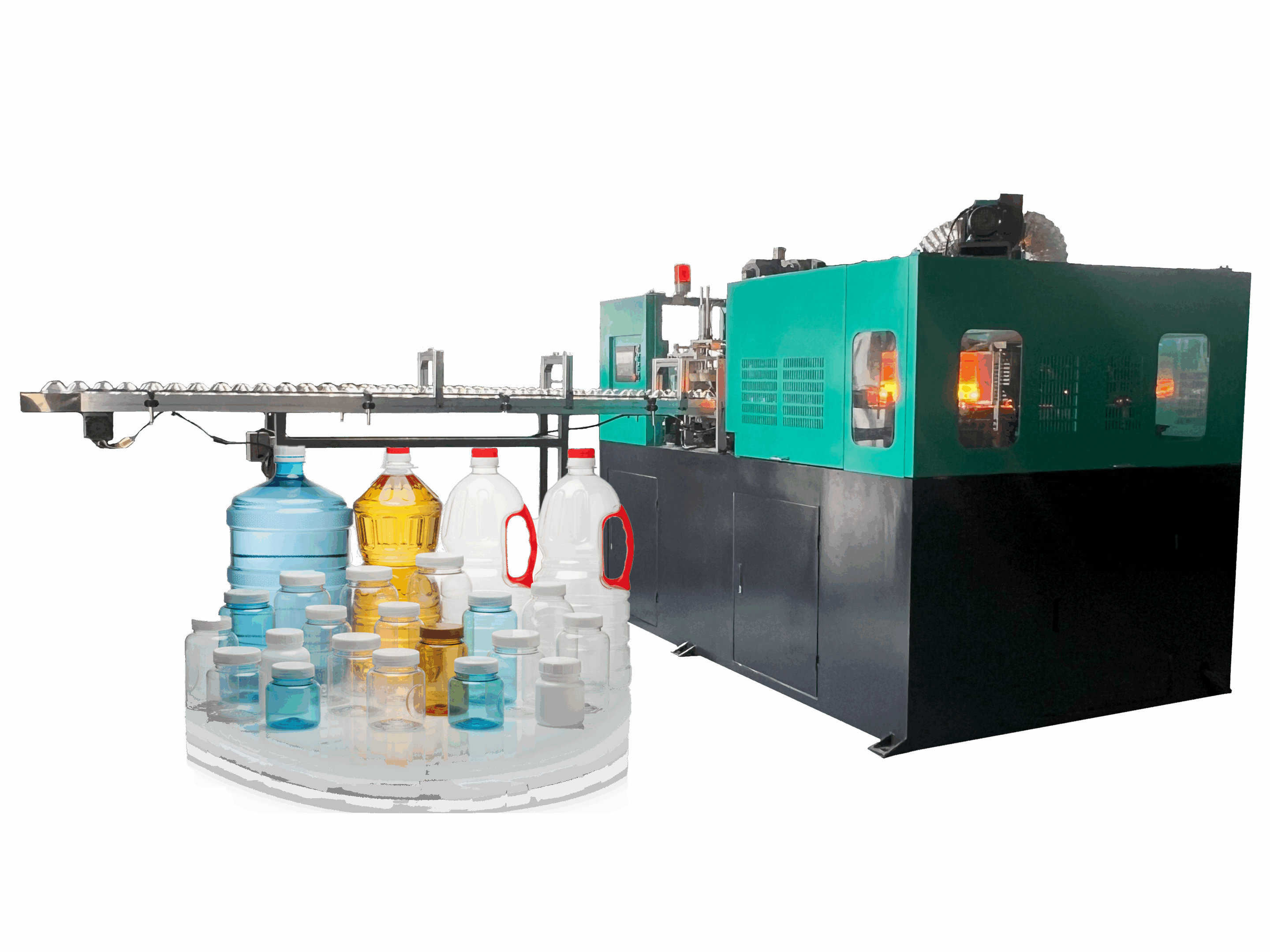
Why PE Plastic Is Everywhere in Blow-Molded Packaging
Walk through any supermarket, warehouse, or filling line. Most of the opaque bottles and jerrycans you see are made from one family of material: PE plastic, especially HDPE.
It is used for:
- Milk and yogurt bottles
- Detergent and household cleaner bottles
- Agrochemical jerrycans and drums
- Motor oil and industrial fluid containers
PE is popular because it is forgiving on the Makine, tough in real life, and cost-effective enough to survive pressure from brands and retailers.
The Short Answer: What People Really Mean When They Say “PE Bottle”
When people in factories, RFQs, or emails say:
“We want to make a PE bottle.”
In most extrusion şişirme kalıplama projects, they actually mean:
“We want to make an HDPE bottle or jerrycan on an extrusion blow molding line.”
Other PE types (LDPE, LLDPE, MDPE) show up as blends or special cases, but the workhorse is HDPE.
How This Guide Helps You Choose the Right PE Grade
If you run or plan an extrusion şişirme kalıplama (EBM) line, your PE choice decides:
- Çevrim süresi
- Scrap rate
- ESCR (environmental stress crack resistance)
- Top-load and drop performance
- How many complaints you get from the warehouse
This guide walks through PE in plain factory language so you can:
- Understand the main PE types for şişirme kalıplama
- Read resin datasheets without guessing
- Match PE grade, bottle design, and machine settings
- Avoid the classic “the bottle is failing in the warehouse” surprises
PE Plastic Explained in Plain Language
What “PE” (Polyethylene) Is and How It’s Made
PE (polyethylene) is a plastic made from ethylene, which comes from cracking crude oil or natural gas.
In simple steps:
- Ethylene gas goes into a reactor.
- Under pressure, temperature, and with catalysts, ethylene units join into long chains.
- The result is PE resin: small pellets or granules you receive in bags or big bags.
These chains can be:
- Very long and packed tightly → high density (HDPE)
- More branched and loosely packed → lower density (LDPE, LLDPE)
This chain structure controls stiffness, impact strength, and how the melt behaves in your kalıp kafası.
Why PE Behaves So Well in Extrusion Blow Molding
Extrusion blow molding needs a material that:
- Flows through the screw and die without burning
- Has enough melt strength so the parison does not collapse
- Welds well when the mold closes and pinches the bottom
- Crystallizes and cools fast enough to keep cycle times short
PE, especially HDPE, is good at all of these. Key reasons:
- Good melt strength → parison hangs without tearing too fast
- Impact resistance → realistic drop tests from 1–1.5 m
- Chemical resistance → can hold detergents, agrochemicals, and oils
- Wide processing window → you can adjust temperature and speed without instant failure
“Plastic in General” vs. “PE Plastic for Blow Molding”
“Plastic” is a big family: PET, PP, PVC, PS, PC, and more.
İçin extrusion blow molded bottles, the main players are:
- PE (mostly HDPE)
- PP (for some hot-fill or higher-temperature needs)
The PE grades for blow molding are not the same as film or injection grades. Blow-molding PE typically:
- Has a lower MFI (thicker melt) for good parison control
- Has higher molecular weight for strength
- Is optimized for ESCR, especially for detergents and chemicals
When buying PE, you want “blow molding grade HDPE/MDPE/LLDPE”, not just “any PE.”
Types of PE for Extrusion Blow Molding (HDPE, LDPE, LLDPE, MDPE)
HDPE: The Workhorse for Bottles, Jerrycans, and Drums
HDPE (High Density Polyethylene) is the default choice for:
- Milk bottles and dairy packaging
- Edible oil bottles
- Detergent and softener bottles
- Agrochemical jerrycans
- Lube oil and industrial fluid containers
- Drums and tanks
Why factories like HDPE:
- Stiff → good top-load and stacking
- Good ESCR → handles detergents, surfactants, many chemicals
- Fast cooling → short cycle times
- Good processability on extrusion blow molding screws and die heads
LDPE & LLDPE: When You Need Soft, Squeezable Containers
LDPE (Low Density) ve LLDPE (Linear Low Density) provide:
- Softer, more flexible walls
- Better squeeze feel
- Often higher clarity than HDPE (but still more opaque than PET)
Typical uses in ekstrüzyon şişirme:
- Squeezable sauce or condiment bottles
- Some cosmetic or personal care bottles that must be very soft
- Thin-wall flexible containers
Often you do not use 100% LDPE/LLDPE. You blend them with HDPE to tune:
- Squeeze vs. stiffness
- Gloss vs. stress cracking
- Drop impact performance
MDPE and Blends: Fine-Tuning Impact, Stiffness, and ESCR
MDPE (Medium Density) sits between LDPE and HDPE.
It is useful when you want:
- Good impact strength at low temperature
- Decent ESCR
- Medium stiffness
Examples:
- Jerrycans that need both toughness and stack stability
- Some pressurized or semi-pressurized containers
- Cold-chain packaging where low-temperature impact matters
In practice, many factories run HDPE/MDPE/LLDPE blends rather than a single pure grade. Resin suppliers often offer a “blow molding grade” with this mix already optimized.
Where PE Overlaps with PP and PET in Real Bottle Projects
In real projects, PE competes with PP ve PET, not just technically but also on cost, filling conditions, and logistics.
Typical overlap zones:
- PE vs PET
- Small dairy drinks: PET for visibility vs. HDPE for light-blocking
- Edible oil: PET for clarity vs. HDPE for tougher handling and lower cost
- PE vs PP
- Hot-fill up to around 100 °C and microwavable packs: PP often wins
- Ambient detergents, agrochemicals, oils: HDPE/MDPE remain safer and easier to process
The material choice is rarely just “which is better.” It is usually “which material fits the filling temperature, shelf-life, and total cost per filled unit.”
Where You See PE Today: Real Blow-Molded Products
Food & Dairy Packaging
Common PE applications in food and dairy include:
- HDPE milk bottles with view stripes
- Yogurt drink bottles
- Edible oil bottles (especially opaque or tinted)
- Juice or flavored drink bottles in some markets
Why HDPE works here:
- Good light barrier when pigmented
- Strong top-load for stacking on pallets
- Reliable neck sealing under cap torque
Home & Personal Care
In home and personal care, you see PE in:
- Laundry liquid and softener bottles
- Sprayer and trigger bottles for cleaners
- Shampoo and shower gel bottles (often PE or PP)
- Multi-purpose household chemical bottles
Here, appearance and feel matter as much as strength. Blends of HDPE with LDPE/LLDPE are common to get better hand feel and gloss.
Industrial and Chemical
For tougher uses, PE is used in:
- Stackable jerrycans (5–30 L)
- Car-care and engine oil bottles
- Agrochemical cans
- Drums and IBC components
These products depend heavily on:
- ESCR for chemicals and surfactants
- Drop and stack performance for UN or transport tests
- Consistent neck dimensions for tight closures
Special Designs: Handled Containers, View Stripes, Co-Ex Bottles
Ekstrüzyon şişirme with PE makes complex shapes practical:
- Integrated handles for large volumes
- View stripes (co-ex sight stripes) to show fill level
- Multilayer co-extrusion for:
- Recycled core with virgin skin
- EVOH barrier for oxygen-sensitive products
- Color separation (white outside, natural inside)
Why Extrusion Blow Molding Loves PE Plastic
How Extrusion Blow Molding Works Step-by-Step with PE
- Feeding – PE pellets (and masterbatch) are fed into the hopper.
- Plasticizing – The screw rotates, melts, and mixes the PE. Additives and color disperse in the barrel.
- Parison forming – Molten PE is pushed through the die head and a hollow tube (parison) drops between open mold halves.
- Mold closing and pinching – The mold closes, pinching the bottom and sealing the neck region.
- Blowing – Air is blown in through the blow pin and the parison inflates to the shape of the mold cavity.
- Cooling & crystallization – The PE cools on the mold surface and dimensions stabilize.
- Deflashing & take-out – Flash is trimmed and bottles move to leak testing and packing.
PE’s melt strength and cooling behavior make these steps repeatable and predictable.
Why PE’s Melt Strength and Cooling Are Ideal for Hollow Parts
İçin ekstrüzyon şişirme, the parison behaves like a hanging rope of molten plastic. If it is too soft, it sags and the shoulder becomes thin. If it is too stiff, it may not fill the corners.
PE, especially HDPE blow-molding grades, offers:
- Balanced viscosity → stable parison with controlled swell
- Good melt strength → supports longer parison lengths for larger containers
- Fast crystallization → shorter cooling time and realistic cycle times
Where PE + Extrusion Blow Molding Beats Injection Molding and Thermoforming
PE plus ekstrüzyon şişirme is usually better when you need:
- Integrated handles
- Thicker walls (for reuse, transport, or aggressive chemicals)
- Large sizes (5–200 L)
- Flexible wall thickness distribution (thicker in corners, handles, neck support)
Injection molding is better for solid parts, closures, or very precise threaded components. Thermoforming is better for wide, shallow trays.
For most hollow containers from 50 ml up to drums, PE with ekstrüzyon şişirme is more flexible and economical.
HDPE vs LDPE/LLDPE in Blow-Molded Bottles
How HDPE Behaves in Extrusion Blow Molding
Key HDPE characteristics on your line:
- Stiffness – Higher density gives higher modulus and better top-load.
- ESCR – Special blow-molding HDPE grades have strong resistance to stress cracking in detergents and chemicals.
- Üst yük – Helps with stacking and palletizing.
- Processability – Stable parison, predictable swelling, good pinch-off welding.
Factories choose HDPE when they care about long-distance transport, stacking pallets, and compatibility with detergents, agrochemicals, or oils.
When LDPE/LLDPE Grades Make More Sense
LDPE/LLDPE (alone or blended) make sense when:
- The bottle must be squeezable (sauces, creams, gels).
- You want a soft-touch feel.
- You accept lower stiffness and top-load.
They help:
- Reduce crack noise when squeezing
- Improve impact at low temperature
- Improve surface finish and gloss in some blends
Blending PE Types: Balancing Squeeze, Gloss, Impact, and Cost
In practice, many factories do not switch 100% from HDPE to LDPE. A typical blend might be:
- 80–90% HDPE
- 10–20% LDPE or LLDPE
By adjusting the blend, you can tune:
- Squeeze feel vs. stacking strength
- Gloss vs. ESCR
- Impact strength vs. weight
Practical Examples: Which PE Type for Common Bottles
- Milk bottles – Mainly HDPE with food-contact approval, often with white masterbatch.
- Detergent bottles – HDPE with strong ESCR, sometimes blended with LDPE/LLDPE for softness.
- Agrochemical jerrycans – HDPE or HDPE/MDPE, high ESCR, UN-tested.
- Lube oil bottles – HDPE with good stiffness and stress-crack resistance over long storage.
Five PE Resin Specs That Actually Matter for Your Factory
Resin datasheets contain many values. For ekstrüzyon şişirme, five specs make the biggest difference.
1. Density: What 0.94–0.96 Means for Stiffness and Lightweighting
Typical blow-molding HDPE density is around 0.94–0.96 g/cm³.
- Higher density (~0.96):
- Stiffer bottles
- Better top-load and stacking
- Possible lightweighting (fewer grams per bottle)
- Lower density (~0.94):
- More flexibility
- Better impact, especially at lower temperatures
If you want to lightweight, a slightly higher density grade with good ESCR can help you keep the same performance at lower gram weight.
2. Melt Flow Index (MFI): Finding the Sweet Spot for Parison Control
İçin ekstrüzyon şişirme, you usually want a low MFI resin (the exact value depends on the grade and application).
- Too low MFI (very viscous):
- Parison may not fill fine details easily
- Requires higher pressure and careful temperature control
- Too high MFI (too fluid):
- Parison sags
- Strong thickness variation, especially in tall bottles and jerrycans
You want an MFI that matches your bottle size, die head design, and screw design.
3. Molecular Weight & Melt Strength: Keeping the Parison from Sagging
Behind MFI is molecular weight and molecular weight distribution.
For you, the important effect is melt strength:
- Higher molecular weight → stronger melt → parison keeps shape longer.
- Too low → parison stretches under its own weight and thins at the shoulder.
For tall containers and large jerrycans, a high melt strength HDPE with proper parison programming is critical.
4. ESCR (Environmental Stress Crack Resistance)
ESCR measures how well the bottle resists crack formation under stress and chemical attack.
Low ESCR plus detergents, cleaners, or agrochemicals can cause:
- Fine cracks after weeks or months
- Leaks in the warehouse
- Swelling around handles or panel areas
For detergents, softeners, agrochemicals, and oils, you want blow-molding HDPE with strong ESCR performance, validated in tests.
5. Additives & Masterbatch
Common additives and masterbatches:
- Slip / antiblock – helps bottles slide on conveyors and avoid sticking.
- Antioxidants – protect resin during processing.
- UV stabilizers – help with outdoor storage and sun exposure.
- Color masterbatch – white, natural, tinted, or brand-specific colors.
They affect:
- Screw torque and barrel temperature settings
- Surface friction (important for high-speed conveyors)
- Long-term color and mechanical stability
When switching masterbatch supplier, always run trials and adjust temperatures and back pressure if necessary.
Matching PE Plastic Grades to Your Bottle Application
Food & Dairy
For food and dairy HDPE şişeler, you typically need:
- Food-contact approval (according to local regulations)
- Strong neck sealing and low warpage
- Compatibility with cold-chain (fridge, short freezing)
Important checks:
- Resin has food-contact certificates
- No strange odor in pellets or bottles
- Bottle design supports stacking without paneling
Household Detergents & Cleaners
Detergent bottles face three main risks:
- Stress cracking from surfactants
- Perfume attack
- Paneling during long storage
Odaklan:
- ESCR-optimized HDPE grade
- Good corner thickness and handle design
- Adequate cooling and wall distribution for flat panels
Agrochemicals & Industrial Jerrycans
Here, you must think about:
- UN or transport tests
- Drop tests (top, side, corner)
- Stack tests under load and time
Resin and design must work together:
- HDPE or HDPE/MDPE blend with high ESCR
- Sufficient corner and handle thickness
- Proper parison programming to avoid thin spots
Personal Care & Cosmetics
These bottles often need to:
- Feel soft and “premium” in hand
- Have high gloss and clean color
- Hold creamy or oily formulations
PE Çözümler:
- HDPE blended with LDPE/LLDPE for softness
- Colors tuned with high-quality masterbatch
- Stable parison control for consistent wall thickness around label panels
Lube Oils & Automotive Fluids
For lube oil and car-care liquids:
- Long-term storage, sometimes in hot warehouses
- Oily İletişim with walls over months or years
You need:
- HDPE with long-term ESCR for oils
- Enough thickness in handles and corners
- Neck design that resists creep under cap torque
PE Plastic, Machine Design, and Your Process Window
PE resin does not work alone. It works together with screw design, die head, mold, and cooling.
Screw and Barrel Design
Blow-molding screws for HDPE/LDPE/LLDPE are designed to:
- Melt gradually without burning
- Mix color/masterbatch fully
- Build enough pressure for a stable parison
If you switch from 100% HDPE to a more flexible blend (HDPE + LLDPE), you may need to:
- Adjust barrel temperature profile
- Slightly adjust screw speed
- Check pressure and back pressure settings
Die Head and Parison Control
With PE, die head design and parison programming decide wall thickness. You can adjust:
- Die gap (mechanical or programmed)
- Parison thickness profile (for co-ex or programmed heads)
On modern extrusion şişirme makineleri, parison programming helps you keep wall thickness tighter, reduce weight, and maintain performance.
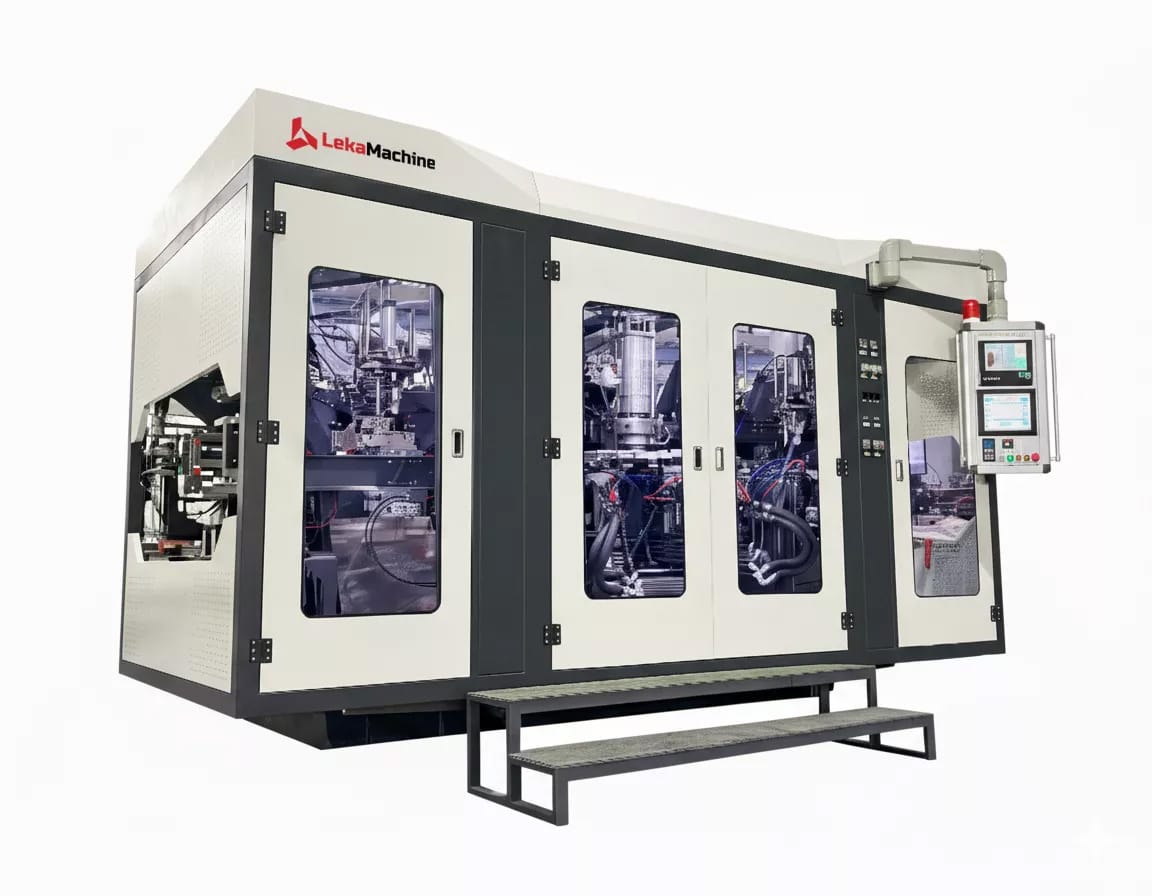
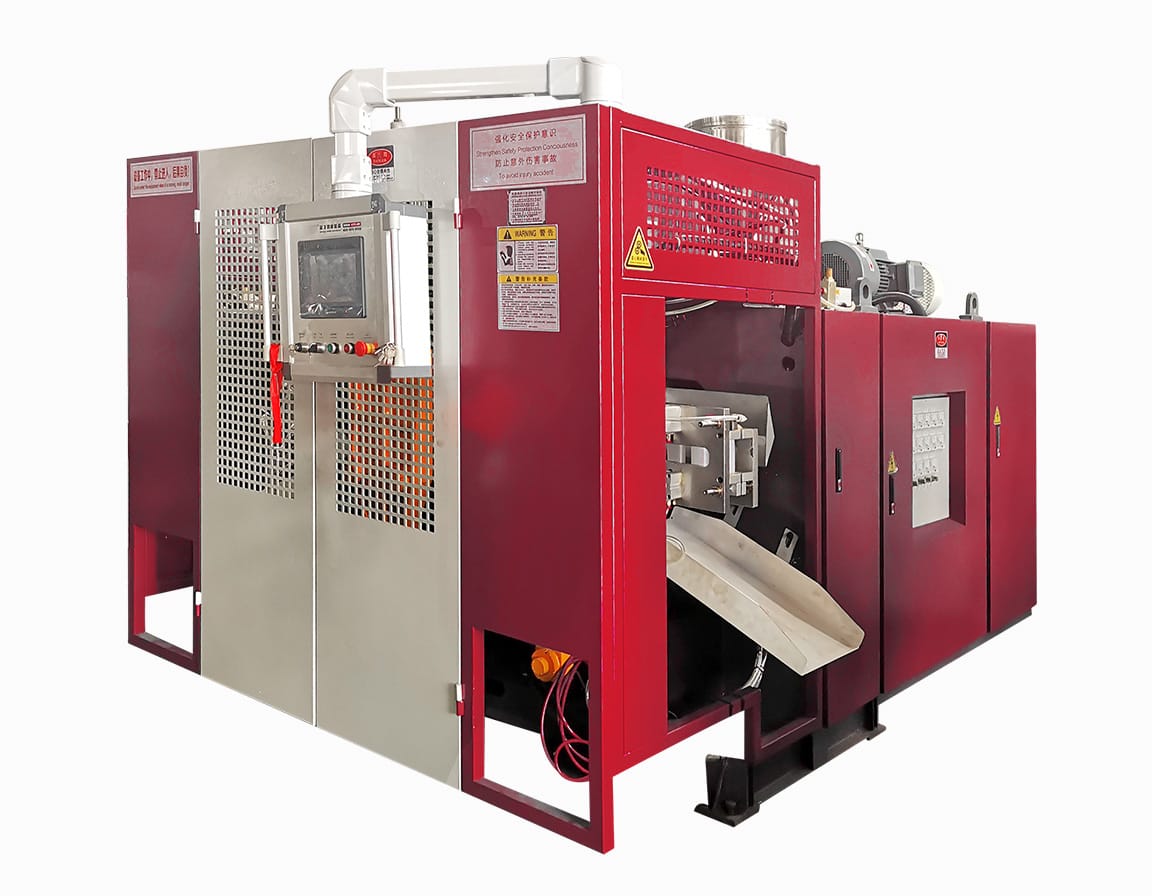
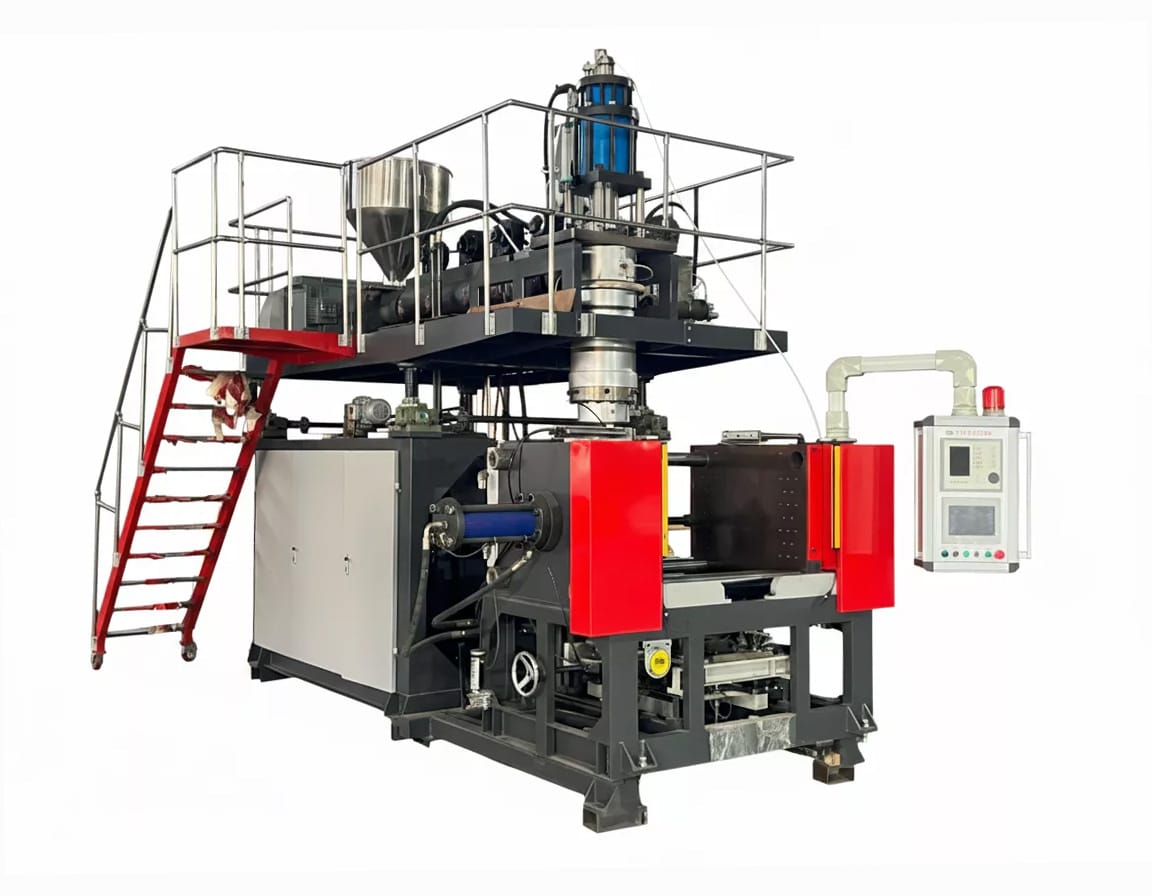
Learn more about our Extrusion Blow Molding Machines
Cooling and Mold Design
PE shrinks as it cools. Uneven cooling gives:
- Oval bottles
- Warped panels
- Neck ovality and capping issues
Points to watch:
- Balanced cooling channels around neck, body, and handle
- Enough cooling time in the mold for heavy sections
- Correct mold steel and surface finish for your application
What You Can Tune on the Extrusion Blow Molding Machine
On a PE line, your typical tuning levers are:
- Barrel and head temperatures
- Screw speed and back pressure
- Blow pressure and blow time
- Cooling time and mold temperature
- Clamp pressure and closing speed
A good extrusion blow molding machine gives you a broad, stable process window, so small variations in resin lot or ambient temperature do not destroy your cycle or Kalite.
Common PE Problems in Extrusion Blow Molding (With Root Causes)
Typical Defects and What They Mean
1. Parison sag, shoulder thinning, and hanging
Likely related to:
- Melt strength too low (wrong grade or temperature too high)
- Head temperature too high
- Parison too long for its strength
2. Bubbles, gels, black specks
Often caused by:
- Moisture or contamination in regrind
- Burnt material in dead spots of barrel or head
- Poor cleaning or degraded masterbatch
3. Short shots, warpage, and bottle ovality
Usually linked to:
- Insufficient blow time or pressure
- Uneven cooling channels
- Mold not venting air properly
4. Cracking, leaks, and paneling in warehouse
Frequently connected with:
- ESCR too low for the liquid inside
- Thin corners or handle areas
- Stacking loads not considered in design
- Storage in high temperature or under sunlight without UV stabilization
Quick Troubleshooting Table
| Symptom | Muhtemel Sebep | Adjust First |
|---|---|---|
| Shoulder too thin, heavy bottom | Low melt strength / head too hot | Lower head temperature, reduce cycle speed, check grade |
| Parison swinging and touching mold | Parison too soft / too long | Increase melt viscosity (lower temp), shorten parison, adjust grade |
| Random black dots / specks | Burnt material, dirty barrel/head | Purge thoroughly, schedule cleaning, check heaters |
| Bubbles in wall | Moisture in regrind or masterbatch | Dry material if needed, reduce regrind ratio |
| Warped or oval bottles | Uneven cooling / poor venting | Balance cooling, clean vents, adjust cooling time |
| Cracks after weeks in detergent | Poor ESCR or thin critical sections | Change to ESCR-optimized grade, thicken corners/handles |
| Paneling during stacking | Walls too thin / hot storage | Increase wall thickness in panel, adjust formulation and stacking load |
PE vs PET vs PP: Choosing the Right Material
Quick Comparison
- PE (HDPE/MDPE)
- Opaque or tinted
- Very good ESCR and impact
- Medium barrier to oxygen
- Highly recyclable within HDPE streams
- PET
- Clear and glossy
- Good gas barrier
- Suited to stretch blow molding (şişirme ve germe)
- Very common for beverages
- PP
- Higher heat resistance
- Good for hot-fill and microwavable packs
- More brittle at low temperature than PE
When HDPE / PE Blow Molding Is Better Than PET Stretch Blow Molding
Choose PE ekstrüzyon şişirme when:
- You need handles or complex shapes not easy with PET preforms.
- The product is light-sensitive (milk, some chemicals).
- You need high ESCR for detergents and agrochemicals.
- You want to reuse molds in different machines over time.
Where PP Competes with PE
PP competes with PE in:
- Hot-fill sauces or broths
- Microwavable applications
- Some medical or labware bottles
For many ambient-filled, chemical, or oil products, PE remains safer and easier to run on extrusion blow molding lines.
How Brands Think About Total Cost of Ownership
Brand owners and OEM factories look beyond resin price per kg. They consider:
- Bottle weight (grams per unit)
- Machine energy (kWh/kg)
- Scrap rate
- Mold cost and changeover time
- Recycling and sustainability commitments
This is where a combined discussion of material, machine, and design makes sense, and where a machine builder can position extrusion blow molding and PET stretch blow molding solutions for different segments.
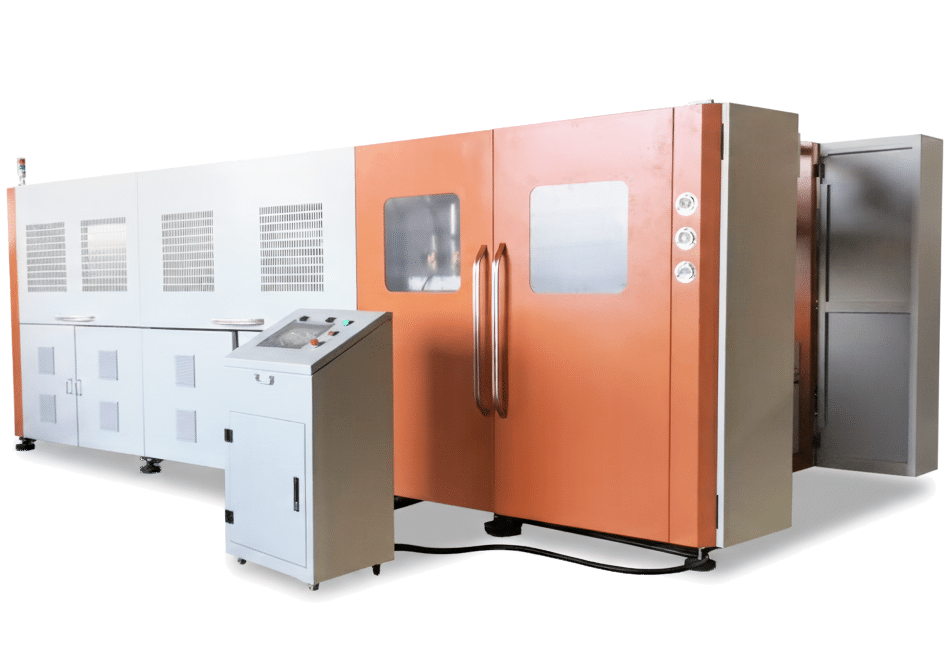
Stretch Blow Molding Machine for PET Bottles
Blow Molding Machinery for Plastic Packaging Production
Recycling, rHDPE, and “Greener” PE in Extrusion Blow Molding
How HDPE Bottles Become rHDPE
A simple recycling path:
- Used HDPE şişeler are collected and sorted.
- Labels and caps are removed as much as possible.
- Bottles are ground into flakes and washed.
- Flakes are melted, filtered, and pelletized into rHDPE.
Running rHDPE on Your EBM Line
When you run rHDPE, expect:
- More variation in color and melt flow
- Possible gel particles or small contaminants if filtration is limited
- Slightly different odor
You may need to:
- Adjust melt temperature
- Adjust back pressure
- Modify parison programming
- Use multilayer co-ex: rHDPE in the core, virgin HDPE as skin
Colour, Odour, and Appearance Limits
rHDPE works best when:
- Bottle color is white, natural, or darker
- End-users accept slight shade variation
- Product does not require crystal clarity
For premium cosmetics or very strict food packaging, many plants still prefer virgin HDPE or multilayer structures with virgin inner and outer layers.
Designing PE Bottles “for Recycling”
Design choices that help recycling:
- Use single-material body and closure where possible
- Avoid heavy metallic labels or multi-material sleeves that are hard to remove
- Keep color systems simple and consistent
- For co-ex, ensure outer and inner layers are still polyolefin-compatible
From Our Factory Visits: Typical PE Project Scenarios
Case 1: Dairy Factory Lightweighting HDPE Bottles
A dairy producer wanted to:
- Cut 2–3 grams from a 1 L milk bottle
- Keep the same drop and top-load performance
- Avoid changing the filling line
Key moves:
- Switched to a slightly higher density HDPE with strong ESCR
- Used parison programming to thicken shoulder and base areas
- Tuned cooling and clamp pressure to reduce warpage
Result: lower resin cost per bottle, same stack height and handling strength, no spike in warehouse complaints.
Case 2: Detergent OEM Solving Stress Cracking
A detergent OEM was facing:
- Cracks around handle and panel areas after 3–6 months in storage
- Leaks when pallets were stored in hot climates
What changed:
- Resin switched from a generic HDPE to an ESCR-focused blow-molding grade
- Handle and corners were thickened via parison control and minor mold change
- Storage and stacking patterns were adjusted to keep loads realistic
After the change, crack rate dropped sharply and claims from distributors fell.
Case 3: Agrochemical Line Adding rHDPE While Keeping UN Approval
An agrochemical packer wanted to add recycled content but keep:
- UN test approvals
- Drop and stack performance
Çözüm:
- Moved to a co-ex structure: rHDPE core with virgin HDPE inner and outer skins
- Validated new bottles through UN testing again
- Tuned machine settings for the slightly different melt behavior
They reached their recycled content target without sacrificing safety or approvals.
What to Check First When a Client Says “The Bottle Is Failing in the Warehouse”
When you hear this sentence, systematic checks help:
- What is inside? – Detergent, agrochemical, oil, food, or something new?
- How is it stored? – Temperature, time, stacking height, pallet type.
- Where are the cracks or leaks? – Corners, handles, panel centers, neck area.
- What resin and masterbatch are used? – Any recent supplier or batch change?
- Did anyone change weight, cycle time, or mold?
This usually shows whether the root cause is PE grade, design, or machine settings.
Checklist: Choosing the Right PE Plastic for Your Extrusion Blow Molding Project
Use this as a quick pre-project checklist.
- Clarify application and filling
- Cold, ambient, or hot fill
- Water, dairy, oil, detergent, agrochemical, or solvent
- Define performance targets
- Drop test height and cycles
- Stack height and duration
- ESCR requirements
- Shelf life and storage conditions
- Set appearance targets
- Color and gloss level
- Soft or stiff feel
- Label panel flatness
- Match PE grade to your machine
- Check if screw and head suit the MFI and density
- Confirm if parison control is available and working
- Confirm cooling capacity is enough for planned thickness and cycle
- Align your partners
- Resin supplier
- Mold maker
- Machine builder
You can also turn this checklist into a downloadable “PE Material Checklist for Extrusion Blow Molding Factories” for your customers.
How LEKA Machine Looks at PE Plastic as an Extrusion Blow Molding Partner
As a şişirme makinesi üreticisi with long experience serving food, beverage, home care, and industrial customers worldwide, LEKA works with PE every day on extrusion blow molding lines.
Typical PE-based projects include:
- 50–500 ml hotel amenities and cosmetic bottles
- 1–5 L detergent and household cleaner bottles
- 5–30 L stackable jerrycans
- 120–220 L drums and tanks on accumulator-head machines
On each project, the team looks at:
- Resin choice – density, MFI, ESCR, PCR content
- Bottle design – handles, view stripes, wall distribution, label panels
- Machine spec – series and clamp size, number of die heads or cavities, parison control, co-ex, and automation options
The goal is simple: reduce total cost per bottle, not just the machine price.
Explore Extrusion Blow Molding Machines for PE/HDPE/PP
FAQ: PE Plastic and Extrusion Blow Molding
Is PE Plastic Safe for Food and Dairy Packaging?
Yes, when you use food-grade HDPE with the right certifications and follow good processing practice, HDPE is widely used for milk, yogurt, and edible oils. Always check local regulations and resin certificates.
What Is the Difference Between PE and HDPE Bottles?
PE is the general family (polyethylene). HDPE is a type of PE with higher density. In most extrusion blow-molded bottles and jerrycans, “PE bottle” really means “HDPE bottle.”
Can I Use Recycled PE (rHDPE) on My Existing Extrusion Blow Molding Machine?
Often yes, especially in blends. You may need to adjust temperatures, back pressure, and parison control. For sensitive products or strict appearance requirements, consider multilayer structures with rHDPE in the core.
How Do I Know If My Bottle Failures Are from PE Material or Machine Settings?
Şunlara bakın:
- Has the resin or supplier changed?
- Did anyone change weight, cycle time, or mold recently?
- Where do failures appear (handles, corners, panels)?
If failures start after a resin change, the grade may not have enough ESCR or melt strength. If failures start after process changes, machine settings or cooling may be the first place to look.
What PE Grade Should I Start with If I’m Launching a New HDPE Bottle Line?
As a starting point, choose a blow-molding grade HDPE recommended by your resin supplier for your bottle size and application, with the required ESCR and an MFI suitable for your machine and die head. From there, fine-tune the grade and blends based on trials and test results.
Yazar Hakkında
This article is written from the perspective of a technical sales manager working with extrusion blow molding and stretch blow molding projects, helping factories choose the right combination of machine, mold, and PE resin for stable, low-cost production. The LEKA team has supported PE blow-molding lines for food, home care, cosmetics, agrochemicals, and endüstri̇yel ambalaj across multiple regions.
If you want a quick review of your current PE bottle project, you can prepare:
- Bottle drawing and weight
- Output target per hour or per year
- Current or planned PE grade (with datasheet if possible)
Then share these details for a practical review of resin choice, bottle design, and suitable ekstrüzyon şişirme makinesi configuration.
özen gösterme yükümlülüğünü güçlendirin


0 Yorum