
How can I ensure an all-electric blow molding machine is truly compatible with In-Mold Labeling (IML)?
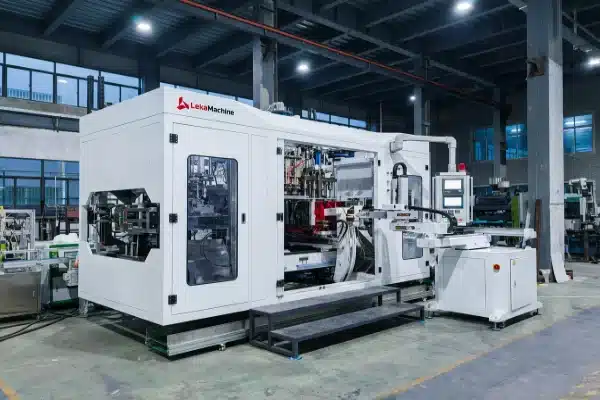
At our factory, we often see clients struggle with integration failures because they assumed any modern machine works with In-Mold Labeling 1 robots. Don’t let incompatible interfaces or poor structural stiffness ruin your production efficiency.
To ensure IML compatibility, verify the machine controller supports Euromap 67 or 82 interfaces for seamless robot synchronization. You must also calculate the mold open daylight to accommodate End-of-Arm Tooling clearance and demand a "wet cycle" time guarantee that accounts for the robot’s entry and exit movements.
Here are the specific technical inquiries you must make to avoid costly mistakes.
What specific controller interfaces and software logic are required for seamless IML integration?
When we configure machines for export, we frequently find that standard software lacks critical IML features. This oversight often causes costly wiring delays and safety signal issues during installation.
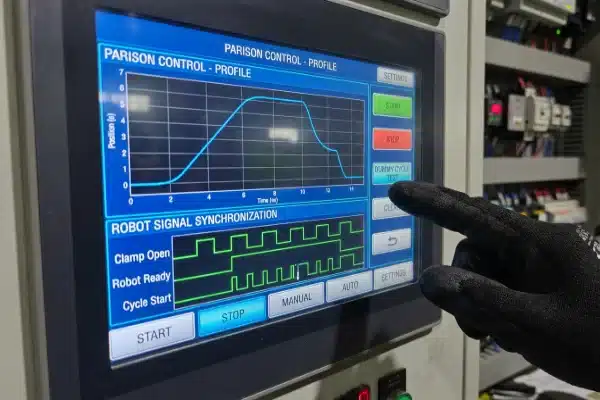
Essential software requirements include a standard Euromap 67 or 82 interface for plug-and-play safety signals. The controller must also feature "Dummy Cycle" capability for dry-run testing and specific parison management logic to automatically purge material if the IML robot errors out, preventing die head jams.
The Importance of Standardized Interfaces
In the world of ekstrüzyon şişirme 2, "spaghetti wiring" is the enemy of uptime. When integrating an IML robot, you cannot rely on improvised hardwiring. You must confirm the machine comes pre-wired with Euromap 67 (discrete signal) or Euromap 82 (OPC UA 3 data).
This "Plug-and-Play" standard handles critical tasks instantly:
- Emergency Stops: If the robot stops, the machine stops immediately.
- Mold Permissive Signals: The mold will not close unless the robot confirms it has exited the safety zone.
- Reject Signals: If the robot drops a label, it tells the machine to reject that specific bottle downstream.
Without this interface, your technicians will spend days troubleshooting signal noise and timing latencies.
Integrated Static Charging Control
Another often-overlooked software feature is the control of the Electrostatic Charging 4 Generator. In basic setups, this is a separate box with a manual dial. However, in our high-end electric machines, we integrate this into the HMI.
Why does this matter? It allows you to save the voltage and current settings directly into the bottle recipe. If you change molds from a shampoo bottle to a detergent container, the static charge settings load automatically. This ensures the label pins correctly every time without operator guesswork.
Parison Management Logic
Extrusion blow molding (EBM) is a continuous process. Unlike enjeksiyon kalıplama 5, the plastic keeps coming out of the die head even if the machine stops.
If the IML robot encounters an error (e.g., it fails to pick a label), the machine cycle stops. If the extruder doesn’t react, the parison 6 will grow too long, sticking to the mold or the robot arm. You must ask about "Purge/Deflect" logic. The controller should detect the robot fault and automatically cut and discard the parison safely while the operator fixes the issue.
Comparison of Control Features
| Özellik | Standard Configuration | IML-Optimized Configuration | Fayda |
|---|---|---|---|
| Robot Interface | Hardwired terminal blocks | Euromap 67 / Euromap 82 | Safety & plug-and-play setup |
| Static Charging | Manual external knob | HMI Integrated & Recipe Saved | Consistent label pinning |
| Error Handling | Machine stop (Parison drools) | Auto-Purge / Deflect Mode | Prevents die head jams |
| Testing Mode | Production only | "Dummy Cycle" (Simulation) | Troubleshooting without waste |
How do physical machine dimensions and frame mechanics affect IML performance?
Our engineering team always checks structural rigidity first because electric machines can vibrate significantly under heavy IML robot loads, which destroys mold alignment over time.
Physical compatibility depends on calculating "Mold Open Daylight" to ensure the robot arm fits without clipping guide pins. Additionally, the machine frame must be reinforced to handle the inertia and moment arm vibration from top-entry robots, while safety fencing must include pre-designed portals for label magazines.

Calculating "Mold Open Daylight"
One of the most common mistakes buyers make is confusing "Opening Stroke" with "Daylight."
- Opening Stroke: How far the platen moves back.
- Daylight: The actual space available between the mold halves when fully open.
For IML, you need significant clearance. The robot’s End-of-Arm Tooling 7 (EOAT) usually holds a label and needs to enter the mold, place the label, and exit. If your mold is thick, a standard opening stroke might not leave enough room for the robot to maneuver without hitting the mold guide pins.
The Calculation:
$$ \text{Daylight} = \text{Max Platen Distance} – \text{Total Mold Thickness} $$
Always ask us or your supplier to verify the remaining daylight against the dimensions of your specific IML robot tooling.
Frame Stiffness and Inertia
All-electric machines are precise, but they can be lighter than hydraulic counterparts. A high-speed top-entry IML robot acts like a giant inverted pendulum. As it swings in and out in under a second, it creates a massive "moment arm" that rocks the machine.
If the machine frame isn’t reinforced, this vibration causes:
- Mold Misalignment: Guide pins wear out prematurely.
- Sensor Errors: Vibration trips sensitive safety sensors.
- Label Shift: The robot arm shakes, placing labels inaccurately.
We ensure our frames are reinforced to absorb this kinetic energy, maintaining the precision of the electric toggle system.
Safety Fencing Layouts
Never assume a standard safety fence works for IML. A standard fence seals the machine off. An IML system requires a Label Magazine—a station where the robot picks up fresh labels.
This magazine often sits dıştan or on the edge of the safety zone so operators can refill labels without stopping the machine. If the fencing isn’t pre-designed with "portals" or "removable sections" for this, you will have to cut the fence on-site. This is not only ugly but often violates CE or OSHA 8 safety certifications.
Mechanical Checkpoints for IML
| Bileşen | Standard Machine Risk | IML Requirement |
|---|---|---|
| Platen Opening | EOAT hits guide pins | Extended Stroke / Wide Daylight |
| Machine Frame | Vibration / Swaying | Reinforced Structural Steel |
| Safety Fence | Fully enclosed | Portals for Label Magazine |
| Platen Holes | Standard pattern | Custom drillings for Robot Mount |
What guarantees should I request regarding cycle time and defect management?
We advise buyers to look beyond theoretical machine speeds. Real-world IML production involves complex interactions that can severely impact your actual daily output if not calculated correctly.
You should request a guaranteed "Wet Cycle" time that specifically includes the robot’s interaction time, usually adding 0.5 to 1.5 seconds. Furthermore, verify the machine has "Missed Label" reject logic to automatically divert naked bottles and ensure the robot path does not intersect with flash ejection zones.

The "Wet Cycle" Guarantee
Machine datasheets list "Dry Cycle" times—how fast the machine moves without plastic. This number is useless for IML.
In IML, the mold must stay open longer. The robot needs to:
- Enter the mold area.
- Pin the label (using static or vacuum).
- Exit the safety zone.
Only then can the mold close. This "Robot Intervention Time" typically adds 0.5s to 1.5s to every cycle. While this sounds small, over a year, it represents millions of bottles. When asking for a quote, demand a Guaranteed Cycle Time in IML Mode based on your specific bottle drawing. This prevents suppliers from over-promising capacity.
Flash vs. EOAT Interference
This is a specific pain point in Extrusion Blow Molding (EBM) that doesn’t exist in injection molding. EBM creates "flaş 9" (scrap plastic) at the top (moil) and bottom (tail) of the bottle.
When the bottle is ejected, this scrap flies off. If your IML robot is entering the mold from the top, there is a high risk that the falling scrap will tangle with the delicate robot mandrels or the label magazine.
Critical Question: "Can you demonstrate via simulation that the flash ejection path does not intersect with the robot’s flight path?"
If they clash, you will have constant downtime clearing jammed plastic from the robot arm.
"Missed Label" Reject Logic
Robots aren’t perfect. Sometimes vacuum cups fail, or static charge is weak, and a label is dropped.
A smart machine configuration includes logic where the robot sends a "Vacuum Fault" signal to the controller. The machine should reject that specific "naked" bottle automatically using a downstream diverter. If this logic isn’t present, unlabelled bottles will mix with good inventory, leading to customer complaints and manual sorting labor.
Cycle and Quality Protocol
| Gereklilik | Why it Matters | What to Ask For |
|---|---|---|
| Cycle Guarantee | Standard quotes ignore robot delay | "Guaranteed output with IML active" |
| Reject Logic | Prevent mixed inventory | "Automatic naked bottle rejection signal" |
| Flash Management | Prevent robot jams | "Flash path vs. Robot path simulation" |
| Dummy Cycle | Setup efficiency | "Simulation mode for dry runs" |
Sonuç
Asking these technical questions ensures your new electric machine runs IML projects smoothly, maximizing ROI 10 and minimizing downtime from the very first day.
Dipnotlar
1. Overview of the In-Mold Labeling manufacturing process. ↩︎
2. Guide to extrusion blow molding technology and applications. ↩︎
3. Official standard for OPC UA industrial communication. ↩︎
4. How electrostatic charging improves label adhesion. ↩︎
5. Comparison of injection molding versus other plastic processes. ↩︎
6. Technical definition of a parison in blow molding. ↩︎
7. Role of End-of-Arm Tooling in robotic automation. ↩︎
8. OSHA standards for machine guarding and safety. ↩︎
9. Understanding flash defects in plastic molding. ↩︎
10. Definition of Return on Investment in manufacturing. ↩︎


0 Yorum