
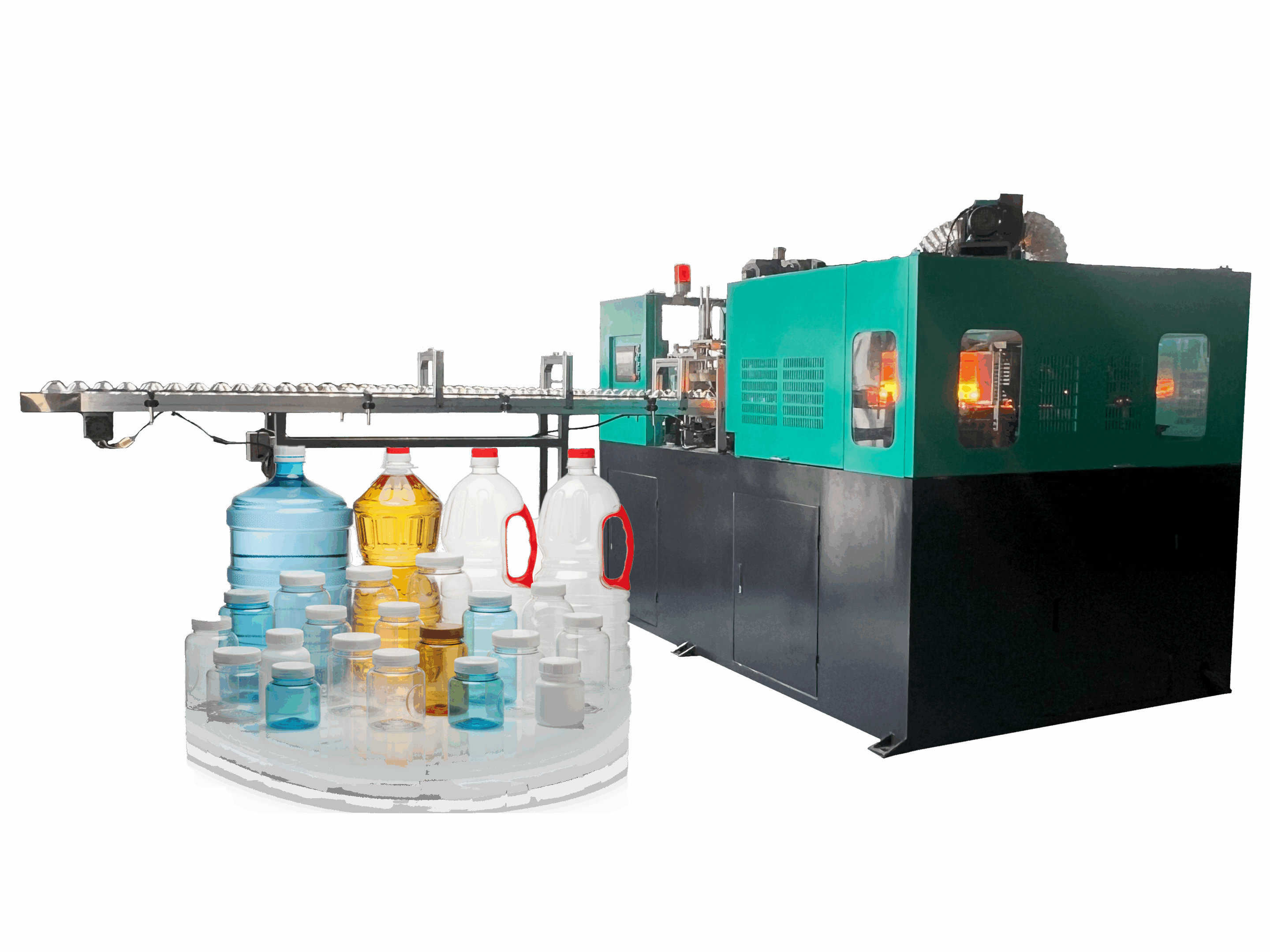
How can I determine if the hopper and feeding system of an all-electric extrusion blow molding machine are easy to clean?
At our factory, we know that a clogged hopper leads to lost production hours and frustrated operators. When you face frequent color changes 1 or material swaps, the inability to clean your feeding system quickly destroys your profit margins. Here is how to evaluate the design before you buy.
To determine cleanability, inspect the hopper for a steep 60° cone angle and electropolished stainless steel surfaces (Ra < 0.4 µm). Verify that the loader uses a swing-away mechanism for tool-free access and that the feed throat has a separate cooling block to prevent material bridging and sticking.
An easy-to-clean system is not just about hygiene; it is about speed. Let’s look at the specific features that save time.
What design features should I look for that allow for quick material changeovers without tools?
In our experience helping clients switch between black and white resins, tools are the enemy of speed. If an operator has to hunt for a wrench, your downtime clock is ticking. We design our systems to minimize tool usage to keep your line moving.
Look for a "swing-away" vacuum loader mount that tilts aside without heavy lifting or wrenches. Additionally, ensure the magnetic drawer features easy-clean wiper sleeves. These tool-free designs allow operators to clear resin and metal shavings in minutes rather than hours, significantly reducing changeover downtime.
The Importance of Tool-Free Access
When you are running a busy factory, every minute of machine downtime costs money. The most critical feature for quick changeovers is the "Swing-Away" loader access. On older or cheaper machines, the vacuum receiver 2 is bolted directly to the hopper flange. To clean the throat, your team must unbolt it, often requiring a crane or two people to lift the heavy unit.
A superior design uses a hinged mechanism or quick-release clamps. This allows a single operator to tilt the heavy loader aside safely. They can then vacuum out the hopper throat immediately. This simple change can reduce a 45-minute job to a 5-minute job.
Magnetic Drawer Safety and Speed
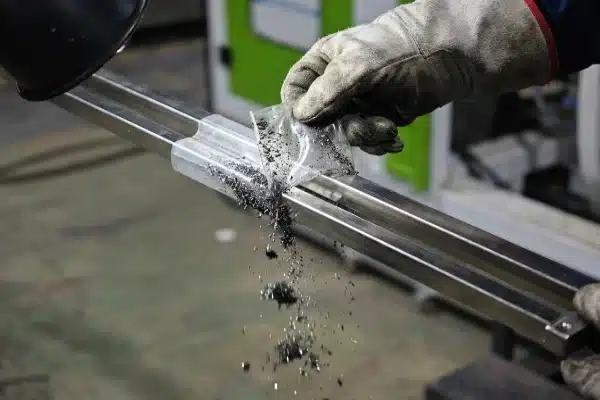
Another area often overlooked is the magnetic drawer. Rare-earth magnets 3 are incredibly strong. If the drawer bars are bare metal, operators have to scrape sharp metal shavings off by hand. This is dangerous and difficult, so operators often skip it, leading to screw damage later.
You should look for "easy-clean" wiper sleeves. These are non-magnetic tubes that slide over the magnetic bars. To clean them, the operator simply pulls the tubes off, and the metal debris falls away instantly.
Comparison of Access Methods
Below is a comparison of standard designs versus the time-saving designs you should demand:
| Özellik | Standard "Budget" Design | "Easy-Clean" Design | Time Saved Per Changeover |
|---|---|---|---|
| Loader Mount | Bolted Flange (Requires Wrench) | Hinged / Swing-Away | 20–30 Minutes |
| Magnet Cleaning | Manual Scraping (Risk of Injury) | Wiper Sleeves | 10–15 Minutes |
| Hopper Lid | Screw Knobs | Over-Center Clamps | 2–5 Minutes |
How do I check for dead spots in the hopper that could trap old resin and cause contamination?
When we run trials with regrind material 4, we often see flow issues that do not happen with virgin pellets. Standard injection molding hoppers often fail in blow molding applications because they lack the geometry to handle lightweight fluff.
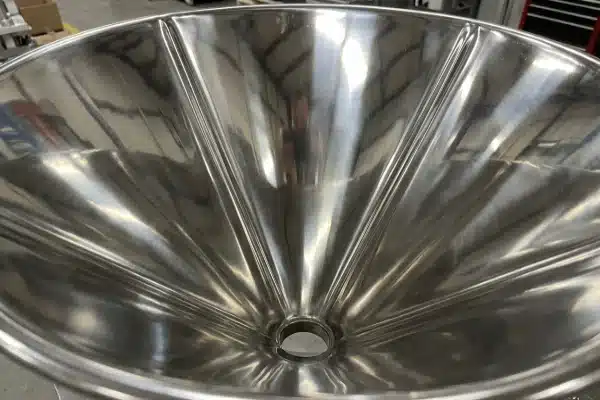
Check for dead spots by verifying a hopper cone angle of at least 60° to prevent rat-holing of lightweight regrind. Inspect the transition adapter for a smooth conical machine finish rather than a flat plate, as flat surfaces create internal ledges where material stagnates and burns.

Understanding Cone Geometry
The shape of your hopper dictates how material flows. Standard hoppers often use a 45° angle, which is fine for heavy, round pellets. However, in ekstrüzyon şişirme 5 (EBM), you are likely using regrind (ground-up flash and tails). This material is light and irregular.
If the angle is too shallow, the material flows down the center but sticks to the walls. This creates a "rat-hole." When you add new color, the old material stuck to the walls eventually falls in, ruining your new batch with streaks. You must demand a cone angle of at least 60°. This steepness forces all material to slide down evenly (mass flow 6), cleaning the walls as it goes.
The Problem with Flat Transitions
The most common "dead spot" is found at the bottom of the hopper. The hopper is usually square, but the feed throat is round. To connect them, cheap manufacturers use a flat adapter plate. This creates a 90-degree internal ledge.
Material sits on this ledge, never entering the screw. Over days or weeks, heat from the barrel degrades this stagnant plastic. It turns into black specks (carbon) that randomly drop into your production, causing high scrap rates. A sanitary design uses a machined, conical transition piece that guides material smoothly with zero ledges.
Surface Finish Requirements
Finally, the texture of the steel matters. Rough steel acts like sandpaper, holding onto fine dust. This is especially true for red or blue pigments.
- Kaçınılması Gereken Durumlar: Standard Mill Finish or Bead-Blasted (too rough).
- Demand: Electropolished Stainless Steel 7 (Ra < 0.4 µm).
Run a white cloth inside the hopper. If it snags or turns gray from steel dust, the finish is too rough for quick color changes.
Can the supplier demonstrate the cleaning process via video before I finalize the order?
We encourage our clients to ask for video evidence because it reveals the truth about machine usability. A drawing might look good, but a video shows the actual effort required by the operator.
Yes, a reputable supplier should provide a continuous video showing a complete color change. Request specific footage of the manual slide gate operation and the draining process via the side chute. This visual proof confirms that resin empties fully without requiring operators to stick their hands inside.
What to Look for in the Video
Do not settle for a generic marketing video. You need to verify the functional aspects of the feeding system. Ask the supplier to film a material drain sequence.
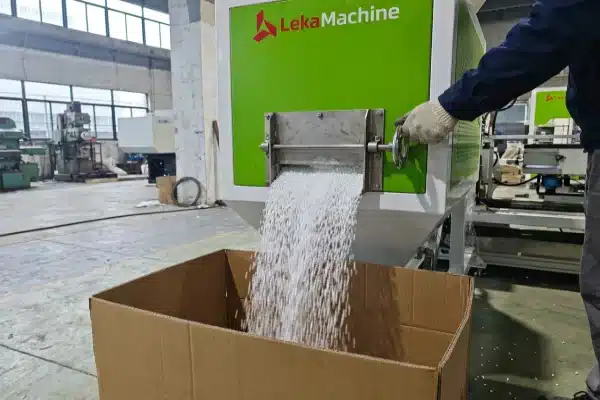
First, look for the Side-Drain Chute. When you need to empty the hopper, you should not have to purge all the material through the screw. That wastes electricity and machine time. A good hopper has a manual slide gate with a side chute. The video should show the operator opening this gate, allowing the resin to pour into a box önce it enters the machine. This saves 50kg+ of material per changeover.
Visualizing Flow via Sight Glasses
Secondly, check the sight glass design in the video. Small, round portholes are useless. You need vertical, elongated sight glasses.
In the video, watch the material flow through the glass. You want to see if the virgin pellets and the regrind are separating into layers (segregation 8). A long vertical window allows you to see the mixture quality instantly. If the supplier cannot show you this, their design may be hiding flow problems.
Video Checklist for Buyers
Use this table to request specific video demonstrations from your supplier:
| Video Segment | What You Need to Verify | "Pass" Criteria |
|---|---|---|
| Draining | Manual Slide Gate Operation | Gate moves smoothly; Material empties into a box, not the floor. |
| Visibility | Material Flow | Sight glass is large/vertical; flow is visible and consistent. |
| Access | Hopper Opening | Operator opens hopper without tools in under 60 seconds. |
| Yüzey | Internal Wipe Down | Cloth glides over surface; no sharp corners snagging the cloth. |
Does the feeding system design support easy access for my operators during daily maintenance?
Our engineers prioritize maintenance access because we know that hard-to-reach parts get neglected. If a part is difficult to clean, your team will stop cleaning it, leading to failure.
The system supports easy access if it features a modular "cassette" screw change capability for workbench cleaning. Furthermore, verify that the water-cooled feed throat is an isolated module. This ensures operators can descale cooling channels without dismantling the precise servo motor alignment during routine maintenance.
Modular Cooling Blocks
A major pain point in extrusion maintenance is the feed throat cooling block 9. This block prevents plastic from melting too early and clogging the entry. Over time, the water channels inside this block fill with scale and rust, reducing cooling efficiency.
In a poor design, the cooling block is cast directly into the gearbox adapter. To clean it, you have to tear down the entire drive system. In a smart design, the Water-Cooled Feed Throat Block is a separate module. You can unbolt it and clean the water channels without touching the sensitive alignment of the servo motor.
Static Dissipation Features
All-electric machines present a unique cleaning challenge: Static Electricity 10. Unlike hydraulic machines, which have oil mist and humidity, electric machines are very dry. This creates high static charges. Plastic dust clings aggressively to the glass and steel walls, resisting vacuum cleaning.
Check for dedicated Grounding Lugs and anti-static discharge points on the hopper receiver. Without these, your operators will struggle to clean fine dust, and they may even get painful static shocks when touching the loader.
Deep Cleaning: The Cassette System
For medical or food packaging clients, "clean" means 100% sterile. Standard cleaning is not enough. You should ask if the machine supports a "Cassette" or "Cartridge" Screw change.
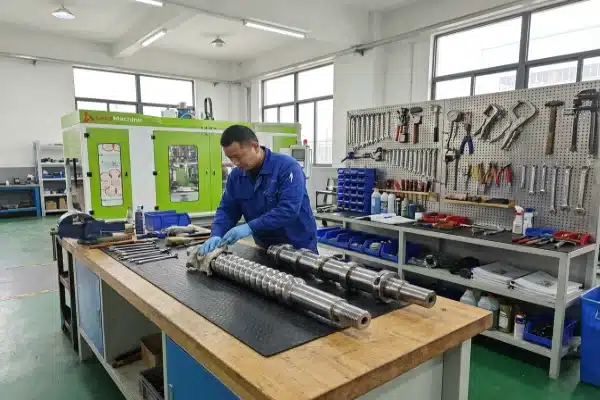
This feature allows the entire feed section (Screw + Rear Barrel) to be undocked and removed. Your maintenance team can then place it on a workbench for deep polishing and inspection. This is the only way to guarantee the removal of carbon buildup for sensitive applications.
Maintenance Design Features Summary
| Özellik | Function | Benefit for Operator |
|---|---|---|
| Isolated Cooling Block | Separates water channels from drive unit | Easy descaling without realignment |
| Grounding Lugs | Removes static charge | Dust falls off walls; no electric shocks |
| Cassette Screw | Allows removal of feed section | Enables 100% deep cleaning on a bench |
Sonuç
To ensure a hopper is easy to clean, look for tool-free swing-away loaders, steep 60° cone angles, and electropolished surfaces that prevent material waste and costly downtime.
Dipnotlar
1. Strategies to reduce production changeover time. ↩︎
2. Understanding vacuum loader system components. ↩︎
3. Benefits of magnetic separation for purity. ↩︎
4. Guide to processing regrind material efficiently. ↩︎
5. Fundamentals of the extrusion blow molding process. ↩︎
6. Differences between mass flow and funnel flow. ↩︎
7. Advantages of electropolishing for sanitary applications. ↩︎
8. Causes and solutions for material segregation. ↩︎
9. Importance of maintaining extruder cooling systems. ↩︎
10. Risks of electrostatic discharges in plastics. ↩︎


0 Yorum