
Vietnam'daki 10 En İyi Ekstrüzyon Şişirme Makinesi Üreticisi
Our 2025 guide to the 10 best Extrusion blow molding machine manufacturers in Vietnam, comparing cost, local service, energy efficiency, and lead times.
As a technical sales manager in this industry, I’ve seen firsthand how choosing the right machinery partner is critical for success in Vietnam’s dynamic manufacturing sector. The right Extrusion blow molding machine isn’t just about the initial price; it’s about total cost of ownership, local support, and efficiency. This guide cuts through the noise to help you shortlist the best suppliers with a proven ability to serve the Vietnamese market, focusing on what truly matters for your production floor.
Manufacturers At-a-Glance (with Official Sites)
Why This Matters in 2025 (Extrusion blow molding machine trends, uptime, energy)
In 2025, the Vietnamese manufacturing landscape is defined by rising energy costs from EVN, increasing labor rates, and intense competition in FMCG, chemical, and lubricant markets. Your choice of an Extrusion blow molding machine directly impacts your operational expenditure (OPEX). The focus has shifted from pure speed to overall equipment effectiveness (OEE), prioritizing energy efficiency (kWh per kg of processed resin), fast changeovers for smaller batch sizes, and, most critically, responsive local or regional technical support to maximize uptime.
A machine that is down waiting for a part from Europe can erase any potential gains in cycle time. That’s why this list heavily weighs a manufacturer’s verified service presence in Vietnam or the immediate ASEAN region. Remote diagnostics are now standard, but you still need a partner who can get a technician and parts to your factory in Ho Chi Minh City or Hanoi quickly.
Cost and Pricing Signals for 2025 (Extrusion blow molding machine pricing, cost drivers)
Machine pricing in Vietnam can range from under 1.5 billion VND for a basic, single-head shuttle machine from a regional supplier to over 25 billion VND for a high-output, multilayer rotary wheel machine from a premium German manufacturer. Key cost drivers include clamp tonnage, number of cavities, multilayer head complexity (e.g., 6-layer with EVOH), level of automation (in-mold labeling, takeout robots), and whether the machine is all-electric or hydraulic. Remember to budget for import taxes (VAT and duties), international freight, and the cost of on-site commissioning and training, which can add 10-15% to the total investment.
Energy, Utilities, and Sustainability (all-electric Extrusion blow molding machine, energy efficiency)
With Vietnam’s electricity prices on the rise, all-electric Extrusion blow molding machines are becoming the standard for new investments. They can reduce energy consumption by 25-40% compared to older hydraulic models. When you get a quote, demand specific data on kWh per 1,000 bottles for your specific container. Also, consider machines with well-insulated ekstrüder barrels and efficient servo-hydraulic systems if a fully electric model isn’t suitable. Given potential power fluctuations, ensure the machine’s control systems have adequate protection.
Throughput vs. Flexibility Trade-offs (rotary vs continuous vs accumulator head)
Your production needs dictate the right machine platform. High-volume, single-product lines like cooking oil or dairy bottles benefit from rotary wheel machines. Most Vietnamese producers, however, handle a diverse portfolio of products (shampoos, detergents, sauces) and need flexibility. For this, continuous extrusion shuttle machines are often the best fit. For large industrial containers and jerry cans (over 5 litres), which are common in the chemical and agrochemical sectors, accumulator head machines are the required technology for delivering a large parison quickly.
Mold, Tooling, and Quick-Change Strategy (quick changeover, parison control, in-mold labeling)
Molds are a significant part of your investment. To maximize flexibility, I recommend investing in quick-change systems. Don’t just take the salesperson’s word for it; ask for a video of a complete mold and color changeover. A 30-minute changeover versus a 3-hour one dramatically improves your ability to respond to market demands. Also, prioritize machines with precise parison programming to reduce material usage and improve container consistency, which is crucial for lightweighting initiatives.
Process Control and Quality (wall thickness control, parison programming)
Modern process control is non-negotiable. Look for systems with at least 100-point parison programming to ensure optimal material distribution, especially for complex shapes or containers with handles. This directly reduces scrap rates and ensures top-load strength. A stable process means less operator intervention and consistent Kalite from the first shift to the last, a key factor in managing product quality for demanding customers.
Materials and Multilayer Barriers (HDPE, PP, PETG, EVOH multilayer bottles)
While HDPE remains the workhorse material for most bottles and jerry cans in Vietnam, demand for value-added packaging is growing. For products sensitive to oxygen, like chili sauce, ketchup, or certain chemicals, a multilayer bottle with an EVOH barrier layer is essential. Ensure your machine supplier has proven experience with co-extrusion technology. Also, discuss the use of post-consumer recycled (PCR) resins, as sustainability is becoming a key requirement for exporting to Western markets.
Top 10 Extrusion Blow Molding Machine Manufacturers in vietnam
Kautex Maschinenbau (German OEM with regional service hub)

The web of KAUTEX for blow molding machine factory/manufactures
A global leader in extrusion şişirme kalıplama technology, Kautex is known for its high-performance machines, especially for the automotive and industrial packaging sectors. They offer advanced solutions for multilayer containers and complex 3D shapes. For Vietnam, service and support are typically dispatched from their regional hub, ensuring access to expert-level technical assistance.
Ana ürünler
Kautex focuses on KBB all-electric shuttle machines for consumer packaging, KCC hydraulic machines for industrial applications, and specialized systems for composite pressure vessels and automotive fuel tanks. Their multilayer heads are considered among the best in the industry.
Artıları
Exceptional reliability and build quality. Advanced process control for high scrap reduction. Strong performance in complex multilayer applications. All-electric machines offer excellent energy efficiency.
Eksileri
Premium pricing reflects their German engineering. Lead times can be longer than regional competitors. Best suited for high-volume, high-specification production.
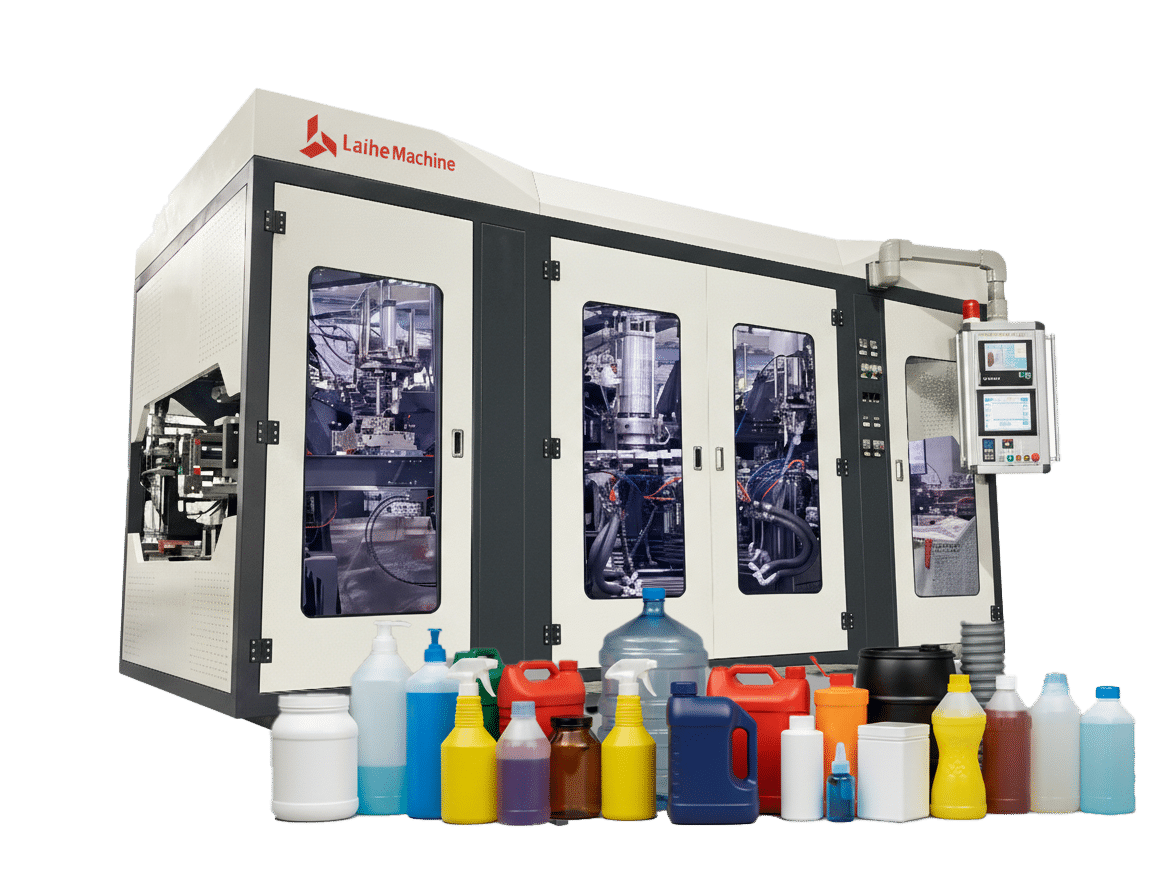
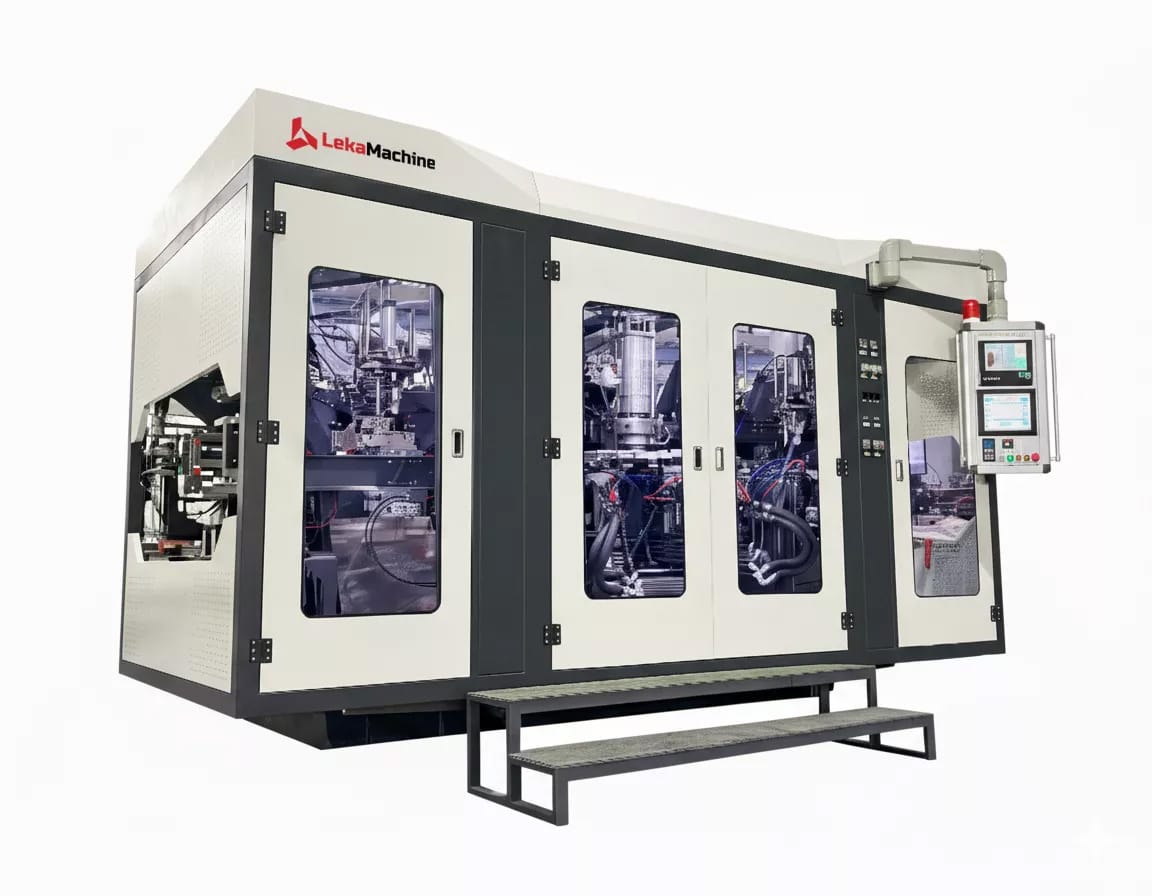
lekamachine (Asya'da kapsama alanı olan küresel OEM)
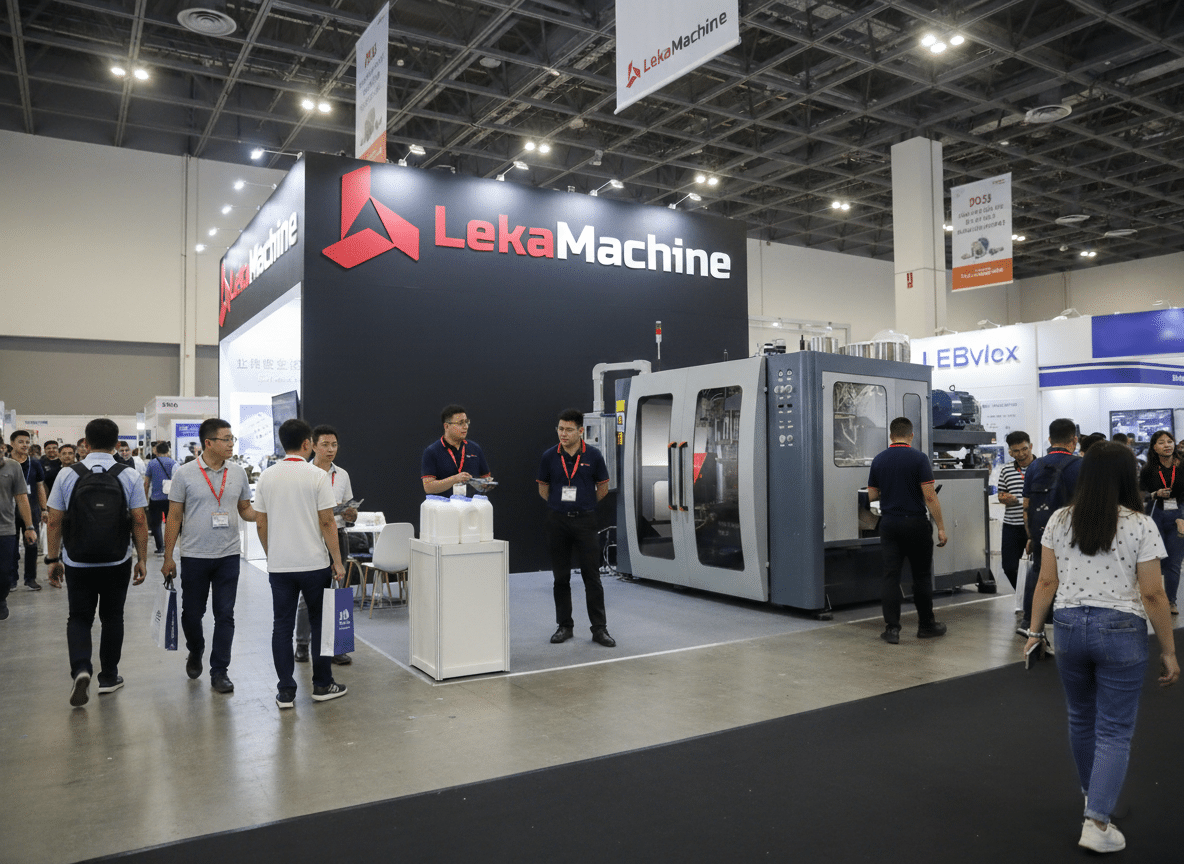
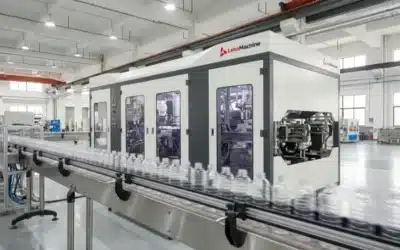
Trade show display of an extrusion blow molding machine with viewing windows and sample HDPE containers at the lekamachine company booth.
Leka Machine provides a strategic balance of modern technology, cost-effectiveness, and rapid delivery, making it a compelling choice for Vietnam’s fast-growing businesses. With a strong manufacturing base in Asia, they offer both extrusion and stretch şişirme çözümleri tailored for FMCG, pharmaceutical, and chemical packaging, with a support model designed for regional responsiveness.
Ana ürünler
Their portfolio includes fully automatic Extrusion blow molding machines for containers from 10ml to 30L, specializing in HDPE, PP, and PETG. They offer single to multi-cavity configurations with features like parison control, auto-deflashing, and options for view stripes and multilayer co-extrusion.
Artıları
Highly competitive pricing and excellent value. 30–90 day delivery lead time, a major advantage for startups or capacity expansions. Flexible machine configurations for diverse applications. Direct, responsive service and remote diagnostics from their regional technical center.
Eksileri
Less established brand recognition compared to German competitors. The most advanced, niche technologies may be limited compared to premium European options.
Official site: https://lekamachine.com
Bekum (German OEM with regional support)

The web of BEKUM for blow molding machine factory/manufactures
Bekum is a pioneer in the blow molding industry, with a reputation for robust and reliable machinery. Their machines are widely used in Vietnam for producing packaging for dairy, household chemicals, and edible oils. They have a strong presence in Southeast Asia, providing reliable service and parts support to Vietnamese customers.
Ana ürünler
Their portfolio includes the HYBLOW series (hydraulic), EBLOW series (all-electric), and large accumulator head machines. They are known for their C-frame clamp design and patented spiral mandrel extrusion heads for excellent wall thickness distribution.
Artıları
Proven long-term reliability and machine lifespan. Excellent part quality and consistency. Strong regional service network. Wide range of machine sizes and configurations.
Eksileri
Higher initial investment compared to Asian manufacturers. Can be over-engineered for very simple applications. Lead times for new machines can be significant.
Fong Kee International Machinery (Taiwanese OEM with local agents)

The WEB for FKI of extrusion blow molding machine
Fong Kee is a major Taiwanese manufacturer with a strong reputation across Asia for building durable and cost-effective machinery. They have a significant installed base in Vietnam, supported by local agents for sales and service. Their machines are a practical choice for producers looking for a reliable workhorse without the premium price of European equipment.
Ana ürünler
They offer a wide range of continuous extrusion shuttle machines, accumulator head machines for up to 30L jerry cans, and double-station models for high output of smaller containers. They also offer multilayer co-extrusion systems.
Artıları
Good balance of price and performance. Robust construction designed for demanding production environments. Established presence and service support in Vietnam. Shorter lead times than European competitors.
Eksileri
Technology and control systems may not be as advanced as top-tier German brands. Energy efficiency on older hydraulic models may be lower than new all-electric designs.
ST Soffiaggio Tecnica (Italian OEM with regional agents)

The WEB of STblow for blow molding machine manufactures
ST Soffiaggio Tecnica from Italy offers a range of compact and efficient Extrusion blow molding machines. They are well-regarded for their all-electric models, which provide significant energy savings and clean operation, making them suitable for pharmaceutical and food packaging. They serve the Vietnamese market through regional sales and service partners.
Ana ürünler
Their lineup is centered around the ASPI series of all-electric machines and EC series of hybrid machines, suitable for containers from a few milliliters up to 30 litres. They focus on single and double-station shuttle platforms.
Artıları
Excellent energy efficiency on their all-electric models. Compact machine footprint. Precise and repeatable movements ideal for quality-critical applications. Competitive pricing for European technology.
Eksileri
Brand is less known in Vietnam compared to German or Taiwanese competitors. Local support network might be less extensive.
Graham Engineering Corporation (US OEM with specialized solutions)

The web of Graham Engineering (USA) America for blow molding machine factory/manufactures
GEC is a leader in rotary wheel şişirme kalıplama technology, designed for extremely high-volume production of single-serve containers. While a significant investment, these machines offer the lowest cost per bottle for dedicated, high-demand products. They also provide accumulator head and shuttle machines for industrial applications.
Ana ürünler
Their flagship is the Graham rotary wheel series. They also build accumulator head machines for large parts and industrial containers, and shuttle machines under the Welex brand. Their systems are highly customizable.
Artıları
Unmatched output for high-volume applications. Very low flash and material waste. Proven technology with a long history of reliability. Strong in multilayer barrier technology.
Eksileri
Very high initial capital investment. Not suitable for flexible, short-run production. Requires a significant factory footprint and infrastructure.
SIPA (Italian OEM with broad packaging portfolio)
Şişirme kalıplama makinesi fabrikaları/üreticileri için SIPA web sitesi
While widely known for PET stretch blow molding, SIPA also offers a robust line of Extrusion blow molding machines. Their strength lies in providing integrated solutions, from bottle design to complete filling lines. They have a strong sales and service presence in Southeast Asia, including Vietnam.
Ana ürünler
SIPA’s Extrusion blow molding range includes single and double station machines suitable for HDPE and PP packaging for food, personal care, and detergents. They emphasize fast cycle times and energy-efficient designs.
Artıları
Ability to offer complete turnkey packaging lines. Strong design and lightweighting expertise. Good energy performance. Established service network in the region.
Eksileri
Extrusion blow molding is a smaller part of their overall business compared to PET Çözümler. Their brand may be less associated with this specific technology.
Jih-Hlong Plastic Machinery (JH) (Taiwanese OEM with local distribution)
Jih-Hlong is another strong Taiwanese manufacturer known for producing reliable, no-frills Extrusion blow molding machines. They are a popular choice in Vietnam for companies needing dependable capacity for general-purpose containers, like bottles for lubricants, chemicals, and household goods. They are represented by local distributors.
Ana ürünler
They offer a comprehensive range of hydraulic shuttle machines, from small bottle production up to 20-litre jerry can machines. Their designs are straightforward, easy to maintain, and robust.
Artıları
Very competitive pricing. Simple, user-friendly controls. Strong and durable mechanical construction. Good availability of spare parts through local channels.
Eksileri
Less focus on all-electric technology and advanced energy-saving features. Control systems are functional but less sophisticated than European counterparts.
Parker Plastic Machinery (Taiwanese OEM with regional presence)

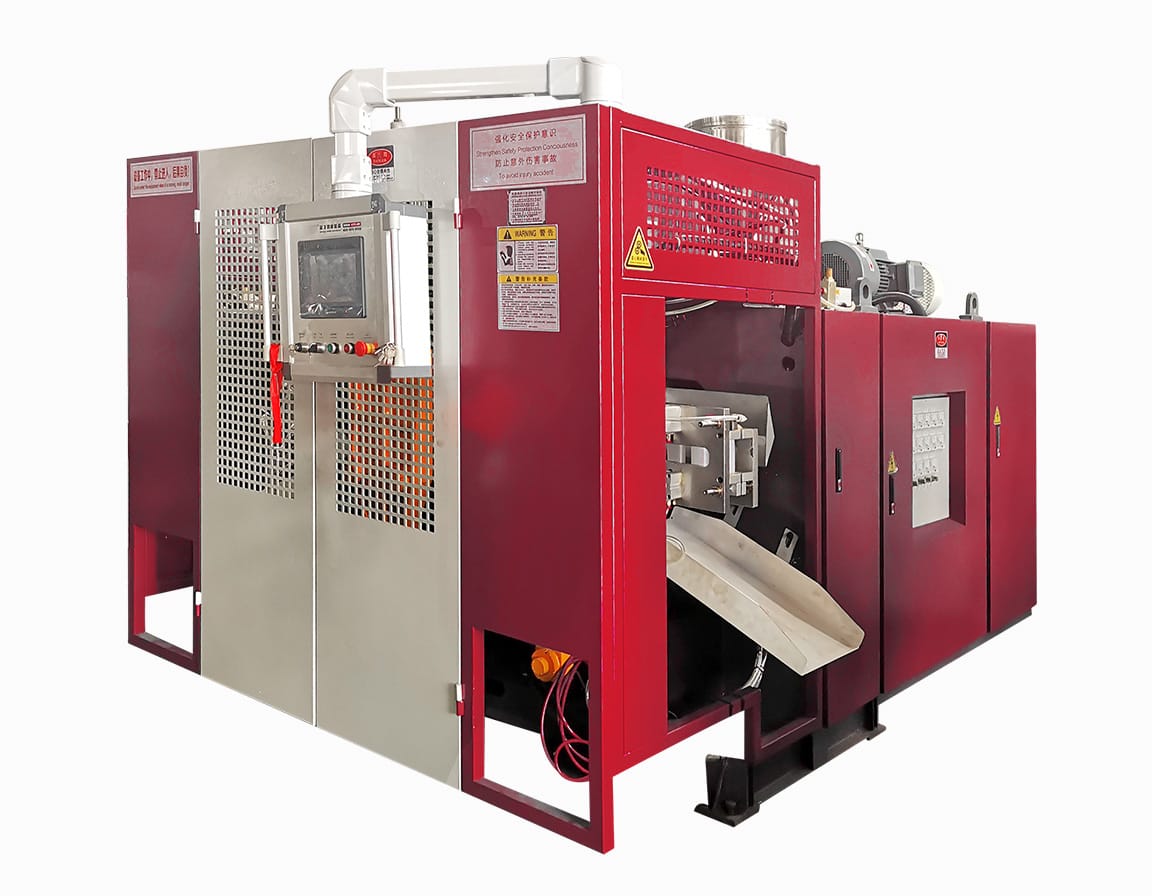
Bu ekstrüzyon üfleme kalıplama makinesi, içi boş plastik şişeleri şekillendirmek için kontrol paneli ve işleme ünitelerine sahip kapalı bir çerçeveye sahiptir.
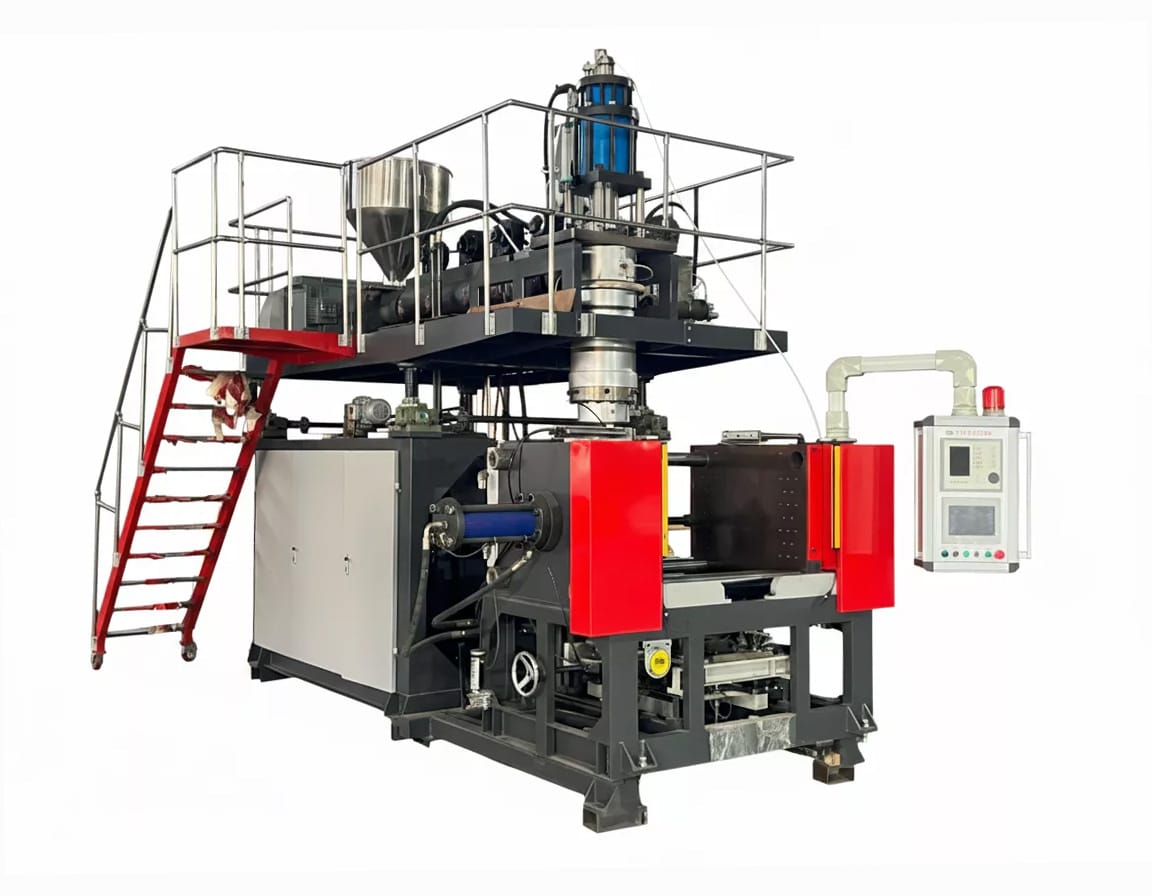
Parker is a well-established Taiwanese brand with a significant footprint across Southeast Asia. They produce a wide variety of şişirme makineleri, including accumulator head models for large industrial drums and tanks. Their equipment is known for its durability and is often used in the chemical and lubricant industries in Vietnam.
Ana ürünler
Their range covers everything from small bottle machines to large accumulator head systems capable of producing 220-litre L-ring drums. They offer both hydraulic and all-electric shuttle machines.
Artıları
Extensive range of machine sizes and types. Strong capability in large part and industrial container molding. Good value for the investment. Solid service support in the region.
Eksileri
Their user interface and software may feel less modern than premium brands. Focus is more on industrial applications than high-speed consumer packaging.
Techne Graham (Italian OEM with specialized focus)
The web of Graham Engineering (USA) America for blow molding machine factory/manufactures
Techne, now part of Graham Engineering, specializes in high-speed, long-stroke shuttle machines, particularly for the dairy and food industries. They are known for innovative solutions like integrated leak testing and in-mold labeling. Their presence in Vietnam is typically through regional agents focused on high-volume packaging converters.
Ana ürünler
The Advance series is their all-electric platform, designed for high efficiency and cleanliness. Their 4000 series offers high-cavitation solutions for smaller bottles. They have strong expertise in PP and hot-fill applications.
Artıları
Excellent cycle times and output on their long-stroke models. Strong focus on food-grade and cleanroom applications. All-electric machines are highly energy efficient. Good integration capabilities.
Eksileri
Premium pricing. Machines are highly specialized and may be less flexible for general-purpose molding. Service network may be less dense than larger competitors.
Factors to Consider When Choosing a Extrusion blow molding machine Manufacturer for a Startup (startup manufacturer selection)
For a startup in Vietnam, the three most important factors are speed to market, predictable cash flow, and accessible support. A machine with a short delivery lead time, like 60-90 days, allows you to start generating revenue months earlier than one with a 6-9 month lead time. Look for a manufacturer offering simple, reliable machines that are easy to operate and maintain. Proximity of service is key; a problem that can be fixed in one day by a regional technician is a minor issue, but one that requires waiting a week for someone from Europe is a major crisis.
How to Find a Extrusion blow molding machine Manufacturer for Your Startup (how to choose, vendor shortlist, RFQ)
First, create a shortlist of 3-4 vendors from the list above that fit your budget and application. Insist on seeing machines running in a production environment, ideally in Vietnam or a neighboring country. For your Request for Quotation (RFQ), provide your exact bottle drawings, material specifications (including color and any PCR content), and required annual output. The most crucial step is a pilot run: send your own molds and a sample of your specific resin to the manufacturer for a trial. This is the only way to verify their claims on cycle time, energy consumption, and bottle quality before you buy.
Domestic vs. Overseas Extrusion blow molding machine Manufacturers (local service vs cost)
While there are few, if any, domestic manufacturers of advanced Extrusion blow molding machines in Vietnam, the key distinction is between regional Asian suppliers (China, Taiwan) and European/US suppliers. Asian machines typically offer a lower initial investment and faster delivery times. European machines command a premium for their advanced technology, energy efficiency, and precision. For many Vietnamese businesses, a hybrid model works best: a high-quality machine from an Asian OEM that offers a strong price-to-performance ratio and has a dedicated regional hizmet team.
Maintenance, Spare Parts, and SLAs (service coverage, spare parts, MTTR)
Before signing a purchase order, get a clear commitment on service. Ask for the location of their nearest spare parts depot and their guaranteed response time for a technician to be on-site at your factory. A good Service Level Agreement (SLA) should define response targets and Mean Time To Repair (MTTR). A recommended spares kit is essential; having critical components on-site can turn a multi-day shutdown into a one-hour fix.
Installation, Commissioning, and Ramp-Up (FAT/SAT, acceptance criteria)
The process should include a Factory Acceptance Test (FAT) at the manufacturer’s site and a Site Acceptance Test (SAT) at your facility in Vietnam. The SAT criteria should be clearly defined in the contract: for example, running the machine for 8 continuous hours at a target OEE of 85% with a scrap rate below 2%. Plan the installation schedule carefully, accounting for Vietnamese holidays like Tết, when logistics and labor can be challenging.
Pilot Runs and Acceptance Criteria (OEE, kWh per 1,000 bottles)
The pilot run is your most powerful negotiation and verification tool. Use your production mold and material to establish a baseline for key performance indicators. The acceptance criteria should be written into the contract and measured during the SAT. The most important metrics are OEE (Overall Equipment Effectiveness), energy consumption (kWh per 1,000 bottles), and video-verified changeover time. This data-driven approach removes subjectivity and ensures you get the performance you paid for.
Total Cost of Ownership and ROI Modeling (TCO calculator, payback model)
Don’t just look at the purchase price. Build a simple Total Cost of Ownership (TCO) model. Factor in the machine cost, freight and taxes, energy consumption (using your local VND per kWh rate), typical annual maintenance and spares cost, and labor. A slightly more expensive but highly energy-efficient machine can have a much faster payback period and lower TCO over 5-7 years. Your model should reflect the reality of operating in Vietnam.
Operator Training and Change Management (HMI standardization, SOPs)
Effective training is crucial for success. Ensure the manufacturer provides comprehensive on-site training in Vietnamese. The machine’s Human-Machine Interface (HMI) should be intuitive and preferably available in Vietnamese. Standardizing operating procedures (SOPs) for startups, shutdowns, and changeovers across all shifts will ensure consistent production and quality, regardless of which operator is on duty.
Digital Connectivity and Data (remote monitoring, MES/ERP integration)
Even for a small operation, digital connectivity is a major advantage. Modern machines can provide remote access for diagnostics, allowing an engineer in another country to troubleshoot issues without traveling. This dramatically speeds up problem-solving. Data on production counts, cycle times, and alarms can be exported to help you track performance and can often be integrated with higher-level MES or ERP systems as your company grows.
Case Studies and Benchmarks (before/after energy savings, changeover, OEE)
A producer of 5-litre HDPE jerry cans for lubricants in Dong Nai upgraded from an old hydraulic machine to a new all-electric shuttle machine. They reduced their energy consumption per bottle by 35%, saving over 200 million VND annually on electricity costs alone.
An FMCG company in Binh Duong producing shampoo bottles was able to reduce their mold changeover time from 4 hours to 45 minutes by investing in a machine with a quick-change system. This allowed them to accept smaller, more profitable orders and reduce their finished goods inventory.
A food company producing chili sauce bottles in Ho Chi Minh City adopted a 6-layer co-extrusion machine to incorporate an EVOH barrier. This extended their product’s shelf life from 6 months to 18 months, enabling them to expand into export markets.
RFQ Checklist and Vendor Scorecard (RFQ template, vendor comparison)
When you send out your RFQ, be specific. I recommend demanding the following: guaranteed cycle time for your primary container, energy consumption in kWh per 1,000 bottles, a video demonstrating a full mold and color change, a detailed preventive maintenance schedule, the cost of a two-year essential spares kit, and a map showing their service technician coverage for Vietnam. Ask for at least two customer references in Vietnam or Southeast Asia that you can speak with. Use this data to create a scorecard to compare potential vendors objectively.
Other Options Than Extrusion blow molding machine Manufacturers (contract manufacturing, refurb, alternatives)
If the capital investment for a new machine is too high initially, consider alternatives. You can use a contract manufacturer (toll blow molder) in one of Vietnam’s industrial parks to produce your bottles. This allows you to enter the market with zero capital expenditure on machinery. Another option is to purchase a refurbished machine from a reputable supplier, which can save 30-50% on cost, though you may sacrifice some efficiency and warranty coverage. Finally, for certain applications (small bottles, high clarity), consider other processes like injection blow molding or PET stretch blow molding.
SSS
What is the main difference between a shuttle and a rotary Extrusion blow molding machine?
A shuttle machine moves the mold(s) back and forth under the extrusion head, making it flexible for different products but with lower output. A rotary wheel machine has multiple molds on a continuously spinning wheel, offering very high output but is best for dedicated, high-volume production of a single product.
What is a realistic delivery timeline to a factory near Ho Chi Minh City?
For machines from Asian manufacturers (China, Taiwan), expect 60-120 days from order to delivery. For European machines, it is typically longer, ranging from 180-270 days. Always confirm this in writing.
Why would I need a multilayer machine with EVOH?
You need it for oxygen-sensitive products like sauces (ketchup, chili sauce), fruit juices, or certain chemicals. The EVOH layer acts as a gas barrier, preventing oxygen from spoiling the product and extending shelf life significantly.
What is a good energy consumption target for an all-electric machine?
For a modern all-electric Extrusion blow molding machine producing a standard 1-litre HDPE bottle, a good target would be in the range of 0.40 – 0.55 kWh per kg of processed resin.
What are the most important Site Acceptance Test (SAT) criteria?
The key three are: 1) A continuous production run (e.g., 4-8 hours) achieving a target OEE (e.g., >85%). 2) A scrap rate below a specified target (e.g., <2%). 3) Verification of the cycle time and energy consumption promised in the quotation.
What should a basic Service Level Agreement (SLA) include?
It should specify a guaranteed on-site response time for a technician (e.g., within 48 hours for urgent issues), telephone/remote support availability (e.g., 24/7), and the price structure for service calls inside and outside the warranty period.
Are molds from different machine brands interchangeable?
Generally, no. Molds are designed for the specific platen layout, shuttle stroke, and clamp mechanics of a particular machine brand and model. Transferring a mold to a different brand usually requires significant and costly modifications.
Are there financing or leasing options available in Vietnam for machinery?
Yes, several local and international banks in Vietnam offer asset financing and leasing for industrial machinery. Manufacturers or their local agents can often provide introductions to financial partners who understand the industry.
Sonuç (sonraki adımlar, kısa liste, pilot, SLA)
Choosing the right Extrusion blow molding machine manufacturer for your operations in Vietnam is a decision that will impact your profitability for a decade or more. The best choice balances the right technology for your products with a verified, responsive local or regional service structure and a predictable total cost of ownership. Use this guide to create a shortlist of 3-4 potential partners.
Your next steps are clear: demand data, not just brochures. Insist on a pilot run with your specific molds and materials to verify performance. Most importantly, negotiate a strong Service Level Agreement that guarantees the support you need to keep your factory running. By following this disciplined approach, you can secure a reliable and profitable production asset for your business.


0 Yorum