

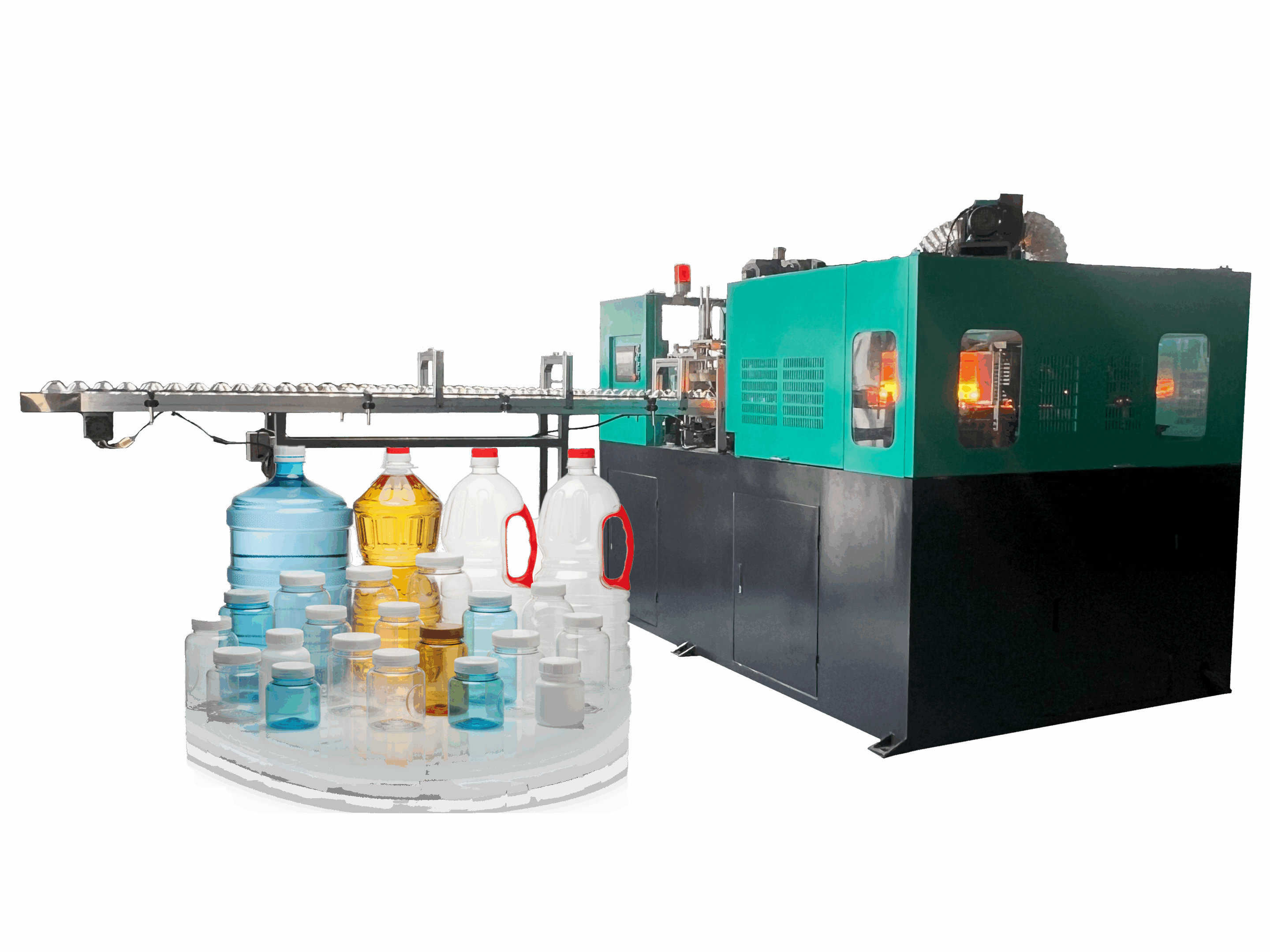
What Bottle Drawings Do I Need for an All-Electric Extrusion Blow Molding Machine Quote?

At LEKA Machine, we often see projects stall because of incomplete drawings. Without clear specs, our engineers cannot calculate cycle times or guarantee wall thickness, leaving you with vague quotes.
To get an accurate quote for an all-electric extrusion blow molding machine, you must provide both 3D STEP files for volumetric calculations and 2D PDF drawings for tolerances. Explicitly detail the neck finish standards (like SPI), minimum wall thickness, flash layout, and specific weight requirements to ensure the machine configuration matches your production goals.
Let’s break down the specific technical details you need to include in your package to ensure we deliver the right engineering solution.
Do I need to provide 3D STEP files or are 2D PDF drawings sufficient for a quote?
Relying solely on 2D sketches creates massive headaches on our assembly floor. We cannot visualize complex curves or calculate precise clamping forces without depth data, often leading to tooling errors.
You need both formats. 3D STEP/IGES files allow us to calculate material displacement and mold geometry accurately. However, 2D PDF drawings are equally critical because they legally define tolerances, surface finishes, and specific quality notes that 3D models cannot convey.
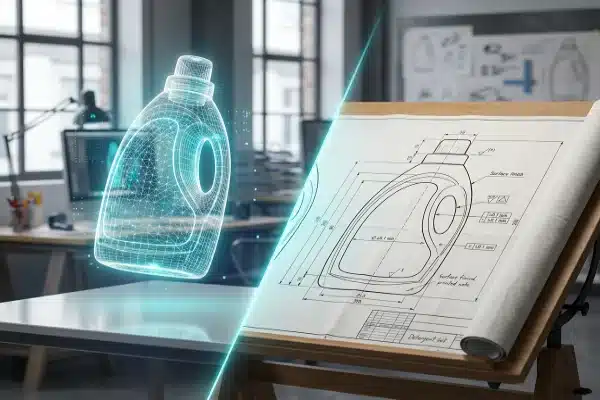
When you approach us for a machine configuration, we use a dual-format documentation strategy to ensure the equipment capability matches your bottle design. A single file type is never enough for a professional quote on high-end electric machinery.
The Role of 3D Files (STEP/IGES)
We import your 3D files directly into our simulation software. This allows our engineering team to calculate the volumetric displacement of the bottle. Without this, we cannot accurately size the extruder screw or the accumulator head. The 3D geometry also helps us simulate the "Blow-Up Ratio"—the relationship between the parison diameter and the bottle’s widest point. If this ratio exceeds 3:1 or 4:1, we know immediately that your machine requires specialized spreading heads or ovalization tooling to prevent webbing.
The Necessity of 2D PDF Drawings
While the 3D model shows us the shape, the 2D drawing tells us the rules. This is where you must clarify "Conditioned" versus "As-Molded" dimensions. Plastic shrinks for 24 to 48 hours after molding. On your PDF, you must explicitly state if the dimensions are for the cold, finished bottle or the hot, fresh production check. If this isn’t clear, mold makers may cut the steel incorrectly by double-counting shrinkage rates.
Furthermore, 2D drawings are the only place to define surface finish standards, such as VDI or SPI grades. An all-electric machine offers precise control, but it cannot fix a poor mold finish defined by a vague drawing.
| Özellik | 3D STEP File | 2D PDF Drawing |
|---|---|---|
| Primary Function | volumetric calculation, blow-up ratio analysis | Legal tolerances, surface finish, quality notes |
| Machine Config | Sizing the extruder and die head | Determining acceptance criteria (QC) |
| Critical Missing Info | Cannot show tolerances or shrinkage context | Cannot show complex curvature volume |
| Supplier Usage | Simulation and mold flow analysis | Final inspection and contract verification |
Should I specify exact tolerances for the neck finish and thread dimensions?
Leaking bottles are the nightmare of every production manager. When clients ignore neck specs, we often see caps stripping or failing seal tests during the Factory Acceptance Test (FAT).
PCR (Post-Consumer Recycled) 1
Specifying exact tolerances is mandatory. You must cite the specific industry standard (e.g., SPI-SP-400 or PCO 1881) rather than just dimensions. This ensures we manufacture the calibrated neck inserts correctly, preventing leaks and ensuring your bottles fit downstream capping equipment perfectly.
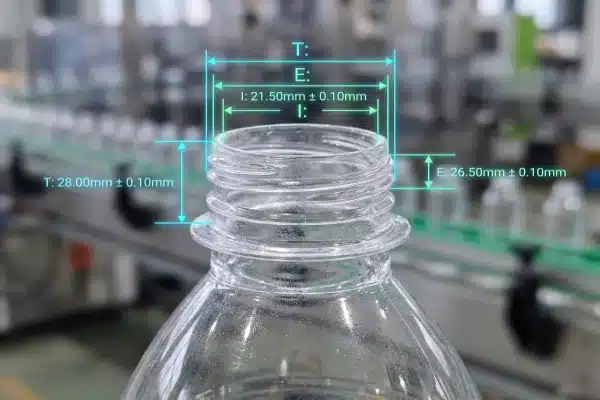
The neck finish is the most critical interface of your product. It is the only part of the bottle that interacts mechanically with another component (the cap) and your filling line. Simply writing "28mm neck" on a drawing is a recipe for disaster.
closure’s inner seal 3
Defining Standard Protocols
You must reference specific standards like SPI-SP-400 veya PCO 1881. These codes tell our mold engineers exactly how to design the "calibrated neck insert" (moils). This ensures that the threads are not just the right size, but also the right shape and pitch to engage the closure’s inner seal. If you are using a custom cap, we need the cap drawing alongside the bottle drawing to validate the fit.
The Five Critical Dimensions
Your 2D drawing must detail the specific dimensions that control the seal. We look for the following five key metrics to ensure your machine’s calibration unit is set up correctly:
- T Dimension: The outside diameter of the thread peaks.
- E Dimension: The outside diameter of the neck wall (thread valley).
- I Dimension: The inner diameter of the neck, which controls flow and nozzle fit.
- S Dimension: The distance from the top rim to the first thread start.
- H Dimension: The total height of the finish.
Tolerance Management
On an all-electric EBM machine, we can hold very tight tolerances due to the precision of the servo movements. However, we need to know your "Go/No-Go" limits. For example, the T dimension typically requires a tolerance of ±0.15mm. If you do not specify this, a standard mold maker might default to looser general tolerances, resulting in caps that back off during shipping.
| Dimension Symbol | Description | Critical Failure Risk |
|---|---|---|
| T (Thread OD) | Outer diameter of thread peaks | Cap strips or jumps threads if too small |
| E (Thread Root) | Outer diameter of neck wall | Cap feels loose; poor torque retention |
| I (Inner Dia) | Opening size | Filling nozzle collision or plug seal failure |
| H (Height) | Total neck height | Cap bottoms out before sealing (leaker) |
Is it necessary to include the target bottle weight and minimum wall thickness?
In our testing center, undefined weight targets lead to wasted resin. Without knowing your limits, we cannot optimize the parison controller for maximum profitability, risking your long-term margins.
PCO 1881 4
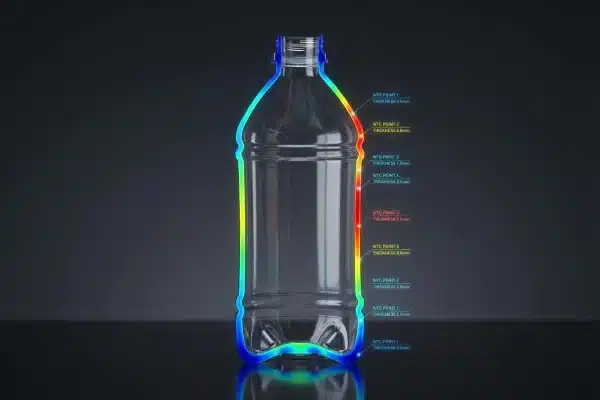
Yes, including target weight and minimum wall thickness is essential. This data dictates how we configure the Parison Wall Thickness Controller (WTC). A clear minimum thickness requirement prevents us from under-engineering the machine, ensuring the bottle survives drop tests without using excessive, costly material.
Weight and thickness are not just quality metrics; they define the profitability of your production line. When we configure an all-electric machine, we use these numbers to program the servo-driven parison head.
legally define tolerances 6
Configuring the Parison Profile
Modern machines use a 100-point parison profile to vary thickness from top to bottom. If you only provide an "average" wall thickness, you are missing the point. You must mark the absolute minimum wall thickness allowed at the bottle’s weakest points, usually the bottom corners or the shoulder radius. This forces us to configure the WTC to push extra material into these stretch zones while thinning out the straight walls to save money.
Structural Columns and Top-Load
If your bottle needs to be stacked (Top-Load requirement), your drawing should indicate vertical "load paths." This signals us to use Radial Thickness Control (SFDR). SFDR allows us to shape the parison die to deposit thick vertical strips of plastic that act like pillars inside the bottle wall. Without this note on your drawing, we might quote a standard machine that lacks the radial servo capability, leaving you with weak bottles that collapse on the pallet.
Material Considerations
The target weight also helps us determine the cooling capacity. A heavier bottle contains more heat energy and requires a longer cycle time or more intensive mold cooling channels. If you omit the weight, our theoretical output quote will be wrong. We also need to know if you are using PCR (Post-Consumer Recycled) material or calcium carbonate fillers, as these affect the density and flow rates, changing how we calculate the target weight relative to the screw speed.
| Spec Requirement | Why It Matters for Machine Config | Result of Omission |
|---|---|---|
| Target Weight | Determines screw size and cooling time | Machine may not meet output speed targets |
| Min. Wall Thickness | Sets Parison WTC programming points | Weak corners or failed drop tests |
| Top-Load Force | dictates Radial Thickness (SFDR) need | Bottles collapse during stacking/shipping |
| Resin Type (e.g., PCR) | Affects screw design and melt flow | Poor mixing or inconsistent bottle weight |
How does sharing the flash layout help in sizing the mold platen correctly?
Ignoring flash areas often forces us to resize machines mid-project. If we underestimate the projected area, the mold "breathes" during the blow cycle, ruining your parting lines and aesthetics.
Blow-Up Ratio 7
Sharing the flash layout allows us to calculate the Total Projected Area, which determines the minimum clamping force required. This ensures the machine has enough tonnage to keep the mold closed under pressure, preventing flash defects and ensuring the automated deflashing stations function without jamming.
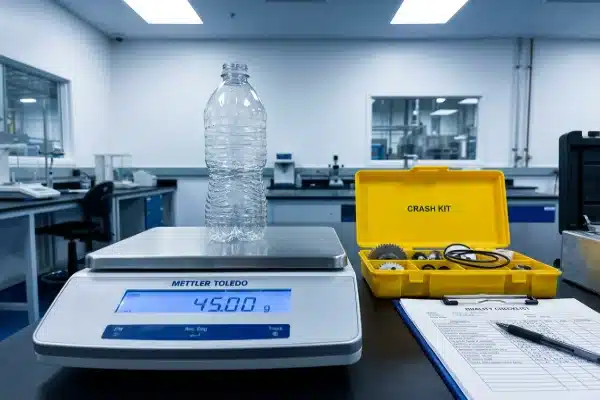
The "flash" is the excess material pinched off at the top (neck) and bottom (tail) of the bottle, and sometimes along the handle. While it is waste material, it is crucial for sizing the machine.
standards (like SPI) 9
Calculating Clamping Force
The clamping force of a machine (measured in kN or Tons) must counter the blow pressure pushing outwards. This calculation is based on the Total Projected Area, which includes not just the bottle, but the flash pockets as well. A bottle with a handle or an offset neck generates significantly more flash area than a simple cylinder. If you do not provide a sketch of the expected flash layout, we might underestimate the required tonnage. This results in the mold opening slightly during blowing—a defect called "breathing"—which creates thick, ugly parting lines that are impossible to trim cleanly.
Automated Deflashing Clearance
Most of our clients want fully automated production. This means the machine must punch out the flash automatically. Your drawing needs to show a "Punch Clearance Zone". This is particularly vital for handleware. If the handle hole is too small or the flash area is too tight against the bottle body, the automated punch tool will collide with the product. By seeing the flash layout early, we can advise if you need to adjust the handle design to accommodate standard punch tooling, saving you the cost of complex custom automation.
Pinch-Off Geometry
Finally, the flash layout helps us design the "pinch-off" blade. This is the metal edge that cuts the parison. You should specify if you need a "compression" edge (stronger weld, harder to trim) or a "cutting" edge (clean trim, weaker weld). This detail affects leak testing results. A sharp pinch-off cuts cleanly but might cause stress cracks; a dull one seals well but leaves a mess. We need this info to select the right mold steel and cutting geometry.
Sonuç
Providing a complete drawing package—3D models, 2D tolerances, and flash details—ensures accurate quotes and efficient machine delivery. By detailing these specs upfront, you help us build a production line that meets your quality standards from day one.
ekstrüzyon şişirme 10
Dipnotlar
- Official government guidance on using recycled plastics in packaging. ↩︎
- Technical explanation of tolerance limits from a measurement instrument leader. ↩︎
- Major closure manufacturer illustrating the importance of seal engagement. ↩︎
- ISBT is the authority maintaining the PCO 1881 thread specification. ↩︎
- Major resin supplier documentation regarding material properties and shrinkage. ↩︎
- ASME Y14.5 is the standard for defining engineering tolerances. ↩︎
- Educational resource explaining fundamental blow molding mechanics. ↩︎
- NIST resource on Model-Based Enterprise and 3D data standards. ↩︎
- The Plastics Industry Association (formerly SPI) establishes these container standards. ↩︎
- General overview of the manufacturing process context. ↩︎


0 Yorum