
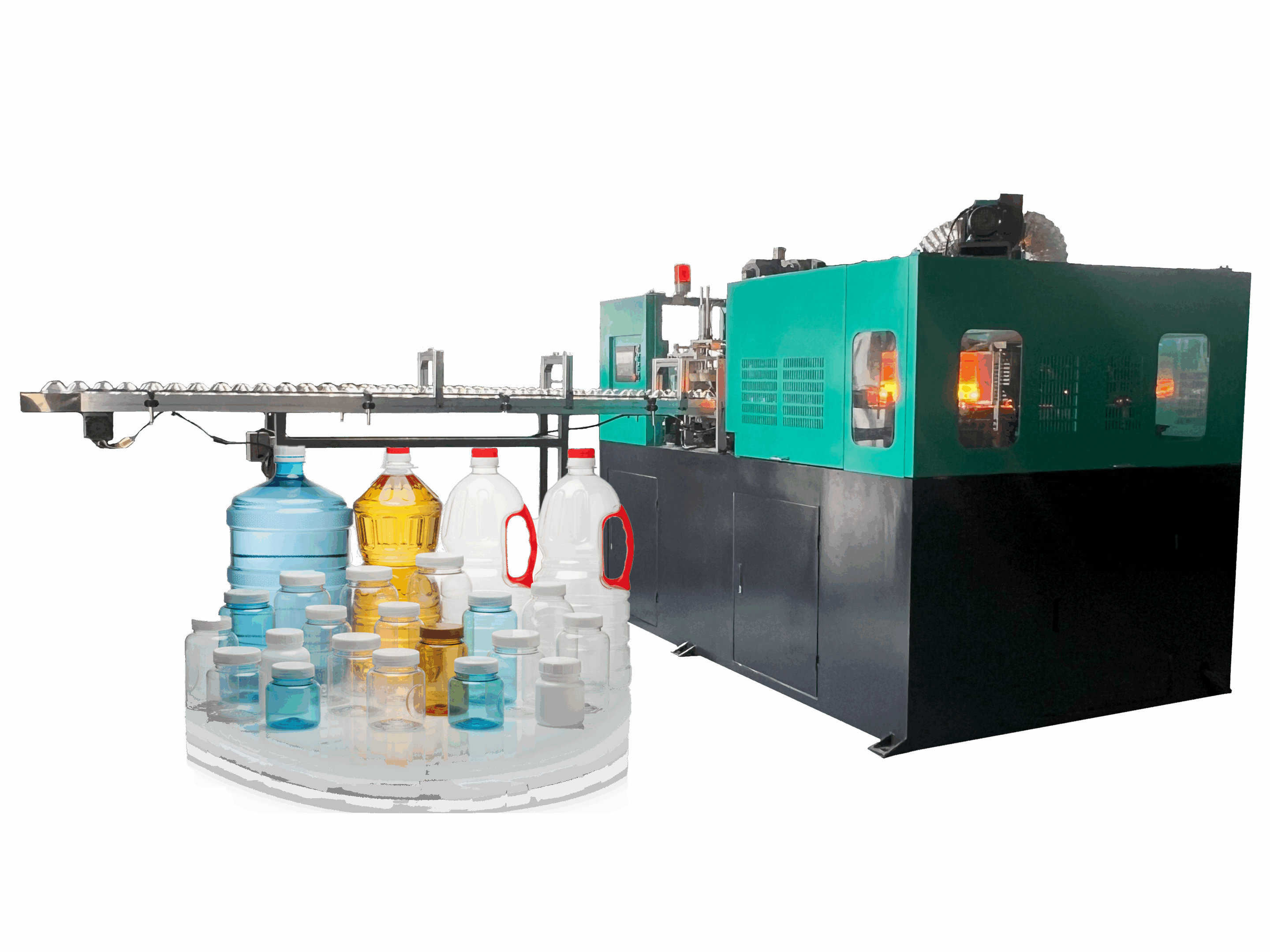
Ekstrüzyon Şişirme Kalıplama Makinesi Özellikleri: Kaçınılması Gereken 6 Teknik Tuzak
Buying a new machine is stressful. If you miss one small technical detail during the negotiation, you could end up with a machine that struggles to produce quality bottles or wastes expensive plastic for years. Let’s fix that before you sign the contract.
To succeed, you must verify the clamp force calculation to prevent parting line flash and check the extruder L/D ratio (24:1–30:1) for proper mixing. Also, insist on a parison controller with at least 100–300 profile points and confirm the servo-hydraulic system specs for maximum energy efficiency.
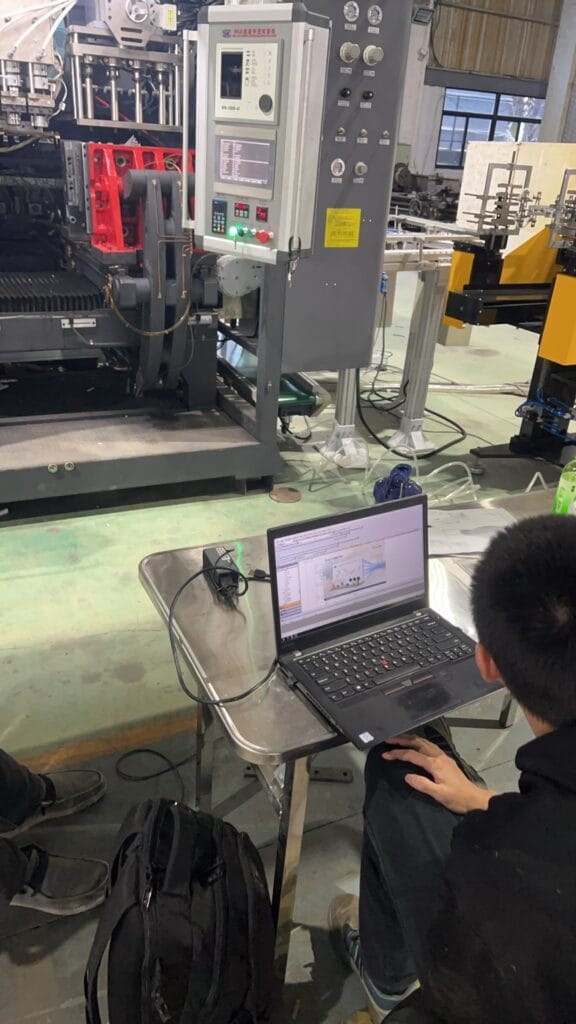
I have been in this industry for a long time, and I have seen too many factory owners regret their machine specifications six months after delivery. They focused too much on the fiyat tag and not enough on the technical “guts” of the equipment. At LEKA Machine, I always tell my clients that the devil is in the details. A machine might look good on paper, but if the screw geometry isn’t right for your material, or the platens are two inches too narrow for your robot arm, you are in trouble. I want to share the exact technical checklist I use to help my clients avoid those expensive traps.
How can I ensure the technical specifications of the extrusion blow molding machine match my production requirements?
Guessing your machine specs is a disaster waiting to happen. You don’t want a machine that is too weak to hold your mold closed or one that is too power-hungry for your profit margins.
Start by calculating the necessary clamping force based on your product’s projected area multiplied by the blow pressure. Then, select the right extruder screw diameter and Length-to-Diameter (L/D) ratio to match your required output (kg/hr) while keeping a 15-20% safety buffer for stability.

When you sit down to define your requirements, you need to go beyond the basic “I need to make a 5-liter bottle” request. You need to look at the physics of your production. I always start with two critical areas: the Clamping Force and the Extruder Capacity. If you get these wrong, nothing else matters.
The Math Behind Clamping Force
Many buyers underestimate clamp force. If the force is too low, the pressure of the air blowing inside the mold will force the two halves of the mold apart. This creates “flash” (excess plastic) along the seams. This ruins the look of your bottle and forces you to do manual trimming, which costs labor money. On the flip side, buying a machine with huge clamp force that you don’t need is a waste of electricity and money.
You should use this general rule of thumb: calculate the projected area of your bottle (width x height) and multiply it by the blow pressure. For standard HDPE containers, you usually need about 3 to 5 kN of force per square centimeter of projected area. Always ask your supplier to show you their calculation. If they are just guessing, run away.
The Heart of the Machine: Extruder L/D Ratio
The extruder is where the plastic melts. The Length-to-Diameter (L/D) ratio of the screw tells you how well the machine mixes the plastic. A higher number means a longer screw.
- Why it matters: If you are running simple clear material, a standard ratio is fine. But if you are using masterbatch (color) or mixing in recycled material (regrind), you need a longer screw to ensure the color is even and the melt is consistent.
- My recommendation: For most modern production, do not settle for less than 24:1. If you are doing high-quality cosmetic bottles or heavy color mixing, go for 30:1.
| Özellik | Recommended Spec | Why it is Important |
|---|---|---|
| L/D Ratio | 24:1 to 30:1 | Ensures proper melting and color mixing. Short screws cause “unmelted” spots. |
| Drive System | AC Inverter or Servo | Old DC motors are energy hogs. AC or Servo gives stable torque at low speeds. |
| Cooling Fans | Automatic Control | Barrel fans must kick in automatically to prevent the plastic from burning (degrading). |
What questions should I ask my supplier to verify the machine’s customization options?
Standard machines rarely fit your specific needs perfectly. If you don’t ask for the right customizations now, you will end up with a “good enough” machine that kills your efficiency every single day.
Ask specifically about the Parison Duvar Kalınlığı Controller—demand at least 100 to 300 profile points for material savings. Also, inquire about the brand of servo-motors used for energy saving and verify the die head center distances to maximize your output per cycle.

MOOG200 duvar kalınlığı kontrolörü
I often tell my customers that customization is where you make your profit. A standard machine can make a bottle, but a customized machine makes a profitable bottle. The difference is usually in the control systems and the energy efficiency. You need to ask tough questions here to make sure you aren’t getting 10-year-old technology.
Parison Duvar Kalınlığı Kontrolü
This is the secret weapon for saving money. The “parison” is the tube of hot plastic that drops down before it is blown into a bottle. Gravity makes this tube uzatmak, making the top thin and the bottom thick. A controller adjusts the gap in the die head to fix this.
Some cheap machines only have 30 or 50 points of control. This is not enough. You want a controller (like MOOG or B&R) that offers 100 to 300 points. This allows you to program the thickness of the bottle precisely every millimeter. You can make the corners strong (where bottles break) and the flat panels thin (where you don’t need plastic). I have seen clients save 5 to 10 grams of plastic per bottle just by upgrading this feature. Over a year, that is tons of resin saved.
Servo-Hydraulic Systems: Not Just a Buzzword
In the past, machines ran pumps that spun at full speed all day, even when the machine was idle (like during cooling time). This boils the hydraulic oil and wastes electricity. Today, you must ask for “Servo-Hydraulic Systems.”
These systems only spin the motor when the machine needs to move. If the machine is cooling the mold, the motor stops.
- Energy Impact: You can reduce electricity bills by 40% to 60%.
- Oil Life: Because the oil doesn’t get as hot, you don’t need a massive chiller just for the oil, and the hydraulic fluid lasts longer.
- Noise: Your factory floor will be much quieter.
Don’t just ask “is it servo?” Ask “What brand is the servo drive and pump?” Top brands like Sumitomo or reputable Chinese brands ensure reliability.
How do I evaluate the compatibility of the machine with my existing molds or product designs?
You likely have a warehouse full of expensive molds. It is a production nightmare if your new shiny machine cannot run your old profitable molds because the platens are the wrong size.
Measure your physical mold width against the machine’s tie-bar clearance and check the minimum and maximum mold thickness range. Crucially, verify the die head center distance matches your existing multi-cavity molds to avoid paying for expensive new tooling.
One of the saddest things I see is when a new machine arrives, and the customer realizes their old molds don’t fit. They assumed that because the machine is a “5 Liter” machine, it would fit their 5-liter mold. This is a dangerous assumption. You need to pull out your tape measure and check the physical limits of the machine’s clamping unit.
Tie-Bar Clearance vs. Mold Width
The “Tie Bars” are the big steel columns that guide the mold movement. Your mold needs to fit *between* these bars. If your mold is 500mm wide, but the space between the tie bars is only 480mm, you cannot mount the mold.
Don’t just look at the “Platen Size.” The platen is the big metal plate, but the tie bars get in the way. Always ask for the “Distance Between Tie Bars” (Horizontal and Vertical). Also, consider the water pipes. Even if the mold fits, do you have room to plug in the cooling hoses without hitting the bars?
Head Center Distance
If you run multi-cavity molds (making 2, 3, or 4 bottles at once), the distance between the bottle necks is fixed. This is called the “Center Distance.”
If your mold has a center distance of 140mm, but the new machine’s die head is set to 160mm, the plastic parison will not drop into the mold cavities correctly. Changing the center distance on a machine head is expensive and difficult later. You must match this spec *before* you buy. If you have molds with different distances, ask the supplier if the head is adjustable or if you need to buy a second head kit.
| Measurement | What to Check | The Risk |
|---|---|---|
| Tie-Bar Distance | Must be wider than your mold width + hose clearance. | Mold won’t physically fit in the machine. |
| Open Stroke | (Bottle Depth x 2) + Robot Arm clearance. | Mold opens, but the bottle is trapped inside. |
| Min/Max Mold Thickness | Check your thinnest and thickest molds. | Machine cannot clamp tight (too thin) or can’t lock (too thick). |
What are the most common technical pitfalls I should avoid during supplier discussions?
Suppliers love to say “yes” to every request to get the sale. But relying on verbal promises without checking the deeper technical reality leads to production failures and maintenance headaches later.
Avoid ignoring the specific screw design needed for PCR (recycled) materials, as standard screws will wear out fast. Also, do not overlook Industry 4.0 connectivity like OPC-UA for data logging, and ensure deflashing units have independent force controls to protect your molds.
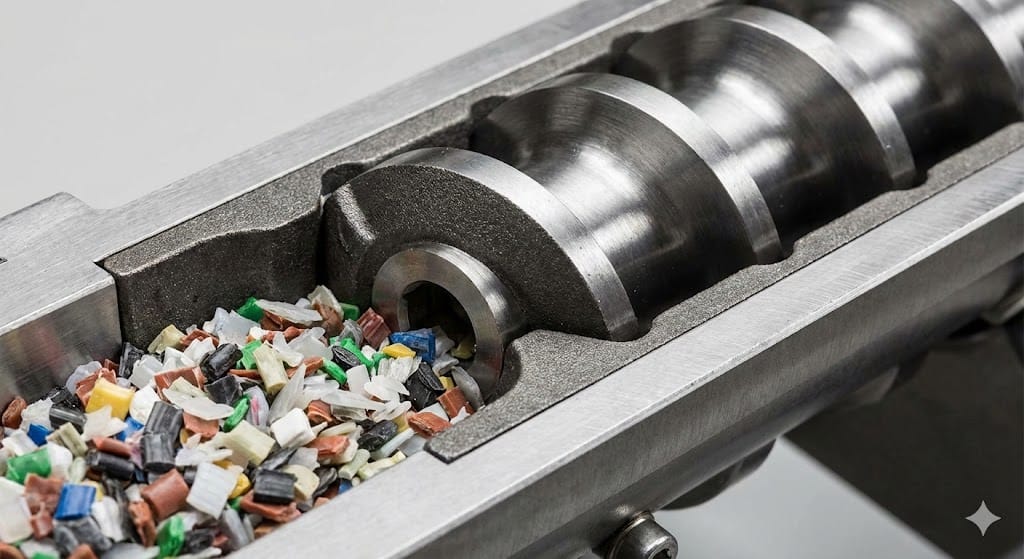
Close-up of an extruder screw channel where plastic flakes are conveyed and melted as part of an extrusion blow molding machine.
We are entering a new era of üretme. The old ways of “melt and blow” are changing because of environmental laws and data requirements. If you buy a machine today based on specs from ten years ago, your machine will be obsolete before you even turn it on. I want to highlight two major pitfalls regarding materials and data.
The PCR Trap (Recycled Material)
Everyone wants to use PCR (Post-Consumer Recycled) material now. It’s good for the planet and required by law in many places. However, PCR is dirty. It often contains tiny bits of metal, sand, or paper labels.
If you run PCR through a standard nitrided steel screw, it will act like sandpaper. I have seen screws lose their mixing ability in just six months.
Çözüm: You must demand a “Bimetallic Barrel and Screw.” This is a super-hard coating that resists abrasion. Also, ask for a special screw geometry designed for “low temperature mixing.” PCR can be sensitive to heat; if you overheat it, it smells bad and turns yellow. A standard screw generates too much shear heat. You need a specific design for this.
Future-Proofing with Data (OPC-UA)
Your big clients (like Nestle, Coca-Cola, or Unilever) are going to start asking for data. They want to know the carbon footprint of every bottle. They want to know the exact temperature the plastic was melted at.
If your machine has a cheap, closed PLC system, you cannot get this data out. You end up writing numbers on a clipboard like it’s 1980.
Çözüm: Ask if the PLC supports “OPC-UA.” This is a standard communication language. It allows your machine to talk to your office computer (ERP or MES system). Even if you don’t use it today, having it means you are ready for the future. It allows for remote diagnostics, meaning I can log into your machine from China to help you fix a problem, saving you days of downtime.
Deflashing Unit Protection
Finally, look at the deflashing unit (the part that punches out the scrap plastic). Many cheap machines link the deflashing hydraulic pressure to the main clamp pressure. This is bad. You might need high pressure to hold the mold, but low pressure to punch the scrap. If you punch too hard, you damage the cutting edges of your mold. Ensure the deflashing station has “Independent Pressure Regulation.” It’s a small detail that saves your expensive molds.
Sonuç
Don’t just buy a machine; buy a production solution. By verifying the clamp force, checking the screw ratio, ensuring mold compatibility, and future-proofing for PCR and data, you secure your factory’s profitability for the next decade.
My Role
I am Slany Cheuang, the Technical Sales Manager at LEKAmachine. I bridge the gap between complex engineering specs and real-world business needs. I help factory owners in Europe and the Americas build efficient, reliable production lines without the stress of guessing. If you are confused about a spec or need a second opinion on a machine configuration, I am here to help you navigate the details.


0 Yorum