
Şişirme Üfleme Kalıplama Kalıp Başlıkları İçin Tam Rehber (2025 Sürümü)
The difference between a profitable production run and a mountain of expensive scrap often comes down to one key part.
In my years as a technical sales manager in the blow molding industry, I’ve seen many companies struggle. They face problems like unstable product weights, dangerously thin corners on containers, and high failure rates. They blame the material, the operator, or even the temperature in the factory.
But most of the time, the real problem is deep inside their machine. The key to fixing it is the blow molding die head.
It’s the “paintbrush” of our industry, but it’s often the most misunderstood part of the whole process.
Welcome to the guide for mastering the blow molding die head. I’m Slany Cheuang, a Technical Sales Manager at Leka Machine. My job is to help manufacturers use blow molding technology to get real business results.
Precise control of the die head is the secret to fixing production problems and boosting efficiency. The success of your product—its strength, its look, its cost—depends on how well you understand and control this single component.
Forget about trial and error. This guide will be your new blueprint. We will go beyond the basics and dive into the practical knowledge that separates the industry leaders from the rest. We will break down how it works, explore the technology, and show you how to control it with precision.
This isn’t just about making a plastic bottle. It’s about making it perfectly, every single time.
Core Insight: What You Will Learn About the Blow Molding Die Head

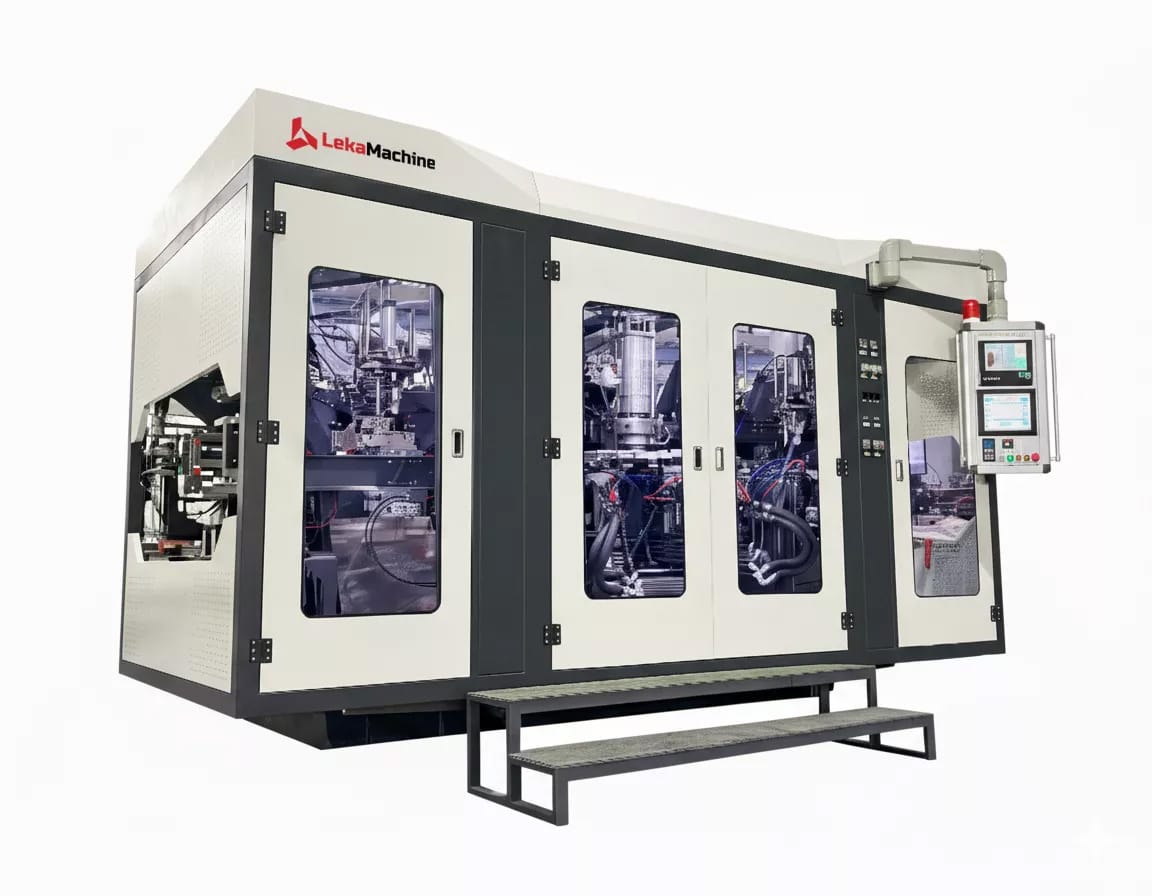
Interior view of dual mold stations showing hydraulic clamp frames, heated platens, cooling channels, and blow pin assemblies.
This guide is meant to be your main resource. After reading it, you will have a deep and practical understanding of:
- Core Mechanics: We’ll show how the die head turns melted plastic into a perfect, hollow tube (a “parison”) ready for molding. We’ll also identify every key part.
- Choosing the Right Tech: You’ll learn the key differences between continuous extrusion, accumulator, and co-extrusion die heads. You’ll be able to choose the ideal one for your product, from small bottles to large industrial drums.
- Mastering Wall Thickness Control: We will provide a step-by-step guide to parison programming. This is the most important technique for reducing material waste, making products stronger, and cutting down cycle times.
- Troubleshooting Like an Expert: You’ll get real solutions for common blow molding problems like thin corners, black specks, and inconsistent weights. This will help you fix issues quickly and effectively.
- Design and Maintenance Secrets: We’ll show how die head design and materials affect its lifespan and performance. We’ll also provide a maintenance checklist to keep your production line running smoothly.
Yazar Hakkında
I’m Slany Cheuang, the Technical Sales Manager at Leka Machine. With a lot of experience in şişirme kalıplama, I help clients optimize their production lines, from choosing the right machine to solving tough processing problems. I love turning complex engineering ideas into practical, profitable solutions for our partners. At Leka Machine, we believe a knowledgeable customer is our best partner, and this guide shows our commitment to that idea.
Understanding the Core Function: From Melt to Parison
Before you can control it, you have to understand it.
The blow molding die head has one main goal: to take the steady stream of melted plastic from the extruder and shape it into a hollow, perfectly formed tube called a parison. The Kalite of this parison determines everything that follows. A perfect parison makes a perfect product. A bad parison is destined for the scrap grinder.
The Journey of Melted Plastic
Picture the process. The extruder acts like a powerful pump, pushing melted plastic toward the die head under high pressure. Once inside the die head, the single stream of melt meets the first key part: the mandrel, or torpedo. This torpedo-shaped part splits the plastic, forcing it to flow around it through carefully designed channels. This action creates the hollow center of the parison.
A well-designed die head ensures the plastic flows back together seamlessly on the other side of the mandrel, without creating weak spots called weld lines. From there, the plastic, now hollow, is guided to the exit. It passes through the final, adjustable opening—the die gap—and comes out of the machine as a parison, hanging vertically, ready to be captured by the closing mold.
Every step of this journey, from the channel design to the temperature control, is engineered to make sure the plastic flows at a uniform speed and pressure. This is the foundation for a high-quality product.
What are the main parts of a blow molding die head?
While designs can vary, nearly all extrusion blow molding die heads share a common set of key components. Understanding what each part does is the first step to effective troubleshooting and control.
- Die Body: This is the main structural housing for the whole assembly. It’s a heavy, solid block of high-grade steel that contains all the internal flow channels and provides mounting points for heater bands and other components. Its large mass helps maintain stable heat.
- Mandrel / Torpedo: As mentioned, this is the internal component that splits the melt flow to create the hollow shape. Its surface finish and design are critical to prevent material from degrading and to ensure the plastic rejoins smoothly, minimizing weld lines.
- Die Pin / Mandrel Tip: This is the inner component of the final exit. It controls the inside diameter of the parison. In advanced systems, the die pin is the moving part in the parison programmer, changing the wall thickness by adjusting its position.
- Die Bushing / Die Ring: This is the outer component of the final exit. It controls the outside diameter of the parison. The die bushing is usually stationary, while the die pin moves relative to it.
- Die Gap: This isn’t a physical part, but the critical space between the die pin and the die bushing. The size of this ring-shaped opening directly determines the initial thickness of the parison wall. A bigger gap makes a thicker parison.
- Heater Bands: These are external electric heaters clamped onto the die body. The die head is not passive; it must be kept at a precise, even temperature—often within a degree or two of the target. If one section is cooler, the plastic flow in that area will slow down, leading to an uneven parison. Multiple heater bands create different heating “zones” for precise temperature control across the entire die head.
A Full Breakdown of Die Head Technologies
Not all die heads are created equal.
The technology you choose is directly linked to the product you want to make. A die head designed for a small shampoo bottle would be completely useless for producing a 220-liter chemical drum.
At Leka Machine, we engineer our equipment for specific uygulamalar, and that starts with using the right die head technology.
When is a Continuous Extrusion Die Head Best?
This is the workhorse of the şişirme kalıplama world, valued for its speed and simplicity. In a continuous extrusion system, the extruder runs constantly, producing an endless stream of parison. As soon as a parison reaches the right length, the mold closes around it, cuts it from the flow, and moves away to be blown. At the same time, a new parison is already starting to form for the next cycle.
- How it works: A continuous, non-stop extrusion of the parison.
- Pros: Fast and efficient, making it very reliable for high-volume production. The mechanics are often less complex and more cost-effective. Heat stability is excellent because the process never stops.
- Cons: The main limitation is something called “parison sag.” Because the parison is extruded slowly and hangs under its own weight, a very long or heavy parison will start to stretch at the top while it is still being formed. This results in a thin top and a thick bottom, making it impossible to produce a part with uniform wall thickness.
- Product Applications: This technology is the top choice for high-volume production of small to medium-sized containers. Think of milk jugs, shampoo and conditioner bottles, small household chemical containers, and pharmaceutical bottles.
- The Leka Machine Connection: Our extrusion blow molding machines designed for the packaging and consumer goods industries are equipped with high-performance continuous extrusion die heads. We focus on flow channel designs that allow for quick color changes and use materials that ensure a long, productive life for 24/7 operations.
When Should You Use an Accumulator Head?
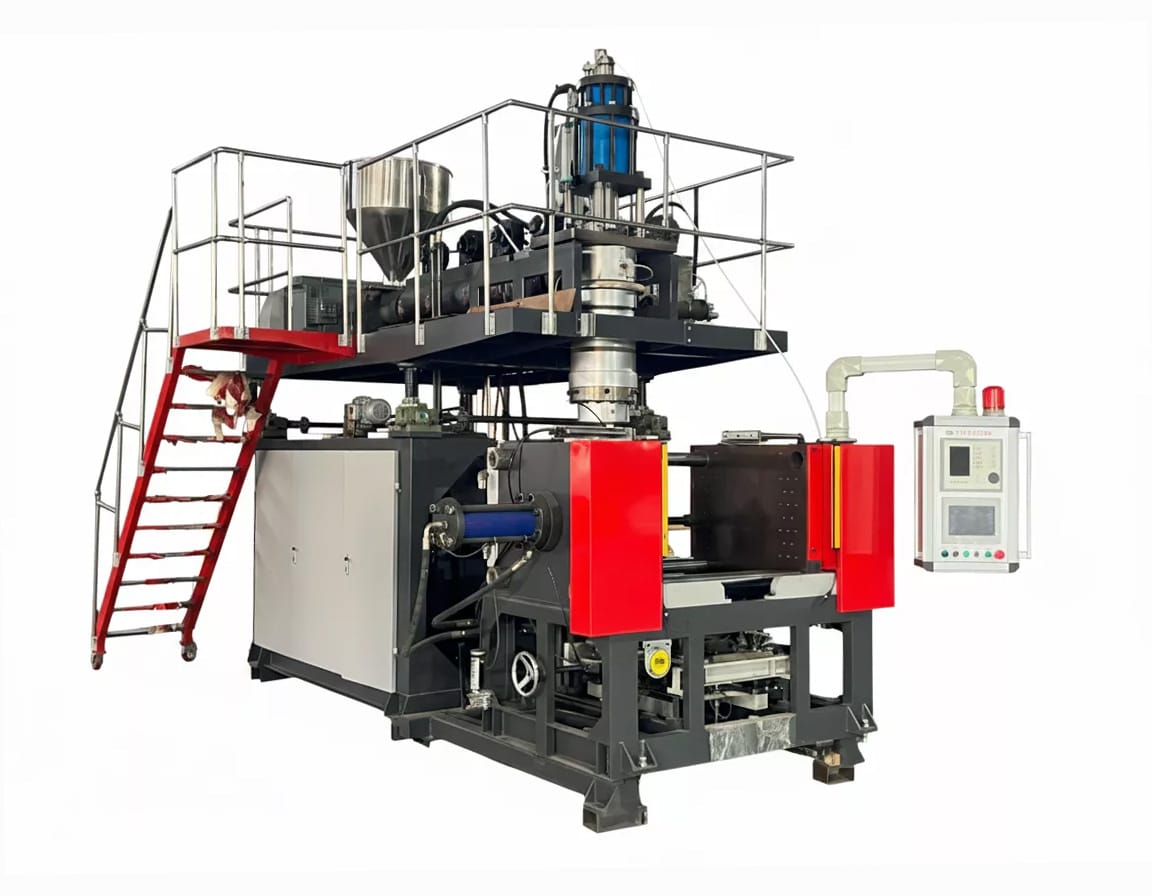
When you need to make large, heavy, and strong parts, an accumulator head is the only choice. This technology was invented specifically to overcome the problem of parison sag. Instead of extruding the parison directly and continuously, it first gathers or “accumulates” a large amount of melted plastic in a reservoir inside the die head.
- How it works: It stores a large shot of melt and then pushes it out very quickly to form a large parison in seconds.
- Pros: Fast extrusion speed. By using a hydraulic piston to force the melt out, an accumulator head can push out a huge, heavy parison—perhaps 2 meters long and weighing 35 kg—in just 5 to 10 seconds. This incredible speed means the parison has no time to sag under its own weight before the mold closes. This is the key to achieving uniform wall thickness in very large parts.
- Cons: The mechanics are more complex, making them more expensive. Cycle times are longer because you have to wait for the accumulator to fill for each shot. If not designed perfectly, the process of filling and emptying the accumulator can create more noticeable weld lines.
- Product Applications: This is the world of industrial products. Large chemical drums (jerry cans), automotive parts like fuel tanks and spoilers, large toys like slides and playhouses, and traffic barriers are all made using machines with accumulator heads.
- The Leka Machine Connection: This is one of our core specialties. Our large-part ekstrüzyon şişirme makineleri are built around robust, high-performance accumulator heads. We invest heavily in CFD (Computational Fluid Dynamics) modeling to perfect the internal geometry of our accumulator heads. This ensures a first-in, first-out melt flow, minimizes material degradation, and delivers a parison with superior strength and integrity for even the most demanding applications.
Co-Extrusion Die Heads (Multi-Layer)
Sometimes, a single layer of plastic isn’t enough. You might need an oxygen barrier layer to keep food fresh, a chemical barrier to hold aggressive solvents, or you might want to sandwich a layer of recycled material between two layers of virgin plastic to save costs and improve sustainability. This is where co-extrusion comes in.
- How it works: Multiple extruders feed different types of plastic into a single, highly complex die head. This die head has concentric, layered flow channels that bring these melt streams together just before the final die gap, forming a single parison with distinct, bonded layers.
- Pros: It allows you to create products with enhanced properties that are impossible with a single material. This includes barrier properties, improved aesthetics, soft-touch outer layers, and the ability to use recycled content without it touching the product.
- Technical Challenges: This is the peak of die head complexity. Controlling the thickness of each individual layer requires a sophisticated control system and a perfectly designed die head. Ensuring the different plastics adhere to each other properly is also a major challenge.
- Product Applications: The classic example is a ketchup bottle, which often has an inner layer of EVOH (ethylene-vinyl alcohol copolymer) as an oxygen barrier to preserve the product. Other applications include pesticide bottles, fuel tanks (which need a hydrocarbon barrier), and cosmetic tubes.
- The Leka Machine Connection: We thrive on this technical challenge. Leka Machine offers advanced co-extrusion solutions capable of producing parts with up to 6 different layers. Our engineers work closely with clients to configure the optimal combination of extruders and design a co-extrusion die head that guarantees precise layer distribution and superior product performance.
The Unbreakable Link: How the Die Head and Wall Thickness Controller Work Together
Before we dive into setting wall thickness parameters, it’s essential to understand a critical concept: the blow molding die head and the wall thickness controller are an inseparable, symbiotic system. They are the “muscle” and the “brain.”
Having the world’s most advanced die head without a precise controller to command it is like having a Ferrari without a steering wheel. And a top-tier controller connected to a slow, poorly designed die head can’t reach its full potential.
The Die Head: The “Muscle” of Precision Execution
The die head is the physical actor. The hydraulic or servo-electric actuator inside it, connected to the die pin, is the mechanism that changes the wall thickness. When it receives a command, the actuator must react with micron-level precision in milliseconds, moving the die pin to alter the die gap. The Kalite of the die head’s design—its mechanical tolerances, response speed, thermal stability—determines how quickly and accurately this “muscle” can execute commands. A well-designed Leka Machine die head ensures that commands are executed faithfully, without delay or compromise.
The Wall Thickness Controller: The “Brain” of Smart Decisions
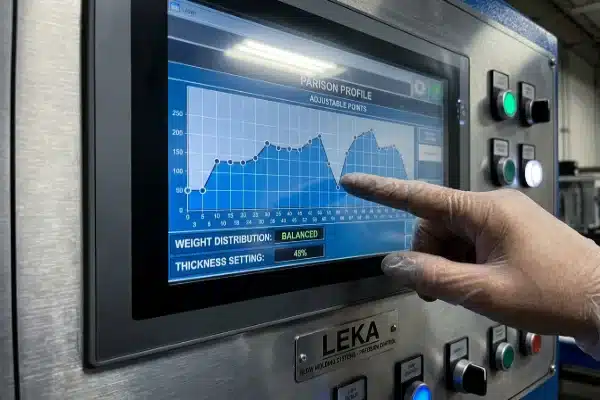
The wall thickness controller (like the MOOG or B&R systems we often integrate) is the “brain” of the operation. It doesn’t perform any physical action, but its electronic signals are the sole basis for all movement. The profile of 100 or more points that the operator sets on the controller screen is the detailed battle plan the “brain” creates for the upcoming production task. During the few seconds of parison extrusion, the controller reads this plan at an extremely high frequency and converts each point’s thickness requirement into a precise voltage or current signal sent to the die head.
How Do They Work Together?
Imagine a skilled puppeteer (the controller) and a well-made marionette (the die head). Every subtle thought and finger movement of the puppeteer requires the marionette’s joints to respond flexibly and without resistance to deliver a perfect performance.
In the şişirme kalıplama işlemi:
- Plan: The controller (brain) holds the complete blueprint for the parison’s thickness distribution.
- Command: The controller sends out a continuous stream of command signals at high speed.
- Execution: The die head’s servo valve receives the signals, precisely controls the hydraulic (or electric) power, and drives the die pin (muscle) to move.
- Result: The die gap changes in real-time, extruding a customized parison with a thickness that perfectly matches the preset blueprint.
Therefore, when evaluating a şişirme makinesi, you must never look at the die head or the controller in isolation. You must assess their performance as an integrated system. It is this seamless, high-speed, high-precision collaboration between the muscle and the brain that ultimately achieves the goal of making stronger products while saving material.
How Parison Programming Precisely Controls Wall Thickness
Now we get to the most important operational technique in ekstrüzyon şişirme: parison programming.
This is where art meets science. It’s where a good operator can save a company thousands of dollars in material costs while making a stronger, higher-quality product.
Why is it so critical? When a round parison is blown into a non-round (like a square or rectangular) mold, the plastic has to stretch much farther to reach the corners than it does to form the flat sidewalls. Without intervention, this extra stretching results in dangerously thin and weak corners. At the same time, the flat areas become unnecessarily thick and heavy.
Parison programming solves this by creating a parison that is intentionally not uniform in thickness along its length. It’s made thicker in the sections that will form the corners and thinner in the sections that will form the flat sides.
What is a Parison Programmer?
A parison programmer is a sophisticated electro-hydraulic control system. At Leka Machine, we often integrate controllers from world-class manufacturers like MOOG or B&R into our machines. Here’s how the system works:
- The Profile: An operator creates a “profile” on a control screen, which is essentially a graph with up to 100 set points. This graph represents the desired thickness of the parison from top to bottom.
- The Signal: As the parison is being pushed out, the controller reads this profile, point by point. It converts the desired thickness at each point into an electronic signal.
- The Servo Valve: This signal is sent to a high-precision servo valve, which controls the flow of hydraulic oil.
- The Actuator: The hydraulic oil moves a piston or actuator, which is physically connected to the die pin inside the die head.
- The Result: By precisely moving the die pin up and down relative to the fixed die bushing, the system dynamically changes the size of the die gap as the parison is being extruded. A smaller gap creates a thinner section, and a larger gap creates a thicker section. This all happens in a matter of seconds, resulting in a parison with a custom, engineered thickness profile.
Step-by-Step Guide: Setting Up Your Wall Thickness Profile
Let me walk you through a real-world example. Let’s say we need to produce a 20-liter rectangular jerry can on one of our Leka Machine accumulator head machines. An initial setup without parison programming would be a disaster—the corners would be paper-thin. Here is how we fix it.
- Analyze the Product Shape. We know the most stretching will happen at the top and bottom corners of the container, as well as the handle area. The large, flat side panels will require the least material.
- Create an Initial Profile Curve. We start by creating a baseline profile. On the controller, we will program a clear “hump” (increased thickness) at the points of the parison that correspond to the top and bottom of the can. We’ll add another smaller hump for the handle area. In contrast, for the parison sections that will form the flat sidewalls, we will program the profile to be significantly thinner.
- Test and Measure. We shoot one parison, mold it, and let it cool. The first product will never be perfect. We then take the finished jerry can to our QC station and use an ultrasonic thickness gauge. We measure the thickness at critical points: the center of the flat panels, the top corners, the bottom corners, and the thinnest point on the handle.
- Fine-Tune and Optimize. Let’s say our measurements show the bottom corners are still a bit too thin (e.g., 1.8mm instead of our 2.0mm target) and the side panels are a bit too thick (e.g., 2.5mm instead of our 2.2mm target). We go back to the controller. We find the set points that correspond to the bottom of the can and increase their values slightly. Then we find the set points for the side panels and decrease their values. We run another part and repeat the measurement process. We continue this iterative process of adjusting, producing, and measuring until every point on the container is within our specified tolerance. The result is a lighter, stronger, and more cost-effective product, produced with the absolute minimum plastic required. This process, which might take a few hours during initial setup, pays for itself thousands of times over during a long production run.
How to Fix Common Blow Molding Wall Thickness Issues
Even with a good profile, problems can arise. Here is a quick troubleshooting guide:
- Problem: Corners are too thin. The most common issue. The fix is to increase the thickness values for the points on the controller profile that correspond to the corners.
- Problem: Flat areas are too thick / Part is overweight. This is pure material waste. The fix is to gradually decrease the thickness values on the profile that correspond to the flat, low-stretch areas of the product.
- Problem: Horizontal thin bands appear on the product. This often indicates a single bad set point or a sharp, abrupt change in the profile. Smooth out the curve on the controller. It could also indicate a momentary drop in hydraulic pressure or a failing heater band causing a cold spot.
- Problem: Inconsistent results between products. If wall thickness varies on otherwise identical parts, the problem isn’t the profile itself. Look for instability elsewhere: fluctuating melt temperature, unstable hydraulic pressure, or a change in the material’s Melt Flow Index (MFI).
Our 60-90 day delivery time at Leka Machine isn’t just for manufacturing; it allows us to pre-program and optimize these profiles for you at our facility, using your own molds and material. This ensures that when your machine arrives, it’s ready for efficient production from day one.
Key Design Considerations for Optimal Performance
The performance of a die head isn’t just about how it’s operated; it’s rooted in its design and the materials used to build it. This is where decades of engineering experience become a competitive advantage.
Flow Channel Geometry: Avoiding Weld Lines and Melt Fracture
The path the plastic takes inside the die head is critical. Any sharp corners, dead spots, or rough surfaces can cause problems. “Dead spots” are areas where plastic can stagnate and “burn,” eventually breaking off and causing black specks in the product. Poorly designed channels can also prevent the plastic from “healing” properly after it flows around the mandrel, leading to weak weld lines, which can be a catastrophic failure point. Modern die heads, like those we design at Leka Machine, use smooth, heart-shaped or spiral-shaped flow channels optimized with CFD software to ensure a gentle, low-shear flow. This gentle handling of the melt preserves the plastic’s molecular structure, resulting in a stronger, flawless parison.
What kind of steel is used for a blow molding die head?
A die head is a high-precision tool that operates in a harsh environment of high heat and pressure. The material it’s made from is crucial for its longevity and performance. We typically use high-quality, pre-hardened tool steels like 42CrMo (the European equivalent is 4140 steel). After the complex internal channels are machined, the parts undergo a critical surface treatment process called nitriding. Nitriding diffuses nitrogen atoms into the surface of the steel, creating an extremely hard, wear-resistant, and corrosion-resistant “case” or skin. This ultra-hard surface is essential for resisting the abrasive effects of certain plastics (like those with glass fibers) and for preventing corrosion from materials like PVC, which can release acidic gases. A well-made, properly nitrided die head can provide decades of reliable hizmet.
The Role of the Die Head in Processing Different Materials (HDPE, PP, PVC)
Different plastics behave differently in their molten state. High-Density Polyethylene (HDPE) is very viscous and has high “melt strength,” meaning it resists sagging well. Polyvinyl Chloride (PVC) is very heat-sensitive and degrades easily if it gets too hot or sits in a dead spot for too long. The die head must be designed with the specific material in mind. For example, a die head for PVC will have exceptionally smooth, chrome-plated flow channels with zero dead spots to prevent material from burning. A die head for a very low-viscosity material might have a different die gap geometry to control the flow rate.
Understanding the Difference: Preform vs. Extruded Parison
This is a point of frequent confusion for newcomers to the industry, so let’s clear it up. Everything we have discussed so far applies to Ekstrüzyon Şişirme. There is another major process called Streç Şişirme, which is fundamentally different.
- Extrusion Blow Molding: Uses a die head to extrude a parison. This process is used for materials like HDPE, PP, and PVC. The products typically have a matte or satin finish, and handles can be molded in one piece. Jerry cans and milk jugs are classic examples.
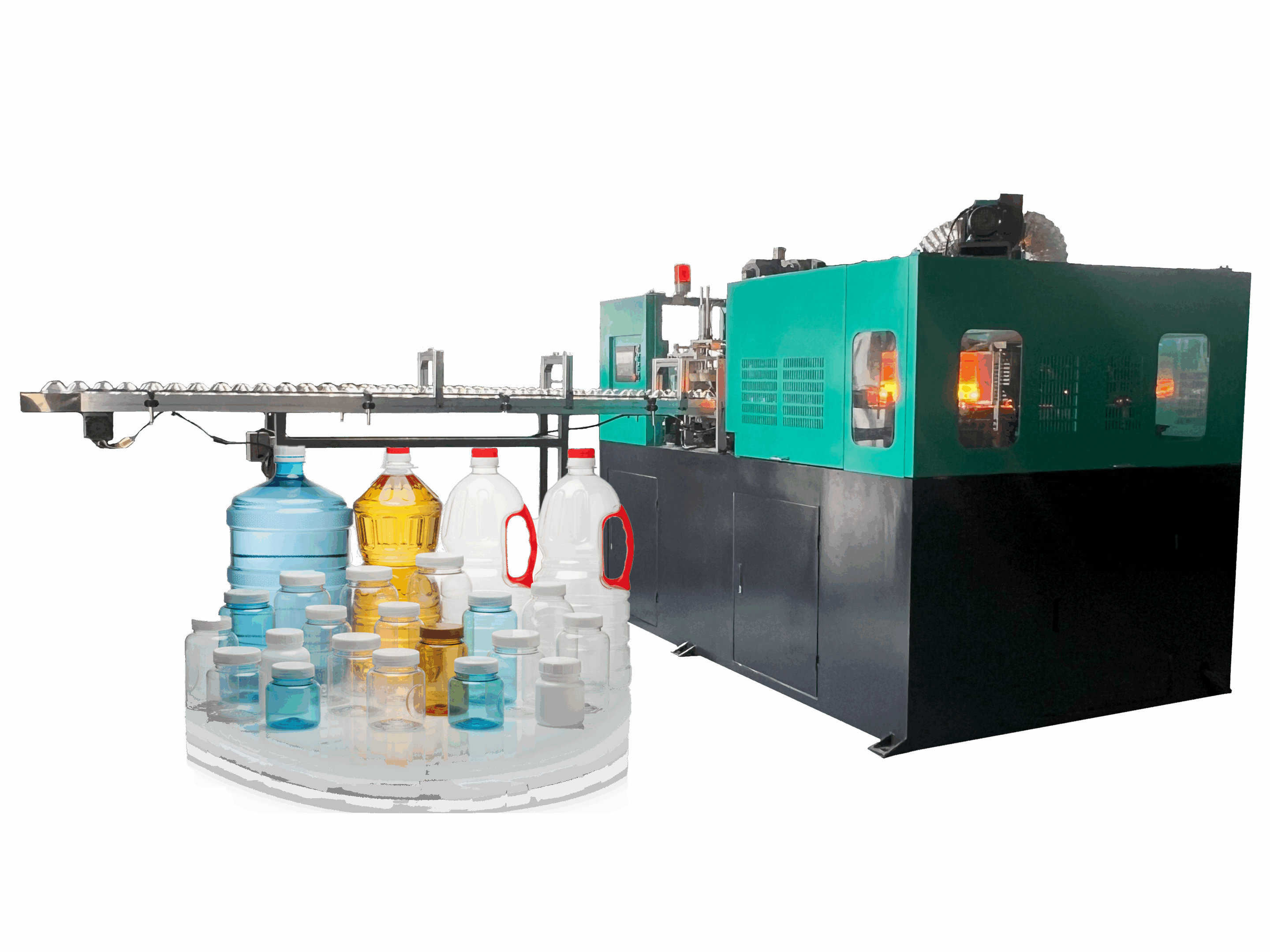
- Stretch Blow Molding: This is a two-step process. First, an injection molding machine creates a “preform,” which looks like a thick-walled test tube with the final bottle neck threads. In the second step, this preform is reheated, placed in a mold, stretched axially with a stretch rod (the “stretch”), and then inflated with high-pressure air (the “blow”). This biaxial stretching gives the material incredible strength and clarity. The process is used almost exclusively for PET (Polyethylene terephthalate).
Bu key takeaway is that stretch blow molding machines do not use a die head to form the parison. They use an injection-molded preform. If your goal is to make crystal-clear beverage bottles, water bottles, or wide-mouth jars from PET, you need a streç şişirme makinesi. If you are making industrial containers, packaging bottles, or automotive parts from HDPE or PP, you need an ekstrüzyon şişirme makinesi.
Leka Machine proudly manufactures both types of machinery. We provide clear guidance to our customers to ensure they invest in the right technology for their product, directing them to our extrusion blow molding machines for parison-based solutions and our stretch blow molding machines for preform-based applications.
Best Practices for Die Head Longevity and High Performance
A die head is a significant investment. Proper maintenance is not optional; it’s essential to protect that investment and ensure consistent product quality.
Regular Cleaning and Inspection Checklist
- Daily/Per Shift: Visually check the die gap area for any buildup of degraded plastic (“die drool”). This should be carefully removed using brass or copper tools (which are softer than steel and won’t scratch the die).
- Weekly: Check the heater bands. Make sure they are all drawing the correct amperage and that the temperature controller readings are accurate. One failed heater band can ruin production.
- Monthly: Verify the calibration of the parison programmer’s position sensor (LVDT). If the sensor’s reading drifts, your wall thickness control will become inaccurate.
- Annually (or as needed): Perform a full teardown and deep cleaning. This is a major job, but it is critical. The die head is taken apart, and all internal components are cleaned in a special high-temperature oven or with specialized cleaning compounds to remove all carbon buildup. Check the die pin and die bushing for any signs of wear or damage. Any scratches or nicks on these critical surfaces must be carefully polished out.
Common Problems and Their Solutions
- Problem: Black specks in the product.
- Likely Cause: Carbonized plastic is flaking off from inside the die head. This is the most common sign that a deep cleaning is needed.
- Çözüm: In the short term, you can try to purge the extruder with a dedicated cleaning compound. For a long-term fix, the die head must be disassembled and thoroughly cleaned.
- Problem: Vertical lines on the product.
- Likely Cause: Debris is stuck in the die gap, or there is a scratch/nick on the die pin or bushing.
- Çözüm: First, try to carefully clean the die face. If the lines persist, the die head must be taken apart to find and remove the debris or polish out the scratch.
- Problem: Inconsistent parison diameter.
- Likely Cause: Fluctuations in extruder output pressure or melt temperature.
- Çözüm: Check the extruder’s drive system, the condition of the screw, and ensure all heating zones on the barrel and die head are stable.
- Problem: Parison is “curtaining” or folding.
- Likely Cause: The die gap is not perfectly concentric, causing one side to be thicker than the other, which makes the parison curl.
- Çözüm: This requires a mechanical adjustment. Use a set of adjustment bolts on the die head to center the die bushing relative to the die pin.
Common Die Head Commissioning Problems and Solutions
Theoretical knowledge and maintenance checklists are fundamental, but the real test comes when you change to a new mold or material and need to set up the die head from scratch. As a technician, I know how challenging this process can be. Here are some of the most common on-site commissioning problems I’ve encountered over the years, along with their solutions, to help you get into stable production faster.
Adjusting for an Eccentric Parison (One-Sided Wall Thickness)
This is the most basic and crucial commissioning step. Before you start setting up complex wall thickness profiles, you must ensure that the parison extruded without any intervention is uniform and concentric.
- Diagnosis: First, turn off the wall thickness control system, leaving the die pin in a fixed, central position. Extrude a short parison, long enough to measure. After it cools, use a thickness caliper or micrometer to measure at least four points (e.g., 0°, 90°, 180°, 270°) at the same height on the parison. If the readings are inconsistent, for example, 2.2mm on one side and 1.8mm on the other, you have an eccentricity problem.
- Çözüm: This is a purely mechanical adjustment. On the die body, you will find a set of centering adjustment bolts (usually four or eight). The principle is “loosen one side, tighten the opposite.” For example, if you find the wall is thinnest on the north side (0°) and thickest on the south side (180°), you need to slightly tighten the adjustment bolt on the north side while slightly loosening the bolt on the south side. This will physically shift the die bushing slightly to the north, reducing the gap on the south side and increasing it on the north. This process requires great patience. Make very small adjustments each time (e.g., an 1/8 turn), then extrude and measure again. Repeat this “measure-adjust-remeasure” cycle until the wall thickness difference at all points is within an acceptable range (e.g., ±0.05mm). Only on this concentric foundation can your wall thickness profile function accurately as intended.
Eliminating Weld Lines on the Parison
Weld lines are formed when the plastic melt divides to flow around the mandrel inside the die head and then merges again. While they can’t be eliminated 100%, a prominent, weak weld line is a major quality risk for the product.
- Diagnosis: On the parison or final product, you will see one or two symmetrical vertical lines that are slightly different in color or have a slight indentation. You might feel them slightly when you touch them.
- Çözüm:
- Optimize Temperature: This is the most common solution. The strength of the weld line is directly related to the temperature and pressure at which the melt streams merge. Try gradually increasing the temperature in the die head zones (2-3°C at a time). Higher temperatures help the melt “weld” back together better, which can fade the line and increase its strength. Be careful, as too high a temperature can cause material degradation.
- Check for Cleanliness: Any tiny contaminant or carbon buildup in the die head’s flow channels can hinder the smooth merging of the melt. If the problem persists after temperature adjustments, you may need to consider a deep cleaning.
- The Power of Design: Ultimately, the severity of weld lines is largely determined by the die head’s design. This is why at Leka Machine, we invest significant R&D resources to optimize flow channel designs, using heart-shaped or spiral diverter structures to ensure the melt merges in the gentlest, most natural way possible, minimizing weld line issues from the very beginning.
Dealing with Die Drool (“Bearding”)
Die drool, known in the industry as “bearding,” is the gradual accumulation and carbonization of plastic on the die face. It periodically breaks off and sticks to the parison, causing specks, lines, or even holes in the product surface.
- Diagnosis: During a long production run, you can visually see a ring of black, burnt material growing on the outer edge of the die exit.
- Çözüm:
- Optimize Temperature Profile: This is often caused by the temperature in the die exit zone being set too high, or the residence time being too long. Try moderately lowering the temperature of the die exit heating zone. Sometimes, slightly increasing the extrusion speed to reduce the melt’s residence time at the die face can also help.
- Check the Die Face Surface: The exit edges of the die bushing and die pin must be perfect and sharp, without any scratches or pits. Any tiny surface imperfection can become an “anchor point” for melt to adhere and degrade. If damage is found, the part needs to be removed for fine polishing.
- Material Selection: Certain grades of plastic or color masterbatch have poor thermal stability and are more prone to breaking down at high temperatures. If you struggle with this problem long-term, talk to your material supplier about whether a more thermally stable alternative is available.
Addressing a Curling or Bending Parison
An ideal parison should hang straight down like a plumb line. If it bends or curls in one direction, the mold may not capture it correctly, leading to scrap parts.
- Diagnosis: The extruded parison does not hang vertically but clearly bends to one side.
- Çözüm: The root cause of this problem is almost always uneven temperature. If the temperature around the die gap ring is not uniform—for example, 200°C on one side and 195°C on the other—the plastic will flow better and faster on the hotter side and slower on the cooler side. This speed difference causes the parison to naturally bend toward the slower (cooler) side. The solution is to:
- Check All Heater Bands and Thermocouples: Use a multimeter or clamp-on ammeter to confirm that every heater band on the die head is working correctly and drawing consistent power. Check that all thermocouples are securely installed and giving accurate readings. A loose thermocouple can cause false temperature readings and uneven heating.
- Avoid External Environmental Effects: Make sure no air conditioning vents, fans, or drafts are blowing directly onto the die head. The cooling effect of this external airflow is enough to create a significant temperature difference and cause the parison to bend.
By systematically troubleshooting and solving these common commissioning issues, you can significantly shorten the setup time for new products and use your valuable machine time for production instead of repeated trial and error.
Frequently Asked Questions About Blow Molding Die Heads
- What is the difference between a die and a mold in şişirme molding?
- The die (specifically, the die head) is the tool that shapes the molten plastic into a hollow tube (the parison). The mold is the two-halved tool that closes around the parison and gives the product its final external shape when air is blown in.
- How does die swell affect the parison?
- Die swell is a natural phenomenon where the diameter and wall thickness of the parison increase slightly the moment it exits the die gap. This happens because the long-chain polymer molecules, which were compressed and oriented inside the die head, relax and expand. Engineers must account for a material’s specific die swell ratio when designing the die gap to achieve the desired final parison dimensions.
- What is the average lifespan of a blow molding die head?
- With proper maintenance, a high-quality die head from a reputable manufacturer like Leka Machine is a long-term asset. The die body itself can last for decades. The “wear parts”—primarily the die pin and die bushing—may need to be replaced every 5-10 years, depending on the abrasiveness of the material being processed.
- Can I use the same die head for both HDPE and PP?
- Generally, yes. HDPE and Polypropylene (PP) have similar processing characteristics, and a die head designed for HDPE will usually run PP well with adjustments to temperature and speed. However, materials like PVC or CPVC, which are more corrosive and heat-sensitive, absolutely require a die head specifically designed and coated for them.
- How much does a blow molding die head cost?
- The cost varies dramatically depending on the type, size, and complexity. A small, simple continuous extrusion die head for a single-layer bottle machine might cost a few thousand dollars. A large, complex, 6-layer co-extrusion accumulator head for an automotive application could cost over one hundred thousand dollars, making up a significant portion of the entire machine’s cost.
Partner with Leka Machine for Your Blow Molding Success
We’ve traveled from the basic principles of the blow molding die head all the way to the complex details of its design, control, maintenance, and on-site commissioning. It should be very clear now that this component is more than just a piece of steel—it is the absolute nerve center of your ekstrüzyon şişirme operation. Mastering its function is the most direct path to atıkların azaltılması, improving product quality, and maximizing profitability. A well-designed, properly controlled die head allows you to put plastic only where you need it, creating products that are both strong and lightweight—the goal every manufacturer strives for.
At Leka Machine, we don’t just sell machinery. We build partnerships. We understand that our success is tied to yours. That’s why we invest heavily in robust engineering, using high-quality materials and advanced design techniques to build die heads—and entire machines—that you can rely on, day in and day out. We provide the tools, but we also provide the knowledge, training, and support to ensure you can wield them with expert precision.
Ready to optimize your production and master wall thickness control? Ready to turn material waste into pure profit? Contact me, Slany Cheuang, today for a free, no-obligation consultation. Let’s discuss your product, your challenges, and how we can engineer the perfect solution for you.
Explore our lines of Extrusion Blow Molding Machines and Stretch Blow Molding Machines to see our full range of capabilities. The next generation of your product starts here.


0 Yorum