
How Can Plant Managers Verify Actual Production Capacity and Evaluate Global Blow Molding Suppliers?
At our facility, we often see customers burned by unrealistic quotes that look perfect on paper but fail on the floor. You face immense pressure to hit throughput targets, but misleading specifications and poor support threaten your profitability.
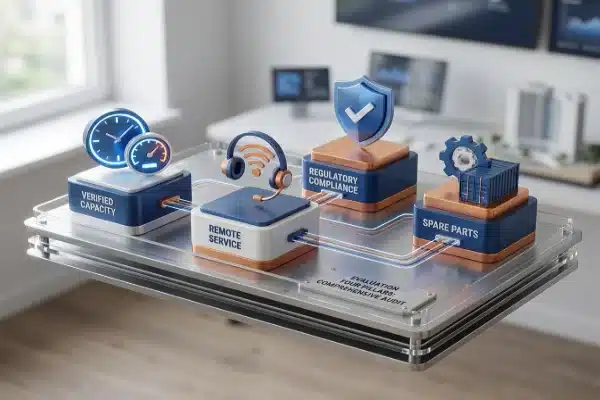
To effectively evaluate global suppliers, plant managers must audit four key pillars: verified production capacity through witnessed 24-hour run-offs, specific after-sales Service Level Agreements (SLAs) with remote diagnostics, regulatory compliance (CE/NRTL) beyond self-declarations, and transparent spare parts logistics with guaranteed lead times for critical components.
This guide cuts through the marketing noise to help you audit potential partners and secure your investment.
How do I verify the actual production capacity versus the theoretical output listed in quotes?
When we test machines on our assembly floor, we know that theoretical numbers are useless for your P&L. You cannot afford a 30% gap between the brochure specifications and your daily production log.
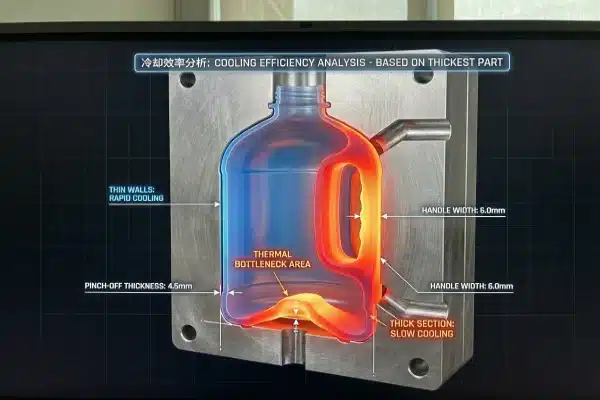
Theoretical output assumes 100% efficiency and ideal cooling, which rarely exists in reality. To verify actual capacity, demand a Factory Acceptance Test (FAT) that applies an 85% OEE factor and specifically accounts for the cooling bottleneck of your thickest flash pinch-off, rather than just the bottle wall thickness.

The Gap Between Theory and Reality
In the blow molding industry, "Theoretical Output" is often a mathematical fantasy. It is usually calculated based on the dry cycle time of the machine plus the minimum possible cooling time for the resin, assuming zero interruptions. However, in our engineering experience, the real constraint is rarely the machine’s mechanical speed—it is the thermodynamics of the plastic.
The most common oversight we see is calculating cooling time based on the bottle’s wall thickness. In reality, the cycle time is dictated by the flash pinch-off areas (the handle or the bottom tail). These areas are significantly thicker than the bottle wall and hold heat longer. If you eject the bottle before these areas are solid, the bottle deforms or fails leak testing.
The "FAT" vs. "SAT" Protocol
To protect your investment, you must move the validation process upstream. Do not wait for the Site Acceptance Test (SAT) at your factory to discover the machine runs slow. You must enforce a strict Factory Acceptance Test (FAT) before the machine leaves the supplier.
Factory Acceptance Test (FAT) 1
We recommend demanding a calculation that applies a realistic Overall Equipment Effectiveness (OEE) factor. A machine quoted at 1,000 bottles per hour theoretically might only yield 850 bottles per hour when you account for mold venting, parison cut-off consistency, and operator breaks.
Overall Equipment Effectiveness (OEE) 2
Recommended Verification Checklist
Use the following table to audit a supplier’s capacity claims during the quotation phase. If they refuse to provide these details, treat the quote with skepticism.
| Metric | "Theoretical" Quote | "Real-World" Verification Requirement |
|---|---|---|
| Cooling Calculation | Based on bottle wall thickness ($T_{wall}$). | Based on thickest pinch-off area ($T_{pinch}$). |
| Efficiency Factor | 100% (No stops). | 85% OEE (Accounts for minor stops/rejects). |
| Ambient Conditions | Ideal lab temperature (20°C). | Your factory’s peak summer temperature (e.g., 35°C). |
| Cycle Definition | Dry Cycle + Cooling. | Dry Cycle + Cooling + Mold Movement + Part Take-out. |
The 24-Hour Stress Test
Finally, refuse to sign off on the final payment until the machine has successfully completed a continuous production run. While a 1-hour demo is easy to stage, a 24-hour run exposes thermal drift (machines heating up and losing precision), hydraulic oil degradation, and software bugs. At our factory, we encourage clients to witness this "stress test" personally or via live video feed to ensure the machine can maintain the quoted cycle time without overheating or drifting parameters.
What specific after-sales support and remote troubleshooting capabilities should I look for?
We build our machines to withstand heavy industrial use, but we know components eventually fail. You dread the downtime caused by waiting days for a technician to fly out when a simple software glitch halts your entire production line.
Effective support requires a VPN-tunneling module for instant PLC code-level diagnostics, not just a phone number. You must demand contractually defined Service Level Agreements (SLAs) that specify maximum response times, such as four hours for critical downtime, alongside penalties if the supplier fails to meet these obligations.
The Necessity of Remote Diagnostics
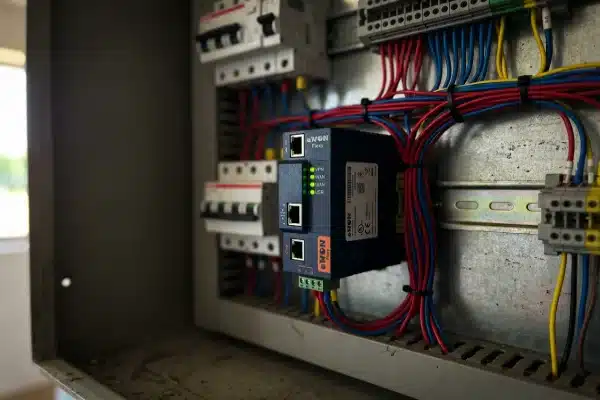
In 2025, a supplier offering "24/7 support" via WhatsApp or email is not enough. True industrial support requires a hardwired connection to the machine’s brain. When we design our electrical cabinets, we integrate VPN-tunneling modules (such as eWON or Secomea).
VPN-tunneling modules 3
This technology allows engineers to "remote in" to the PLC and HMI securely. We can see exactly which sensor is failing, reset a servo drive error, or patch a line of code without leaving our office. For you, this means the difference between a 30-minute stop and a 5-day outage while waiting for a visa and a flight.
Defining the Service Level Agreement (SLA)
Vague promises like "prompt service" are unenforceable. Your purchase contract should explicitly define SLAs. A strong SLA categorizes issues by severity and assigns a specific time limit for the supplier’s response.
If a supplier is confident in their machinery, they will agree to these terms. If they hesitate, it often indicates they lack the engineering depth to support their exports.
The "Software Hostage" Risk
A critical but often overlooked aspect of support is access to the machine’s logic. Many manufacturers lock their PLC code to prevent competitors from copying it. However, this creates a "hostage" situation for you. If the manufacturer goes bankrupt or you have a dispute, you are left with a "bricked" machine that cannot be modified or repaired.
Recommendation: Negotiate for "Unlocked" administrative access to the PLC or an escrow arrangement where the source code is held by a third party. At the very least, ensure you have the right to modify the HMI recipe parameters without a password.
Evaluating Support Tiers
When comparing quotes, ask the supplier to fill out their commitment level based on this matrix:
| Support Tier | Critical Response Time | Remote Access Capability | Engineering Cost |
|---|---|---|---|
| Basic (Avoid) | "Next Business Day" | Phone/Email only. | $150/hour + Travel. |
| Standard | < 12 Hours | Screen sharing (TeamViewer). | Included in Warranty. |
| Professional | < 4 Hours | Direct VPN to PLC/Servo. | Lifetime Free Remote Diag. |
How can I ensure the machine complies with my local safety regulations and CE standards?
Exporting to Europe and North America has taught us that safety stickers are not enough to pass an audit. You risk heavy fines or an immediate factory shutdown if local inspectors find non-compliant electrical panels or unguarded pinch points.
A CE Mark is often a self-declaration and insufficient for OSHA compliance in the USA. You must verify that critical components are Listed by an NRTL like UL or ETL, or budget for a Third-Party Field Evaluation. For Europe, validate the Declaration of Conformity against specific machinery directives.

The CE Self-Declaration Trap
For our European clients, the "CE" mark is the standard. However, many buyers do not realize that for most industrial machinery, CE is a "Self-Declaration." This means the manufacturer simply signs a paper stating they comply. There is no third-party police force checking every machine leaving China or Italy.
To protect yourself, ask to see the Technical File. You don’t need the whole file, but ask for the "Table of Contents" of their Technical File and the "Risk Assessment" document (based on ISO 12100). If a supplier cannot produce these quickly, their CE mark is likely just a sticker they bought online.
The US Market Reality: CE $\neq$ OSHA
We frequently see US plant managers assume that a CE-marked machine is safe for their facility. This is a dangerous misconception. In the United States, OSHA inspectors look for "NRTL Listing" (National Recognized Testing Laboratory), such as UL, ETL, or CSA.
Most imported machines (from Europe or Asia) do not carry a full machine UL listing because it is prohibitively expensive for custom equipment. Instead, you must ensure:
- Component Listing: The breaker, contactors, and wires inside the cabinet must have the UL logo.
- Field Evaluation: You may need to hire a local inspector to perform a "Field Labeling" service.
Budget Tip: If you are importing to the US, set aside $5,000–$10,000 for this local field certification. Do not expect the foreign manufacturer to cover this unless it was explicitly in the contract.
Safety Logic and Interlocks
Beyond the paperwork, the physical logic of the safety system is paramount. Modern safety standards (like ISO 13849-1) require "Redundancy." This means if one safety switch fails, the machine must still stop.
When inspecting a machine or reviewing a schematic, look for "Safety Relays" or a "Safety PLC" (often yellow or red modules). If the emergency stop button is wired directly to a standard PLC input, the machine is not compliant with current Western safety standards. A standard PLC can crash or freeze; a Safety PLC is designed to fail-safe.
Critical Safety Documentation to Request
- Declaration of Conformity (DoC): Must reference the Machinery Directive 2006/42/EC.
- Electrical Schematics: Must verify wire sizing and color coding standards (e.g., NFPA 79 for the US, IEC 60204 for Europe).
- Pneumatic/Hydraulic Diagrams: To ensure zero-energy states can be achieved during maintenance (Lockout/Tagout).
What are the best practices for evaluating a supplier’s spare parts inventory and shipping speed?
We advise every client to stock a "Crash Kit" because we know that global shipping delays can kill your profit margins. You cannot afford to wait weeks for a proprietary valve or a unique sensor that stops your entire production line.
Scrutinize the Bill of Materials to ensure critical components use global brands like Siemens or Parker rather than rebranded OEM parts. Additionally, require a digital inventory audit and contractually stipulated shipping speeds for "A-list" critical items to prevent being held hostage by long manufacturing lead times during outages.

The Proprietary Parts Trap
Some manufacturers use a "Razor and Blade" business model. They sell the machine cheaply but use proprietary or "re-branded" components. They might scratch off the part number on a hydraulic valve or use a custom-made circuit board that only they can supply.
global shipping delays 4
When that part fails in five years, you are held hostage. You have to pay their price and wait for their shipping timeline.
Siemens 5
The Solution: During the quotation phase, demand a detailed Bill of Materials (BOM) with the original component brands. Ensure that the PLC, HMI, Servo Drives, Hydraulics, and Pneumatics are from globally available brands like:
- Controls: Siemens, B&R, Beckhoff, Omron.
- Hydraulics: Rexroth, Parker, Yuken.
- Pneumatics: Festo, SMC.
If a component is listed as "Generic" or "Manufacturer Brand," demand a global alternative.
Lockout/Tagout 6
The "Crash Kit" Strategy
Do not rely on the supplier’s warehouse. We recommend purchasing a "Crash Kit" alongside the machine. This kit should contain the parts that are most likely to fail or are critical to operation. Including this in the initial capital expenditure (CapEx) is often easier than getting approval for emergency maintenance funds later.
NFPA 79 7
Spare Parts Availability Audit
Before you sign the contract, ask the supplier for their "A-List" of spare parts. These are the high-value, long-lead-time items (like the Parison Controller or Main Servo Motor).
Machinery Directive 2006/42/EC 8
Ask them: "Do you have these in stock right now?"
If they say no, or if the lead time is 8 weeks, you have identified a major risk. Negotiate a clause that requires them to keep specific critical parts in stock at their facility for your specific machine model.
NRTL 9
Recommended Spare Parts Tier List
Use this table to build your initial spare parts order.
| Priority Level | Description | Example Components | Action |
|---|---|---|---|
| Tier 1 (Consumables) | Parts that wear out regularly. | Heater bands, thermocouples, blow pins, cutting knives. | Stock On-Site (100%) |
| Tier 2 (Critical) | Electronic/Hydraulic parts that stop the machine. | Servo drives, PLC CPU, Solenoid valves, SSRs. | Stock On-Site (1 set) |
| Tier 3 (Long Lead) | Heavy items that rarely fail but take months to replace. | Hydraulic pump, Extruder screw/barrel, Gearbox. | Audit Supplier Stock |
Conclusion
Evaluating a blow molding partner requires looking beyond the price tag. By validating capacity via FAT, securing remote technical support, auditing safety compliance, and ensuring open-source spare parts, you mitigate the hidden risks of global sourcing.
ISO 12100 10
Footnotes
- Provides a general definition of the validation protocol mentioned. ↩︎
- Authoritative industry resource defining the efficiency calculation method. ↩︎
- Product documentation for the specific remote access technology described. ↩︎
- Academic source (MIT) providing context on supply chain logistics. ↩︎
- Major manufacturer site validating the global brand requirement. ↩︎
- Official NIOSH/CDC guide on hazardous energy control procedures. ↩︎
- Links to the specific electrical standard mentioned for US compliance. ↩︎
- Official European Commission page regarding the cited regulation. ↩︎
- Official government page explaining the testing laboratory requirements. ↩︎
- Links to the official international standard for machinery risk assessment. ↩︎


0 Comments