
"# How Can You Verify ""Maintenance-Free"" Claims for All-Electric Blow Molding Machines?
<p style=""float: right; margin-left: 15px; margin-bottom: 15px;"">
<img src="https://lekamachine.com/wp-content/uploads/2025/11/milk-bottle-production3.jpg" alt=""Technician inspecting an all-electric blow molding machine cabinet"" class=""top-image-square"">
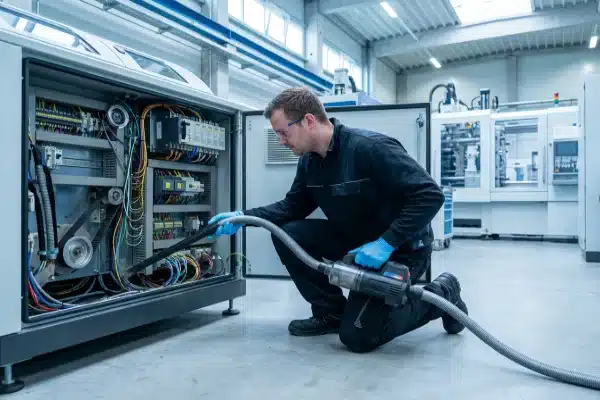
At our facility in Shantou, we often see customers’ eyes light up when they hear the term ""maintenance-free."" It is a powerful selling point for all-electric machinery, especially for factory owners tired of leaking hydraulic oil. However, when we sit down to discuss long-term operations, we have to be honest: ""maintenance-free"" is rarely absolute. If you believe the machine requires zero attention, you risk unexpected downtime. The reality is that while the dirty work decreases, the need for precision monitoring increases.
To verify ""maintenance-free"" claims, you must demand the B10 life calculation for ball screws and confirm if servo encoders use battery-less technology. While electric machines eliminate hydraulic oil changes, you must still strictly maintain grease lubrication intervals, check cabinet air filters, and monitor cooling water quality to prevent premature component failure.
Let’s dig into the technical details so you can ask the right questions and understand exactly what ""low maintenance"" really entails.
Which specific components truly require zero maintenance versus low maintenance?
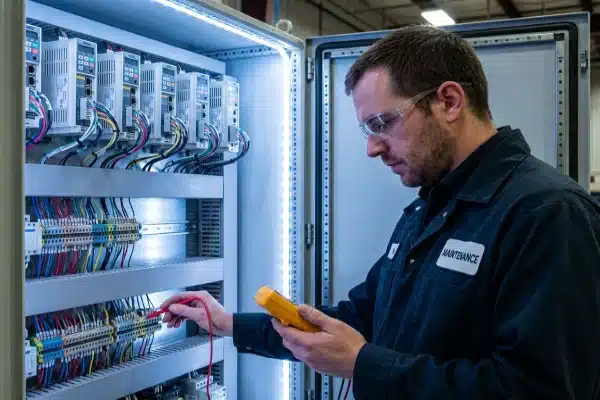
When we design our electric series, we try to eliminate as many wear points as possible, but we know that physics still applies to moving parts. We frequently advise our clients to look past the marketing brochure and look inside the electrical cabinet. The absence of hydraulics doesn’t mean the absence of heat or friction; it just moves the maintenance burden from the pump room to the control cabinet.
True zero-maintenance components in modern electric machines include direct-drive servo motors with sealed bearings and battery-less absolute encoders. Conversely, low-maintenance parts like linear guides, ball screws, and electrical cabinet filters still require automated greasing verification and regular cleaning to maintain precision and prevent expensive electronic overheating.

To truly verify a supplier’s claims, you need to categorize components into ""Install and Forget"" versus ""Monitor and Clean."" A major blind spot we see involves the cooling of the electrical cabinet.
The Cabinet Air Filter ""Critical Path""
In a hydraulic machine, the oil cooler is critical. In an all-electric machine, the electrical cabinet air filter takes its place as the single most critical maintenance item. Electric drives generate significant heat. If the supplier claims the machine is maintenance-free, ask them about the cabinet cooling design.
If the filters clog with dust, the internal temperature rises. This causes the expensive servo amplifiers to overheat and fail—sometimes within hours of a blockage. A truly robust design will include differential pressure sensors that trigger an alarm on the HMI when airflow is restricted. If the machine relies solely on you remembering to vacuum the filters without any sensors, it is not maintenance-free; it is a high-risk liability.
Water System Bio-Fouling
Users often assume ""oil-free"" means ""fluid-free."" This is incorrect. The extruder feed throat and the mold still require chilled water. Since electric drives cannot mechanically compensate for the friction caused by poor cooling, the water circuit is vital. You must treat the water to prevent bio-fouling and scale. We recommend asking if the machine includes flow meters with ""low-flow"" alarms. These sensors detect calcification buildup inside the cooling channels before it affects your bottle cycle time.
Regenerative Resistor Degradation
Electric machines are efficient because they regenerate energy during braking. This energy is often dumped into regenerative resistors. These components endure extreme thermal cycling—heating up and cooling down thousands of times a day. They are not immortal. You should verify that the maintenance schedule includes an annual check of their resistance values (Ohms). If a resistor degrades and opens the circuit, your drive will fault during high-speed deceleration, stopping production instantly.
Component Maintenance Reality Table
| Компонент | Marketing Claim | Actual Maintenance Reality |
|---|---|---|
| Servo Drives | ""Maintenance Free"" | Low Maintenance: Requires air filter cleaning and firmare updates. |
| Ball Screws | ""Lubricated for Life"" | Low Maintenance: Requires auto-lube monitoring and life calculation checks. |
| Cooling Water | ""Set and Forget"" | Medium Maintenance: Requires biocides, descaling, and flow monitoring. |
| Regenerative Resistors | Ignored | Periodic Check: Annual resistance testing to prevent drive faults. |
Do the servo motors need regular greasing or bearing replacements?
We use high-end servos in our production lines, and we know that ""sealed"" usually means sealed against dust, not necessarily against time. When a supplier tells you their motors never need touching, we suggest you ask about the batteries. It sounds trivial, but dead encoder batteries are one of the most frustrating causes of downtime we witness in the field.
Modern AC servo motors typically feature sealed bearings that do not require regreasing for their operational life. However, if the motor utilizes a friction holding brake on vertical axes, you must periodically check the brake gap and torque holding capability, as this mechanical component eventually wears out and requires replacement.
Let’s break down the motor assembly into its three critical sub-systems to see where the maintenance work actually hides.
The Absolute Encoder Battery Dependency
The servo motor itself is robust, but the position encoder attached to the back is the brain. Many standard encoders rely on a backup lithium battery to remember the machine’s ""zero position"" when the power is off.
If the supplier claims the machine is maintenance-free, explicitly ask: ""Do you use battery-less multi-turn encoders?""
- If Yes: Excellent. This is truly maintenance-free.
- If No: You have a maintenance task. You must schedule annual battery replacements. If you forget, and the battery dies during a holiday shutdown, the machine loses its position data. You will spend hours recalibrating the machine before you can blow a single bottle.
Servo ""Holding Brake"" Wear Gap
On an extrusion blow molding machine, the die head moves vertically. This axis requires a servo motor with an internal friction brake to prevent the heavy head from dropping when gravity takes over during a power cut.
Unlike the magnetic motor windings, this brake is a mechanical wear part. It uses friction discs. Over time, these discs wear down. A conscientious maintenance plan includes a procedure to measure the ""brake air gap"" or test the holding torque annually. If this is ignored, one day the power will cut, the brake will slip, and the die head could crash into the mold, causing massive damage.
oil-impregnated bronze bushings 1
Firmware Lifecycle Management
Hardware maintenance is often replaced by software maintenance in electric machines. We advise checking the supplier’s policy on drive firmware updates. If a servo drive fails five years from now, buying a new one might not be enough. The new drive might have newer firmware that doesn’t talk to your old PLC. This forces a ""simple"" part swap to become a costly engineering service call.
How does the absence of hydraulic oil change the preventive maintenance schedule?
When we help clients transition from hydraulic to electric, the first thing they celebrate is the elimination of oil drums. It is a great feeling. But at our factory, we emphasize that the maintenance schedule doesn’t disappear; it transforms. You are trading a wrench and a rag for a multimeter and a vacuum cleaner.
statistical calculation 2
Eliminating hydraulic oil removes the need for fluid analysis, filter changes, and leak management, reducing annual maintenance hours by approximately 40%. The schedule shifts focus toward electrical preventative maintenance, such as retightening terminal connections, vacuuming conductive dust from cabinets, and verifying software backups.

The nature of the debris and wear changes significantly when you go electric. You are no longer fighting sludge; you are fighting dust and chemical reactions.
chemically react 4
Timing Belt ""Conductive Dust"" Management
Electric drives often use heavy-duty timing belts to transfer torque to the mold clamping system. While these belts are clean compared to oil, they generate black rubber dust as they wear.
This dust is problematic because it can be conductive. If it accumulates inside the machine guard and gets sucked into the electrical cabinet or sensor arrays, it can cause short circuits.
- The Check: Ask the supplier about the ""belt tensioning interval.""
- The Design: Verify if the machine guards are designed for easy vacuuming. ""Maintenance-free"" becomes a nightmare if you have to dismantle the whole machine just to vacuum out rubber dust.
Automatic Grease ""Soap"" Compatibility
""Maintenance-free"" usually implies an automatic lubrication pump is handling the greasing. However, this creates a hidden risk: Grease Compatibility.
You must strictly verify the thickener type (e.g., Lithium vs. Polyurea) of the factory grease. If your maintenance team refills the auto-lube reservoir with an incompatible grease type, the mixture can chemically react and harden into a ""soap."" This solid block will clog the lines and starve the ball screws and bearings. The machine will scream ""maintenance-free"" right up until the ball screw seizes.
Maintenance Shift: Hydraulic vs. Electric
| Maintenance Category | Hydraulic Machine | Electric Machine |
|---|---|---|
| Primary Fluid | Hydraulic Oil (Change & Filter) | Cooling Water (Descaling & Biocide) |
| Power Transmission | Hoses & Valves (Leak check) | Belts & Screws (Dust & Lube check) |
| Critical Failure | Pump Failure / Seal Leak | Amplifier Overheat / Belt Snap |
| Чистота | Oil drips, sludge | Rubber dust, fan dust |
| Tools Required | Wrenches, Oil gauges | Multimeter, Laptop, Vacuum |
Can the supplier provide a list of wear parts that still need periodic changing?
We believe transparency is the foundation of a good partnership. When we ship a machine, we want the customer to know exactly what will fail and when. If a supplier hesitates to give you a wear parts list because they want to maintain the ""maintenance-free"" illusion, that is a red flag. You need to know what to stock on your shelf.
conductive dust 5
A credible supplier must provide a detailed Bill of Materials (BOM) for wear parts, including specific lifespans for heater bands, toggle bushings, and timing belts. Requesting this list upfront allows you to calculate the Total Cost of Ownership (TCO) and exposes hidden proprietary parts that may be expensive to source later.
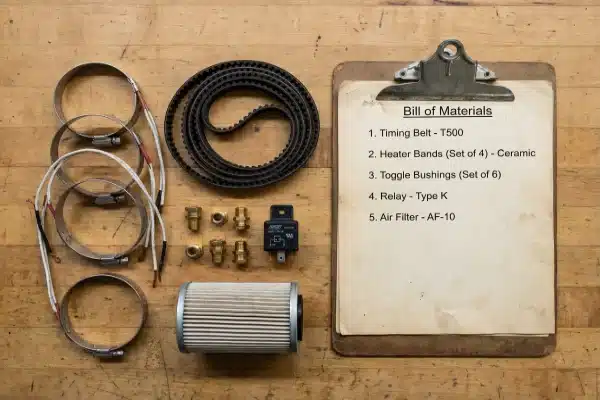
To protect your investment, you need to challenge the supplier with specific requests regarding component life and design limits.
extreme thermal cycling 7
The ""B10 Life"" Documentation Requirement
Do not accept a verbal guarantee that a ball screw is maintenance-free. Challenge the claim by strictly demanding the B10 Life Calculation.
In engineering, this is a statistical calculation that predicts the time at which 10% of a batch of ball screws will fail due to metal fatigue. A credible supplier will be able to show you a calculation (e.g., ""25,000 hours at 80% load""). This proves that their definition of ""maintenance-free"" is based on engineering limits, not marketing fluff. It tells you exactly when you should budget for a refurbishment.
prevent bio-fouling 8
Toggle Linkage ""Dry Run"" Vulnerability
Even on electric machines, the toggle clamp mechanism moves millions of times. It needs lubrication. You must verify if the system uses ""oil-impregnated"" bronze bushings or standard steel bushings.
- Oil-impregnated bushings: These are truly low maintenance and can run safely even if the auto-lube system fails briefly.
- Standard steel bushings: These rely entirely on the auto-lube pump. If a single grease injector blocks, the bushing runs dry and seizes the machine. In this design, the ""maintenance-free"" auto-lube system is actually a single point of failure.
Essential Wear Parts Checklist
| Part Name | Функция | Обычная продолжительность жизни | Warning Sign |
|---|---|---|---|
| Timing Belts | Transfers motor torque | 3 – 5 Years | Cracking, fraying edges, excessive black dust |
| Toggle Bushings | Clamping movement pivot | 5 – 7 Years | Squeaking, play in the mold closing |
| Heater Bands | Melts the plastic | 1 – 2 Years | Slow heating, cold spots in the parison |
| Relays/Contactors | Switches high power | 1 – 3 Million Cycles | Sticking, buzzing noise, burnt smell |
| Fan Filters | Cools the electronics | Clean Monthly | High drive temperature alarms |
Заключение
To summarize, ""maintenance-free"" in electric blow molding really means ""oil-free."" You must still verify battery-less encoders, monitor cabinet cooling, and strictly manage grease compatibility to ensure long-term reliability.
internal temperature rises 9
—"
Сноски
- General background information on self-lubricating bearing materials. ↩︎
- Defines the international standard for rolling bearing life calculations. ↩︎
- Government resources on lifecycle costing and economic analysis. ↩︎
- Provides technical data on grease thickener compatibility and risks. ↩︎
- Government safety information regarding industrial dust hazards. ↩︎
- Explains the technology behind battery-less absolute encoders in servos. ↩︎
- Research on the effects of thermal cycling on power resistors. ↩︎
- Official guidance on managing water quality in cooling systems. ↩︎
- Manufacturer documentation on electrical cabinet climate control solutions. ↩︎
- Educational resource explaining the fundamental physics of AC motors. ↩︎


0 Комментариев