
How can I protect my intellectual property when buying an all-electric blow molding machine?

At our factory, we know your bottle design is your competitive edge. Worrying about leaks during machine validation is natural, but unchecked risks can destroy your market advantage.
To protect your intellectual property, enforce a strict Non-Disclosure Agreement covering mold cooling layouts and cycle times, not just bottle aesthetics. Crucially, require contract clauses for "Patent Indemnity" and "Process Recipe" ownership, ensuring your unique electric machine settings remain trade secrets rather than public knowledge.
Let’s break down the specific legal and technical steps to secure your investment.
legal costs 1
How should I draft a Non-Disclosure Agreement for my bottle design?
When our engineering team reviews your drawings, we treat them as top secret. However, standard agreements 2 often miss the technical details that actually drive your profit margins.
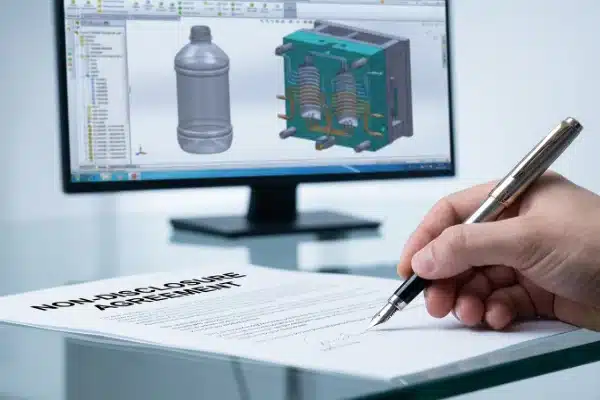
A robust Non-Disclosure Agreement must define "Confidential Information" broadly to include preform geometry, cooling channel layouts, and specific cycle time targets. Additionally, establish clear jurisdiction in a neutral location or your home country to ensure any legal judgment regarding design theft is actually enforceable.
Defining the Scope of Secrecy
Many buyers make the mistake of thinking an NDA only covers the final look of the bottle. In our experience, the "how" is often more valuable than the "what." When drafting your agreement, you must expand the definition of "Confidential Information." It is not enough to protect the JPEG of the bottle; you must protect the engineering logic behind it. This includes the preform geometry, the specific mold cooling layouts, and the cycle time targets you are aiming for. These technical specifications reveal your production economics. If a competitor knows your cooling layout, they can reverse-engineer your cost structure.
Jurisdiction and Enforcement
A contract is only as good as its enforceability. If you are buying from overseas, a judgment in your local court might be ignored by a foreign supplier. We always recommend that our clients define the "Jurisdiction and Governing Law" carefully.
- Neutral Location: Choose a jurisdiction known for fair arbitration.
- Arbitration Bodies: Require arbitration through internationally recognized bodies like the International Chamber of Commerce (ICC) or CIETAC. This ensures that if a breach occurs, the judgment is enforceable across borders.
Pre-emptive Registration
Before you even send us or any supplier a 3D file, you should register your industrial design or design patent. This establishes a "date of creation." If a leak occurs, you have irrefutable proof that the design belonged to you before the supplier ever saw it. This legal timestamp is your first line of defense.
| Компонент | Standard NDA Coverage | Required Manufacturing NDA Coverage |
|---|---|---|
| Visuals | JPG/PDF of the final bottle | 3D CAD files (STEP/IGES) & Preform drawings |
| Производительность | Нет | Cycle time targets & Weight tolerances |
| Оснастка (инструментальная оснастка) | Нет | Cooling channel mapping & venting logic |
| Economics | Pricing | Projected output rates & material costs |
What due diligence prevents patent infringement risks?
We often see buyers focus solely on machine output, ignoring legal risks. Without proper checks, you might accidentally import technology that violates local patents in your region.
aseptic filling methods 4
Perform a "Freedom to Operate" (FTO) search to ensure specific machine features do not violate local process patents. Furthermore, include a "Patent Indemnity" clause in your contract, requiring the manufacturer to cover legal costs if their equipment design infringes on third-party intellectual property rights.

reverse-engineer your cost structure 5
The "Freedom to Operate" Check
You might assume that because a machine is sold globally, it is legal everywhere. This is a dangerous misconception. A manufacturer’s patent in their home country does not protect you in your sales region. We advise conducting a "Freedom to Operate" (FTO) search specific to your market (e.g., US, EU, or Australia). You need to verify that unique features—such as specific aseptic filling methods or in-mold labeling mechanisms—do not violate process patents held by your local competitors. If you skip this, you could face a cease-and-desist order effectively shutting down your production line.
The Indemnity Safety Net
You cannot possibly audit every toggle mechanism or servo drive design yourself. That is why the contract must shift this burden to the supplier. You must include a "Patent Indemnity" clause.
- What it does: It guarantees that the equipment design does not infringe on third-party patents.
- Результат: If you are sued for using the machine, the manufacturer agrees to cover all legal costs and damages. Without this, you are financially exposed to lawsuits caused by your supplier’s engineering choices.
Sub-tier Liability
Machine builders rarely make every part in-house. We often outsource test mold fabrication or specialized components. However, those third-party vendors are not automatically bound by your NDA. You must enforce "Sub-tier Flow-down" liability. This means the primary machine builder is contractually liable for any leaks caused by their outsourced vendors. If the mold shop leaks your design, the machine builder pays. This forces the builder to be extremely rigorous with their own supply chain security.
How do I secure my process recipes and production data?
On our all-electric platforms, we fine-tune servo curves 6 to shave milliseconds off cycle times. This data is valuable, and you must prevent competitors from accessing it.
Classify your "Process Recipe," including parison profiles and servo velocity curves, as a protected Trade Secret within your contract. Implement a "Digital Air Gap" for remote maintenance to prevent the manufacturer from harvesting your production volume data or cycle counts via IIoT connections.

Industrial Internet of Things 7
Recipes are Intellectual Property
On an all-electric extrusion blow molding machine, the "recipe" is far more precise than on hydraulic machines. The specific 100-point parison profile, the servo clamping velocity curves, and the heating profiles constitute high-value IP. These settings are what allow you to save 3% on resin or run 10% faster than the competition. You must classify these "Process Recipes" as Trade Secrets in your contract. If a competitor buys the same machine, they should not get your optimized settings pre-loaded as a "standard" configuration.
The Remote Access Trap
Modern machines come with IIoT (Industrial Internet of Things) capabilities for remote troubleshooting. While useful, this creates a vulnerability. If we can see your machine status, we can potentially see your total cycle counts and reject rates.
- Риск: A supplier could aggregate this data to analyze your market volume or sell market intelligence to competitors.
- The Solution: Mandate a "Digital Air Gap" or strict permission protocols. The machine should not be permanently connected to the supplier’s cloud. Remote access should be a "key-turn" event—enabled only when you request support and disabled immediately after.
Protecting the "Soft" Assets
Hardware is easy to see, but software settings are easy to steal. By legally defining your specific machine parameters as trade secrets, you prevent the supplier from using your hard-won optimization data as a selling point for other customers.
| Data Type | Risk Level | Protection Strategy |
|---|---|---|
| Parison Profile | Высокий | Define as "Trade Secret" in contract |
| Cycle Counts | Средний | Disable permanent cloud reporting |
| Reject Rates | Высокий | Restrict remote access permissions |
| Servo Curves | Высокий | Prohibit replication on other machines |
Can I require the destruction of trial molds and prevent marketing leaks?
We love showcasing successful projects, but we respect your launch timeline more. Uncontrolled samples or premature social media posts can alert your competitors before you even ship products.
International Chamber of Commerce 8
Stipulate in your purchase contract that all trial molds and FAT samples must be shipped to you or destroyed with a signed "Certificate of Destruction." Additionally, enforce a "marketing blackout" clause prohibiting the supplier from using your machine photos or product samples in their promotional materials.

Managing the FAT Cleanup
During the Factory Acceptance Test (FAT), we produce hundreds of "start-up" bottles to prove the machine works. These bottles are physical evidence of your new product. If left at the factory, they might end up in a showroom or, worse, a competitor’s hands.
- Contract Requirement: Explicitly state that every trial mold, flash sample, and bottle produced must be accounted for.
- Действие: They must either be shipped to your facility or destroyed.
- Verification: If destroyed, it must be done in the presence of your representative or recorded on video, followed by a signed "Certificate of Destruction."
The Marketing Blackout
Manufacturers are eager to prove their capabilities. It is common practice to take photos of a machine on the shop floor to post on LinkedIn or WeChat. "Look at this high-speed line we just built!" inadvertently reveals your capacity and launch plans. You must include a "marketing blackout" clause. This strictly prohibits the supplier from using photos of your machine, mold, or produced samples in brochures, trade show videos, or website case studies without written permission.
Why Critical Thinking Matters Here
You must assume that anything left behind is public. By enforcing these physical cleanup protocols, you close the loop on IP protection. It is not just about documents; it is about the physical artifacts of the manufacturing process. A scrap bottle in a trash bin at the supplier’s factory is a leak waiting to happen.
Заключение
Protecting IP requires legal precision and technical safeguards. By controlling data, contracts, and physical samples, you secure your market advantage before the machine ever arrives.
industrial design 10
Сноски
- News coverage of legal disputes and the financial impact of litigation in industrial sectors. ↩︎
- Official government guidance on the legal framework and use of NDAs. ↩︎
- General overview of trade secret protection for proprietary manufacturing processes and recipes. ↩︎
- Example of advanced filling technology from a major industry leader in blow molding. ↩︎
- Academic legal analysis of reverse engineering and its implications for trade secret law. ↩︎
- Technical documentation regarding the optimization of servo drive performance in industrial machinery. ↩︎
- ISO standards committee focusing on IoT and digital twin technologies in industrial settings. ↩︎
- Authoritative body for international arbitration and dispute resolution in commercial contracts. ↩︎
- Official guidance on filing design patents to protect the visual appearance of products. ↩︎
- Explains the concept of industrial design as a form of intellectual property. ↩︎


0 Комментариев