
 independent glass linear scales 1 linear scale and servo following error check (ID#1)” class=”top-image-square”>
When we design our machine frames and select servo components at the factory, we often see competitors claiming "precision" without the hardware to back it up PLC Scan Time 2. You might worry that investing in an all-electric machine won't yield the tight tolerances promised in the brochure. High-precision molding isn't magic; it is the result of specific engineering choices and verifiable metrics Gauge R&R 3.
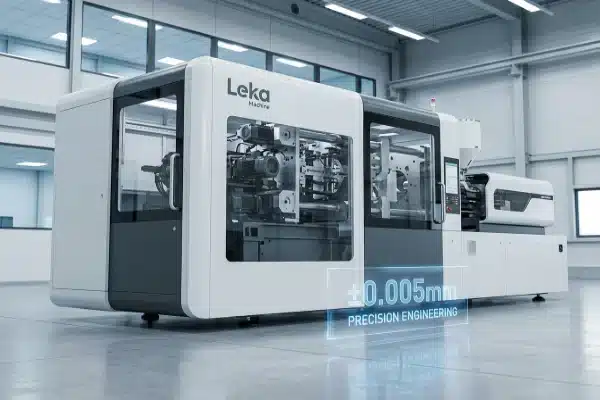
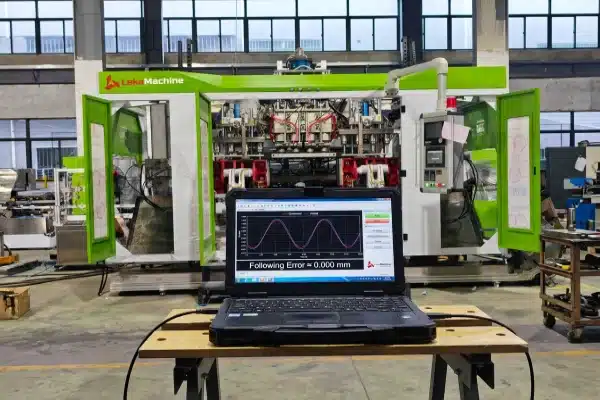
To determine micron-level repeatability, do not rely on standard motor encoders; instead, verify the machine uses independent glass linear scales on the platen to close the position loop. Additionally, inspect the servo drive’s "Following Error" logs to ensure the gap between the command and actual position remains near zero during motion.
True precision requires digging past the sales pitch Cg/Cgk study 4. You must look at the control architecture, the mechanical linkages, and specific validation tests.
What is the resolution of the linear transducers used for clamp positioning?
In our experience upgrading customers from hydraulic to all-electric systems, we find that many buyers confuse motor resolution with actual linear resolution S-Curve (Jerk Limited) 5. When we calibrate our machines, we know that relying solely on the motor's internal encoder is a mistake. This only tells you where the motor is, not necessarily where the mold platen mounted directly on the moving platen 6 is.
You must distinguish between "Motor Encoder" resolution and "Linear Scale" resolution. A true micron-level machine utilizes independent glass linear scales (like Heidenhain or Gefran) mounted directly on the moving platen. This bypasses mechanical backlash, belt stretch, and thermal expansion, providing feedback on the actual load position rather than just the motor rotation.
The Deception of Rotary Encoders
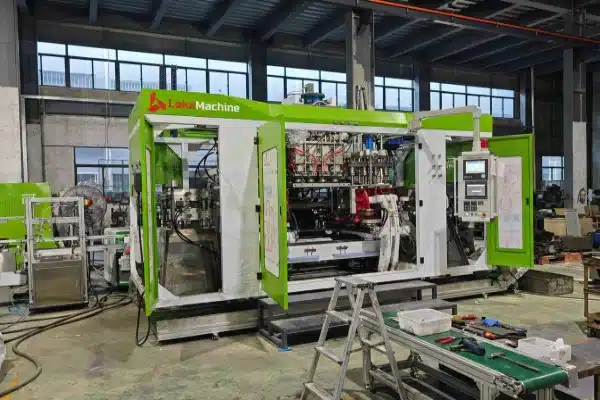
If a supplier tells you their precision comes from the servo motor's encoder alone, be skeptical. A motor might have a high-resolution encoder (e.g., 20-bit), but it connects to the mold platen via belts, ball screws, and couplings metal bellows couplings 7. Every mechanical link introduces error.
- Belt Stretch: Under heavy clamping force, belts can stretch slightly.
- Thermal Expansion: As the ball screw heats up, it lengthens.
If the system only reads the motor angle, it assumes the mold is in the right spot. In reality, the mold might be off by 50 microns due to these mechanical variables. At our facility, we insist on "closing the loop" using Glass Linear Scales. These are rulers mounted directly on the carriage. They tell the controller exactly where the steel is, ignoring the motor's theoretical position.
The Critical Role of PLC Scan Time
Resolution is useless if the brain of the machine is too slow to process it. Micron precision requires sub-millisecond reactions. You should verify the PLC Scan Time (often related to the EtherCAT or Profinet cycle time).
If the controller communicates with the drive every 4ms or 10ms, the machine is effectively moving "blind" for several millimeters between commands. For micron-level repeatability, the scan time must be 1ms or less. This ensures the servo drive receives updates fast enough to correct micro-deviations instantly.
Comparison: Open Loop vs. Closed Loop Feedback
| Характеристика | Motor Encoder Only (Standard) | Linear Scale Feedback (Precision) |
|---|---|---|
| Measurement Point | Rear of the servo motor | Directly on the moving platen |
| Backlash Error | Ignored (Controller doesn't see it) | Detected and Corrected |
| Thermal Error | Unaccounted for | Compensated automatically |
| Typical Accuracy | +/- 0.05 mm | +/- 0.005 mm (Micron Level) |
How do you measure and certify the platen position repeatability?
When we conduct final testing on our assembly floor, simply hitting a position target once is not enough. We need statistical proof. Many manufacturers will show you a video of the machine closing properly, but that does not prove stability. You need to separate the machine's inherent capability from operator skill or environmental luck.
Demand a formal "Gauge R&R" study, specifically looking for Type-1 Gauge Repeatability (Cg/Cgk) values. During the Factory Acceptance Test (FAT), use a laser interferometer or dial indicator to isolate the machine's variation. A Cgk value greater than 1.33 is required to certify the machine is statistically "Process Capable" of micron precision.

Statistical Validation (Cg/Cgk)
Do not accept a simple "it looks good" during your FAT. You should mandate a Cg/Cgk study. This is a statistical test used in the automotive and medical industries.
- Cg (Machine Potential): Compares the spread of the machine's positioning measurements against your tolerance range.
- Cgk (Machine Capability): Checks if the measurements are clustered in the center of your target range.
We use a laser interferometer or a high-precision dial indicator for this. We move the platen to a set position 50 times. If the variation is wider than a few microns, the Cgk value drops. If the result is below 1.33, the machine physically cannot hold the tolerances you need for high-end production, regardless of how good the operator is.
The Dead Stop Stress Test
Another practical method we use to stress-test the mechanical frame is the Dead Stop Load Test. Run the clamp to a specific position against a load cell or a hard stop. Repeat this 50 times.
A machine with a weak frame or poor servo tuning will show "creep." This means the position value changes slightly as mechanical components flex or slip. A true micron-level machine will hit the exact same force and position value (within ±1 micron) every single time. This proves the mechanical rigidity matches the electrical precision.
Motion Profiling: The S-Curve
Finally, check the software settings for S-Curve (Jerk Limited) acceleration. Cheaper controllers use Trapezoidal ramps—they start and stop abruptly. This causes a "jolt" or vibration (ringing) when the heavy platen stops.
S-Curves smooth out the acceleration and deceleration. This prevents the mechanical vibration that causes the platen to "dither" or oscillate around the target point. Without S-Curves, you might get to the position, but the mold will vibrate microscopically, affecting the bottle finish.
| Метрика | What it Measures | Acceptable Target |
|---|---|---|
| Cgk Value | Statistical Repeatability | > 1.33 |
| Dead Stop Variance | Mechanical Rigidity | < 1 Micron change |
| Motion Profile | Vibration Control | S-Curve (Not Trapezoid) |
Can we test the parison wall thickness control accuracy during the FAT?
In our engineering department, we focus heavily on the parison controller because this is where raw material money is saved or lost. A machine can clamp perfectly, but if the parison thickness fluctuates, you will have waste. We often see buyers focus on the number of profile points (100 vs. 300), but they ignore the physical speed of the actuator.
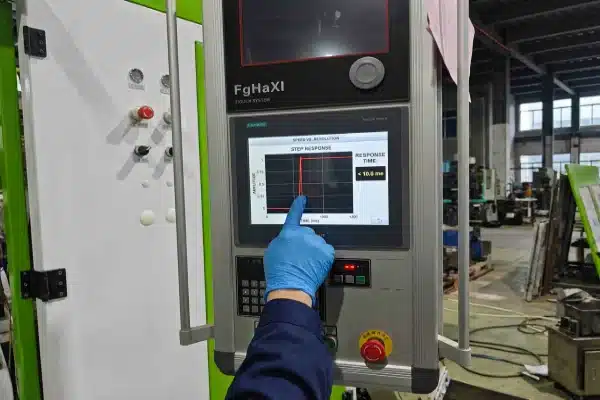
To verify wall thickness accuracy, audit the "Parison Cylinder" Step Response Time data. It implies that the servo actuator must reach 90% of its stroke in under 10ms. High point-count profiles are irrelevant if the actuator is too slow to physically execute the sharp changes required for complex bottle shapes.
Speed vs. Resolution
Imagine you program a sharp change in wall thickness to reinforce the corners of a square bottle. You have 300 points of resolution in your software. However, if the hydraulic or electric actuator is slow, it acts like a low-pass filter. It smooths out your sharp command.
You must ask for the Step Response Time. This measures how fast the cylinder moves from 0 to a set distance. If it is sluggish, your bottle corners will be thin even if the screen says they are thick.
Identifying Torque Ripple
There is a visual test you can perform on our machines or any competitor's machine. During the FAT, ask to mold a bottle with a completely "flat" parison profile. This means the thickness should be constant from top to bottom.
Inspect the resulting parison or bottle.
- Хороший результат: The wall is perfectly smooth.
- Неудачный результат: You see periodic horizontal waves, ribs, or lines.
These waves indicate Torque Ripple. This is instability in the parison servo motor. It means the motor cannot hold a steady position against the pressure of the molten plastic. If you see ripple, the machine cannot hold micron-level tolerances because the motor itself is oscillating.
Why "Zero-Backlash" Matters Here
For the parison shaft, mechanical connection is vital. We use metal bellows couplings or direct-drive mounts. These are rigid.
Many budget machines use elastomer (rubber spider) couplings. These rubber elements compress and rebound. When the servo motor changes direction rapidly to adjust thickness, the rubber absorbs the movement. This introduces hysteresis. You command a 10-micron change, the motor moves, but the screw doesn't move immediately because the rubber is compressing. This destroys accuracy.
Parison Control Checklist
| Компонент | Требование | Why it Matters |
|---|---|---|
| Actuator Speed | <10ms Response | Ensures sharp profile changes |
| Coupling Type | Metal Bellows | Eliminates rubber hysteresis |
| Визуальная проверка | No Periodic Waves | Confirms motor stability (No Ripple) |
Does the servo system provide feedback logs on actual position versus setpoint?
When we troubleshoot issues remotely for our clients in North America or Europe, we don't guess—we look at the data logs. A high-end servo system is transparent. It admits when it is wrong. If a supplier cannot show you a graph comparing "Commanded Position" vs. "Actual Position," they are hiding the machine's true performance.
You must analyze the "Following Error" (or Lag) graph in the servo drive software. A high-precision system maintains a following error of nearly zero throughout the entire motion profile. A sloppy system will show large spikes at acceleration and deceleration points, even if the final resting position appears correct.
The Truth in the Logs
Приверженность отрасли Following Error is the most honest metric in automation. It is the mathematical difference between where the PLC told the motor to be and where the motor actually is at that exact millisecond.
- Low Precision: The error spikes huge when the mold starts moving and when it stops. It eventually settles to zero, but the path was inaccurate.
- Micron Precision: The error line stays flat and close to zero, even during fast movements.
If you see "sawtooth" patterns or large spikes in this log, the machine is struggling to control the load.
Combating Thermal Drift
One of the biggest enemies of micron precision is heat. We know from our own production lines that ball screws expand as they work. A steel ball screw can expand 20-50 microns per meter just from friction heat.
If you start the machine cold at 8:00 AM, by 10:00 AM your "Zero Position" has physically moved.
- The Fix: Verify the machine has an active Thermal Compensation Algorithm.
- Как это работает: Temperature sensors are placed on the ball nut and bearing blocks. The controller reads the heat rise and automatically offsets the target position in real-time. Without this, your first 100 bottles might be perfect, but your noon production will be out of spec.
Checking the Logs During FAT
Do not just watch the machine move. Ask the engineer to open the servo tuning software (like drive monitor).
- Trigger a dry cycle.
- Watch the "Lag" or "Following Error" trace.
- Ask about "Thermal Compensation" settings in the HMI.
If they say "we don't have those sensors," you know you will have to manually adjust the mold settings every few hours as the machine warms up. This is not true micron repeatability.
Заключение
Determining if an all-electric blow molding machine truly reaches micron-level repeatability requires looking beyond the sales brochure. You must verify the presence of glass linear scales rather than just motor encoders and demand Cgk statistical data rather than simple demonstrations. By analyzing Following Error logs and ensuring features like Thermal Compensation , Leka Machine может предложить беспристрастное, экспертное сравнение, чтобы помочь вам принять наиболее обоснованное решение. S-Curve profiling are active, you protect your investment. True precision is measurable, stable, and transparent.
Сноски
1. Linear scales are essential for accurate position feedback in high-precision machinery. ↩︎
2. PLC scan time affects the responsiveness of the control system. ↩︎
3. Gauge R&R studies are used to assess the repeatability and reproducibility of measurement systems. ↩︎
4. Cg/Cgk studies are statistical tests to determine machine capability. ↩︎
5. S-Curve motion profiles limit jerk to reduce vibration. ↩︎
6. Heidenhain is a manufacturer of linear encoders that are mounted on moving platens. ↩︎
7. Metal bellows couplings provide rigid connections for servo motors. ↩︎


0 Комментариев