
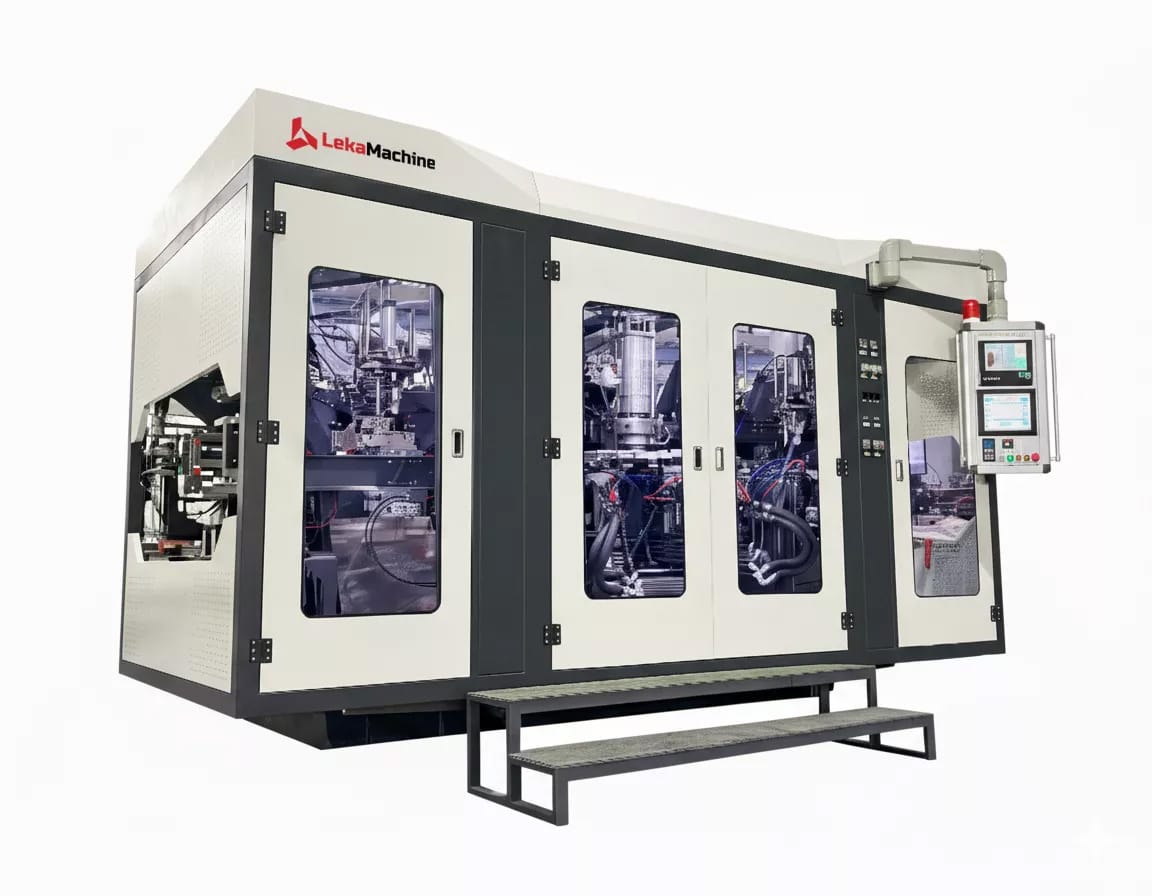
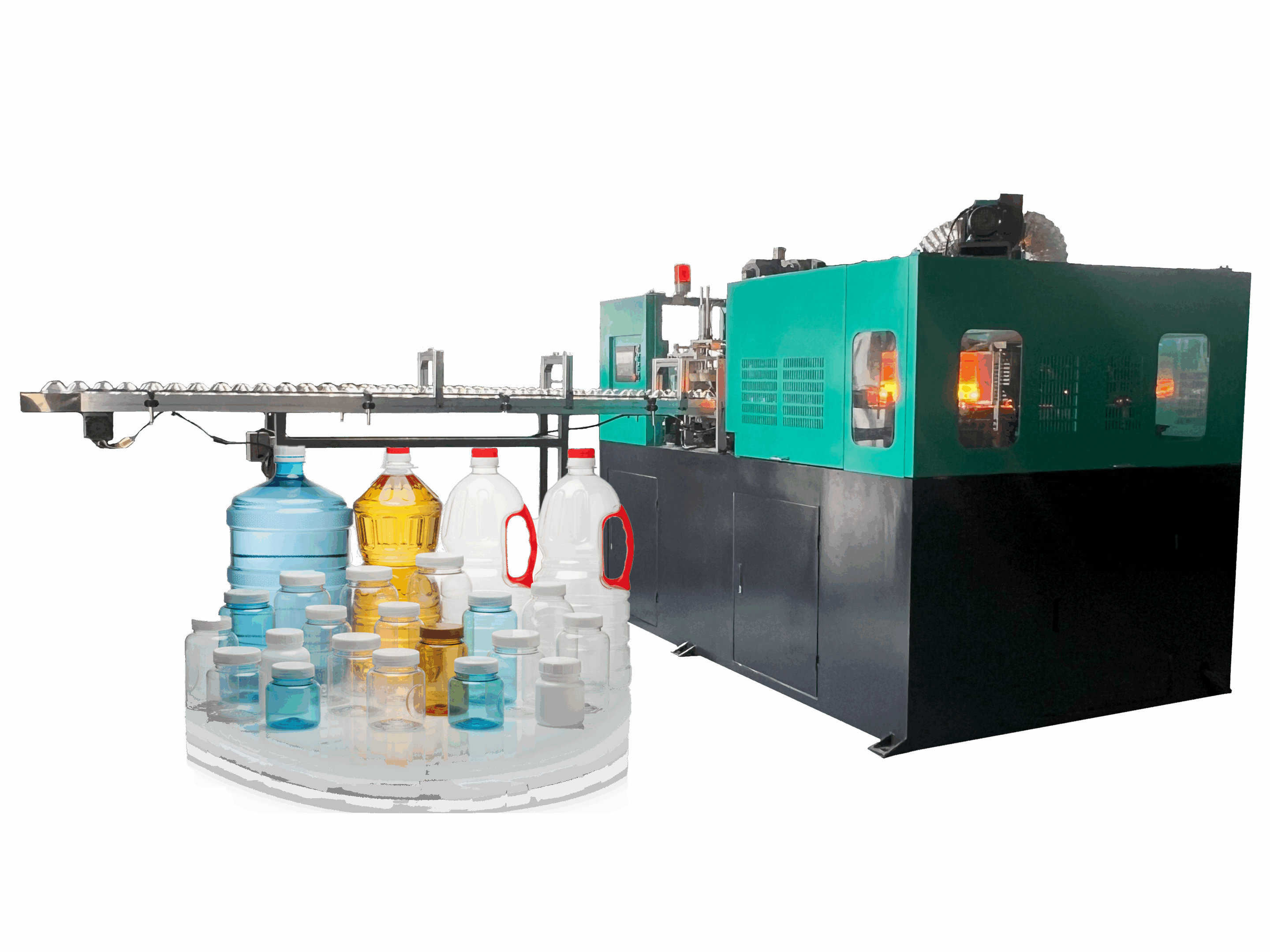
Как следует проверить стабильность работы электрической экструзионной выдувной формовочной машины ALL во время работы на высоких скоростях?
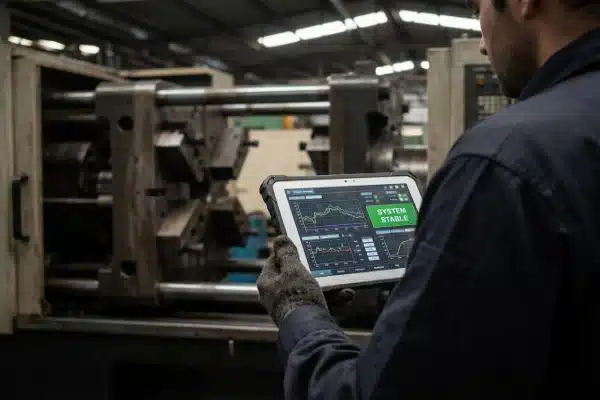
At our facility in Shantou, we frequently see clients overwhelmed by the complexity of validating new high-speed electric machinery. It is frustrating to invest in premium equipment only to face unexplained downtime or inconsistent bottle weights once production actually starts. Instead of relying on vague sales promises, you need a rigorous, data-driven testing protocol to ensure the machine can handle your specific production load.
To accurately test stability, conduct a 24-hour continuous run measuring the Euromap 46 dry cycle time, servo motor casing temperatures below 85°C, and vibration velocity under 2.5 mm/s RMS. Additionally, verify process capability (Cpk) exceeds 1.33 for bottle weight and wall thickness to ensure long-term precision.
To help you validate your next equipment purchase, here are the specific metrics and methods we use on our own floor.
What specific dry cycle times should I look for during the factory acceptance test?
When we invite clients for a Factory Acceptance Test (FAT), there is often confusion between "theoretical speed" and actual usable output. Relying on brochure numbers can lead to production bottlenecks that ruin your ROI calculations. Real-world validation requires isolating the machine’s movement speed from process variables to see its true potential.
You should measure the "Dry Cycle" strictly according to Euromap 46 standards. For competitive high-speed performance, look for confirmed times under 2.4 seconds for small-stroke machines (<10L) and under 3.8 seconds for larger platforms, ensuring the clamping movement is distinct from cooling constraints.

Understanding Euromap 46 Validation
In our engineering department, we strictly adhere to the Euromap 46 standard to define speed. This test measures the time required for the clamp to lock, open, and lock again—without the plastic cooling time. This isolates the mechanical efficiency of the servo system.
When testing, do not just use a stopwatch on a running cycle. You must inspect the machine’s internal timers or HMI logs. A high-speed electric machine should not struggle to hit these targets. If a machine requires 4.0 seconds for a small 500ml bottle stroke, it suggests the servo motors are undersized or the toggle system has high friction.
strain gauges 2
Comparison of Dry Cycle Targets
We recommend comparing your test results against these benchmarks to determine if the machine is truly "high-speed."
| Machine Platform Size | Stroke Length | Target Dry Cycle (Euromap 46) | Performance Level |
|---|---|---|---|
| Small (<5L) | 250mm – 350mm | < 2.4 Seconds | Отличная |
| Small (<5L) | 250mm – 350mm | > 3.0 Seconds | Standard/Slow |
| Medium (10L – 20L) | 450mm – 600mm | < 3.8 Seconds | Отличная |
| Medium (10L – 20L) | 450mm – 600mm | > 5.0 Seconds | Standard/Slow |
Verification of Ball Screw Thermal Compensation
High-speed cycling generates heat in the ball screws, causing them to expand physically. Without software compensation, this expansion can shift the mold closing position by 0.2mm to 0.5mm over a few hours.
During the FAT, we always ask the operator to show the "Thermal Compensation" active status in the software. Run the machine dry for 4 hours and measure the clamp position drift. A stable machine will show zero drift because the software automatically adjusts the servo home position to account for the heat expansion.
How do I measure parison thickness consistency during continuous running?
In our experience exporting to Europe and North America, nothing kills profit margins faster than high scrap rates due to uneven wall thickness. If your parison fluctuates, you waste resin and produce weak bottles. Visual inspection is not enough to catch these subtle deviations during high-speed runs; you need hard data.
vibration velocity 3
To verify consistency, utilize a 100-point parison controller to program a sharp "step-change" and check for a response time within 10–15 milliseconds. Furthermore, run an Extruder Torque Ripple test at low speeds; torque fluctuations must remain within ±2% to prevent invisible surging and ensure stable bottle weights.

Parison Programmer Response Lag
The heart of bottle quality is the parison controller. We test the 100-point controller by programming a "square wave" profile—asking the die gap to jump from 50% to 100% instantly.
We hook up an oscilloscope or use the high-speed internal data logger to view the servo valve reaction. If the reaction time is slower than 15 milliseconds, the material distribution on the bottle will drift as the machine speeds up. This "lag" means the thick part of the plastic won’t land on the bottle corner where it is needed, resulting in weak spots.
Extruder Torque Ripple Test
One critical yet often overlooked test involves running the extruder at extremely low speed (1% of max RPM). Why do we do this? Because stability at low speed predicts stability at high speed.
Monitor the motor torque or current ripple on the drive display. A high-quality servo extrusion system must show less than ±2% torque fluctuation. If you see ripples of 5% or 10%, it indicates "surging." In production, this surging causes invisible waves in the parison, leading to bottles that fluctuate in weight randomly.
Troubleshooting Parison Instability
If you detect inconsistency, use this checklist to isolate the cause:
| Симптом | Probable Cause | Test Method |
|---|---|---|
| Random Weight Changes | Torque Ripple / Surging | Run extruder at 1% speed; check Amps stability. |
| Thin Corners | Slow Servo Response | Program a sharp step-change; measure lag time. |
| Vertical Streaks | Die Head Contamination | Inspect die surface; check heater band uniformity. |
| Drifting Weight (Hourly) | Temperature Instability | Check PID heating logic; ensure <1°C deviation. |
Can the machine maintain precise servo movements without overheating over 24 hours?
We often hear from customers who bought budget machines that run perfectly for an hour but lose precision as the shift progresses. This "thermal drift" results in mold slamming and rejects. It is critical to ensure the drive system is robust enough to handle the heat of continuous maximum output.
DC Bus Voltage 5
Yes, but you must verify thermal stability by monitoring the servo motor casing temperatures using a thermal camera. During a continuous 24-hour run, temperatures must plateau below 85°C (185°F). Higher readings indicate undersized motors or poor cabinet ventilation, leading to eventual shutdown.
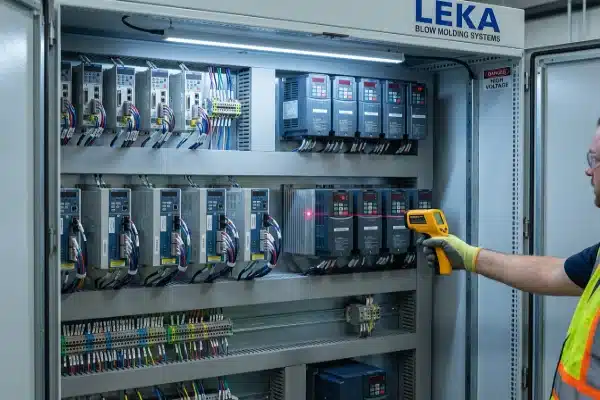
servo motor casing temperatures 6
Servo Casing Thermal Saturation
Heat is the enemy of electronics. When we validate our LEKA machines, we perform a "Thermal Saturation" test. We run the machine at maximum dry cycle speed for 24 hours.
Using a thermal camera, we monitor the casing of the clamp servo motors. The temperature should rise and then "plateau" (stabilize). If the temperature continues to climb past 85°C (185°F), the motor is undersized for the application. Overheating leads to magnet demagnetization over time, causing a permanent loss of torque and eventual machine failure.
Regenerative Energy (DC Bus) Headroom
All-electric machines act as generators when they brake. When the heavy clamp stops closing, it generates massive energy that goes back into the drive system.
We monitor the DC Bus Voltage during the fastest deceleration phase. The voltage must remain at least 10-15% below the "Overvoltage Trip" threshold. If the voltage spikes too close to the limit, the machine will trip off randomly during fast cycles. This proves whether the regenerative resistors or grid-tie modules are sufficiently sized for the job.
Following Error Limits
Access the HMI engineering page and look for a value called "Following Error" or "Position Error." This measures the difference between where the computer told the motor to be and where it actually is.
During the "lock-over" toggle phase (the hardest part of the cycle), a high-precision machine should maintain a deviation of less than 0.05mm. If the error is large, the machine is struggling to push the mold closed, which will eventually damage the toggle pins and bushings.
What vibration or noise indicators suggest instability at maximum speed?
While assembling our machines in Guangdong, we treat excessive noise as a symptom of mechanical failure, not just a nuisance. Ignoring subtle vibrations during the buying process can lead to catastrophic bearing failure and tie-bar damage later on. You need to listen to what the machine is telling you through data.
oscilloscope 7
Use a vibration meter to analyze the extruder gearbox and clamp base at maximum RPM. Stable operation requires vibration velocity below 2.5 mm/s RMS. Additionally, ensure tie-bar strain deviation is less than 5%, as high-frequency spikes or uneven strain predict structural misalignment and early wear.

Vibration Spectrum Analysis
We recommend using a vibration meter to check the extruder gearbox and clamp base while the machine runs at full speed. You are looking for two things:
- Overall Velocity: This should remain below 2.5 mm/s RMS. Higher values indicate general imbalance or looseness.
- Frequency Spikes: Look for high-frequency spikes (>3x RPM). These spikes are the "fingerprint" of bearing defects or gear mesh misalignment.
If a new machine vibrates heavily during the FAT, do not accept it. Vibration never gets better with time; it only gets worse.
heat in the ball screws 9
Tie-Bar Strain Imbalance Check
A stable chassis is defined by how evenly it distributes force. At maximum clamping force, we use strain gauges on all four tie bars.
The deviation between the four bars must be less than 5%. If one bar is taking 20% more load than the others, the platen is not parallel. This will cause the mold to wear out unevenly and will eventually snap the tie bar. This is a critical check for long-term durability.
Process Capability (Cpk) Calculation
Ultimately, stability is about the product, not just the machine. We use the Cpk (Process Capability Index) to quantify stability.
Collect 50 consecutive bottles during the test run. Measure their weight and critical wall thickness. A stable all-electric machine must achieve a Cpk > 1.33. This statistical number proves that 99.99% of the production falls within your tolerance limits. If the Cpk is low (<1.0), the machine is not precise enough for your application, regardless of how fast it moves.
Interpretation of Cpk Results
| Cpk Value | Machine Stability Status | Action Required |
|---|---|---|
| < 1.0 | Unstable | Reject machine; requires major mechanical/control tuning. |
| 1.0 – 1.33 | Marginal | Acceptable for non-critical parts; monitor closely. |
| > 1.33 | Stable | Good. Capable of reliable high-speed production. |
| > 1.67 | Отличная | Six Sigma quality; ideal for medical/precision packaging. |
Заключение
Testing an all-electric blow molding machine requires looking beyond the glossy brochure. By verifying Euromap 46 dry cycles, monitoring servo thermal saturation, and calculating Cpk values, you ensure your investment delivers consistent profits. At LEKA Machine, we believe in transparency—using these data points to prove our engineering quality before the machine ever leaves our factory.
Euromap 46 standard 10
Сноски
- Government resource explaining statistical process control and capability indices. ↩︎
- Government guide explaining the technology used to measure mechanical strain. ↩︎
- International standard defining vibration severity limits for industrial machinery. ↩︎
- Educational resource explaining control system feedback and error measurement. ↩︎
- Explanation of regenerative braking technology and DC bus management in drives. ↩︎
- Manufacturer documentation regarding operating temperature limits for servo motors. ↩︎
- Definition of the electronic test instrument used for signal analysis. ↩︎
- General overview of the blow molding process and parison control. ↩︎
- Technical guide from a major manufacturer on thermal expansion in ball screws. ↩︎
- Official industry standard defining the dry cycle test method for plastics machinery. ↩︎


0 Комментариев