

At our facility, we know that a jammed safety door can halt an entire production line THK or Hiwin 1. We design our machines to withstand millions of cycles, but we still see operators struggling with sticky doors on inferior equipment, which kills profitability and increases fatigue.
To determine rail durability, inspect for specific brands like THK or Hiwin and verify dynamic load ratings. Perform a physical "wipe test" for black metallic dust, measure actuation force with a gauge, and check for consistent, silent rolling motion without catch points or lateral play.
Let’s explore the critical checks you must perform to ensure your safety door system is built to last dynamic load ratings 2.
Why Do High-Quality Linear Guides Matter for the Daily Operation of the Safety Door?
In our engineering department, we prioritize low-friction rolling dynamics because we understand the stress placed on all-electric machines. If we use substandard rails, the intense vibrations from the molding process will quickly destroy the door mechanism.
High-quality linear guides matter because they convert high friction into low rolling resistance, reducing operator effort to under 110 Newtons. They withstand thermal expansion and vibration from blow molding, preventing structural misalignment, premature binding, and the rapid onset of musculoskeletal disorders in your workforce.
The Shift to All-Electric and Thermal Challenges
The industry is moving toward all-electric extrusion blow molding machinery to save energy. However, removing hydraulic fluid eliminates a natural thermal regulator. This allows machines to run faster, but it also subjects the frame—and the safety door—to higher continuous cycle rates.
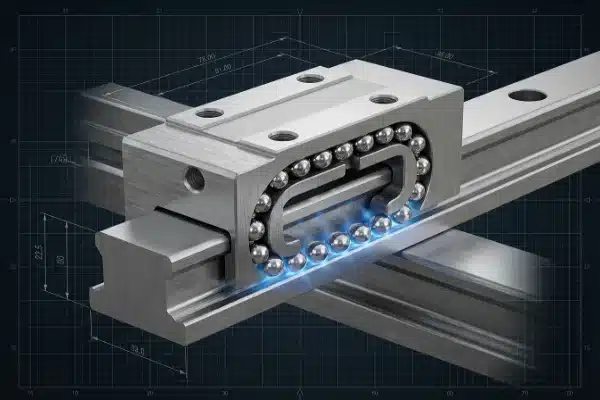
We have found that standard rigid guides often fail under these conditions. They cannot handle the structural misalignment caused by thermal expansion and vibrational shockwaves. This is why tribological architecture 3 (the study of friction and wear) is so critical. A high-quality rail system acts as a buffer. It absorbs multi-axis inaccuracies and prevents the metal-on-metal binding that leads to downtime.
Rolling vs. Sliding Dynamics
The core difference lies in how the door moves. Cheap systems use sliding contact, which generates heat and requires force. Quality systems use rolling elements. Below is a comparison of how different rail technologies impact your daily operation:
Table 1: Linear Guide Technology Comparison
| Характеристика | Rolling Element Guides (Preferred) | Plain Sliding Guides (Avoid) | Polymer Bearings (Specific Use) |
|---|---|---|---|
| Friction Type | Rolling (Low resistance) | Sliding (High resistance) | Sliding (Low-to-Medium) |
| Heat Generation | Minimal | Высокий | Низкий |
| Wear Pattern | Consistent over time | Uneven, leads to jams | Gradual material loss |
| Техническое обслуживание | Greasing required | Frequent oiling | Dry running (No grease) |
| Грузоподъемность | High (Heavy doors) | Средний | Low (Light doors only) |
By selecting the right "architecture" for the rail, we ensure that the door remains light and easy to move, even after months of 24/7 production.
How Can I Check the Durability and Smoothness of the Door Mechanism During a Site Visit?
When we calibrate our flight controllers and machine guards during the Заводские приемочные испытания (FAT) 4, we use strict metrological standards. You should not rely on a visual glance; you need to physically interact with the machine to find hidden flaws.
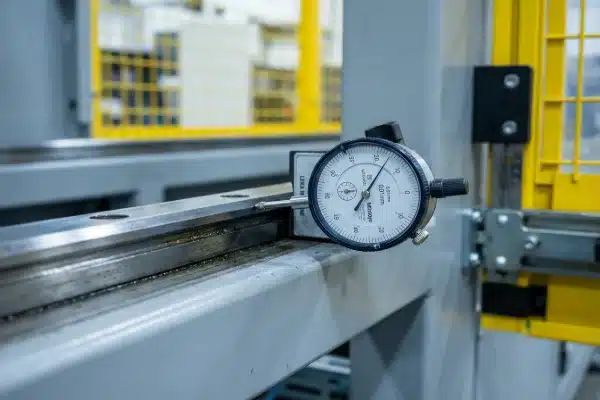
You can check durability during a site visit by performing a tactile "breakaway force" test and a visual "wipe test" on the rail grease. Use a dial indicator to measure parallelism and look for black particulate in the lubricant, which indicates active pitting and subsurface material fatigue.
The "Wipe Test" Protocol
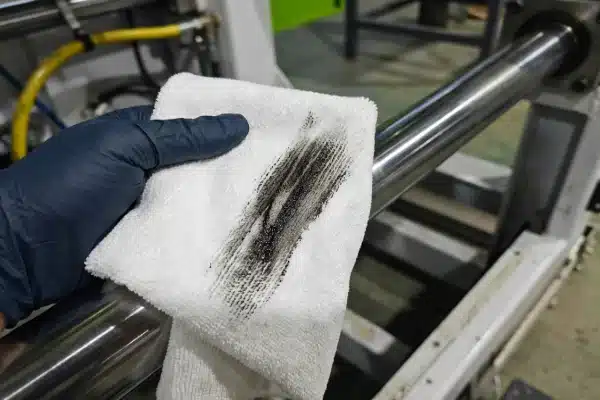
One of the most effective ways to judge the health of a machine is the "wipe test." This is a standard procedure in our quality control process. You simply take a clean white cloth and wipe the grease on the rail.
If the grease is clear or slightly colored by the lubricant, the rail is healthy. However, if you see black metallic residue or plastic dust mixed in, the rail is degrading. This "slurry" acts like sandpaper, grinding down the steel raceways. This indicates that the seals have failed or the steel is suffering from pitting—where small fragments break away due to fatigue.
Tactile and Kinematic Inspection
You do not always need advanced tools to find a problem. Your hands are excellent sensors. We recommend the following steps during your walk-through:
- Lockout/Tagout (LOTO): Ensure the machine is completely powered down.
- Breakaway Test: Push the door from a dead stop. Does it require a sudden, hard shove to get moving? It should glide immediately.
- Travel Consistency: Move the door slowly across its full path. Feel for "catch points" or rough spots. These suggest the rails are not parallel.
- Vibration Check: Hold the handle lightly while moving the door. A grinding sensation means the internal balls are damaged.
Table 2: Visual and Tactile Inspection Checklist
| Inspection Point | Healthy Condition | Warning Sign (Action Required) |
|---|---|---|
| Rail Surface | Shiny, smooth, light oil film | Dull, pitted, rusted, or dry spots |
| Grease Appearance | Clean, consistent color | Black, gritty, or mixed with plastic chips |
| Movement Sound | Silent or soft "whoosh" | Clicking, grinding, or metallic screeching |
| Door Alignment | Even gap top-to-bottom | Door drags at the bottom or jams at the end |
Do the Sliding Rails Require Frequent Maintenance or Lubrication to Prevent Jamming?
In our experience exporting to the US and Europe, we find that neglected maintenance is the number one cause of premature failure. Clients often forget that a blow molding factory is a harsh environment filled with airborne contaminants.
Yes, sliding rails require frequent maintenance because airborne flash and plastic dust mix with grease to form an abrasive slurry. Regular cleaning and re-greasing are essential to purge contaminants, though self-lubricating polymer options can reduce this burden by running dry and resisting dust adhesion.
The Dust and Grease Trap
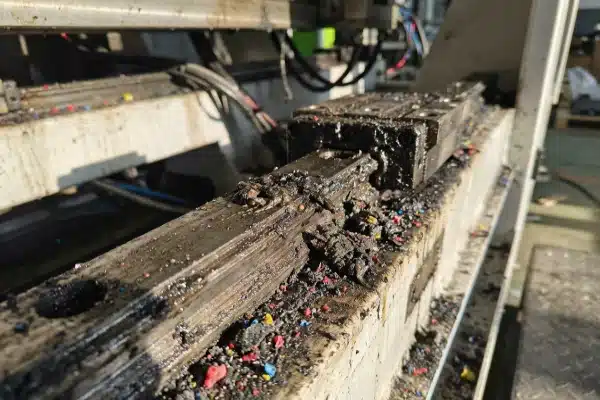
The biggest enemy of a linear guide is the environment it lives in. Blow molding creates static-charged plastic dust and flash. Standard grease acts like a magnet for this dust. If the carriage seals are torn or missing, this dust enters the ball bearings.
Once inside, the dust mixes with the grease to create an abrasive paste. This destroys the precision steel surfaces. We provide a "Crash Kit" of spare parts with our machines, but we prefer you avoid using it by following a strict maintenance schedule. You must purge the old, dirty grease before adding fresh lubricant.
Self-Lubricating Alternatives
To solve this maintenance headache, we sometimes recommend engineered polymers like PTFE or UHMW-PE for specific applications. These materials are self-lubricating.
- Pros: They run completely dry. Dust does not stick to them because there is no wet grease. They are maintenance-free.
- Cons: They cannot handle the same heavy loads as steel ball guides.
Predictive Maintenance (PdM)
Modern manufacturing is moving away from calendar-based maintenance. We are integrating IoT solutions that listen to the machine.
- Vibration Analysis: Sensors detect the specific frequency of a damaged bearing long before you can hear it.
- Servo Telemetry: If the door is automated, the servo motor acts as a sensor. If the motor needs more amps to move the door today than it did last month, friction is increasing.
Table 3: Maintenance Strategy Matrix
| Стратегия | Action | Лучшее для |
|---|---|---|
| Reactive | Fix it when it jams. | Low-volume, low-budget shops (Not recommended). |
| Preventative | Clean and grease weekly. | Standard steel rail systems in dusty plants. |
| Passive | Use dry-running polymer bearings. | Lighter doors; high-dust environments. |
| Predictive | Monitor motor amps/vibration. | High-speed, automated production lines. |
Will a Sticky or Heavy Safety Door Negatively Impact the Operator's Efficiency and Fatigue?
Our design team focuses heavily on the "human factor" because we know that a tired operator makes mistakes. If a worker has to wrestle with a heavy door hundreds of times a shift, productivity will inevitably drop.
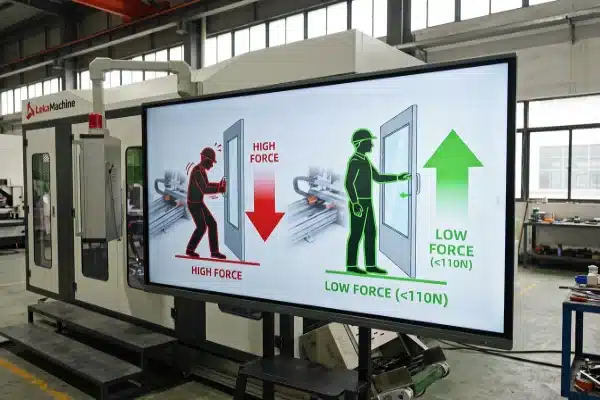
A sticky safety door negatively impacts efficiency by increasing the biomechanical exertion required for every cycle. This leads to rapid muscular fatigue, slower cycle times, and a higher risk of chronic injuries, creating a regulatory paradox between safety containment and ergonomic operating limits.
The Regulatory Paradox
We face a difficult balance when designing safety guards. ISO 14120 regulations 5 state that guards must be rigid enough to contain a high-velocity impact (like a mold defect or ejected part). This means the door must be heavy and made of steel or thick polycarbonate.
However, ergonomic standards limit the amount of force a human should use. The limit is typically 110 Newtons. If the rails are worn out, the force required to move that heavy door can easily exceed this limit. This creates a legal and safety risk. The door is safe for impact, but unsafe for the human back and shoulders.
The Cost of Fatigue
When rails degrade, the friction coefficient rises. An operator might open and close a door 30 to 60 times an hour.
- Fresh Rails: 20 Newtons of force. Total work is manageable.
- Worn Rails: 80+ Newtons of force. Total work quadruples.
This leads to Musculoskeletal Disorders (MSDs) 6. An operator with a sore shoulder moves slower. They take longer breaks. They may even bypass safety interlocks to avoid moving the door, which is a massive liability.
Keeping Efficiency High
We ensure our machines maintain low-friction movement to keep your cycle times fast. A smooth door means the operator stays in rhythm with the machine. We use self-aligning compact rails that forgive minor misalignments, ensuring the door glides effortlessly even if the machine frame shifts slightly due to heat.
By maintaining your rails, you are not just protecting the machine; you are protecting your production rate and your employees' health.
Заключение
To ensure reliable production, inspect linear guides for pitting, perform wipe tests, and monitor actuation force. Choosing quality rails and maintaining them prevents downtime and protects your operators.
Сноски
1. Official product page for linear guideways from a major manufacturer. ↩︎
2. Authoritative explanation of dynamic load ratings for bearings from a leading manufacturer. ↩︎
3. Wikipedia provides a comprehensive overview of tribology, the study of friction and wear. ↩︎
4. Wikipedia defines and explains the Factory Acceptance Test (FAT) in an industrial context. ↩︎
5. TÜV SÜD offers information on ISO 14120, a standard for machine guarding. ↩︎
6. Replaced with an authoritative OSHA (.gov) page providing an overview of ergonomics and the prevention of musculoskeletal disorders. ↩︎


0 Комментариев