
How can I distinguish between trading companies and original manufacturers of all-electric extrusion blow molding machines?
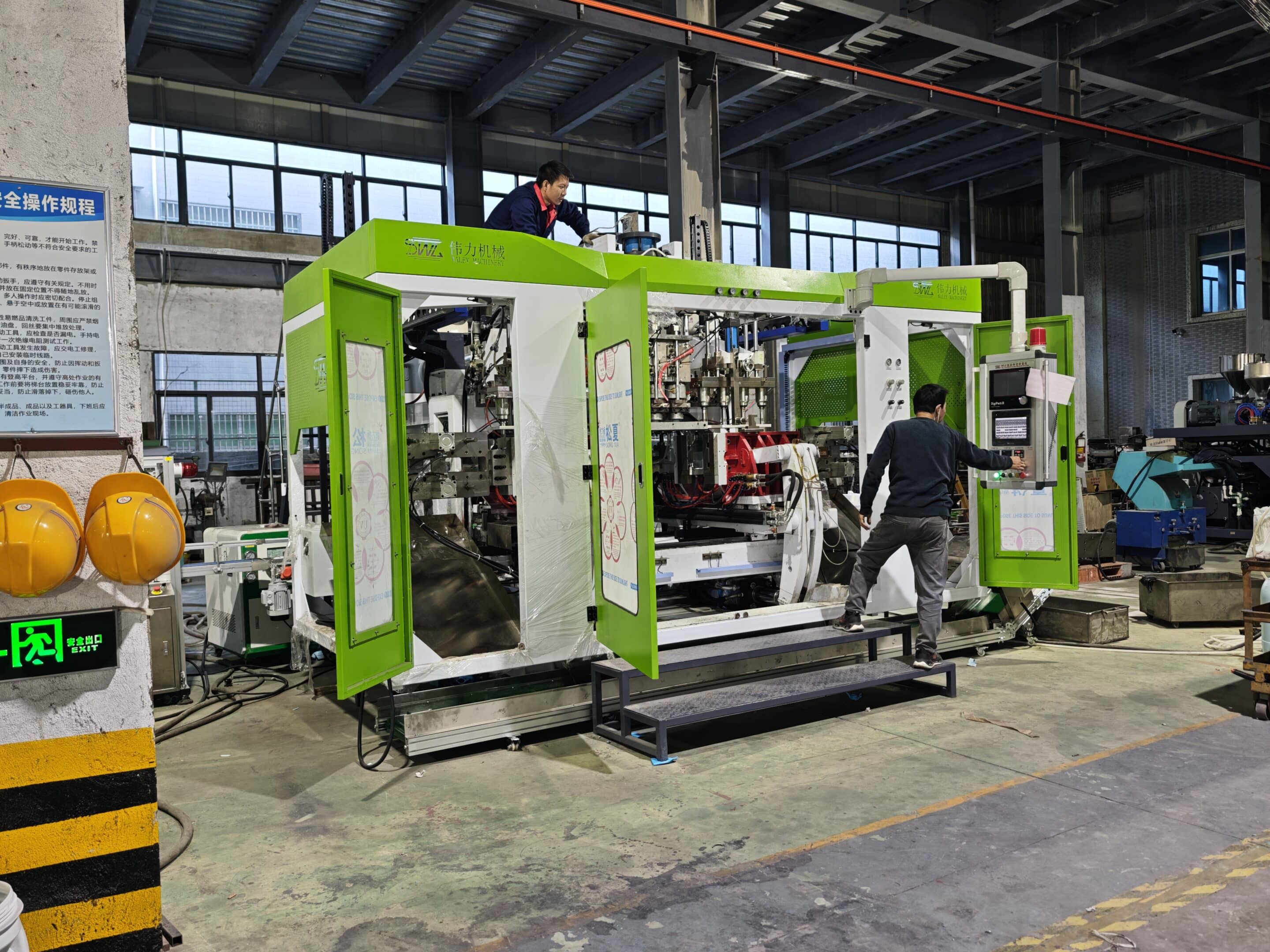
At LEKA Machine, we often encounter clients who have been burned by "factories" that turned out to be mere middlemen. You need a partner with the technical depth to solve problems, not just a salesperson who vanishes when issues arise. Buying from a trader masquerading as a manufacturer introduces unnecessary risk to your supply chain.
servo drives 1
To verify a supplier, examine their Chinese Business License for "Production" keywords and cross-reference their registered address on satellite maps to confirm industrial infrastructure. Crucially, demand a live video tour of their CNC machining workshop to prove they process raw steel rather than just assembling outsourced components.
Distinguishing a genuine Original Equipment Manufacturer (OEM) from a trading company requires looking past the polished website and examining the legal and physical infrastructure of the business. Here is how you can uncover the truth.
Original Equipment Manufacturer (OEM) 2
What documentation should I request to prove the company owns the production facility?
Paperwork in China can be confusing, but specific keywords on legal documents reveal the true nature of a business. We help our clients navigate these documents daily to ensure they are dealing directly with the source, avoiding the markup and communication delays associated with intermediaries.
ball screws 3
Request the "Business License" and scrutinize the "Scope of Business" for terms like "Manufacturing" or "Production," avoiding those listing only "Wholesale." Additionally, ensure the "Certificate Holder" on ISO/CE documents exactly matches the company’s bank account name to verify they are not simply using a supplier’s credentials.
The first step in your due diligence should always be a request for the Business License (营业执照). In China, every company has a defined "Scope of Business" (经营范围) on their license. A trading company is legally restricted from claiming they manufacture goods if they only hold a trading license.
Decoding the Business License
You do not need to be fluent in Chinese to spot the difference. Ask the supplier to send a high-resolution scan of their license and use a translation tool to check the Scope of Business field.
- The Red Flag: If the license lists "Wholesale" (批发), "Retail" (零售), or "Import/Export" (进出口) without any mention of production, they are a trader.
- The Green Light: A real factory must list "Production" (生产), "Manufacturing" (制造), or "Processing" (加工).
The Certificate Consistency Check
We also recommend a rigorous examination of ISO 9001 and CE certificates. A common tactic used by traders is to provide a valid certificate that actually belongs to the factory they source from, hoping you won’t notice the name difference.
- Действие: Compare the "Certificate Holder Name" against the company name on their bank account details and proforma invoice.
- Reality: If the names do not match perfectly, or if the certificate is issued to a "Partner" or "Sister Company," you are likely dealing with a middleman.
Geolocation Forensics
Finally, use digital tools like Baidu Maps or Google Maps to investigate the registered address found on the license.
- Manufacturers: We are invariably located in designated industrial zones (e.g., "Shantou Industrial Park"). Satellite views should show large, flat-roofed factory structures, truck yards, and loading docks.
- Traders: They are often registered in commercial office towers (e.g., "Room 1204, International Finance Center") or residential complexes. If the address points to a skyscraper in a city center, they are not casting steel and assembling 10-ton machines there.
Product Portfolio Analysis
Scrutinize their entire product catalog. Genuine manufacturers usually specialize in a narrow niche. For example, we focus heavily on blow molding. If a supplier offers a "supermarket" inventory—selling injection molding, extrusion, granulators, and obscure auxiliary equipment all under one brand—they are likely aggregating products from multiple sources to maximize sales opportunities.
| Document / Asset | Genuine Manufacturer Indicator | Trading Company Indicator |
|---|---|---|
| Business License Scope | Includes "Production" (生产) or "Manufacturing" (制造). | Lists "Wholesale" (批发), "Sales," or "Import/Export." |
| Registered Address | Industrial zone, factory structures visible on maps. | Commercial office tower, residential area, or co-working space. |
| Product Portfolio | Specialized niche (e.g., only Blow Molding). | Broad mix of unrelated machinery (Injection + Extrusion + etc.). |
| Certificate Holder | Matches the Bank Account Name exactly. | Mismatch or listed as "Cooperating Factory." |
How can a live video tour of the factory floor help me verify manufacturing capabilities?
We love showing visitors our machining center because heavy metal cannot be faked or staged for a quick call. However, trading companies often rely on rented showrooms or assembly halls that hide their lack of real production infrastructure, hoping you won’t ask to see the "dirty" parts of the factory.
PLC source code 5
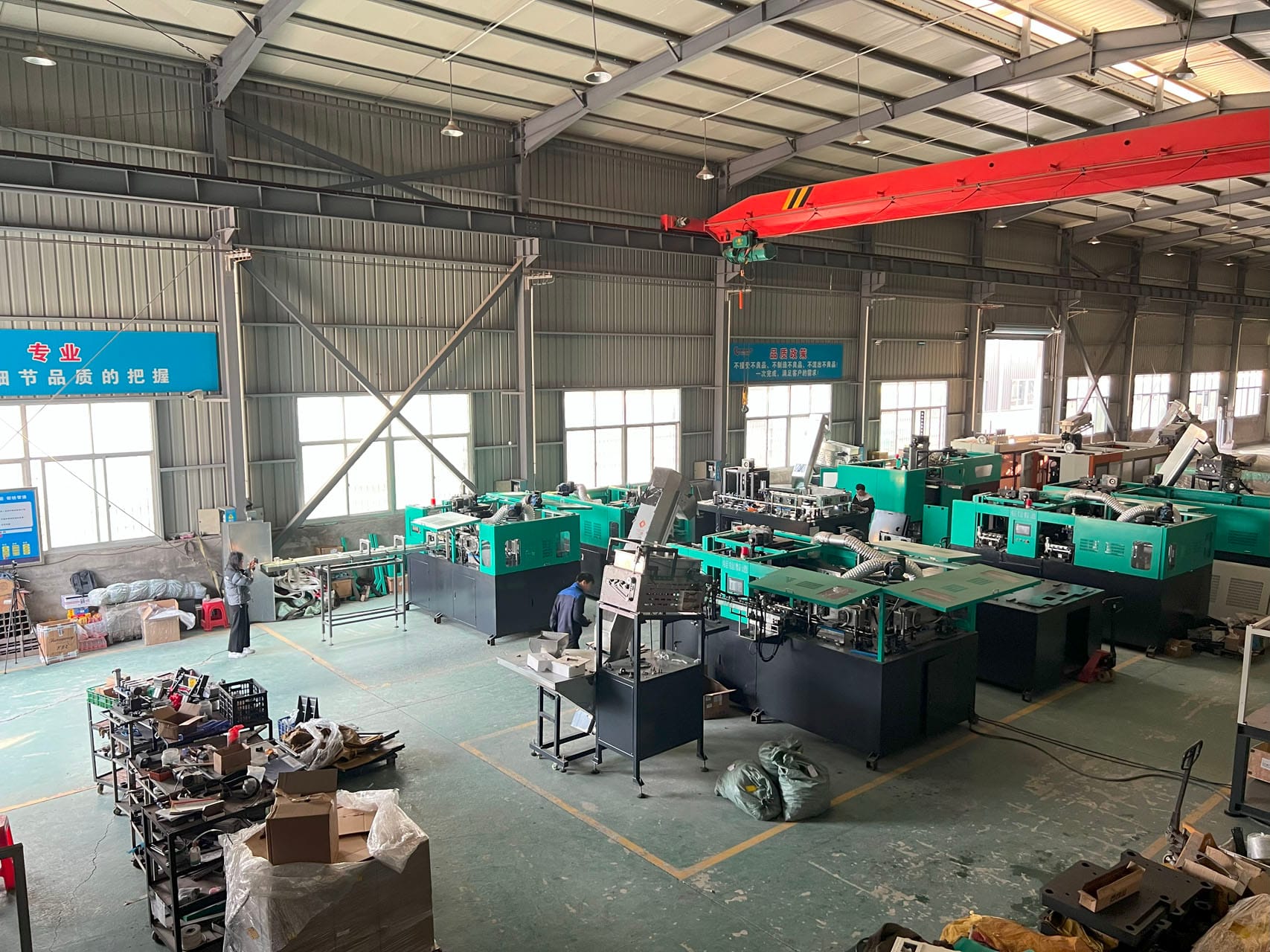
During a live video call, insist on seeing the CNC machining workshop where raw steel castings are processed into platens. While trading companies can easily stage a clean assembly hall or showroom, they cannot fake the heavy industrial machinery, metal chips, and raw materials required for in-house fabrication.
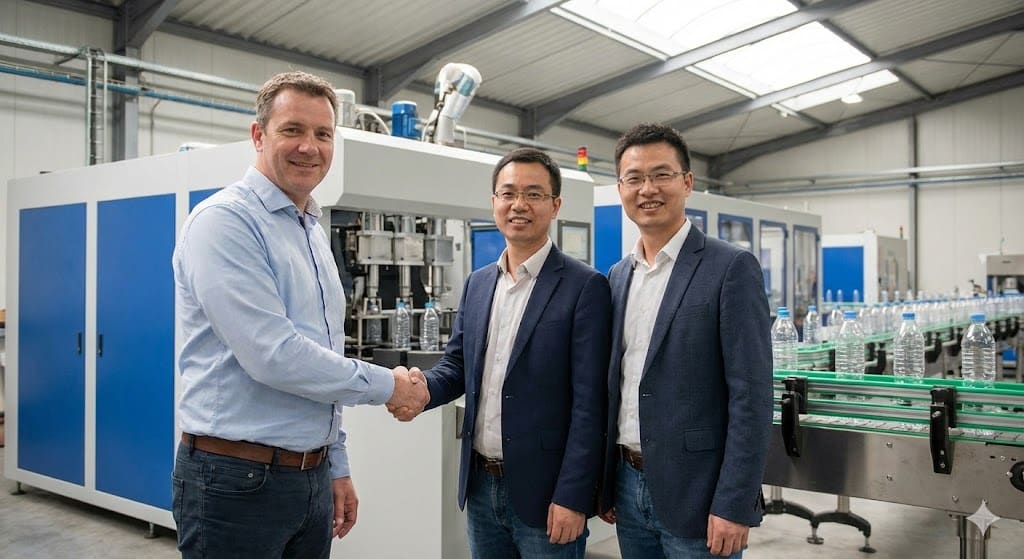
A "showroom" proves nothing. Anyone can rent a warehouse and put three finished machines in it to look like a factory. To verify a manufacturer, you must ask to see the Machining Workshop.
The Un-fakeable Workshop
Building a blow molding machine involves processing massive raw steel castings into precision platens, toggles, and frames. This requires heavy infrastructure that traders cannot replicate.
- Heavy Machinery: Look for large-scale CNC boring mills, gantries, and lathes. These are multi-million dollar investments that trading companies do not make.
- The Process: Ask to see the "Works in Progress." You should see metal chips on the floor, oil coolant, and sparks.
- Raw Materials: Look for piles of rusted steel castings waiting for processing. A trading company might have shiny finished machines, but they will not have raw, unprocessed metal lying around.
Assembly vs. Manufacturing
Traders often claim they are manufacturers because they have a small workshop where they attach covers or stickers to machines bought elsewhere. This is "Assembly," not "Manufacturing."
- Assembly Hall: Clean, quiet, finished machines only. Easy to stage.
- Machining Center: Noisy, messy, heavy equipment. Impossible to stage.
The Staff Test
During the video tour, look at the workers. In a real factory, the staff on the floor will be wearing uniforms with the company logo. In a staged tour, you might see people in street clothes or inconsistent uniforms, which suggests they might be contractors or employees of the actual factory where the trader is merely visiting.
| Характеристика | Real Factory Environment | Staged / Trading Environment |
|---|---|---|
| Key Equipment | CNC Boring Mills, Lathes, Gantries. | None, or just light tools like screwdrivers. |
| Atmosphere | Noise from cutting metal, smell of oil/coolant. | Quiet, clean, office-like atmosphere. |
| Inventory | Raw steel castings, unfinished frames. | Only finished machines wrapped in plastic. |
| Video Request | "Sure, let’s walk over to the CNC area." | "The connection is bad there" or "It is restricted." |
What specific technical questions can I ask to test the supplier’s engineering depth?
Our engineering team answers complex questions instantly because we designed the machines and wrote the software. Traders, however, often act as a "relay station," struggling with technical specifics and revealing their reliance on external factories for critical information.
CNC boring mills 7
Test the supplier’s depth by asking for immediate data on dry cycle times or requesting 2D CAD drawings for specific consumables like blow pins. Genuine manufacturers can access files and data instantly, whereas trading companies typically delay responses while they relay questions to the actual factory engineers.

The "Technical Lag Time" test is one of the most effective ways to spot a trader. A salesperson at a trading company is a facilitator, not an expert. They have to ask someone else for the answer.
CE certificates 9
The "Lag Time" Test
Ask a question that requires a specific calculation or data point.
- The Question: "What is the exact dry cycle time versus the production cycle time for a 5-liter HDPE jerrycan on this specific model?"
- Manufacturer: We can give you a number immediately or pull up a test record from our server in minutes.
- Trader: "I will check with our technical team and get back to you." (This delay happens because they have to call the actual factory).
The "Servo Logic" Access Query
For modern all-electric machines, software is just as important as hardware.
- The Question: "Can you modify the PLC source code to add a specific parison control motion profile for my unique bottle design?"
- Manufacturer: We own the intellectual property (IP). We can authorize logic changes or explain exactly how our controller handles that profile.
- Trader: They are typically locked out of the proprietary firmware. They cannot promise customization without the factory’s permission, which is often denied to protect the factory’s IP from the trader.
Bill of Materials (BOM) Transparency
Request a detailed BOM identifying specific brands and model numbers of critical components like ball screws and servo drives.
- Manufacturer: We have direct supply chains with Rexroth, Physis, or Delta. We will list the exact models (e.g., "Rexroth MSM series").
- Trader: They often obscure these details, listing generic terms like "European Brand Motor" or "High-Quality Screw." They do this to prevent you from calculating their markup or because they simply don’t know what the factory will install until the machine arrives.
The "Spare Part Drawing" Challenge
During your negotiation, pick a specific custom consumable part—like a blow pin tip or a clamping toggle pin—and ask for its 2D engineering CAD drawing.
- Manufacturer: We can retrieve this file from our engineering server and share a PDF or screenshot within 5 minutes.
- Trader: They do not have server access. They have to email the factory, wait for a reply, and then forward it to you. This process creates a noticeable delay.
After-Sales "Relay" Risks
Consider the protocol for a servo overload error.
- Direct Access: Manufacturers provide a direct line to a control engineer who can remotely access the drive parameters to troubleshoot.
- Relay: Traders act as a communication relay, passing screenshots back and forth between you and the real factory. This "game of telephone" significantly slows down troubleshooting and increases downtime.
| Test Scenario | Manufacturer Response | Trading Company Response |
|---|---|---|
| Complex Scenario Question | Immediate, data-backed answer. | "Let me consult the engineer" (Delay). |
| PLC Logic Modification | "We can adjust the code/parameters." | "The system is standard/locked." |
| Request for CAD Drawing | File provided in minutes. | "We will send it tomorrow/later." |
| BOM Specifics | Precise Brand & Model Numbers listed. | Vague descriptions ("European Style"). |
Заключение
Verify license scopes, inspect machining workshops live, and test engineering response speeds to ensure you are partnering with a genuine manufacturer who can support your long-term success.
ISO 9001 10
Сноски
- Provides technical background on the electronic amplifiers used in motion control. ↩︎
- Defines the core industry term used to distinguish factories from traders. ↩︎
- Explains the mechanical component cited as a critical part for verification. ↩︎
- Defines the comprehensive list of parts used to verify component transparency. ↩︎
- Explains the industrial computing system central to the software customization test. ↩︎
- Defines the technical engineering files used to verify manufacturer capabilities. ↩︎
- Explains the specific heavy industrial machinery required for manufacturing. ↩︎
- Provides context for the specific mapping tool recommended for checking Chinese addresses. ↩︎
- Official European Commission page explaining the conformity marking discussed. ↩︎
- Links to the official standard for quality management systems mentioned in the text. ↩︎


0 Комментариев