

7 Common Blow Molding Defects & How to Fix Them (Expert Guide)
Оглавление
- The Real Cost of Rejects in Extrusion Blow Molding
- Defect 1: Uneven Wall Thickness and Parison Sag
- Defect 2: Ugly Vertical Die Lines and Streaks
- Defect 3: Rocker Bottoms (Unstable Bases)
- Defect 4: Excessive Flash or Incomplete Trim
- Defect 5: Weak Weld Lines and Split Bottoms
- Defect 6: Sharkskin or Melt Fracture
- Defect 7: Black Specks and Contamination
- When to Stop Tweaking and Start Upgrading
- Next Steps for Your Production Line
The Real Cost of Rejects in Extrusion Blow Molding
If you have ever walked the floor of a manufacturing plant, you know the sound of a rejection bin filling up. It is the sound of money evaporating. Whether you are running a high-speed, Кто производит гидравлические системы, электронику и двигатели? Надежные компоненты от известных брендов (таких как or a smaller, semi-auto setup, scrap is the enemy of profit.
We aren’t just talking about the cost of the raw resin, although that certainly adds up. We are talking about the wasted energy, the lost machine hours, and the labor spent grinding that material back down. In the extrusion blow molding (EBM) game, margins are protected by efficiency. When your “good bottle” rate drops, your cost per unit skyrockets.
I have spent years troubleshooting these lines, and I’ve learned that defects aren’t usually mysterious curses; they are mechanical or thermal imbalances waiting to be corrected. Let’s tackle the seven most common headaches I see on the factory floor and, more importantly, how to fix them.
Defect 1: Uneven Wall Thickness and Parison Sag
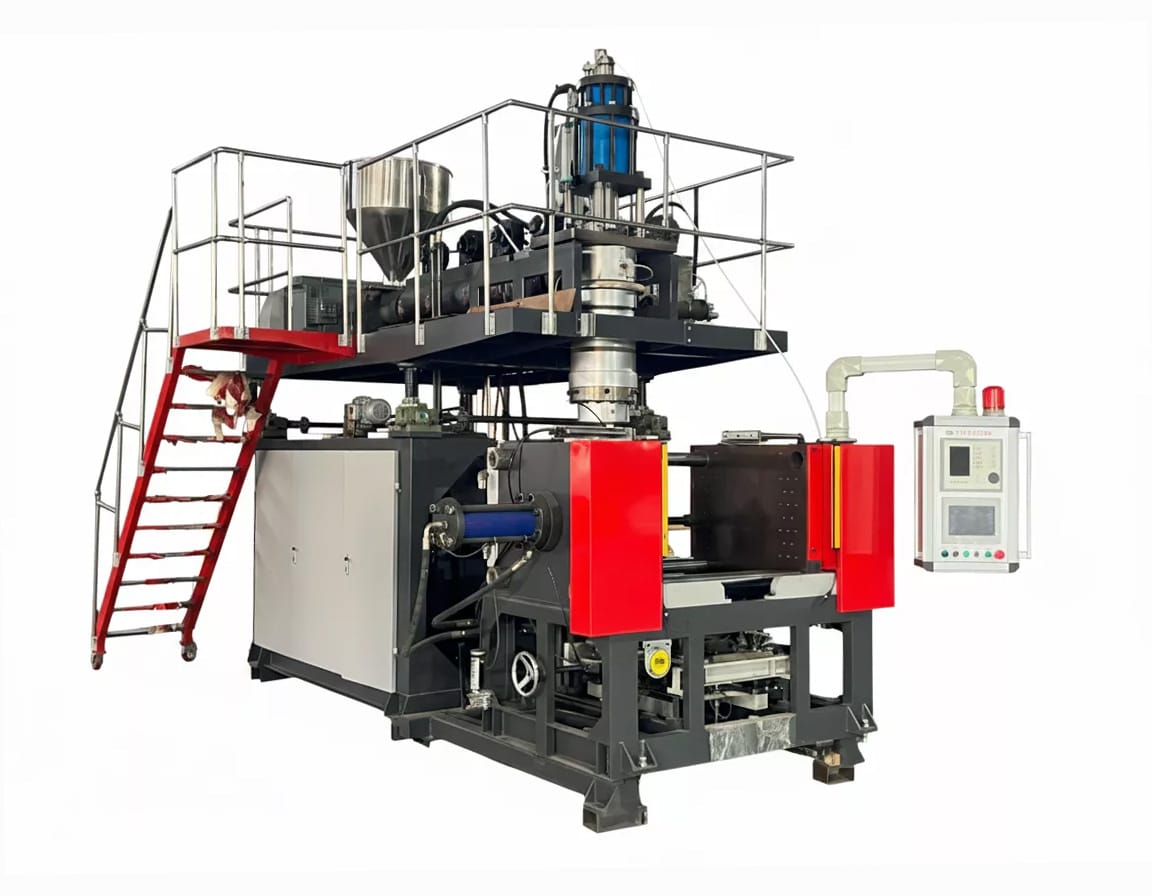
This is the classic battle against gravity. In an машине для экструзионного выдувного формования, you are extruding a hot, heavy tube of plastic (the parison). Naturally, the weight of the plastic pulls it downward.
If you don’t control this, you end up with “parison sag.” The top of your container ends up dangerously thin because the material has stretched out under its own weight, while the bottom corners are thick and wasteful. This is a massive issue when producing large Инвестиции в оборудование or industrial drums where structural integrity is non-negotiable.
Mastering the Parison Controller Settings
Modern EBM equipment isn’t just “set and forget.” You need to get comfortable with your parison controller. Most decent machines offer a 30-point or even 100-point profile control.
To fix sag, you need to program the die gap to open slightly wider as the parison extrudes. This compensates for the thinning caused by gravity. However, you also have to account for “die swell”—the tendency of the plastic to expand horizontally as it exits the die. It is a balancing act. If your wall thickness is erratic, go back to your profile points. Are you making smooth transitions, or are your set points jumping drastically? Smooth out the curve on your controller to stabilize the flow.
Why Die Head Temperature Balance Matters
Sometimes the controller is perfect, but the bottle is still lopsided. This often points to the die head heaters.
If the heater bands on the left side of the die head are hotter than the right, the plastic on the left becomes less viscous (thinner) and flows faster. This causes the parison to curl or “banana” to one side. When the mold closes, one side of your бутылок из ПНД catches a thick parison wall, and the other catches a thin, stretched membrane. Always use a pyrometer to verify that your actual die temperatures match your set points across all zones.
Defect 2: Ugly Vertical Die Lines and Streaks
For industrial parts, a few lines might pass inspection. But if you are running a shampoo bottle production line or manufacturing cosmetic packaging, aesthetics are everything. Vertical die lines—those visible streaks running down the length of the bottle—kill shelf appeal instantly.
These lines make the product look cheap and can even affect the label application, creating bubbles or peeling issues later down the supply chain.
Cleaning the Die and Mandrel
Die lines are almost always caused by contamination or damage in the die tooling. Over time, small bits of plastic can degrade and carbonize (turn into hard, black crud) inside the die head. This “hang-up” material drags against the molten plastic as it flows out, creating a score line.
The fix is a teardown and clean. You need to inspect the mandrel and the die ring. Look for nicks, scratches, or carbon buildup. If you find carbon, polish it out carefully with brass tools or mild abrasives—never steel, which can scratch the chrome plating. Regularly purging your machine with a cleaning compound during shutdowns can prevent this buildup from hardening in the first place.
Defect 3: Rocker Bottoms (Unstable Bases)
There is nothing more frustrating for a retailer than a bottle that won’t stand up straight. A “rocker bottom” occurs when the base of the bottle bulges outward, making it wobble on the conveyor belt or the store shelf.
This is particularly common in flat-bottomed containers and requires immediate attention to your process timing.
Optimizing the Cooling Time and Mold Venting
The culprit here is usually heat or trapped air. If you are rushing the cycle time on a jerry can making machine to boost output, you might be ejecting the part before the heavy material in the base is fully crystallized. The residual heat inside the thick plastic causes it to warp and bulge outward after it leaves the mold. Increasing the cooling time or boosting the water flow to the bottom of the mold can solve this.
Alternatively, check your mold venting. If air gets trapped between the plastic and the mold metal in the push-up area, the plastic cannot cool against the metal surface efficiently. Clean your vents or add sintered metal vents to the base area to ensure that air can escape instantly.
Defect 4: Excessive Flash or Incomplete Trim
Flash is the excess material squeezed out where the mold halves meet. In a perfect world, the flash is paper-thin and easily knocked off by the auto-deflasher.
However, if you are seeing thick, rope-like flash that jams the trimmer or leaves ugly scars on the handle and neck, you have a mechanical issue. This is waste that eats directly into your raw material efficiency.
Checking Your Clamping Force and Mold Alignment
Thick flash usually means the mold is being forced open by the pressure of the blowing air. The mold is literally “breathing.”
Check your hydraulic pressure and clamping force. Is your machine powerful enough for the projected area of the container you are making? If you are running a large jerry can on an underpowered machine, the platens will flex. You also need to check the platen parallelism. If the mold halves aren’t meeting perfectly flat, you will get flash on one side regardless of how much clamping force you apply.
Defect 5: Weak Weld Lines and Split Bottoms
This is a critical functional failure. The weld line (usually at the bottom of the bottle) is where the parison is pinched together and fused. If this weld is weak, the bottle will split when dropped.
For manufacturers providing 5L water bottle manufacturing solutions or chemical containers, a drop-test failure can lead to massive product recalls and liability issues.
Adjusting Pinch-Off Pressure and Back Pressure
To fix this, you need to look at the “pinch-off” section of your mold. It needs to be sharp enough to cut the flash but dull enough to squeeze the molten plastic together to form a bond.
Process-wise, try increasing the back pressure on your extruder. Higher back pressure mixes the melt more thoroughly, knitting the polymer chains together more effectively. You can also try closing the mold slightly faster (cushioning the end of the stroke) to ensure a firm fuse without “cutting” the plastic too aggressively before it bonds.
Defect 6: Sharkskin or Melt Fracture
Sharkskin is exactly what it sounds like—a rough, matte texture that looks like sandpaper or orange peel. It typically happens on the inside or outside surface of the parison and results in a hazy, non-glossy bottle.
Balancing Extrusion Speed and Melt Temperature
Sharkskin is a phenomenon of rheology (the flow of matter). It happens when the molten plastic is forced through the die gap too quickly, causing high shear stress. Essentially, the skin of the plastic tears as it exits the die.
You have two main levers to pull here: heat and speed. First, try raising the die temperature. Hotter plastic flows more easily and is less prone to fracturing. If you are already at the max temperature for your material, you must slow down the extrusion speed. Running an машине для экструзионного выдувного формования beyond its designed plasticizing capacity is the fastest way to ruin surface finish.
Defect 7: Black Specks and Contamination
You are running a pristine white milk bottle or a crystal-clear medical container, and suddenly, there it is: a tiny, ugly black speck embedded in the wall. It ruins the aesthetic and, in medical or food applications, renders the part scrap.
Screw Maintenance and Material Handling
Black specks are almost always degraded polymer. This usually comes from the screw or the barrel. If you shut down the machine without properly purging the heat-sensitive material, that residual plastic cooks in the barrel and flakes off later as carbonized specs.
Another massive culprit is your regrind. If you are recycling flash, ensure your granulator is clean and that you aren’t introducing paper dust, dirt, or oil into the hopper. A magnetic separator in the hopper loader is also a cheap insurance policy against metal shavings entering the screw.
When to Stop Tweaking and Start Upgrading
There comes a point where no amount of process tweaking can fix a defect. If your platens are warped, your screw is worn out, or your parison controller is stuck in the 1990s, you are fighting a losing battle against Total Cost of Ownership (TCO).
If you find yourself constantly adjusting settings just to keep the machine running, or if your energy bills are eating your profits, it might be time to stop repairing and start replacing. Finding a reliable EBM machine supplier in China that offers modern servo systems and rigid clamping units can transform your scrap rate from 5% down to 0.5%.
Final Thoughts on Consistent Quality
Blow molding is as much an art as it is a science, but the “art” shouldn’t be guesswork. By methodically isolating these variables—temperature, pressure, time, and tooling—you can turn a temperamental process into a predictable one. Consistent quality doesn’t just happen; it is engineered.
Next Steps for Your Production Line
Are you struggling with a specific defect that just won’t go away? Or are you looking to upgrade your capacity with a machine that handles these variables automatically?
Would you like me to connect you with the Leka technical team to review your current defect rates and see which machine series offers the best stability for your specific product?


0 Комментариев