
How should I inquire about the integration solution for the leak detection unit when purchasing an all-electric extrusion blow molding machine?

At our factory, we know that buying a high-speed all-electric machine 1 without checking the downstream integration is a recipe for disaster. If the leak tester cannot keep up or communicate effectively, your expensive machine becomes a bottleneck. We solve this by asking the right technical questions upfront.
To ensure seamless integration, require a vacuum-assisted conveyor for stability and a Fieldbus protocol like Profinet for real-time data exchange. Demand logic that correlates specific leaks to mold cavities and verify the system includes "challenge bottle" automation to validate reject mechanisms without human intervention.
Buying an all-electric machine is about precision and speed. If your leak detection unit (LDU) integration is an afterthought, you lose those benefits. Here is exactly how to structure your inquiry.
How does the machine controller communicate with the leak tester to reject bad bottles?
In our experience exporting to the US and Europe, simple relay connections 2 often fail to provide the data granularity needed for modern production. We advise clients to move beyond basic signals to ensure every defect is traceable.
The machine controller communicates via Fieldbus (EtherCAT or Profinet) rather than simple dry contacts. This allows the leak tester to send specific pressure values and cavity IDs back to the main PLC, enabling the rejection kicker to act precisely based on complex logic rather than just a binary fail signal.

The Necessity of "Cavity Correlation" Logic
When we engineer a производственная линия 3, the goal isn’t just to find a bad bottle; it is to find the причину, of the bad bottle. Simple integration only tells you "This bottle leaks." Smart integration tells you "Cavity #3 is leaking."
You must inquire about Shift Register Logic. In this setup, the blow molding machine assigns a digital "ID tag" to every bottle as it leaves the mold. This ID travels with the bottle data to the leak tester. If the tester finds a hole, it reports back to the main PLC: "Cavity #3 failed." This allows your operators to inspect only mold cavity #3, rather than stopping the machine to check every cavity.
Moving from Discrete I/O to Fieldbus
Many older or budget-friendly systems use "Dry Contact" (Discrete I/O). This is a simple wire that sends a voltage signal: On (Good) or Off (Bad). However, for an all-electric machine running at high efficiency, this is insufficient.
We recommend asking for Fieldbus protocols (like Profinet, EtherCAT, or Modbus TCP). This connection acts like a data highway. Instead of just a "kick" signal, the tester shares real-time data such as:
- Actual pressure decay values (in Pascals or millibars).
- Test time duration per bottle.
- Specific error codes (e.g., "Large leak" vs. "Micro leak").
Reject Verification Sensors
Finally, asking "how it rejects" is not enough; you must ask "how it knows it rejected." A reject signal might be sent, but if the pneumatic kicker jams, the bad bottle stays on the line.
Your integration solution must include a secondary photocell sensor placed physically after the reject station. If this sensor sees a bottle that was supposed to be rejected, it triggers an immediate "Emergency Stop." We call this the "Reject Verification" loop. It ensures that 100% of the bottles packing your pallets are good.
| Характеристика | Discrete I/O (Old Way) | Fieldbus Integration (Recommended) |
|---|---|---|
| Data Transferred | Pass/Fail signal only. | Cavity ID, Pressure Values, Reject Stats. |
| Troubleshooting | Guesswork required. | Targeted (e.g., "Check Cavity #4"). |
| Скорость | Limited by relay switching time. | Real-time, microsecond synchronization. |
| Wiring | Multiple wires for each signal. | Single Ethernet cable. |
Can you supply the conveyor system that aligns bottles for the leak detector?
When we run lightweight bottles on our test bench, we frequently see them tip over on standard conveyors. To maintain the high cycle speeds of an electric machine, we insist on specialized handling equipment that secures the bottle base.
Yes, a dedicated conveyor is essential, specifically one utilizing a vacuum-assisted belt to suction lightweight bottles from below. This stability prevents tipping during high-speed acceleration into the tester, while integrated "jam detection" photo-eyes ensure downstream blockages immediately pause the molding cycle to prevent equipment damage.
Stability via Vacuum-Assisted Conveyors
All-electric extrusion blow molding machines are often used to make lightweight, thin-walled containers 4 to save on resin costs. The problem is that these bottles have a high center of gravity and very little mass. On a standard flat belt, the sudden acceleration of the leak detector infeed will knock them over.
You must ask the supplier for a Vacuum Conveyor. This system uses a perforated belt with a suction fan underneath. It creates a negative pressure that "sucks" the bottle bottom to the belt. This allows the conveyor to run at high speeds without the bottles vibrating, twisting, or falling. A stable bottle means the leak tester probe hits the neck perfectly center every time.
Handling "Trim Flash" Interference
In extrusion blow molding, unlike PET molding, the process creates "flash" (scrap plastic) that is trimmed off. This flash often carries a static charge and clings to the bottle.
If a piece of flash gets stuck on the bottle neck, the leak tester probe won’t seal correctly. The machine will report a "leak" (false reject) because air is escaping around the seal, not through the bottle.
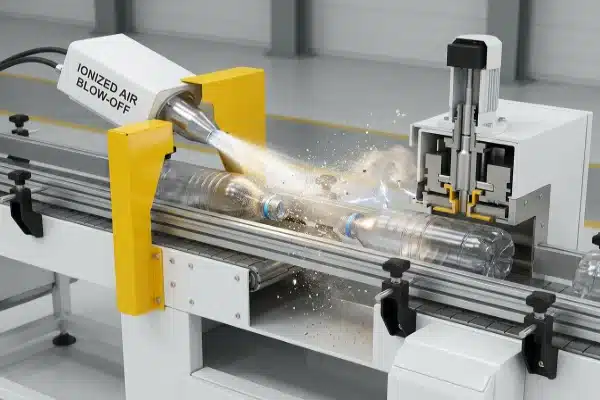
- The Solution: Ask for an Ionized Air Blow-Off station or a de-dusting unit installed immediately before the leak tester. This neutralizes the static and blows away dust and chips, ensuring a clean surface for the test head.
Preventing Downstream Pile-ups
Integration isn’t just about moving bottles forward; it’s about knowing when to stop. If your packer stops or the leak tester faults out, your high-speed electric machine will keep pumping out bottles, creating a massive pile-up in seconds.
The conveyor must have "Downstream Blockage" Interlocks. A photo-eye sensor detects if bottles are backing up. The logic should be programmed so that if the blockage lasts more than 3 seconds (for example), the blow molding machine automatically enters a "Pause" state or diverts bottles to a scrap bin. This protects your expensive electric clamping unit from trying to push bottles onto a full conveyor.
Conveyor Feature Checklist
| Компонент | Функция | Why it is critical for Electric Machines |
|---|---|---|
| Vacuum Belt | Holds bottle to belt via suction. | Prevents light bottles from tipping at high speeds. |
| Ionized Air | Blows off static-charged flash. | Prevents false rejects caused by debris on the neck seal. |
| Jam Sensor | Detects backups. | Pauses the machine automatically to prevent crashes. |
| Adjustable Guides | Side rails that move easily. | Allows for quick changeovers between different bottle sizes. |
What protocols are used to synchronize the blow molding cycle with the testing speed?
We find that mismatched cycle times are the number one reason for lost efficiency. When we design a line, we ensure the tester receives a "heartbeat" signal from the molder to match the production cadence perfectly.
Synchronization protocols rely on real-time feedback where the leak tester adjusts its speed based on the molding cycle time using an encoder signal. For high-output electric machines, we utilize "Continuous Motion" protocols rather than "Stop-and-Go" logic, ensuring the testing process never becomes the bottleneck for your daily output.
"Continuous Motion" vs. "Stop-and-Go"
This is a critical distinction for your Return on Investment (ROI).
- Stop-and-Go Testers: The conveyor stops the bottle, the head comes down, tests, goes up, and the bottle moves. This is fine for slow production (under 1,000 bottles per hour).
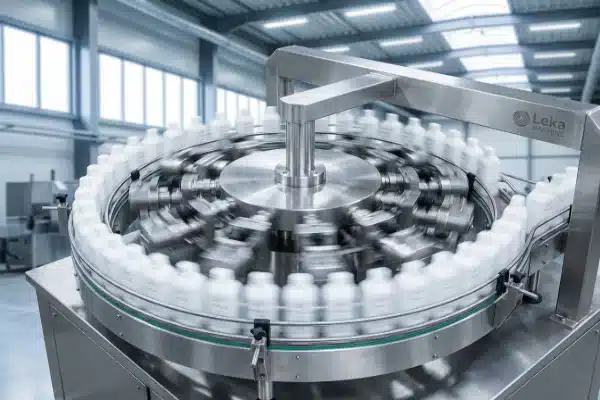
- Continuous Motion Testers: The test heads move with the bottle (either on a rotary wheel or a linear tracking beam). The bottle never stops moving.
Since you are buying an all-electric machine, you are likely targeting high output (2,000 to 10,000+ bottles per hour). You must ask the supplier to verify that the leak tester uses Continuous Motion logic. If you pair a fast electric machine with a Stop-and-Go tester, you will have to slow the molding machine down, wasting its potential.
Managing "Warm Bottle" Decay Curves
Here is a technical nuance many buyers miss. Bottles coming out of the mold are hot. As they travel to the leak tester, they cool down.
- The Physics: As plastic cools, it shrinks. As it shrinks, the internal pressure changes.
- The Problem: A standard leak tester might interpret this natural pressure change as a leak.
You need to ask if the integration includes Temperature Compensation algorithms or "Warm Bottle Decay Curves." The tester needs to know the bottle is fresh from the mold. The protocol should allow the tester to adjust its pass/fail threshold dynamically based on the temperature or the time elapsed since the bottle left the mold. This prevents you from throwing away perfectly good bottles just because they were still warm.
Throughput Comparison Table
| Характеристика | Stop-and-Go System | Continuous Motion System |
|---|---|---|
| Bottle Movement | Halted for testing. | Always moving. |
| Max Output (Approx) | < 1,500 BPH. | 2,000 – 30,000+ BPH. |
| Complexity | Low (simple mechanics). | High (requires synchronization). |
| Suitability | Hydraulic / Low-Speed. | All-Electric / High-Speed. |
Do I need a separate PLC for the leak detection unit or is it integrated?
We believe that operator fatigue 6 leads to errors, so we try to minimize the number of screens they need to watch. Centralizing control is key to maintaining a smooth workflow in our client’s factories.
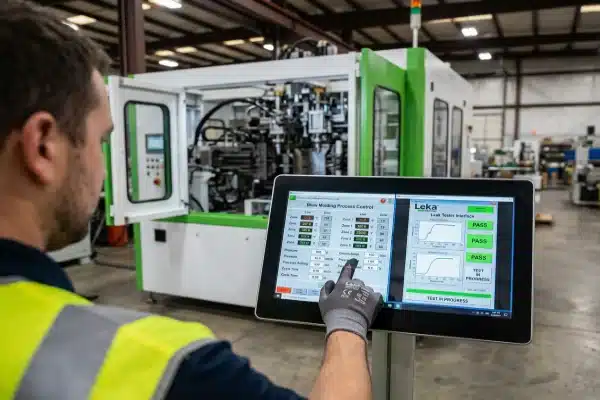
You typically do not need a physically separate control station if you request VNC (Virtual Network Computing) integration. This technology mirrors the leak tester’s interface directly onto the blow molding machine’s main HMI, allowing operators to monitor statistics, adjust sensitivity, and control the entire cell from a single screen.
The Power of VNC Visualization
In the past, an operator had to walk to the blow molding machine to adjust heat, then walk 10 feet to the leak tester to reset a counter.
By asking for VNC (Virtual Network Computing) integration, the leak tester’s screen is "streamed" to the main blow molding machine’s display. The operator can toggle between the machine view and the tester view instantly. This makes setup faster and ensures that alarms on the tester (like "Low Air Pressure") are seen immediately by the person operating the main machine.
Automating the "Challenge Bottle" Routine
The most dangerous failure in a factory is a broken reject system that you think is working. How do you know the kicker is actually firing?
Virtual Network Computing 8
You should ask for an integrated "Challenge Bottle" Routine. This is a software feature where the machine automatically tracks a "virtual" bad bottle (or forces a simulated fail signal) every few hours.
- The system decides "The next bottle is a test."
- It simulates a leak signal.
- It watches the reject sensor.
- If the kicker fires and the sensor confirms rejection, the system logs a "Pass."
- If the bottle is not rejected, the machine alarms and stops immediately.
This automates safety checks. Without this integration, your operators have to manually put a bottle with a hole in it on the line to test the system—a process that is often forgotten or skipped.
Fieldbus protocols 9
Summary of Control Architectures
- Standalone: Two separate screens, two separate brains. Hard to troubleshoot.
- Hardwired Interlock: Machine stops if tester errors, but no data is shared.
- Fully Integrated (VNC + Fieldbus): One screen, shared data, automated challenge routines, and cavity tracking. This is the standard you should demand for an all-electric machine.
Заключение
To maximize the efficiency of your all-electric machine, prioritize vacuum conveyors and VNC integration.
выдувная машина 10
Сноски
- Replaces broken Tesla link with relevant Wikipedia article on the specific machinery process. ↩︎
- Relays are fundamental components in industrial control systems for signal switching. ↩︎
- Explains the concept of organized manufacturing sequences in industrial environments. ↩︎
- Replaces broken FDA link with stable Wikipedia article covering food contact packaging. ↩︎
- ISO standards provide the framework for quality and safety in industrial automation. ↩︎
- Discusses the impact of human factors and fatigue on industrial safety. ↩︎
- EPA information on plastic waste management and recycling of industrial scrap. ↩︎
- VNC allows for remote interface mirroring, essential for centralized machine control. ↩︎
- Fieldbus is the standard for industrial network communication in automated factories. ↩︎
- Provides technical background on the blow molding process used in container production. ↩︎


0 Комментариев