
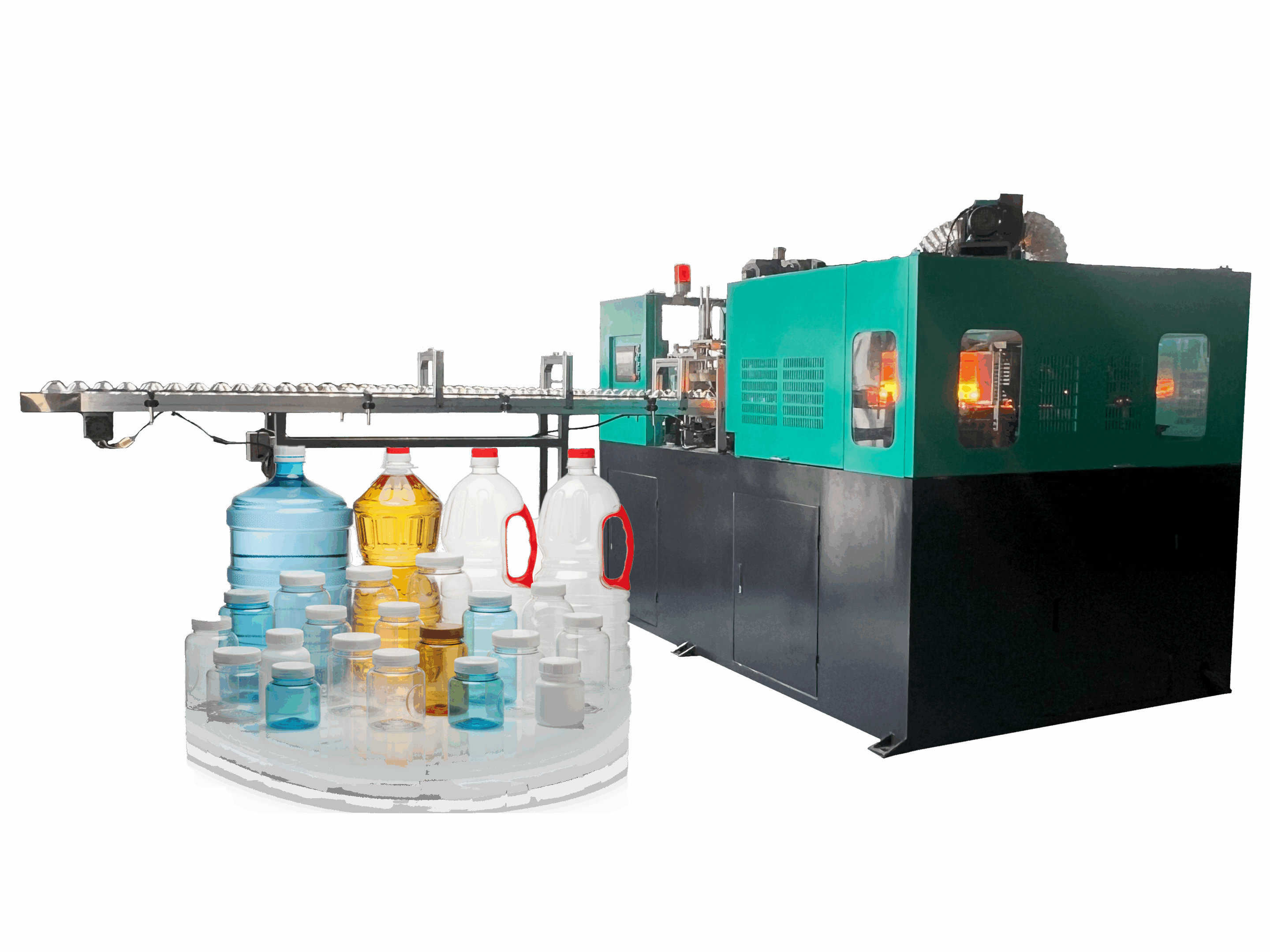
How Should I Evaluate Wall Thickness Control for Irregular Bottles on All-Electric EBM Machines?
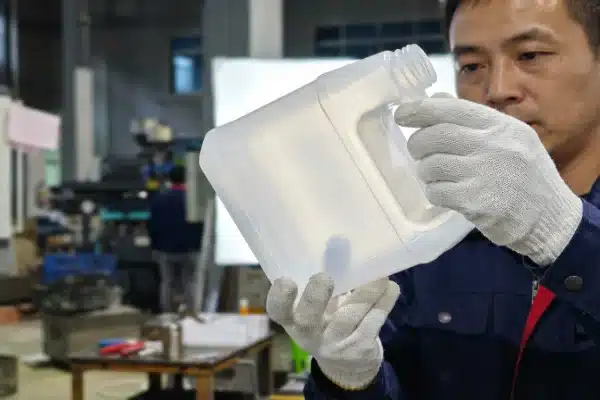
At our factory, we know that producing complex hollow shapes requires more than just standard settings; it demands precision to prevent wasted resin and weak corners in your final product Cubic Spline or S-Curve Interpolation 1. (29 words)
To evaluate wall thickness control, prioritize a parison controller with at least 100 to 400 profile points and spline interpolation. Ensure the servo actuator offers high bandwidth (under 15ms response) and verify if the machine integrates radial control (PWDS) to manage thickness distribution around complex, non-symmetrical bottle circumferences. (48 words)
Let’s break down the technical specifications and control architectures you need to check before signing that purchase order Position-Based Control 2.
How many points of parison control are available to manage complex bottle profiles?
We often see clients struggling with definition on sharp bottle corners because their current machines lack sufficient data resolution in the control loop to capture those details Step Response Time 3. (26 words)
For complex or irregular bottle profiles, a standard 30-point system is insufficient. You should require a controller with 100 to 400 points to minimize quantization errors. High-density profiling allows for precise micro-adjustments at critical stress points like handles, ensuring material is placed exactly where needed without waste. (46 words)
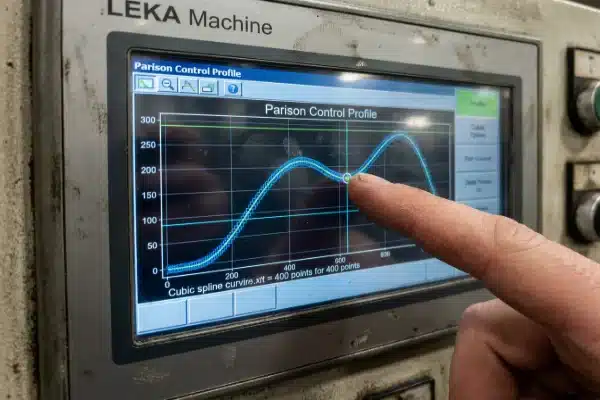
When you are evaluating an all-electric extrusion blow molding machine for irregular shapes, the "resolution" of the parison profile is your foundational metric. Historically, 30 to 100 points were standard. However, our engineering team has found that for irregular geometries—such as square bottles with sharp corners or containers with integral handles—this creates a "quantization error 4." If a stiffening rib is only 2mm wide, but your control points are spaced 3mm apart, the feature gets washed out.
The Math Behind the Points
You need to look for systems offering 400 to 512 control points. This density reduces the step size to sub-millimeter levels (e.g., 0.75mm on a typical household bottle), allowing you to program specific localized thickening bands for hinges or thinning notches for handle webbing.
Interpolation Algorithms matter
The sheer number of points isn’t enough; how the machine moves between them is critical. Lower-end controllers use Linear Interpolation, creating a jerky, faceted movement. Superior controllers use Cubic Spline or S-Curve Interpolation. These algorithms fit a smooth polynomial curve through your setpoints, ensuring the servo motor flows organically like the polymer melt itself. This prevents mechanical "ringing" and ensures that sharp transitions in your bottle design are executed smoothly without overshooting.
Time-Based vs. Position-Based Control
Finally, verify the domain of control. Avoid Time-Based systems where profiles drift if the cycle slows down. Always demand Position-Based Control, which locks the profile to the physical extrusion length. If the screw slows, the profile slows, ensuring your thick corners land exactly where they belong every time.
| Характеристика | Linear Interpolation (Basic) | Spline/S-Curve (Advanced) |
|---|---|---|
| Motion Path | Straight lines between points | Smooth polynomial curves |
| Physical Effect | Mechanical ringing/vibration | Fluid, organic movement |
| Overshoot | High at sharp profile changes | Minimal and controlled |
| Лучшее приложение | Simple round bottles | Complex/Irregular shapes |
Is the servo response fast enough to handle sharp transitions in my bottle design?
When we calibrate servo drives for our electric machines, we find that raw motor power means nothing without the ability to stop instantly and accurately. (24 words)
A servo system must achieve a step response time of under 15 milliseconds to handle sharp transitions effectively. Look for acceleration capabilities of at least 1G and low-latency fieldbus communication like EtherCAT. Slow response times cause profile smearing, resulting in weak corners and inconsistent wall thickness in irregular bottles. (49 words)
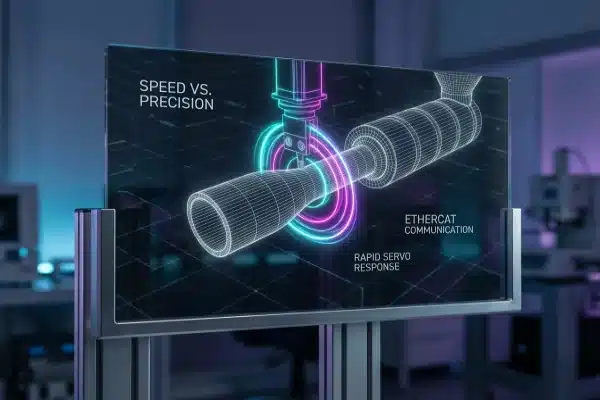
Producing an irregular bottle often requires the die gap to move from 100% open to 30% open and back again in a fraction of a second. This is where the physics of the machine layout becomes critical. The "Bandwidth" of the servo system defines how frequently it can accurately track a command. While hydraulic systems often cap out at 10-20 Hz due to oil compressibility, rigid all-electric linkages can theoretically hit 50-100 Hz. However, this is only possible if the system handles inertia correctly.
Analyzing the "Step Response"
When auditing a machine, ask for the Step Response Time. This measures how long it takes the actuator to move the die gap 10% of its full stroke. For complex profiling, this must be under 15 milliseconds. Anything slower than 25 milliseconds will "smear" your profile features—turning a programmed square wave into a sine wave on the actual parison.
Thermal Stability Risks
A unique challenge we encounter in EBM is that the precision actuator sits directly on top of a 200°C extrusion head.
- Expansion: A steel ball screw can expand with heat, causing a drift of 20-30 microns.
- Demagnetization: Servo motors can lose torque if they get too hot.
- Решение: Ensure the machine features liquid-cooled mounting flanges or active air barriers. Passive cooling is rarely enough for long-term consistency in high-precision molding.
Acceleration: The G-Force Factor
Don’t just look at speed; look at acceleration. To track a jagged profile, the actuator is constantly accelerating and decelerating. For large industrial bottles, we recommend rotary servo + roller screw setups capable of at least 1G (9.8 m/s²) acceleration.
| Performance Metric | Hydraulic EBM | All-Electric EBM (High-End) | Impact on Irregular Bottles |
|---|---|---|---|
| Response Time | 15-40 ms | < 10 ms | Electric enables sharper definitions. |
| Repeatability | ±0.5% (Drifts with oil temp) | ±0.01% (Encoder based) | Electric ensures the "heavy corner" hits the mold corner every cycle. |
| Force Control | Naturally force-dense | Requires oversizing | Electric actuators must be physically larger to match hydraulic force. |
How does the system compensate for material viscosity changes during long production runs?
In our experience exporting to regions with fluctuating raw material quality, we know that viscosity shifts can ruin an entire production run if unchecked. (23 words)
Advanced all-electric systems compensate for viscosity changes by monitoring extruder torque and melt pressure. The controller should automatically adjust the master die gap or cycle timing to counteract parison sag and swell. This active compensation loop ensures consistent bottle weight and wall distribution despite batch-to-batch resin variations. (47 words)
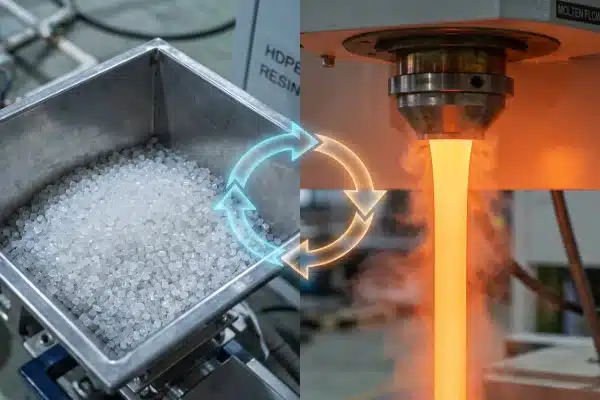
In a perfect world, polymer viscosity would be constant. In reality, it fluctuates with temperature, shear rate, and regrind percentages. For irregular bottles, where the safety factor on wall thickness is often minimized to save weight, these shifts can be catastrophic. Viscosity dictates two fundamental behaviors: Sag (gravity pulling the tube down) and Swell (the plastic expanding upon exit). A 5% shift in viscosity can cause the reinforced corner of a square bottle to drift into the flat panel area.
Active Compensation Mechanisms
You should look for machines that utilize "Auto-Viscosity Compensation." This works by monitoring the extruder screw torque and melt pressure.
- Pressure Rise: Indicates stiffer material, leading to less sag but more swell.
- Pressure Drop: Indicates thinner material, leading to more sag.
Managing PCR (Recycled Materials)
If you are running Post-Consumer Recycled (PCR) material, instability is guaranteed. The gold standard for processing PCR in irregular bottles is the tight integration of the Gravimetric Blender with the Parison Controller 5. If the blender detects a change in bulk density (like a surge of light fluff), it should signal the parison controller to proactively adjust the die gap via Feed-Forward Control. This allows the machine to react до the parison is extruded, rather than waiting for a bad part to be produced.
Radial Control (PWDS) Integration
For non-round bottles, axial control (up and down) is often only half the battle. You likely need Radial Control (PWDS or SFDR) to shape the parison circumference. When evaluating an all-electric machine, verify that the PWDS actuators are also electric and synchronized with the main axis. A phase lag of even 10ms between the "push" (axial) and the "squeeze" (radial) will misalign your material distribution.
| Переменная | Effect on Parison | Compensation Strategy |
|---|---|---|
| High Viscosity | Less Sag, High Swell | Machine increases cycle time or adjusts profile timing; opens Master Gap. |
| Low Viscosity | High Sag, Low Swell | Machine decreases cycle time; closes Master Gap. |
| PCR Fluctuation | Inconsistent Density | Gravimetric Feed-Forward signal to adjust throughput instantly. |
Заключение
Selecting the right EBM machine involves balancing resolution, speed, and adaptive software. Prioritize these factors to ensure high yields and consistent quality for your irregular bottle designs. (26 words)
Сноски
- Provides a mathematical explanation of cubic spline interpolation. ↩︎
- Explains the principles and applications of position control systems. ↩︎
- Defines step response time and its significance in evaluating control system performance. ↩︎
- Found authoritative Wikipedia page on quantization error. ↩︎
- Explains the role and importance of parison control in blow molding. ↩︎


0 Комментариев