
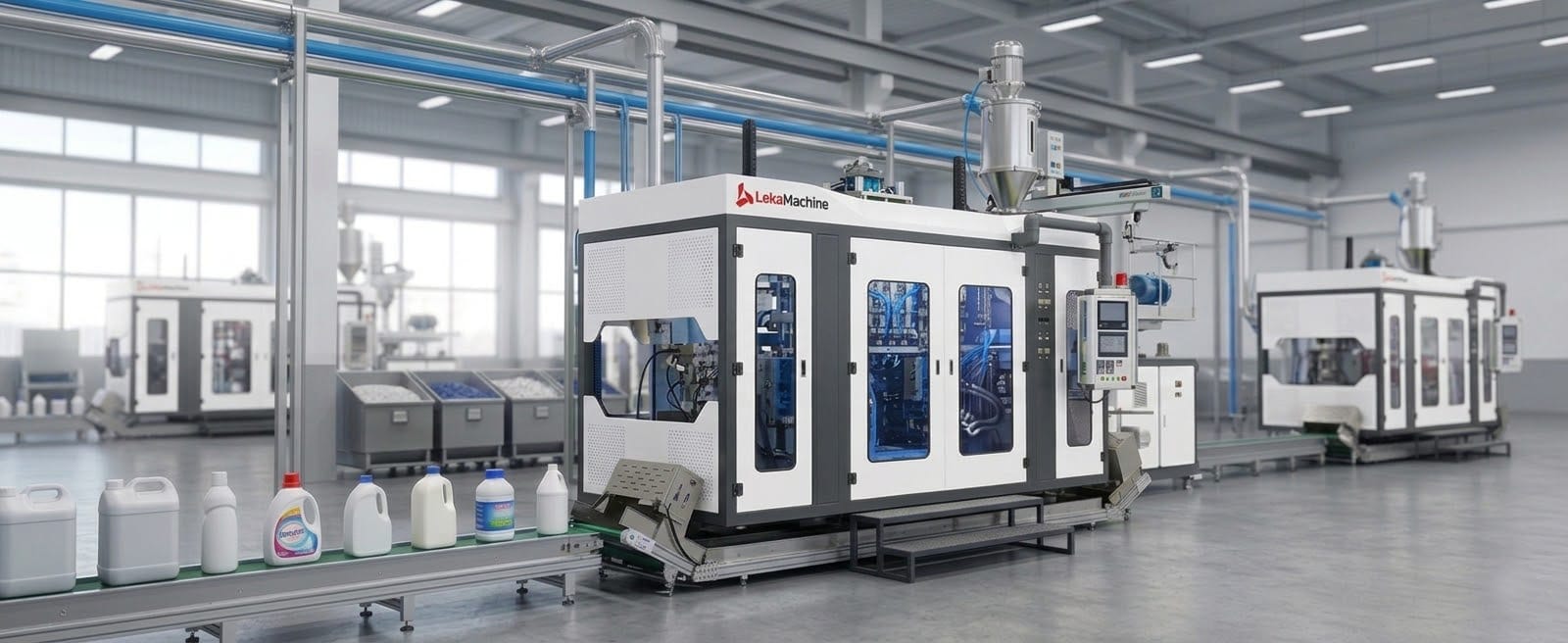
How to Make Chemical Bottles: HDPE Material, Blow Molding Process, and Design Considerations
Chemical bottles are used in a wide range of industries, from household cleaning and industrial chemicals to lubricants, agricultural inputs, and specialty liquid products. Although they may look simple from the outside, chemical containers must meet stricter practical requirements than many general-purpose bottles.
A good chemical bottle needs to resist product contact, protect against leakage, stay stable during storage and transport, and perform reliably on filling and packing lines. That means the manufacturing process must balance material choice, bottle structure, wall thickness, sealing design, and production stability.
Most chemical bottles are made from HDPE and produced through extrusion blow molding. This combination is widely used because HDPE offers strong chemical resistance and durability, while extrusion blow molding supports hollow bottle structures such as handle bottles, utility containers, and jerry cans.
This guide explains how chemical bottles are made, why HDPE is commonly used, which blow molding process is typically involved, and what design factors matter most in reliable chemical bottle production.
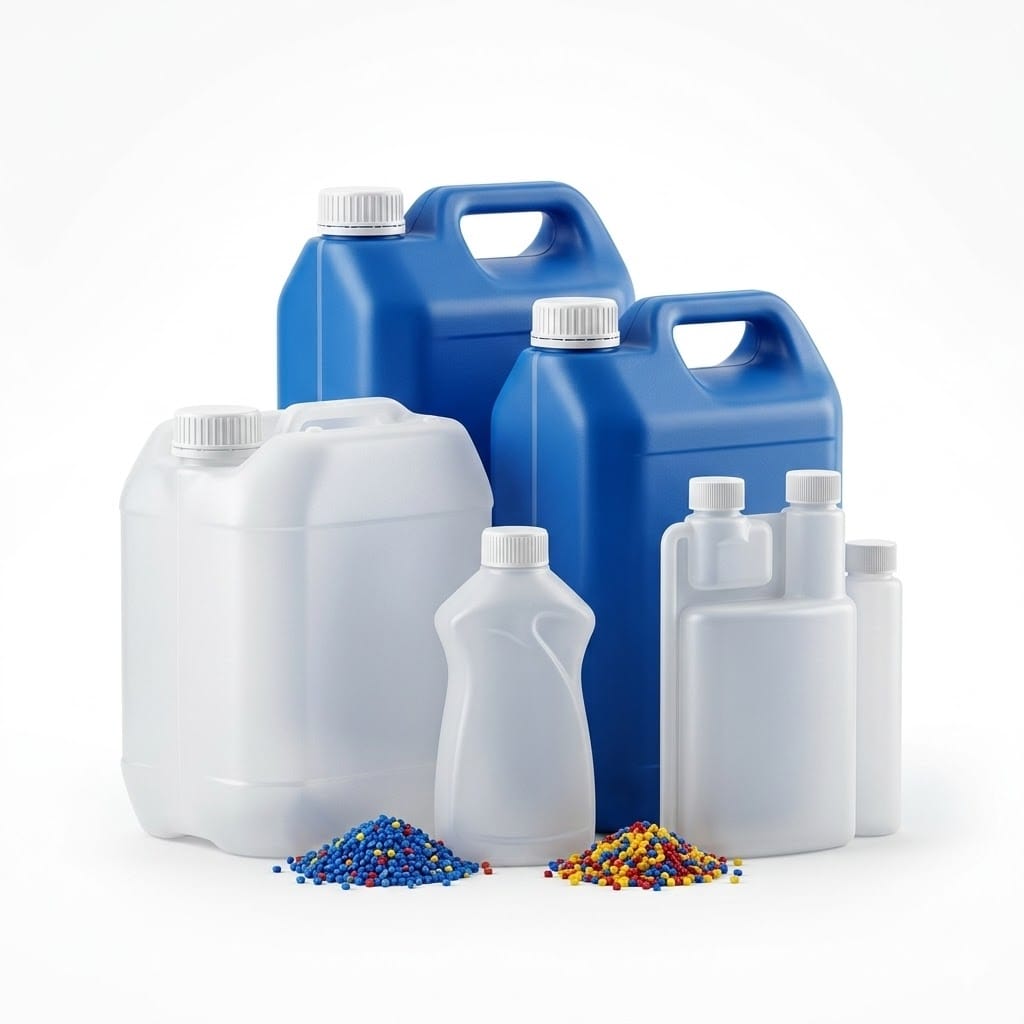
Why Chemical Bottles Are Usually Made from HDPE
HDPE, or high-density polyethylene, is one of the most common materials used for chemical bottle manufacturing. It is widely chosen because it combines practical strength, impact resistance, and chemical durability in a way that suits many industrial and household liquid products.
Chemical packaging often needs to perform under more demanding conditions than standard consumer bottles. Depending on the application, the container may need to resist aggressive formulas, remain stable during long transport cycles, and maintain reliable sealing through storage and repeated handling.
Manufacturers often choose HDPE for chemical bottles because it offers:
- Good chemical resistance for many liquid formulations
- Strong impact performance during transport and use
- Suitable stiffness for upright storage and stacking
- Good compatibility with handle bottle and jerry can structures
- Practical process performance in extrusion blow molding
That is why HDPE remains one of the most practical materials for detergent bottles, bleach bottles, industrial liquid containers, and many other chemical packaging formats.
What Machine Is Used to Make Chemical Bottles?
In most standard projects, chemical bottles are made with Экструзионно-выдувные машины. This process works well for HDPE packaging because it forms the bottle directly from molten plastic, making it suitable for functional bottle shapes and hollow industrial containers.
Extrusion blow molding is especially common for:
- Chemical bottles
- Bleach bottles
- Detergent containers
- Lubricant bottles
- Agrochemical containers
- Handle bottles
- Jerry cans
Compared with bottle processes designed mainly for clear PET packaging, extrusion blow molding is better suited to many HDPE chemical bottle applications where toughness, utility, and structural flexibility matter more than transparency.
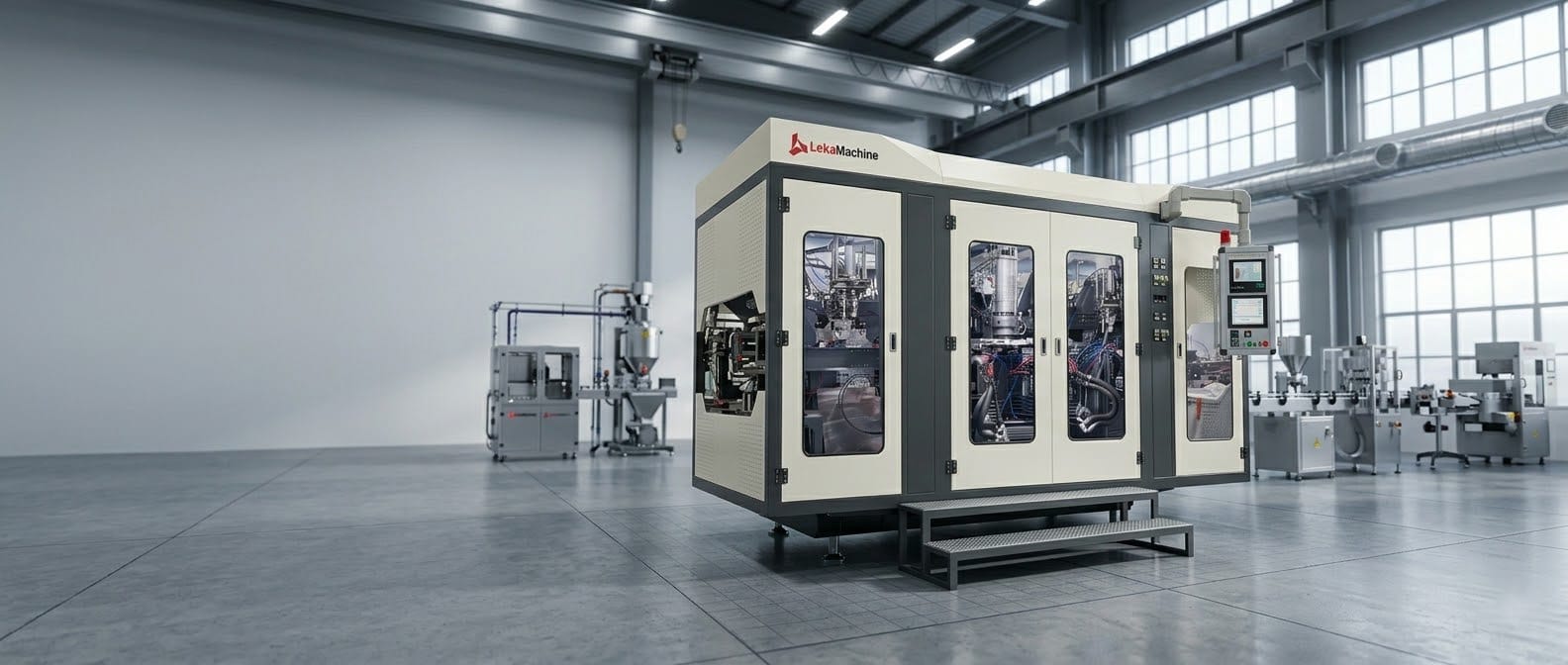
Explore extrusion blow molding machines
Step-by-Step Chemical Bottle Manufacturing Process
The production process for chemical bottles can vary depending on bottle size, chemical compatibility requirements, output targets, and mold design, but the main stages are usually similar across most HDPE bottle projects.
1. Raw material feeding
The process begins with HDPE resin, typically supplied as pellets. The material is loaded into the hopper and fed into the extruder. Depending on the bottle type, color masterbatch or performance additives may also be introduced at this stage.
Material consistency matters early. If resin behavior is unstable, bottle quality and process repeatability become harder to control later.
2. Melting and plasticizing
Inside the extruder, the resin is conveyed, heated, and mixed by the screw until it becomes a uniform molten material. Stable melting is important because poor temperature control can lead to uneven flow, weak bottle sections, or inconsistent cycle performance.
3. Parison formation
The molten HDPE is pushed through the die head and forms a hollow tube called a parison. This stage is critical because the parison strongly influences how material will be distributed across the bottle body, shoulders, base, and handle areas.
If parison control is weak, the final bottle may show uneven wall thickness, weak corners, or unnecessary excess material.
4. Mold closing and blowing
The mold closes around the parison, and compressed air is introduced. The plastic expands outward and takes the final bottle shape according to the mold cavity. This is where the body profile, shoulder geometry, neck structure, and handle form are created.
For chemical containers, this stage must be well controlled because bottle strength and leakage resistance depend heavily on stable formation.
5. Cooling
After the bottle has formed, it remains in the mold long enough to cool and stabilize. Cooling is essential because it affects dimensional consistency, bottle strength, and overall production speed. Poor cooling can cause bottle deformation, unstable geometry, or longer cycle times.
6. Trimming and deflashing
Because extrusion blow molding pinches excess material at mold closure points, additional plastic must be removed after forming. This step is often called trimming or deflashing. It is important for appearance, edge quality, and functional accuracy around sealing or handling areas.
7. Inspection and leak testing
Once bottles are formed and trimmed, they are usually inspected for visible defects, dimensional consistency, and leakage resistance. In chemical bottle production, leak testing is especially important because even a small sealing failure can create serious product, transport, and safety problems.
8. Bottle output and downstream handling
After inspection, bottles move toward conveying, temporary storage, filling, labeling, or packing depending on the factory layout. At this stage, the bottle manufacturing step is complete, but the quality of the bottle still determines how smoothly the rest of the packaging line will operate.
Important Design Considerations for Chemical Bottles
Chemical bottle production is not only about making a container that can hold liquid. The bottle must also match the practical demands of storage, handling, filling, transport, and end use.
Chemical compatibility
The first concern is always whether the bottle material is suitable for the intended chemical product. Different liquid formulations can affect material performance in different ways, so compatibility should be reviewed carefully during packaging development.
Wall thickness distribution
Wall thickness is one of the most important factors in chemical bottle quality. If the bottle is too thin in critical areas, it may fail during transport, capping, squeezing, or stacking. If it is too thick, more material is used than necessary, increasing bottle weight and production cost.
Handle structure and grip design
Many chemical containers use integrated handles or grip features for easier pouring and carrying. These structures must be designed carefully so they remain comfortable in use without weakening the bottle body.
Neck finish and closure matching
The neck area must be produced accurately so that caps or closures fit correctly. Poor neck finish quality increases the risk of capping defects, leakage, and inconsistent sealing.
Stackability and transport stability
Some chemical bottles must remain stable in cartons, on pallets, or in warehouse storage. In these cases, bottle shape, shoulder design, base geometry, and wall strength all affect transport performance.
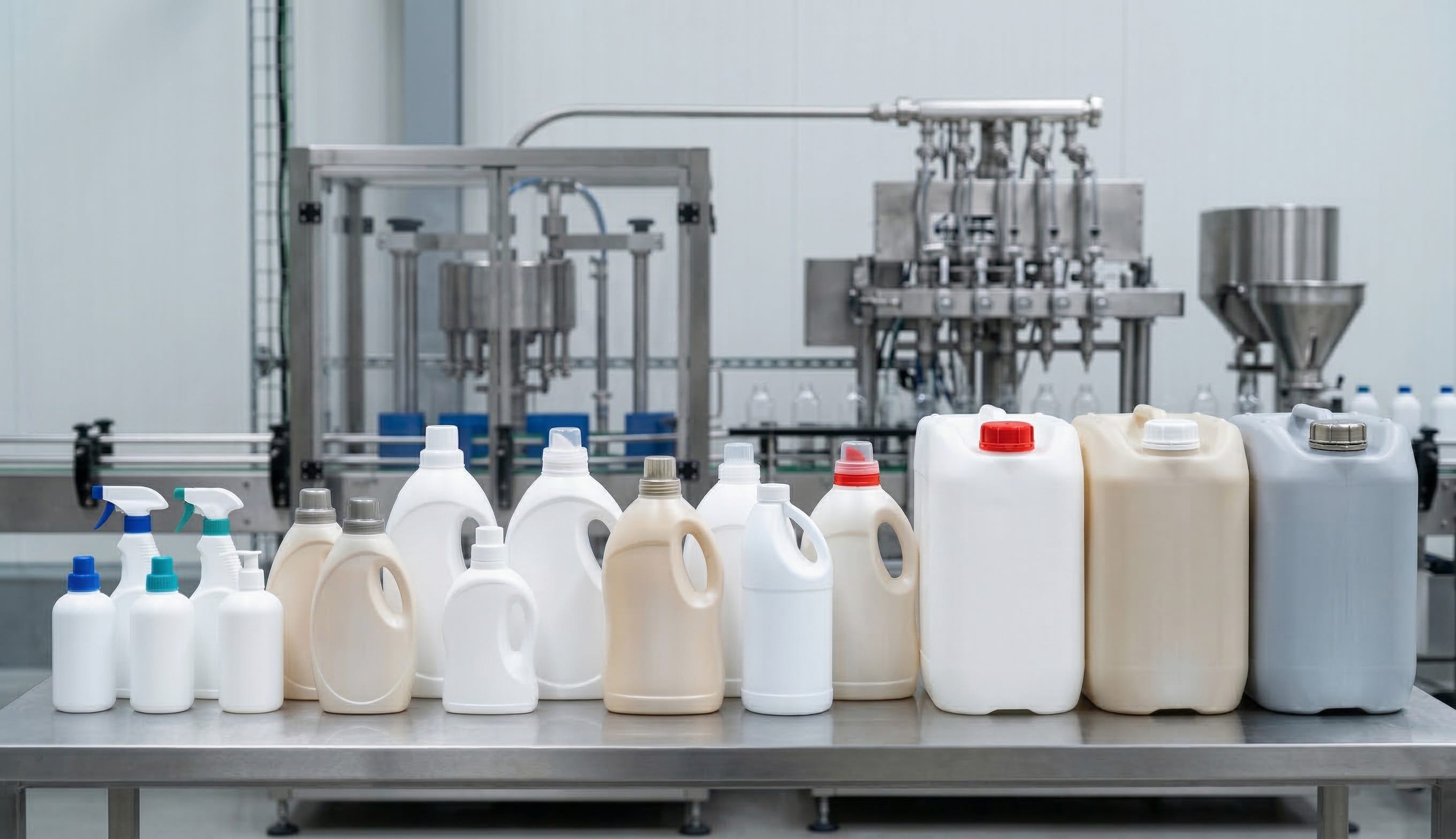
Common Quality Problems in Chemical Bottle Production
Several production issues appear repeatedly when the blow molding process is not stable or when bottle design and process settings are not properly matched.
Common quality problems include:
- Uneven wall thickness
- Weak corners or shoulder areas
- Handle weakness
- Flash trimming defects
- Leakage around the neck or pinch-off areas
- Bottle deformation after cooling
- Inconsistent bottle weight
Most of these issues are not caused by one factor alone. They usually come from a combination of resin behavior, parison control, mold cooling, blowing consistency, and trimming accuracy.
Why process stability matters
A chemical bottle may look acceptable during a short trial and still become unstable in long production runs. That is why stable extrusion, repeatable blowing conditions, balanced cooling, and consistent leak testing matter so much in real factory operation.
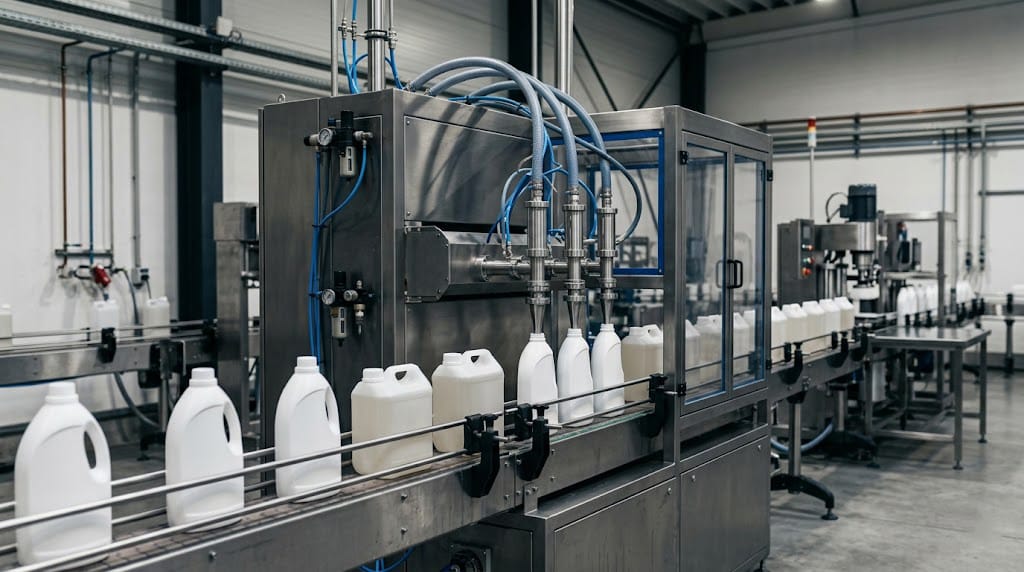
How Chemical Bottle Manufacturing Connects to the Filling Line
In actual production, bottle manufacturing does not stop when the bottle leaves the mold. The container must also work correctly on the downstream line, including filling, capping, labeling, and packing stages.
If bottle dimensions vary too much, if the neck finish is inconsistent, or if the base lacks stability, downstream packaging efficiency can suffer. That is why chemical bottle design and blow molding quality should always be considered together with filling line requirements.
Chemical Bottle Manufacturing vs Standard HDPE Bottle Production
Chemical bottles share many production principles with other HDPE bottles, but they often require tighter attention to sealing safety, wall distribution, handle strength, and product compatibility.
Compared with simpler utility bottles, chemical packaging may place more importance on:
- Leak resistance
- Chemical contact durability
- Transport safety
- More controlled neck and cap performance
- Better structural strength in functional areas
That is why chemical bottle manufacturing is often best approached as a complete packaging engineering task rather than only a simple bottle-forming process.
ЧАСТО ЗАДАВАЕМЫЕ ВОПРОСЫ
What material is commonly used to make chemical bottles?
HDPE is one of the most common materials used for chemical bottles because it offers practical chemical resistance, durability, and good suitability for extrusion blow molding.
What machine is used to make chemical bottles?
In most standard HDPE chemical bottle projects, extrusion blow molding machines are used.
Why is leak testing important for chemical bottles?
Leak testing is important because chemical products often require stronger packaging reliability. Even a small leakage problem can create transport, storage, and safety risks.
Can chemical bottles have handles?
Yes. Many chemical bottles and jerry cans use integrated handles, and extrusion blow molding is well suited to that kind of container design.
Is chemical bottle manufacturing the same as PET bottle manufacturing?
No. Chemical bottles are often made from HDPE through extrusion blow molding, while PET bottles are usually produced by stretch blow molding using preforms.
Заключение
Chemical bottle manufacturing depends on the right combination of material, bottle design, and blow molding process control. HDPE remains one of the most practical materials for this type of packaging because it supports durability, chemical resistance, and functional bottle structures across many applications.
From resin feeding and parison formation to blowing, cooling, trimming, inspection, and downstream handling, each production stage influences whether the final bottle will be safe, stable, and reliable in actual use.
The most useful way to understand chemical bottle production is to see it as a full packaging process. When material performance, bottle engineering, and process stability work together, the result is a container that performs well both on the production line and in the market.