





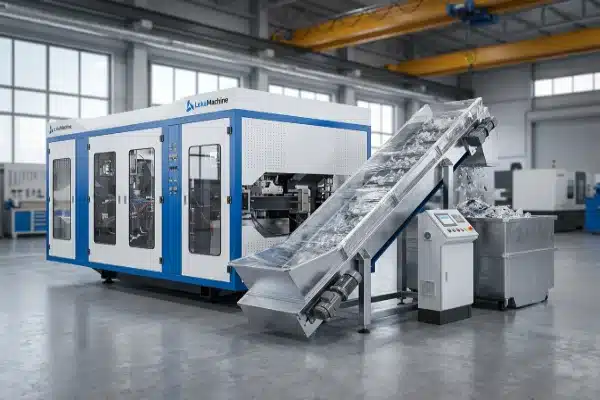
At our factory, we know that ignoring the scrap conveyor design often leads to catastrophic line failures High-Temperature Nylon 1. A poorly engineered system causes material jams, melted belts, and costly downtime that erodes your profit margins.
To verify the scrap conveyor design, you must ensure the belt material withstands temperatures over 260°C and checks for kinematic synchronization with the deflashing cycle. Additionally, confirm the integration of active ESD mitigation and modular link architecture to prevent jams and simplify maintenance.
Let’s examine the critical technical checkpoints to ensure your auxiliary equipment matches the efficiency of your all-electric machine EtherCAT (Ethernet for Control Automation Technology) 2. all-electric extrusion blow molding machine 3
Does the conveyor belt material withstand high-temperature parison drops?
We often see standard rubber belts melt under hot parisons, stopping production instantly Digital Twin technology 4. Without heat-resistant materials, your maintenance costs will skyrocket due to frequent belt failures and granulator issues.
Verify that the belt utilizes high-temperature nylon or PTFE-coated glass capable of resisting temperatures up to 287°C. Ensure the design includes conductive cooling sub-plates to rapidly solidify molten plastic, preventing it from gumming up the downstream granulator blades.
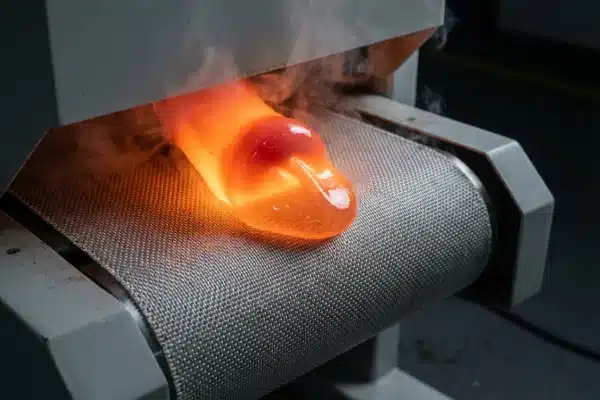
Thermal Resilience and Material Specifications
When we engineer solutions for high-output lines, the first thing we audit is the chemical composition of the belt. In extrusion blow molding, particularly with resins like HDPE or Polycarbonate (PC), the parison exits the die head at temperatures ranging from 190°C to over 260°C. Standard PVC or vulcanized rubber belts are chemically unstable at these ranges; they become brittle, crack, or fuse to the drive rollers.
To verify the design, you must demand specific high-performance polymers. For general purposes, we recommend High-Temperature Nylon, which withstands direct contact up to 154°C. However, for extreme applications, the gold standard is PTFE (Teflon) on a woven glass substrate, which provides a non-stick surface up to 287°C. This non-stick property is vital because it prevents the molten mass from adhering to the belt as it cools.
Active Conductive Cooling Sub-Plates
Material selection alone is not enough. Through our field experience, we have found that even if the belt survives, the molten plastic can remain too hot for the granulator. If a thick parison cookie enters the granulator above its glass transition temperature 5 ($T_g$), it causes "blade gumming"—smearing plastic across the knives and stalling the motor.
A properly designed system must include active aluminum sub-plates mounted beneath the belt in the drop zone. These plates should be plumbed into the machine's chilled water circuit. This setup extracts heat through conduction, creating a rigid skin on the plastic purge before it reaches the grinder.
Матрица выбора материала
We use the following matrix to guide our clients in verifying belt specifications:
| Belting Material | Max Temp | Key Advantage | Recommended Application |
|---|---|---|---|
| High-Temp Nylon | 154°C (310°F) | Modular repairability & impact resistance | General HDPE Bottle Production |
| 3-Ply White Butyl | 149°C (300°F) | FDA/USDA Compliant | Pharmaceutical & Food Containers |
| PTFE / Woven Glass | 287°C (550°F) | Extreme chemical inertness & non-stick | Engineering Resins (PC, ABS) |
| Silicone / Glass | 260°C (500°F) | High dielectric strength | High-Static Environments |
Is the conveyor mechanically synchronized to prevent dangerous jams?
In our testing, unsynchronized conveyors lead to scrap pile-ups that crush mold parting lines. This mechanical oversight risks expensive tooling damage and compromises the safety of the entire molding cell.
A properly designed system uses a master-follower topology where the conveyor drive is electronically coupled to the machine’s controller via VFDs or EtherCAT. This ensures precise movement for every molding cycle, preventing pile-ups and protecting the mold from crushing accumulated scrap.

Kinematic Synchronization and Master-Follower Logic
The most common failure we see in budget auxiliary setups is the "similar speed" fallacy—simply setting a conveyor motor to run at a constant 60Hz. This fails because it cannot account for micro-stops or cycle speed changes in the blow molding machine.
To verify a robust design, you must confirm that the conveyor operates on a Master-Follower architecture. In this setup, the blow molding machine’s controller acts as the Master, sending high-resolution encoder signals to the conveyor’s Variable Frequency Drive (VFD). This creates an electronic line shaft where the conveyor advances a specific distance for every degree of machine cycle rotation.
Implementing Fieldbus Protocols
For modern all-electric machines, we strongly advise verifying the use of EtherCAT (Ethernet for Control Automation Technology). Unlike standard analog signals, EtherCAT uses distributed clocks to synchronize the conveyor within milliseconds of the deflashing mechanism. This allows for Fail-Safe over EtherCAT (FSoE), meaning if the conveyor jams, the molding machine triggers a Safe Torque Off (STO) instantly, preventing the mold from closing on backed-up scrap.
Mechanical Fail-Safes: Slip Clutches and Modular Links
Even with digital synchronization, mechanical anomalies happen. We always inspect for Torque-Limiting Slip Clutches. If a massive purge creates a physical blockage in the granulator, the servo motor might try to power through, snapping the belt or drive shaft. A slip clutch mechanically disengages the drive sprocket when torque limits are exceeded, saving the motor.
Furthermore, we prioritize Modular Plastic Link Belts over endless rubber belts. If a jam damages a rubber belt, you have to replace the whole loop. With modular links, your team can pop out the damaged section and snap in new links in minutes, drastically reducing maintenance downtime.
Comparison of Synchronization Methods
| Synchronization Method | Operational Mechanism | Jam Prevention Efficacy |
|---|---|---|
| Independent AC | Fixed frequency (Hz); no feedback loop. | Poor: Susceptible to pile-ups during speed changes. |
| Master-Follower (Encoder) | Direct signal transfer; electronic line shaft. | High: Instant speed matching; stops if master stops. |
| EtherCAT Fieldbus | Deterministic network with distributed clocks. | Maximum: Sub-millisecond reaction; integrates with safety logic. |
How do smart features and ESD systems optimize the conveyor workflow?
We find that static electricity causes flash to stick to guards, blocking the path. Without smart integration, these invisible forces disrupt automated production and introduce contamination into your regrind.
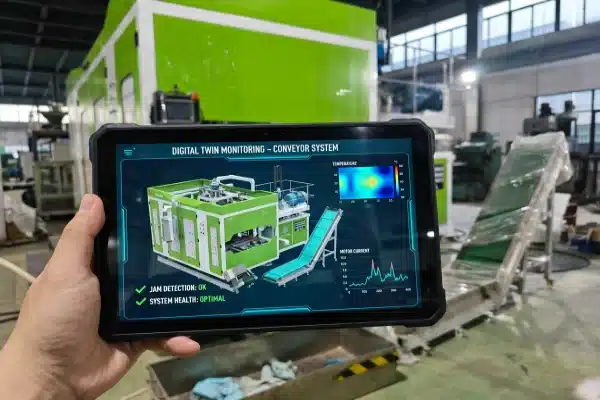
Verify the installation of active DC ionizing bars to neutralize static charges that cause flash to stick. Furthermore, ensure the system utilizes predictive sensors and digital twin validation to optimize drop trajectories and detect jams before they damage the equipment.
Active Electrostatic Discharge (ESD) Mitigation
In all-electric environments, the triboelectric charging of plastic is severe. As the parison is extruded and blown, it strips electrons, creating a strong static charge. We have observed lightweight flash adhering to metal guards rather than falling onto the belt, leading to clogged ejector pins.
Passive grounding is insufficient. You must verify the presence of Active DC Ionizing Bars (like the Model 3024) placed directly beneath the mold drop zone. These generate a dense cloud of positive and negative ions, neutralizing the plastic instantly so it falls freely. For complex geometries, we recommend Air-Assisted Ionizers that use compressed air to physically blow the neutralized flash onto the conveyor.
Intelligent Sensor Deployment
A "dumb" conveyor is a liability. We integrate specific sensors to transform the conveyor into an intelligent node.
- Photoelectric Sensors: Mounted at transition bends to detect physical jams. If a beam is broken for too long, it halts the system before the belt burns out.
- Current Monitoring: Analysis of the servo motor's current draw can predict bearing failure or belt misalignment weeks before a breakdown.
- Thermal Vision AI: Advanced systems use thermal cameras to detect massive "die spills." If a superheated blob is detected, the AI commands the conveyor to speed up, spreading the heat over a larger area to prevent concentrated melting.
Digital Twin Kinematic Validation
Finally, the best verification happens before the machine is built. We utilize Digital Twin technology to run rigid body dynamic (RBD) simulations. By inputting the specific mass and bounce coefficient of your bottle’s moils, we can mathematically predict the drop trajectory. This allows us to optimize diverter rail placement and separation gaps in the software, ensuring that when the physical machine arrives, the scrap separation is flawless without the need for weeks of trial-and-error adjustment.
ESD Technology Checklist
| ESD Application Zone | Recommended Technology | Mechanism of Action |
|---|---|---|
| Primary Drop Zone | High-Performance DC Ionizing Bars | Blankets area in ion cloud to neutralize falling parts. |
| Obstructed Pathways | Air-Assisted Vortex Blowers | Uses airflow to force lightweight flash onto the belt. |
| Regrind Transport | Ring Ionizers | Destaticizes regrind in pipes to prevent bridging in silos. |
Заключение
Verifying your scrap conveyor requires looking beyond the belt surface. By insisting on high-temperature materials, master-follower synchronization, and active ESD integration, you ensure your auxiliary equipment matches the reliability of your primary machinery.
Сноски
1. Replaced with a comprehensive article on high-temperature nylon properties and types. ↩︎
2. Provides comprehensive information on EtherCAT technology for industrial automation. ↩︎
3. Provides technical insights into control systems for all-electric blow molding machines. ↩︎
4. Explains the concept and applications of digital twin technology in manufacturing. ↩︎
5. Defines the critical thermal property of polymers and its significance. ↩︎


0 Комментариев