

How can I determine if the extrusion system of the all-electric extrusion blow molding machine can ensure parison stability?
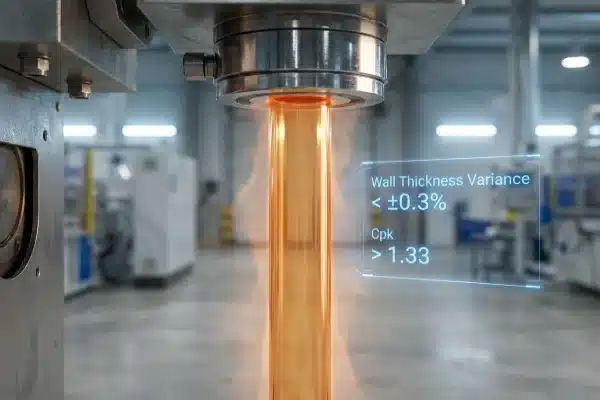
At our factory, we know that unstable parisons kill profit margins. You see inconsistent wall thickness, and your scrap rate climbs, leaving you frustrated with unpredictable output.
To determine parison stability, verify the extruder motor uses high-resolution absolute encoders (20-bit+) and tests for low-speed torque ripple. Perform a consecutive shot weight analysis targeting a Cpk > 1.33 with variation under ±0.3%, and ensure the controller offers closed-loop length control to counteract viscosity shifts.
Let’s break down the specific technical indicators you need to check before signing the contract.
What specs of the servo motor directly impact the precision of the parison wall thickness?
When we calibrate our flight controllers, we find that standard motors often fail at low speeds. This subtle vibration transfers directly to the plastic, ruining the finish.
The critical specs are high-resolution absolute encoders (minimum 20-bit) and low cogging torque. High resolution allows for minute 0.05mm mandrel gap adjustments without jitter, while low cogging prevents rhythmic "bamboo rings" on the parison during slow extrusion cycles, ensuring a smooth surface finish.

To truly understand why the servo motor specification makes or breaks your bottle quality, you have to look beyond the horsepower rating. In our assembly process, we have found that the "brain" and the "smoothness" of the motor are far more important than raw power when it comes to parison control.
The Role of High-Resolution Encoders
Standard servo motors might use a 12-bit or 16-bit encoder. For general automation, this is fine. However, in blow molding, the Parison Wall Thickness (WDS) actuator needs to make micro-adjustments to the mandrel gap. If the feedback loop is low-resolution, the system experiences "hunting." This is where the motor micro-jitters as it searches for the exact position.
We recommend ensuring your supplier uses a high-resolution absolute encoder (minimum 20-bit). This level of precision allows the machine to execute 0.05mm gap changes smoothly. Without this, you will see inconsistent wall thickness in the transition zones of your bottle, specifically where the neck meets the shoulder.
Low-Speed Torque Ripple (Cogging)
Another hidden enemy is "cogging." This happens when an electric motor vibrates rhythmically at low RPMs. Since the extrusion process for thick parisons often requires the motor to run slowly, inferior motors will create faint horizontal lines on the parison. These look like flow marks, but they are actually "bamboo rings" caused by the motor’s magnetic field snapping between poles. You must audit the motor specs for Low-Speed Torque Ripple to ensure the extrusion is glass-smooth.
Integration with Gravimetric Control
Finally, the motor must listen to the right data. We always verify that the servo is integrated with Gravimetric Loss-in-Weight Control. Volumetric dosing (just spinning the screw) is blind to changes in bulk density. If you switch from virgin pellets to a regrind mix (fluff), the density drops. A smart servo system detects this weight loss instantly and speeds up the screw to maintain the same parison weight.
| Характеристика | Standard Motor Spec | High-Precision LEKA Spec | Result on Bottle |
|---|---|---|---|
| Feedback | 16-bit Incremental | 20-bit+ Absolute | No jitter/hunting in profile |
| Low RPM | High Ripple (Cogging) | Low Ripple Design | No "bamboo rings" |
| Dosing | Volumetric Open Loop | Gravimetric Closed Loop | Stable weight using regrind |
How do I test the machine’s ability to handle weight fluctuations during long runs?
We often see competitors’ machines drift after an hour of running. In our testing facility, we stress-test systems to ensure thermal saturation doesn’t alter the bottle weight.
You must perform a "Consecutive Shot Weight" Cpk Analysis by weighing 50 consecutive parisons after the machine reaches thermal equilibrium. A stable system achieves a Cpk > 1.33 with weight variation under ±0.3%, proving the motor’s speed consistency outperforms hydraulic variance.

Validating a machine on the showroom floor is different from running it in a factory. A machine might look stable for five minutes, but does it hold that stability for 24 hours? At our factory, we use a specific validation protocol to ensure the extrusion system is robust against heat and pressure changes.
wall thickness 1
The Cpk Analysis Procedure
To prove stability, you cannot just weigh three random bottles. You need statistical proof. We recommend a "Consecutive Shot Weight" test.
- Warm-up: Run the machine for at least 30 minutes to ensure the barrel, screw, and die head are thermally saturated.
- Sampling: Collect 50 consecutive parisons (or bottles, if the mold is running).
- Measurement: Weigh each one on a precision scale (±0.1g accuracy).
- Calculation: Calculate the Cpk (Process Capability Index). A value over 1.33 indicates the process is statistically capable and stable.
If the weight drifts gradually up or down during this test, it usually indicates thermal instability in the barrel—the heaters are fighting the shear heat. If the weight fluctuates randomly, it points to servo instability or screw slip.
bulk density 2
Monitoring Melt Pressure (Back Pressure)
While the weight test tells you what is happening, the pressure gauge tells you why. During your test run, watch the Melt Pressure (Back Pressure) readout.
- Хороший результат: A flat line with minor deviations (±3 bar).
- Неудачный результат: Sawtooth waves or spikes.
Unstable pressure means the screw is "slipping" in the feed zone or the plastic isn’t melting consistently. Even if the servo motor is holding a perfect RPM, inconsistent pressure will force different amounts of plastic through the die, leading to weight fluctuations.
Rheological Balance 3
Acceptance Criteria Table
When we conduct Factory Acceptance Tests (FAT), we use strict criteria. You should use this table to evaluate your supplier:
| Метрика | Excellent (✓✓) | Standard (✓) | Fail (✗) |
|---|---|---|---|
| Weight Variation | ±0.1% – 0.2% | ±0.3% – 0.5% | > ±0.5% |
| Weight Range (150g) | ±0.5g | ±1.0g | > ±2.0g |
| Pressure Stability | ±2 bar | ±5 bar | > ±10 bar |
| Long-term Drift | No trend | Slight thermal drift | Clear rising/falling trend |
Can the supplier demonstrate the effectiveness of the parison programmer on complex bottle shapes?
Designing complex molds teaches us that gravity is the enemy. Without smart software, the bottom of your hanging parison thins out before the mold even closes.
Barrier Flight design 4
Yes, effective demonstration requires showing a 100-point profile resolution rather than the standard 30 points to avoid visible steps. Additionally, the system must prove its "Parison Sag Compensation" logic, which automatically biases profile points to counteract gravity-induced thinning during the extrusion drop.
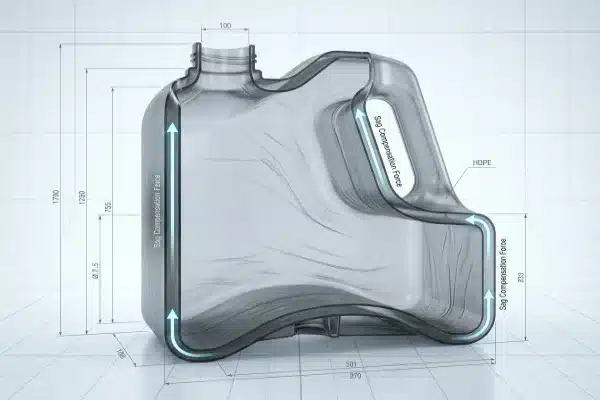
The parison programmer is the conductor of the orchestra. It tells the die head exactly how thick or thin the plastic tube should be at every millimeter of its length. When we develop solutions for oddly shaped bottles (like automotive ducts or handle-ware), we rely on three specific software features.
Melt Pressure 6
The 100-Point Resolution Standard
Older or budget controllers often use a 30-point profile. This means the controller divides the parison length into only 30 adjustable sections. On a large bottle, this results in visible "steps" or rings where the thickness changes abruptly.
We insist on a minimum of 100 profile points. This high resolution allows for smooth, curved transitions in wall thickness. It is the only way to optimize material distribution for lightweighting without creating weak spots. If the supplier shows you a jagged graph on the HMI, ask for higher resolution.
Fighting Gravity: Parison Sag Compensation
Plastic is heavy and hot. As the parison extrudes, the weight of the bottom pulls on the top, stretching it out. This is called "draw-down" or sag. The result? The top of your bottle ends up thinner than the bottom, even if you programmed them to be equal.
You need to verify the controller has "Parison Sag Compensation". This is an algorithm that automatically adds thickness to the upper points of the profile based on the cycle time and material viscosity. It biases the profile to counteract gravity. Ask the supplier to demonstrate this by changing the cycle time—the profile curve should shift automatically.
Closed-Loop Length Control
Have you ever seen a machine where the parison sometimes falls short of the bottom mold cavity? This happens due to slight voltage or viscosity shifts. A robust system features Closed-Loop Parison Length Control. A photocell detects the exact tail length of the falling parison. If the tail is too short or too long, the system micro-adjusts the extruder screw RPM for the next cycle. This self-correcting loop ensures every bottle is fully formed, reducing scrap significantly.
| Характеристика | Функция | Why it Matters |
|---|---|---|
| 100-Point Profile | High-res thickness control | Eliminates visible rings/steps on the bottle. |
| Sag Compensation | Counteracts gravity stretch | Prevents thin tops and heavy bottoms. |
| Length Control | Photocell feedback loop | Prevents short shots and wasted material. |
What screw design features should I look for to ensure consistent melt flow?
In our experience processing HDPE 7, a general-purpose screw is a recipe for disaster. It fails to mix the melt evenly, creating hot streaks that warp the bottle.
Look for a Barrier Flight geometry combined with a Maddock (shear) mixing section. These features are essential to homogenize melt temperature and prevent "thermal streaking," where hotter plastic strips cause the parison to curl or "banana" during the drop, ruining bottle straightness.
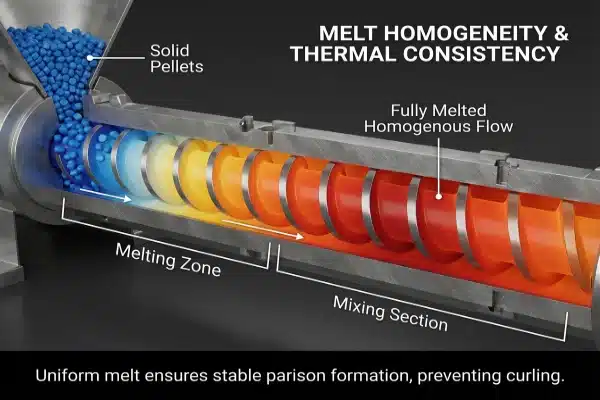
The extruder screw is the heart of the machine. Many buyers ignore it, assuming "a screw is a screw." But at our facility, we know that screw geometry is the primary defense against "parison curling" (bananaing). If the melt isn’t homogeneous, no amount of servo control can fix the bottle.
Process Capability Index 9
Геометрия полета через барьер
Standard general-purpose screws melt plastic by dragging it against the heated barrel wall. This often leaves a cold solid core of plastic in the middle of the channel.
We recommend a Barrier Flight design. This screw has a secondary flight that separates the melted pool from the solid pellets. It forces all the plastic to cross over a barrier gap, ensuring that 100% of the material is subjected to shear and heat. This eliminates un-melted gels (unplasticized material) that create weak spots in the bottle wall.
Maddock Mixing Section
Even if the plastic is fully melted, it might have temperature variations. A stream of plastic at 190°C flows slower than a stream at 200°C. If these streams enter the die head side-by-side, the faster (hotter) side will flow quicker, causing the parison to curl upwards toward the slower (colder) side.
To prevent this, the screw must have a Maddock (shear) mixing section near the tip. This section mixes the melt thoroughly, ensuring a uniform temperature profile. This is critical for preventing "thermal streaking."
Die Head Rheology: First-In-First-Out (FIFO)
Finally, inspect the die head design. It must prioritize Rheological Balance with a First-In-First-Out (FIFO) flow path. If the head has "dead spots" (corners where flow velocity is near zero), material hangs up there and degrades (burns). Eventually, this degraded material releases into the stream, causing a sudden drop in viscosity that destabilizes the parison swing. A clean, streamlined FIFO design ensures the plastic entering the mold is always fresh and consistent.
Заключение
Parison stability relies on precise servos, smart software, and correct screw geometry. Verifying these specs ensures your all-electric machine delivers consistent quality and high profitability.
absolute encoder 10
Сноски
- International standard providing official definitions for plastics terms including wall thickness. ↩︎
- Educational resource explaining the factors affecting bulk density in granular materials. ↩︎
- Overview of rheology, the study of material flow essential for understanding parison behavior. ↩︎
- Technical specifications for advanced screw geometries designed to improve melt homogeneity in extrusion. ↩︎
- Official guidance on rheological properties and viscosity measurement from a national standards laboratory. ↩︎
- Scientific reference explaining the role of melt pressure in maintaining polymer flow stability. ↩︎
- General background on HDPE, a common thermoplastic used in extrusion blow molding. ↩︎
- Industry organization providing standards and technical resources for blow molding and plastics processing. ↩︎
- Official NIST handbook detailing the calculation and application of the Process Capability Index. ↩︎
- Technical documentation for high-resolution absolute encoders used for precise positioning in industrial machinery. ↩︎


0 Комментариев