

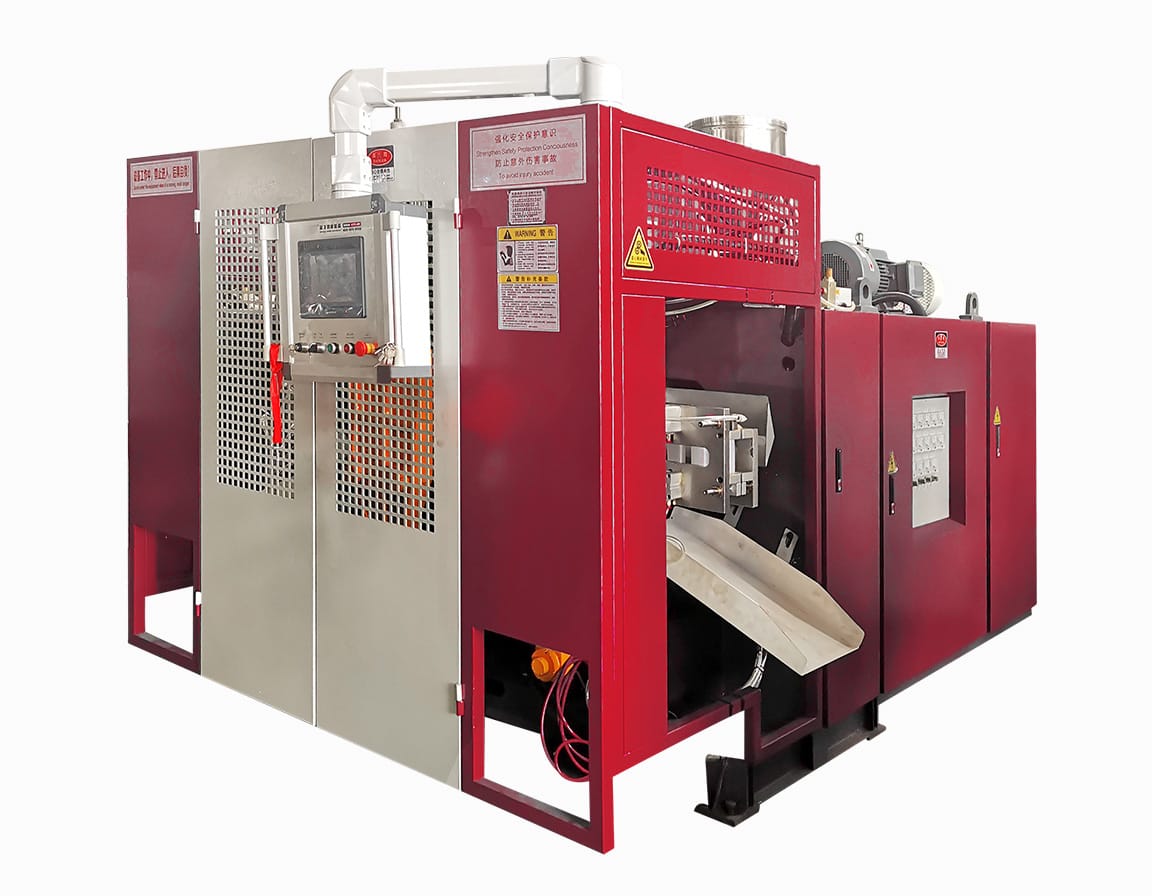



How Should I Request the Operation Manual and Maintenance Guide for the All-Electric Extrusion Blow Molding Machine?
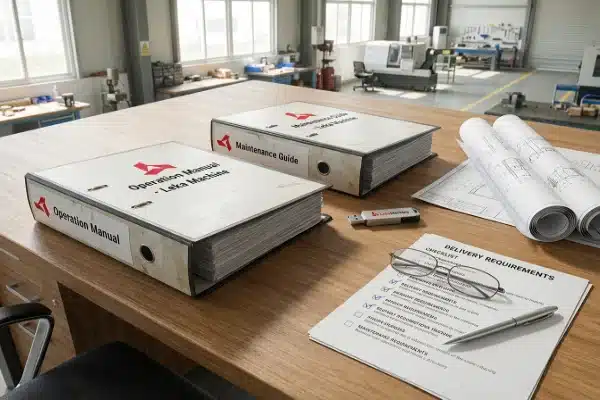
At our facility, we know that a missing manual during a breakdown costs thousands in lost production. Don’t wait until the machine stops to discover the documentation is incomplete or unintelligible. You must define your documentation requirements clearly before the contract is even signed.
To effectively request documentation, specify in your purchase order that the package must include an Operation Manual, a Maintenance Guide with servo calibration steps, "As-Built" electrical schematics matching the physical wiring, and an unencrypted PLC program backup. Withhold final payment until these verified documents are delivered.
Here is the breakdown of exactly what you need to demand to keep your production line running smoothly.
How do I ensure the electrical schematics provided match the exact configuration of my machine?
When wiring cabinets on our assembly floor, we ensure every change is recorded, because we know that outdated drawings make future repairs impossible. However, many suppliers skip this step to save time.
Ensure accuracy by conducting a spot check during the Factory Acceptance Test (FAT). Randomly select three components inside the cabinet and trace their wire numbers against the provided schematics. If discrepancies exist, require the supplier to "Red-Line" the drawings and sign off on the corrections before shipment.
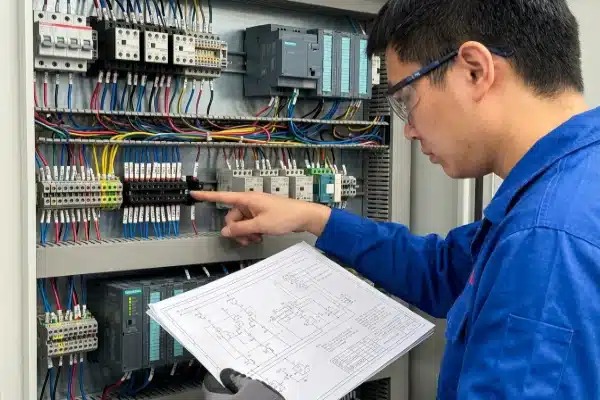
The Importance of "As-Built" Drawings
In the machinery world, there is a massive difference between "Standard Version" drawings and "As-Built" drawings. A standard drawing is a generic template that covers a whole series of machines. It does not account for the specific options you added, such as extra heating zones, specific brands of relays, or custom safety interlocks.
If you accept standard drawings, your local electrician will be blind when trying to trace a fault. For example, if your machine has a custom parison controller, but the drawing shows the standard version, the wire numbers 1 will not match.
The Red-Line Procedure
You do not need to check every single wire, but you must prove that the system works. During your FAT (Factory Acceptance Test), perform the following audit:
- Open the Electrical Cabinet: Look for the device tags on the components (e.g.,
KM-1for a contactor). - Find it on the Paper: Ask the engineer to show you
KM-1on the schematic. - Check the Wire Numbers: Look at the plastic ferrule on the wire connected to
KM-1. Does the number match the drawing? - Mark Errors: If it does not match, hand the engineer a red pen. Make them cross out the wrong number and write the correct one. This is called "Red-Lining."
Checklist for Schematic Verification
Use this table to audit the electrical drawings before you authorize the final payment.
| Item to Check | Требование | Why it Matters |
|---|---|---|
| Wire Numbering | Must match physical wire ferrules 100%. | Essential for tracing shorts or open circuits. |
| Component List | Must list the specific brand used (e.g., Siemens vs. Schneider). | You need to know what to buy if a part fails. |
| Modifications | Custom options must be drawn, not just handwritten notes. | Custom parts are the most likely to fail due to integration issues. |
| Cable Layout | External cable routing plans. | Helps you plan the installation trays in your factory. |
Can I request a comprehensive troubleshooting guide specifically for the servo drive errors?
Since our all-electric models rely entirely on servo precision 2, we know that generic error codes like "Servo Fault" are useless to operators when the machine stops. You need actionable data, not vague alerts.
You must request a mapping table that correlates HMI alarm codes to specific servo drive internal error codes. Additionally, demand the original drive manufacturer’s manual and a step-by-step "Zero-Point Calibration" procedure, ensuring your maintenance team can reset the machine origin after replacing a motor without external support.
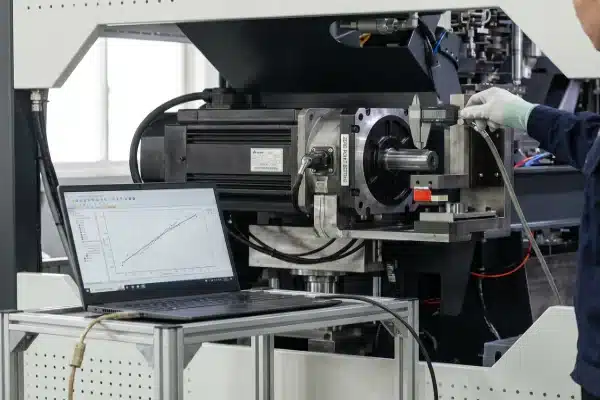
The "Black Box" Problem
All-electric blow molding machines use servo motors for the clamp 3, carriage, and extrusion. These are complex systems. Often, the machine builder treats the servo drive as a "black box." The HMI (screen) simply says "Error 501: Clamp Servo Fault."
This tells you nothing. Is it over-temperature? Over-current? A lost encoder signal? To fix this, you need the "Alarm Mapping List." This document connects the machine builder’s generic error code to the specific code inside the servo drive (e.g., Alarm A.04).
The Zero-Point Calibration (Homing)
This is the single most critical piece of documentation for an electric machine. If a servo motor fails and you replace it, the machine no longer knows where "Zero" is. If you try to run it, the mold might crash into the platen, causing thousands of dollars in damage.
You must ask for a specific procedure: "How to reset the Absolute Encoder Zero Position."
Essential Servo Documentation
Do not accept a manual that says "Contact Supplier for Servo Issues." Demand the following:
Servo Data Requirements
| Document Type | Description |
|---|---|
| Parameter Backup | A digital file or printed list of every setting inside the drive (P-001, P-002, etc.). If a drive burns out, you need these numbers to program the new one. |
| Drive Manual | The original manual from the drive manufacturer (e.g., Delta, Baumüller, Inovance), not just the machine builder’s summary. |
| Homing Procedure | Step-by-step photos showing where to physically position the mold before hitting "Set Zero." |
Is the maintenance manual available in clear English with detailed diagrams for part replacement?
We have seen competitors use auto-translate tools that turn technical instructions into nonsense, risking your technician’s safety 4 during critical repairs. You cannot afford ambiguity when dealing with high-voltage or high-pressure systems.
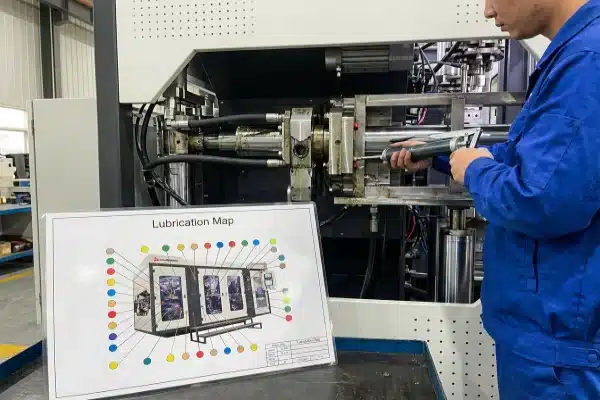
Specify in the contract that the maintenance manual must be written in technical English, not machine-translated text. It must include exploded-view diagrams for high-wear assemblies like the extrusion head and clamping unit, along with a lubrication map identifying specific grease types and intervals for every zerks fitting.
Visuals Over Text
In a good maintenance manual, pictures are worth more than words. Text can be misinterpreted, especially if English is not the supplier’s first language. Diagrams are universal.
You specifically need Exploded View Drawings for the mechanical assemblies. These drawings show every bolt, washer, and seal in the order they are assembled. When your maintenance team takes apart the die head to clean burnt plastic, they need this diagram to put it back together correctly. Without it, they might miss a seal, causing leaks that ruin production.
The Lubrication Map
Do not accept a manual that just says "Grease the machine regularly." That is a recipe for failure. You need a Lubrication Map.
This is a visual guide that points to every single grease nipple (zerk fitting) on the machine. It should tell you:
- Where the point is.
- What lubricant to use (e.g., Lithium-based EP2 vs. High-Temp Paste).
- How often to apply it (Daily, Weekly, Monthly).
Examining Translation Quality
Before you pay, ask for a sample page of the manual. Look for "Chinglish" or nonsense phrases.
- Bad Translation: "Open the electric big mouth carefully."
- Good Translation: "Open the electrical cabinet door with caution."
If the manual is hard to read, it becomes a safety hazard. Your technicians will ignore it, leading to improper maintenance and early machine failure.
Wear Parts Identification
| Компонент | Documentation Needed |
|---|---|
| Extrusion Head | Diagram showing heater band positions and thermocouple depths. |
| Cutting Knife | Adjustment procedure and part number for the specific blade. |
| Toggle System | Bushing and pin dimensions/part numbers for ordering local replacements. |
How do I verify that the PLC program comments are translated for my local engineers?
Our engineering team ensures all code comments are in English, but many suppliers leave logic descriptions in their local language, effectively locking you out of your own machine. This makes independent troubleshooting nearly impossible.
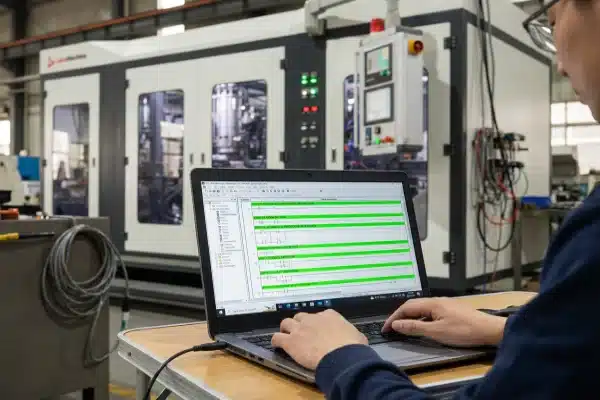
Verify PLC accessibility by requesting a screenshot of the main program routine before final payment. Check that the "Rung Comments" (green text explaining the logic) are in clear English. If the comments remain in the supplier’s native language, your local engineers will be unable to troubleshoot logic issues.
The Difference Between HMI and PLC
Many buyers get confused here. They see the buttons on the screen (HMI) are in English and assume the software is in English. This is wrong.
The HMI is just the interface. The "brain" is the PLC (Programmable Logic Controller 5). The PLC contains the actual code that runs the machine. Inside that code, engineers write notes to explain what is happening. These are called "Comments."
If the HMI is in English but the PLC comments are in Chinese or German, your local controls engineer cannot help you when the machine stops waiting for a signal. They will see the code, but they won’t know why the code was written that way.
Factory Acceptance Test 6
The Screenshot Test
You do not need to be a programmer to check this. Ask the supplier to send a screenshot of "Function Block 1" or the "Main Routine."
source code 7
Look at the text above the logic lines (usually in green).
- Does it say
// Check Safety Gate? (Pass) - Does it say
// 检查安全门? (Fail)
Unlocked Code vs. IP Protection
Some manufacturers lock their code to protect Intellectual Property (IP). While we understand protecting complex algorithms, the basic machine logic (inputs/outputs) must be open to the customer.
головка матрицы 8
If the supplier refuses to give you the source code, you must ask for an "Input/Output (I/O) List." This is a spreadsheet that tells you:
- Input
X0.1= Emergency Stop Button. - Output
Y1.2= Close Mold Valve.
Without this list or the open code, you are 100% dependent on the supplier for the life of the machine. If they go out of business or stop responding, your machine becomes unfixable.
main program routine 9
PLC Deliverables Checklist
| Item | Требование |
|---|---|
| Source Code | Unencrypted copy of the project file (e.g., .ap16 for Siemens). |
| Комментарии | All variable tags and network comments translated to English. |
| Passwords | List of any passwords required to access specific sub-routines. |
| Backup Battery | Instructions on how to change the PLC battery without losing the program. |
Заключение
Securing accurate documentation is as vital as buying the machine itself. By enforcing these requirements before shipment, you ensure long-term uptime and independence from the supplier, protecting your investment for years to come.
electrical cabinet 10
Сноски
- OSHA standards requiring clear marking and documentation of electrical circuits and components for safety. ↩︎
- Educational publication detailing the control theory and precision requirements of industrial servo systems. ↩︎
- IEEE technical standards for the performance and safety of industrial motor systems and controls. ↩︎
- Official UK safety guidelines for the maintenance and safe use of industrial work equipment. ↩︎
- Global industry standards for PLC programming to ensure interoperability and clear documentation practices. ↩︎
- Professional standards for conducting Factory Acceptance Tests to verify equipment meets technical specifications. ↩︎
- Definition and importance of source code accessibility for software-driven industrial machinery. ↩︎
- Technical background on the extrusion process and the function of the die head in manufacturing. ↩︎
- Official manufacturer documentation for programming and maintaining industrial automation control systems. ↩︎
- Technical documentation for industrial electrical enclosures and control components from a leading manufacturer. ↩︎


0 Комментариев