
How Can Buyers Secure Payment Terms When Purchasing All-Electric Blow Molding Machines?

At our facility, we often see buyers focus entirely on machine specifications while overlooking the financial structure of the deal. This oversight can lead to significant leverage loss before the equipment even ships. You need to ensure your capital is protected against delays or performance failures.
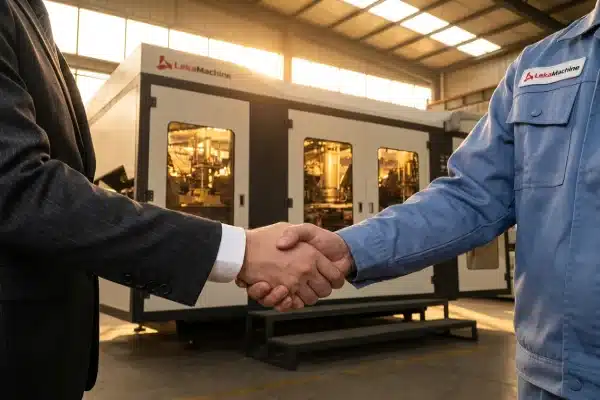
To secure your investment, negotiate a "30-60-10" payment structure tied to strict performance milestones rather than calendar dates. Use an irrevocable Letter of Credit for the pre-shipment payment, ensuring funds are released only after a signed Factory Acceptance Test (FAT) proves the machine meets Cpk and cycle time guarantees.
Most disputes we witness in the industry don’t arise from malicious intent but from misaligned expectations regarding "completion." By structuring your payments correctly, you transform a transactional purchase into a performance-based partnership. The goal is to keep the manufacturer motivated to deliver excellence right up until the machine is producing bottles on your floor.
What specific payment milestones should I negotiate to align with the Factory Acceptance Test (FAT)?
When we schedule production for a new order, we require cash flow to procure raw materials, but we understand you need leverage. Relying on a simple "notification of readiness" to trigger your bulk payment exposes you to the risk of receiving an untested machine.
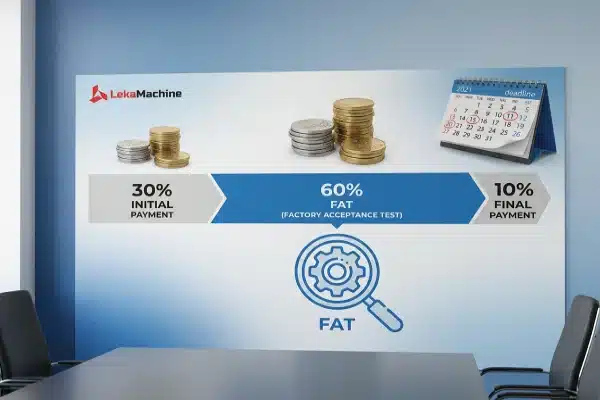
The industry standard dictates a "30-60-10" split: 30% down payment to start production, 60% pre-shipment payment contingent on a successful Factory Acceptance Test (FAT), and a 10% retention released only after the Site Acceptance Test (SAT). This ensures the manufacturer effectively finances the final stage until performance is proven.
The Trap of "Notification of Readiness"
In many standard contracts, the second and largest payment (usually 60%) is triggered when the manufacturer sends a "Notification of Readiness." We strongly advise against this. From our engineering perspective, a machine that is mechanically assembled is "ready," but it may not be "process capable 1."
You must contractually tie this 60% payment to your signature on a specific FAT Acceptance Report. This report is not just a formality; it is a data-driven document. It must confirm that the machine has run for a set period (e.g., 4 dry cycles or 2 hours of wet production) meeting the specific cycle times and Cpk (process capability) values promised in the quote. If the machine runs but produces bottles with uneven wall thickness or flash issues, the payment trigger is not met.
Structuring the 30-60-10 Split
To give you a clearer picture of how this protects you, here is a breakdown of the standard milestone structure we recommend for high-value assets:
| Payment Stage | Percentage | Trigger Event | Risk Mitigation |
|---|---|---|---|
| Down Payment | 30% | Contract Signing | Secures production slot; buyer shows commitment. |
| Pre-Shipment | 60% | Signed FAT Report | Prevents shipping of defective units; verifies cycle time. |
| Retention | 10% | Successful SAT (at buyer’s factory) | Ensures supplier assists with installation and debugging. |
Liquidated Damages for Delays
Beyond the payment split, your negotiation must address schedule slippage. If we or any other manufacturer miss the delivery date, it affects your production capacity. Therefore, the contract should include a "Liquidated Damages 2" clause.
Standard practice is a penalty of 0.5% of the total contract value per week of delay, typically capped at 5% or 10%. This does not just punish the supplier; it compensates you for the lost profit of the bottles you could not produce. Having this clause usually prioritizes your machine in the manufacturer’s assembly queue over clients who have no such penalties.
Is it standard to use an irrevocable Letter of Credit for high-value machinery purchases?
Our export team handles shipments globally, and we find that for transactions exceeding $100,000, trusting a bank often makes more sense than trusting a company. While direct wire transfers are faster, they offer you zero protection once the money leaves your account.
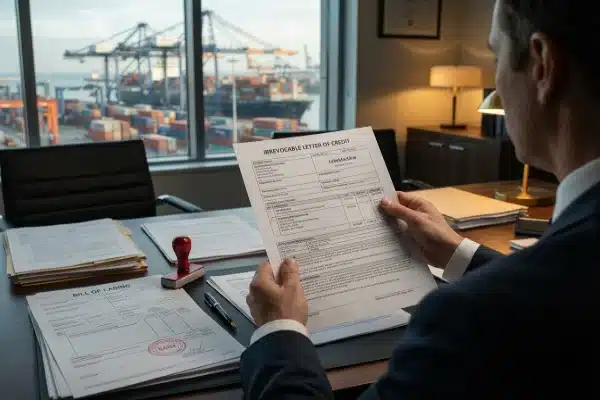
For the major 60% pre-shipment portion, use an Irrevocable Letter of Credit (LC) at Sight. This protects you by legally binding the bank to release funds only when the supplier presents compliant shipping documents, such as the Bill of Lading, proving the machine has actually left their possession.
The Mechanics of the Letter of Credit (LC)
An Irrevocable Letter of Credit 3 functions as a neutral referee. When you open an LC, you dictate the terms. You should stipulate that the bank can only release the funds when the supplier provides specific documents. Crucially, this prevents the "phantom shipment" scenario where a supplier claims to have shipped the goods to demand payment but has not actually secured a vessel booking.
However, an LC usually relies on paper documents, not the physical condition of the machine. To bridge this gap, you can add a clause requiring a "Certificate of Inspection" signed by your designated agent (or yourself) to be one of the mandatory documents presented to the bank.
Mitigating Component Shortage Risks
In the current supply chain climate, specific high-end components—particularly servo drives from brands like Physis or Inovance—can face long lead times. We have seen competitors ship "shells" (machines without the expensive electronics) just to generate a Bill of Lading 4 and claim the LC payment.
To prevent this, you should include a stipulation in the LC requirements: Verification of Servo Drive Serial Numbers. Before the LC is released, the supplier must provide a photo-verified inventory or a packing list certifying that the specific drives are installed in the cabinet.
Comparison: TT vs. LC
Below is a comparison to help you decide which method suits your risk appetite:
| Характеристика | Telegraphic Transfer (T/T) | Irrevocable Letter of Credit (LC) |
|---|---|---|
| Стоимость | Low ($20-$50 fee) | High (0.5% – 2% of value) |
| Скорость | Immediate (1-3 days) | Slow (Drafting takes weeks) |
| Buyer Risk | High (Money gone before receipt) | Low (Bank holds funds) |
| Supplier Preference | High (Cash in hand) | Low (Strict documentation required) |
| Лучший пример использования | Spare parts, small deposits | Main machinery balance (60%) |
The "Digital Hostage" Prevention Clause
All-electric blow molding machines are heavily software-dependent. A hidden risk in modern machinery is the "logic bomb" or remote deactivation timer. This is where a manufacturer programs the PLC 5 to shut down after a certain date if a code isn’t entered—essentially holding the machine hostage for the final payment.
You must include a clause in your purchase agreement explicitly forbidding "logic bombs," time-locks, or remote deactivation protocols in the servo drive firmware or PLC. This ensures that once you pay the 60% and receive the machine, you own it fully, and the supplier cannot remotely "brick" your equipment during a dispute over the final 10%.
How can I retain a portion of the final payment until the machine is successfully installed at my factory?
We know that once the machine leaves our dock, the dynamic changes. You need assurance that we will support the installation, while we need assurance that you won’t invent reasons to withhold the final balance indefinitely.
The release of the final 10% retention should be tied to a Site Acceptance Test (SAT) defined by continuous performance, such as running 24 hours without alarm interruptions, rather than a vague "30 days after arrival" clause, which exposes you to risk if installation is delayed.
Defining "Final Acceptance"
Suppliers often try to insert "Deemed Acceptance" clauses, such as "If the buyer does not reject the goods within 7 days, they are deemed accepted." This is dangerous for all-electric machinery. Thermal stability issues in servo motors or mold cooling imbalances often don’t appear until the machine has reached a steady state of heat, which can take shifts of operation to stabilize.
scrap rate 7
You must negotiate the Deemed Acceptance window to be at least 30 days post-installation. Furthermore, the definition of SAT must be objective. For example: "The machine must produce X bottles per hour at Y weight for a continuous 24-hour period with less than 1% scrap rate." This removes opinion from the payment equation.
The Advance Payment Guarantee (APG)
Your initial 30% deposit is the riskiest money you spend. If the manufacturer goes bankrupt or simply fails to start production, that money is often lost. To secure this, you should demand an Unconditional Bank Guarantee (specifically an Advance Payment Guarantee) from the supplier’s bank.
This document effectively says that if the supplier fails to deliver, the bank will refund your deposit immediately without the need for litigation. While this may cost the supplier a fee, it is a reasonable request for a six-figure investment.
servo drives 8
Swapping Retention for Warranty Bonds
Sometimes, we manufacturers need cash flow and prefer not to wait months for the final 10%. A sophisticated negotiating tactic you can use is to offer to release the final 10% immediately upon installation in exchange for a Warranty Bank Guarantee (WBG).
A WBG is a bond valid for the duration of the warranty period (12–24 months). If the machine suffers a catastrophic failure and the supplier refuses to fix it, you can claim the bond from the bank. This is often better than a simple retention because a WBG covers you for the entire warranty period, whereas a 10% retention is usually paid out after just a few weeks of running.
Irrevocable Letter of Credit 9
Summary of Guarantee Instruments
| Instrument | Назначение | Benefit to Buyer | Benefit to Seller |
|---|---|---|---|
| Advance Payment Guarantee (APG) | Secures the 30% Deposit | Refund if vendor fails to start/ship. | Builds trust with new clients. |
| Performance Bond | Secures Delivery/Specs | Compensation if machine underperforms. | proves confidence in engineering. |
| Warranty Bank Guarantee (WBG) | Secures Post-Sale Service | Cash recourse during warranty period. | Unlocks the final 10% payment early. |
Заключение
Negotiating payment terms is about balancing leverage. By insisting on a 30-60-10 split, utilizing LCs for the bulk payment, and securing your deposit with bank guarantees 10, you ensure that we, the manufacturer, remain as invested in the machine’s success as you are.
Сноски
- ISO standard for statistical methods in process capability and performance. ↩︎
- Defines the legal concept of pre-determined compensation for contract delays. ↩︎
- Official US government guide on using letters of credit for international trade. ↩︎
- Explains the legal document representing the title of goods during transport. ↩︎
- Product documentation for Programmable Logic Controllers used in industrial automation. ↩︎
- Recent news regarding global supply chain disruptions affecting industrial components. ↩︎
- Research publication discussing manufacturing efficiency and scrap rate reduction. ↩︎
- Technical documentation for high-end servo drives mentioned in the article. ↩︎
- The International Chamber of Commerce sets global standards for trade finance. ↩︎
- UK government guidance on bank guarantees for securing advance payments. ↩︎


0 Комментариев