






The Ultimate Guide to Selecting Blow Molding Machine Suppliers in 2026?

At our factory, we often see business owners overwhelmed by the complexity of importing machinery. Choosing the wrong partner leads to production bottlenecks and wasted budget, which stalls your business growth.
To select the best blow molding machine supplier, prioritize manufacturers who offer verified specific energy consumption (SEC) ratings, local "first-pass" spare parts availability, and transparent "wet cycle" Factory Acceptance Tests (FAT). A reliable partner must demonstrate servo-driven hydraulic capabilities and provide clear "digital twin" validation for custom bottle designs.
Let’s break down the four critical pillars of vetting a machinery partner to ensure your investment delivers consistent returns.
How do I verify a supplier’s capability to customize the machine for my specific bottle design?
Our engineering team frequently receives requests where standard machines simply cannot handle complex geometries. Relying on a "one-size-fits-all" solution often results in high scrap rates and inconsistent wall thickness.
Verify customization capability by demanding a "Digital Twin" validation where the supplier simulates kinematic code against your mold model. Ensure they engineer screws specifically for your resin type and offer "Admin Level" PLC access, allowing your team to adjust logic for unique operational requirements without relying on external support.
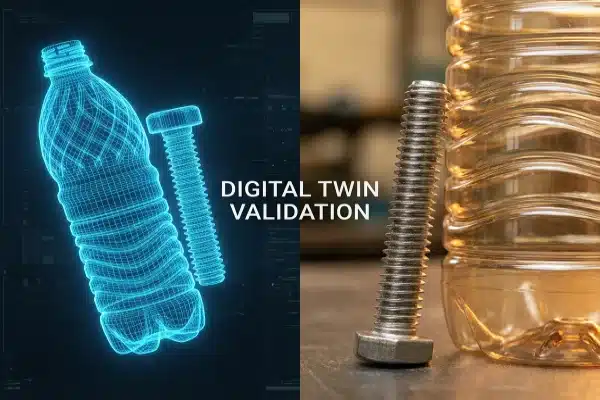
The Power of Simulation vs. Guesswork
In the past, customization often meant "build it and see if it works." However, in modern manufacturing, we use "Digital Twin" validation. Before we cut a single piece of metal, we should be able to simulate the machine’s kinematic code against a digital model of your specific mold. This prevents physical collision risks, especially for complex shapes like handle-ware or asymmetrical automotive parts. If a supplier cannot show you this simulation, they are likely guessing at the configuration.
Screw Design for Resin Specificity
A major point of failure we observe involves the extruder screw. Many suppliers install a "universal" screw to save costs. However, a screw designed for virgin HDPE will struggle with 100% Post-Consumer Recycled (PCR) material or PETG.
Post-Consumer Recycled (PCR) material 1
- Universal Screws: Often cause material degradation or inconsistent parison delivery.
- Custom Screws: Engineered for specific shear rates and compression ratios tailored to your resin.
We strongly advise asking your potential supplier if they engineer the screw geometry based on your specific material data sheet.
PLC Code Sovereignty
Finally, consider who owns the "brain" of your machine. Many manufacturers lock their PLCs, forcing you to pay for service calls for minor adjustments. We believe in providing "Admin Level" access or using non-proprietary hardware (like Siemens or Beckhoff). This ensures your internal team isn’t locked out of making logic adjustments or minor repairs.
Comparison: Standard vs. Customized Engineering
| Характеристика | "Universal" Machine Supplier | Customized Solution Partner |
|---|---|---|
| Screw Design | Generic geometry for all resins | Tailored shear rates for PCR/HDPE/PET |
| Simulation | None (Physical trial & error) | Digital Twin / Virtual Commissioning |
| PLC Access | Locked (Password protected) | Open Admin Access / Non-proprietary |
| Risk Level | High (Potential material burn) | Low (Validated before build) |
What critical questions should I ask about Factory Acceptance Tests to ensure the machine meets my output targets?
When we prepare machines for shipment, we know that a simple "dry cycle" demonstration hides potential cooling bottlenecks. Accepting a basic test often leads to capacity shortfalls once production begins.
You must insist on a "Wet Cycle" Stress Test running continuously for 4 to 8 hours using actual resin and molds. Ask if the FAT includes specific scrap rejection logic testing and demand data on the machine’s thermal stability under load, rather than accepting simple theoretical dry-cycle speeds.

The "Wet Cycle" Reality Check
A "dry cycle" test—where the machine moves without plastic—is useful for checking mechanics, but it is useless for verifying production capacity. It does not account for cooling time, material behavior, or parison stability.
We recommend refusing any FAT that does not include a "Wet Cycle" Stress Test. This involves running the machine with your actual mold and resin for a minimum of 4 to 8 hours continuously. This duration is critical because thermal instability often reveals itself only after the machine has reached a steady heat state, typically after 3 hours of operation. Short runs hide these issues.
"Ghost Shift" Autonomy Features
If you plan to run overnight shifts with minimal staff, you must test the machine’s autonomy during the FAT. Ask the supplier to demonstrate "Ghost Shift" capabilities.
- Auto-Restart Logic: Can the machine recover from minor alarms (like a temporary parison error) without human intervention?
- Scrap Rejection: Does it automatically divert defective bottles produced during startup or error states?
Verified Data Points
Do not just sign off on "good bottles produced." The FAT report should include data logs.
- Cycle Time Consistency: Is the cycle time stable within 0.1 seconds?
- Temperature Drift: Do heater bands maintain setpoints within +/- 1 degree?
FAT Protocol: What to Demand
| Test Type | Duration | Назначение | Critical Success Factor |
|---|---|---|---|
| Dry Cycle | 30 Mins | Mechanical movement check | Smooth motion, no vibration |
| Wet Cycle | 4-8 Hours | Thermal stability & Output | Consistent bottle weight & cooling |
| Changeover | Переменная | Test mold/color change speed | Time from "Stop" to "Good Part" |
| Alarm Sim | Н/Д | Safety & Recovery logic | Machine stops/restarts correctly |
How can I assess the reliability of a supplier’s after-sales service and spare parts delivery to my region?
From our experience exporting to North America and Europe, we know that distance creates anxiety regarding downtime. A supplier without a localized logistics strategy can turn a minor part failure into a week-long shutdown.
Assess reliability by requesting the supplier’s "First-Pass Fill Rate" for spare parts specifically within your geographic region. Verify that critical components like PLC cards and heater bands are stocked locally, and scrutinize their remote diagnostics security to ensure safe, hardware-based VPN access for rapid troubleshooting without compromising your network.
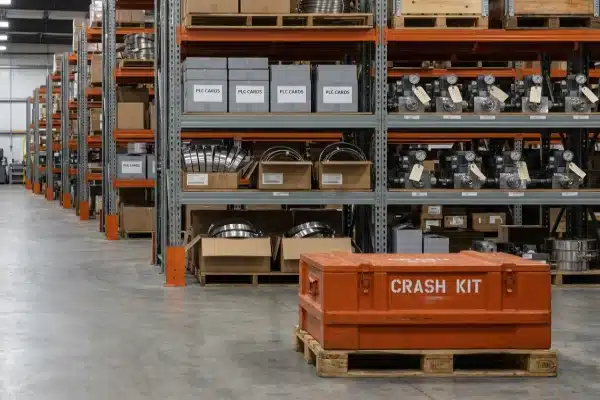
Local "First-Pass" Parts Availability
The most important metric for a remote supplier is their "First-Pass Fill Rate" in your region. This measures the percentage of spare parts orders that are filled immediately from local stock rather than being shipped from the overseas factory.
reporting carbon footprint 2
- Critical Components: Heater bands, thermocouples, hydraulic valves, and PLC cards must be available locally (e.g., within the US or EU).
- Non-Standard Parts: Specialized items can be shipped from headquarters, but consumables must be close to you.
At our facility, we recommend clients purchase a "Crash Kit" along with the machine. This kit contains the essential proprietary parts that would otherwise cause a long stoppage.
servo-driven hydraulic pumps 3
Remote Diagnostics Security
In 2026, remote troubleshooting is standard, but security is often overlooked. You need to scrutinize the cybersecurity of the machine’s remote module.
- Hardware VPN: Ensure the connection uses a hardware-based VPN.
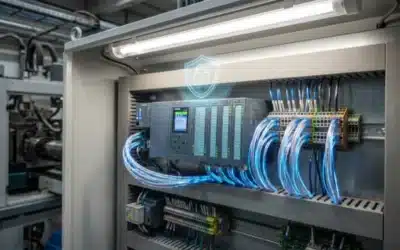
- Physical Switch: There should be a physical "read-only" or "off" switch on the machine cabinet. This gives you control, preventing unauthorized external access to your factory network when you don’t need support.
Evaluating Support Tiers
When comparing quotes, look beyond the price of the machine to the cost of the support contract.
Specific Energy Consumption (SEC) 4
- Tier 1 Support: Local engineer availability (expensive but fast).
- Tier 2 Support: Remote engineer via video call + local 3rd party technician.
- Tier 3 Support: Email/WhatsApp support only (high risk for complex issues).
What are the key indicators of a high-quality supplier when comparing quotes for energy-efficient blow molding machines?
When we optimize parison controllers and hydraulic systems, we see massive differences in power consumption between budget and premium machines. Ignoring specific efficiency metrics can result in utility bills that exceed the machine’s cost over time.
cybersecurity of the machine’s 5
Look for a guaranteed Specific Energy Consumption (SEC) rating measured in kWh per kg of processed plastic, including auxiliary chillers. True high-quality suppliers use servo-driven hydraulic pumps that consume power only during movement, potentially reducing energy costs by 30–60% compared to constant-speed motors used in standard budget machinery.

Understanding Specific Energy Consumption (SEC)
Many flyers slap an "Eco-Friendly" label on the machine, but this is marketing fluff. You need to ask for the Specific Energy Consumption (SEC) rating.
- The Metric: Request the figure in kWh per kg of plastic processed.
- The Scope: Ensure this figure includes the auxiliary chillers and compressors, which often consume more power than the machine itself.
A high-efficiency machine processing HDPE might achieve an SEC of 0.30 kWh/kg, whereas an older hydraulic design could be over 0.55 kWh/kg. Over a year of 24/7 production, this difference is worth tens of thousands of dollars.
steady heat state 7
Servo-Driven Hydraulics Verification
The technology behind the pump matters. You should confirm the machine uses servo-driven hydraulic pumps rather than constant-speed AC motors.
- Constant Speed: The motor runs at 100% RPM even when the machine is idle (cooling phase), wasting energy as heat.
- Servo-Driven: The motor spins only when oil flow is needed. It stops during cooling. This typically yields energy savings of 30-60%.
Native ESG Data Streams
As regulations tighten in 2026 and beyond, reporting carbon footprint is becoming mandatory for many supply chains. A forward-thinking supplier provides machines with native ESG data capabilities. The software should natively export granular "carbon cost" data (energy + material usage per bottle) directly to your ERP system. This eliminates the need for manual calculations when reporting sustainability metrics to your customers.
Factory Acceptance Tests (FAT) 8
5-Year Operational Cost Projection
| Cost Driver | Standard Hydraulic Machine | Servo-Driven Machine |
|---|---|---|
| Первоначальная стоимость | $80,000 | $105,000 |
| Energy (Yearly) | $45,000 | $28,000 |
| Cooling Load | High (Oil heats up) | Low (Less heat gen) |
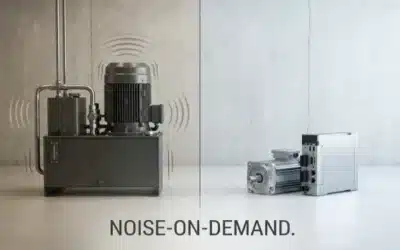
| Noise Level | >85 dB | <75 dB |
| Итог за 5 лет | $305,000 | $245,000 |
Note: Even with a higher upfront price, the servo machine saves $60,000 over 5 years.
Digital Twin validation 9
Заключение
Selecting the right partner requires digging past the brochure claims. Focus on verified engineering, rigorous "wet cycle" testing, and established local support to ensure your production line succeeds long-term.
выдувная машина 10
Footnotes
- Industry standard body for plastics recycling guidelines and certification. ↩︎
- Official US government site regarding mandatory greenhouse gas reporting. ↩︎
- Major manufacturer documentation explaining variable speed pump technology. ↩︎
- Links to the official industry standard (Euromap 46) for machinery energy measurement. ↩︎
- Government framework for critical infrastructure and manufacturing cybersecurity. ↩︎
- Educational resource defining this critical supply chain metric. ↩︎
- Official government resource on industrial process heating and thermal stability. ↩︎
- Defines the standard engineering testing procedure for readers. ↩︎
- Authoritative source on digital twin technology in industrial automation. ↩︎
- Provides general background information on the manufacturing process. ↩︎


0 Комментариев