
Como você pode determinar se sua máquina de moldagem por sopro totalmente elétrica atende aos padrões de subsídio de energia?
We know how frustrating it is to invest in premium all-electric machinery only to have a local government grant rejected due to insufficient paperwork. At our factory, we frequently assist clients who are surprised when an auditor rejects a standard brochure as proof of efficiency. The gap between a machine that é efficient and one that can provar it typically comes down to specific data protocols and real-time validation.
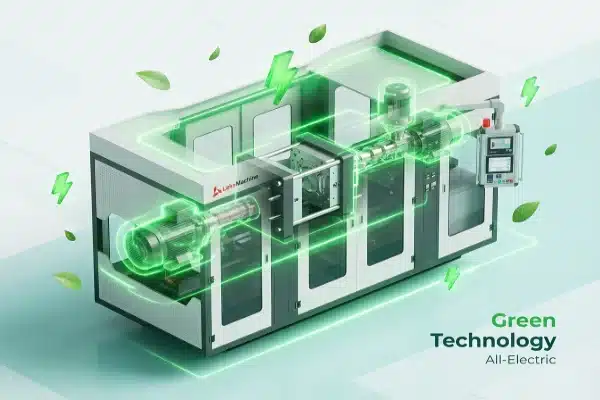
To qualify for high-efficiency subsidies, your machine must typically demonstrate a Specific Energy Consumption (SEC) of 0.29–0.32 kWh/kg for HDPE processing, verified against the Euromap 46.1 standard. Additionally, auditors require data from Class 1 internal meters that isolate production energy from startup spikes, ensuring the equipment meets "Green Technology" criteria.
Let’s break down the exact data points, software capabilities, and certifications you need to secure your funding.
What Specific Energy Consumption Data and Certifications Must the Supplier Provide?
When we prepare documentation for our European and North American clients, we never rely on generic "average power" estimates because they rarely pass strict audit scrutiny. We have learned that vague claims about energy savings are the fastest way to get an application flagged for review. Instead, you need granular, standardized data that defines exactly where the energy goes.
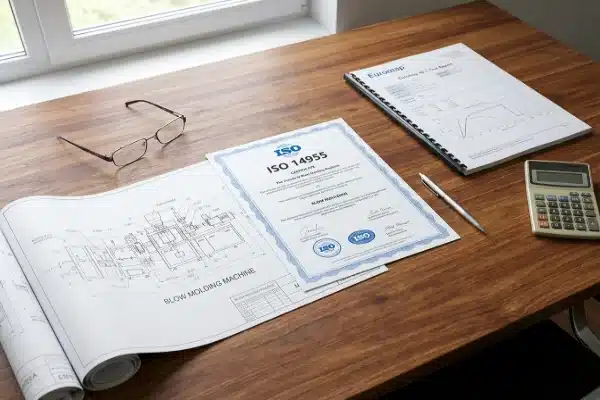
Suppliers must provide test reports compliant with Euromap 46.1 standards, specifically citing Specific Energy Consumption (SEC) in kWh/kg rather than just generic kilowatt ratings. Additionally, possession of ISO 14955 certification for eco-design often fast-tracks approval, provided the data explicitly includes "Plug-to-Product" total draw figures encompassing all peripherals.
Understanding the "Plug-to-Product" Boundary
The most common reason for subsidy rejection is a mismatch in the "system boundary." Many manufacturers like to quote energy usage for just the extruder motor and clamp. However, government auditors look for "Plug-to-Product" efficiency.
When reviewing supplier data, you must ensure the kWh/kg figure includes the auxiliary boundary. This means the test results must account for:
- Extruder feed throat cooling.
- Cabinet air conditioning (essential for servo drives).
- Fan cooling systems.
If a supplier provides a number below 0.29 kWh/kg but excludes these peripherals, your on-site audit will show a higher reading, leading to compliance failure.
The Euromap 46.1 Standard
You should explicitly require the energy consumption test to be conducted according to Euromap 46.1. This is the specific standard for extrusion blow molding machines. It standardizes the measurement so that "idle time" and "production time" are weighted correctly.
For most high-efficiency government subsidies (often labeled "Class 10" or similar), the machine must fall within a specific range.
Energy Efficiency Thresholds for Subsidies
The table below outlines the typical thresholds we see in subsidy applications for HDPE processing.
| Efficiency Tier | SEC Target (kWh/kg) | Likelihood of Subsidy Approval | Notas |
|---|---|---|---|
| Tier 1 (Elite) | < 0.29 | Muito alta | Requires top-tier servo systems and regenerative braking. |
| Tier 2 (Standard) | 0.29 – 0.32 | Alta | The standard target for most modern all-electric machines. |
| Tier 3 (Basic) | 0.33 – 0.40 | Baixa | Often considered "standard industry practice" rather than "green tech." |
| Tier 4 (Legacy) | > 0.45 | Nenhum | Typical of hydraulic or hybrid systems. |
Critical Certifications
Beyond the raw numbers, the physical documentation matters. Check if the machine is designed in accordance with ISO 14955 (Eco-design for machine tools). Possessing this specific certification documentation proves that energy efficiency was a core design principle, not just an afterthought. This is often a checkbox requirement for grants in Asia and the EU.
Can the Machine Software Generate Real-Time Compliance Reports for Audits?
Our engineers spend a lot of time calibrating the software interface because we know that a one-time factory test isn’t enough for ongoing compliance. Auditors often demand to see logs from actual production runs months after installation. If your machine cannot separate "warm-up" energy from "steady-state" production, your average efficiency will look terrible, potentially disqualifying you from performance-based rebates.
The machine software must feature IEC 61557-12 compliant metering that logs "steady-state" energy usage while filtering out the initial "soak time" heating spikes. Crucially, it must correctly log regenerative energy from braking as a negative value (savings) rather than absolute current flow to avoid artificially inflating consumption stats.

The Problem with "Soft Meters"
Many budget controllers use "soft meters." These calculate energy based on what the drive thinks it is outputting. Subsidy auditors often reject this data. You need to verify that the built-in energy monitoring hardware meets IEC 61557-12 standards (Class 1 accuracy). This usually involves physical current transformers (CTs) installed on the main incoming lines, not just a software algorithm.
Handling Regenerative Energy (Regen)
All-electric machines generate power when the heavy clamp brakes or decelerates. This is called Regenerative Energy.
- The Trap: Some basic meters sum up the "absolute current flow." This means when the motor acts as a generator and sends power back to the DC bus, the meter counts it as consumption.
- A solução: Ensure the reporting software explicitly logs Regen as a negative value or a separate line item. If it doesn’t, your most efficient feature (braking energy recovery) will ironically make your machine appear less efficient on the report.
Filtering Out "Soak Time"
Every blow molding machine requires a "soak time" (initial barrel heating) of roughly 2 hours before production starts. This consumes a massive amount of energy with zero output.
If your daily report divides Total Energy by Total KGs produced, this morning spike will skew your kWh/kg ratio upwards. The software must allow you to exclude the "Soak Time" from the daily average report. This ensures the audit focuses on the Low Load Efficiency and operating efficiency, which is what the government cares about.
The "Virtual kWh" Calculation
This is a strategy we often suggest to clients replacing hydraulic or pneumatic systems. Compressed air is 8–10 times more expensive than electricity.
When applying for subsidies, ask if the software or supplier can provide a "Compressed Air Equivalent" calculation. By eliminating pneumatic actuation for carriage movement or pins, you save air. Converting this saved air volume into "Avoided kWh" significantly strengthens the ROI case for the grant.
Software Feature Checklist for Auditors
| Recurso | Função | Why It Matters for Subsidies |
|---|---|---|
| Soak Time Exclusion | Removes startup heating form data. | Prevents morning warm-up from ruining your kWh/kg score. |
| Regen Logging | Tracks energy saved during braking. | Proves the "Green Technology" aspect of the servo system. |
| Real-Time PCL | Graphs load % vs. energy. | Shows efficiency holds steady even when running slower (partial load). |
| CSV/Excel Export | Downloads raw data logs. | Auditors require raw data files, not just PDF screenshots. |
How Do I Verify Actual Power Draw Compared to Rated Connected Load?
We frequently field calls from facility managers worried that their transformer cannot handle a new machine because the "Rated Connected Load" on the nameplate looks enormous. In reality, an all-electric machine rarely draws anywhere near that peak. However, for subsidy applications, you must scientifically prove the difference between potential capacity and actual draw to demonstrate grid friendliness.
You must verify that the machine utilizes an Active Front End (AFE) to maintain a Power Factor greater than 0.95 and low Total Harmonic Distortion. Furthermore, you should request a "Performance Characteristic Line" graph to demonstrate efficiency at partial loads, proving the machine does not waste energy when running below maximum capacity.
Base Load vs. Variable Load
The "Rated Connected Load" is simply the sum of every motor running at peak torque simultaneously—a scenario that almost never happens. For subsidies, you need to provide a "Performance Characteristic Line" (PCL) graph.
This graph shows energy usage at:
- 0% Throughput (Idle): The energy cost of just keeping the machine on.
- 50% Throughput: Typical running speed for complex bottles.
- 100% Throughput: Theoretical max speed.
Subsidies often require proof of "Low Load Efficiency." Real factories rarely run at theoretical max speed 24/7. If the machine is inefficient at 60% speed, it might fail the audit.
The Importance of Active Front End (AFE)
High-efficiency subsidies often disqualify equipment that pollutes the grid with "dirty power," regardless of its kWh consumption.
- Power Factor (PF): You must verify the machine has a PF > 0.95. Low PF puts strain on the electrical grid.
- Total Harmonic Distortion (THD): Variable Frequency Drives (VFDs) naturally create electrical noise. An Active Front End (AFE) filters this out.
If you plug a standard analyzer into the machine and see a Power Factor of 0.70, you will likely be denied the subsidy and may even face penalties from your utility provider.
Verification Protocol
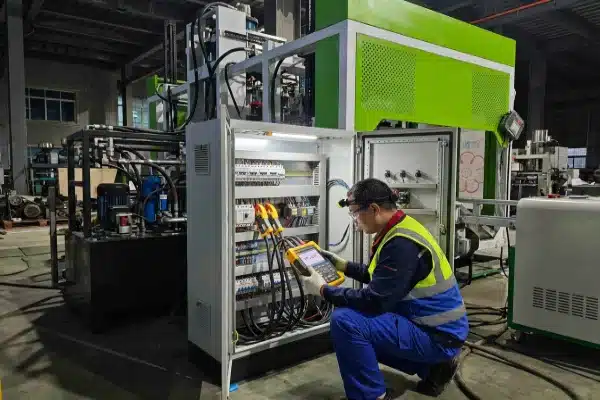
When the machine arrives, don’t just trust the screen. Perform a verification test using an external power analyzer.
Comparison: Rated vs. Actual
| Métrico | Rated (Nameplate) | Actual (Audit Target) | Why the Difference? |
|---|---|---|---|
| Input Current | e.g., 100 Amps | ~35-45 Amps | Rated assumes all motors peak at once; Actual is cyclical. |
| Power Factor | N/A | > 0.95 | AFE corrects the phase angle between voltage and current. |
| Energy Spike | N/A | Smoothing required | Capacitors should buffer the spikes so the grid sees a flat load. |
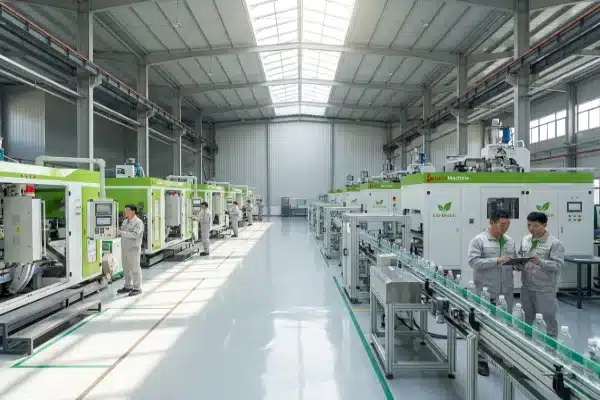
Using this data, you can confidently explain to an auditor that while the machine can draw high power, its standard operation is incredibly lean, justifying the government incentive.
Conclusão
Securing government subsidies for all-electric blow molding machinery requires more than just buying the right machine; it requires the right data. By demanding Euromap 46.1 compliance, ensuring Class 1 metering is built-in, and verifying Active Front End performance, you transform your machine from a production asset into a verifiable green investment.


0 comentários