
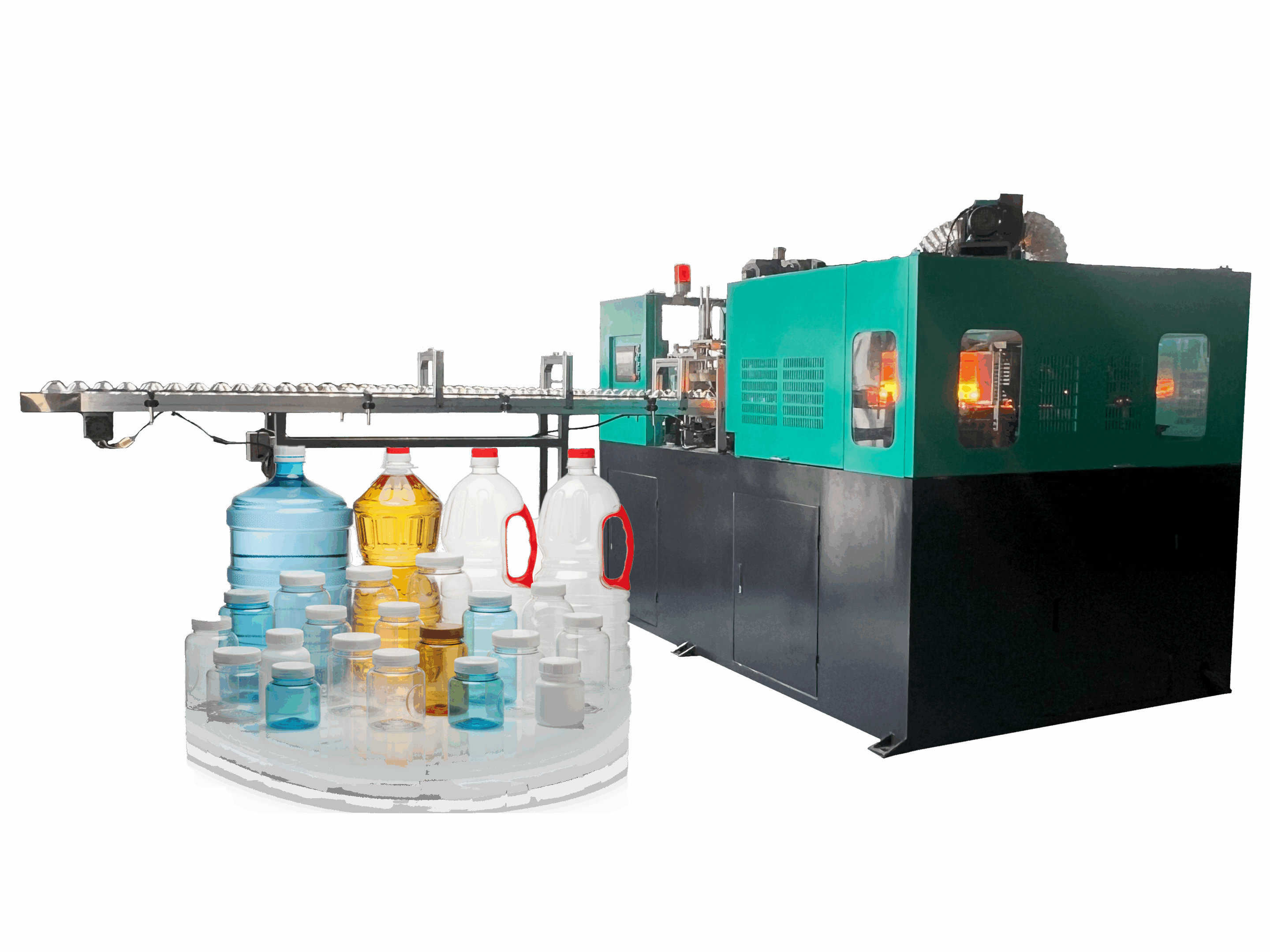

At our factory, we often see clients struggling with high scrap rates when producing small bottles using older technology closed-loop feedback system 1. Precision is difficult to maintain, but choosing the right machinery prevents costly quality failures.
To evaluate all-electric EBM advantages, assess the positional repeatability of servo motors against hydraulic drift. Focus on the elimination of oil contamination for cleanroom compliance and verify if the closed-loop feedback system maintains parison weight stability within ±1% to ensure consistent wall thickness in small, lightweight bottles.
Here is how you can break down the specific benefits for your production line.
How does servo control improve the neck finish accuracy of small pharmaceutical bottles?
When we calibrate machines for pharmaceutical clients, we know that a leaking seal is a disaster for their brand. Standard hydraulics often lack the consistent finesse needed for perfect calibration, leading to rejection.
Servo control improves neck finish accuracy by utilizing closed-loop torque feedback to regulate blow pin insertion depth and clamping force. Unlike hydraulic systems that suffer from pressure spikes, servos ensure uniform volumetric compression and eliminate longitudinal flash lines, guaranteeing the leak-proof seals required for strict pharmaceutical standards.

The Shift from Hydraulic to Electric Precision
For years, the industry relied on Injection Blow Molding (IBM) 2 for small bottles because it offered tight tolerances (±0.02mm). Traditional Sopro por Extrusão (EBM) 3 was faster but less accurate (±0.5mm). However, modern all-electric EBM machines have bridged this gap.
In our experience, the main issue with hydraulic systems is "thermal drift." As the hydraulic oil heats up, its viscosity changes. This causes the machine's movement to vary slightly throughout the day. For a 500ml bottle, this might not matter. But for a 5ml eye-dropper bottle, a micro-fluctuation means the cap won't seal properly.
Digital Clamping and Calibration
All-electric machines use AC servo motors 4 connected to ball screws. This is a digital system. It does not rely on fluid pressure. This allows for two critical improvements:
- Exact Blow Pin Depth: The servo drives the blow pin to the exact same depth every time. This calibrates the inside of the bottle neck perfectly.
- Stable Clamping Force: The machine ensures the mold halves are held together with constant torque. This prevents the mold from breathing (opening slightly) under pressure.
When we eliminate the "breathing" of the mold, we eliminate the flash lines on the neck. This creates a smooth surface that ensures a perfect seal for caps and droppers.
Comparison of Process Tolerances
| Recurso | Traditional Hydraulic EBM | All-Electric Servo EBM | Injection Blow Molding (IBM) |
|---|---|---|---|
| Primary Driver | Hydraulic Fluid Power | AC Servo Motors | Hybrid / Hydraulic |
| Variance Tolerance | ±0.50mm | ±0.05mm (Approaching IBM) | ±0,02mm |
| Thermal Drift | High (Viscosity changes) | None (Digital accuracy) | Baixa |
| Neck Finish Quality | Requires Trimming | Flash-free capability | Flash-free |
Is an all-electric machine cleaner and better suited for cleanroom packaging environments?
Our engineers frequently install machines in ISO-certified rooms 5 for medical clients. We see firsthand how hydraulic leaks ruin sterile environments and overload HVAC systems with excessive heat generation.
Yes, all-electric machines are superior for cleanroom environments because they completely eliminate hydraulic oil, preventing aerosolized mist and floor leaks. Additionally, servo motors operate on "power-on-demand" logic, generating significantly less ambient heat than hydraulic reservoirs, which preserves laminar airflow and reduces the load on facility cooling systems.
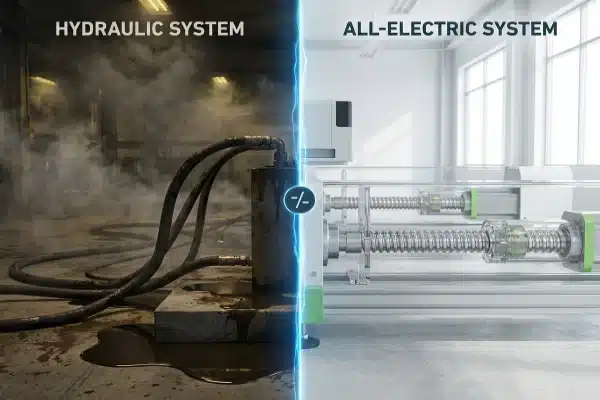
Eliminating Contamination Risks
The biggest enemy in a pharmaceutical or medical packaging facility is particulate matter. Traditional machines are inherently dirty. They rely on gallons of hydraulic oil flowing through hoses under high pressure.
Over time, we find that hoses weep and seals degrade. This creates two problems:
- Oil Leaks: Oil drips onto the floor or machine frame, attracting dust and bacteria.
- Aerosol Mist: High-pressure leaks can create a fine oil mist that floats in the air. This mist can settle on the sterile bottles before they are packaged.
All-electric machines have no oil pumps, no reservoirs, and no hoses. They use grease-lubricated ball screws which are sealed. This removes the primary source of contamination.
Thermal Neutrality and HVAC Load
Another hidden cost we warn clients about is heat. A hydraulic pump runs constantly, turning energy into heat. This heat warms up the cleanroom.
To maintain ISO standards, your air conditioning system must work harder to cool the room down. All-electric machines only use power when they move. They run much cooler.
Impact on Facility Management
| Environment Factor | Sistema Hidráulico | All-Electric System | Benefício |
|---|---|---|---|
| Air Quality | Oil mist risk | Zero emissions | Protects sterile products |
| Floor Cleanliness | Frequent oil leaks | Dry operation | Reduces slip hazards & cleaning |
| Nível de ruído | > 80 dB (Pump noise) | < 70 dB | Better operator environment |
| Heat Load | High (Continuous pump) | Low (Servo only) | Lowers AC electricity bills |
Can I achieve faster cycle times for small cavities compared to traditional hydraulic systems?
We help customers optimize throughput by analyzing their dry cycle times. In our testing, waiting for hydraulic pressure to build up often creates unnecessary bottlenecks in production speed.
You can achieve significantly faster cycle times because all-electric systems allow independent servo motors to overlap mechanical movements, such as carriage shifting while the mold opens. This advanced kinematics reduces dry cycle times to under 1.8 seconds, enabling total production outputs exceeding 6,000 bottles per hour in multi-cavity setups.
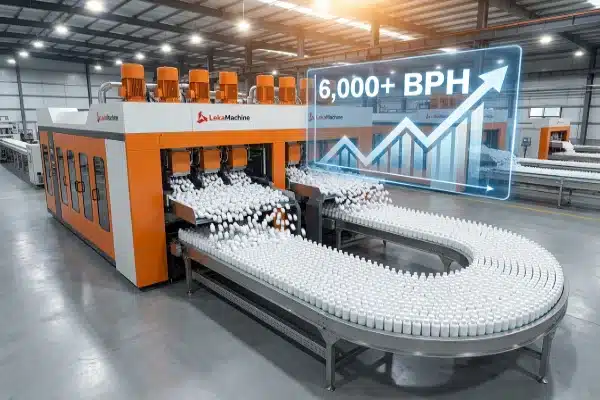
Understanding Dry Cycle Times
The "dry cycle" is the time the machine takes to move without plastic. This includes opening the mold, moving the carriage, and closing the mold.
In older hydraulic machines, these movements are often sequential. The valve opens, fluid flows, and the cylinder moves. It takes time to build pressure.
All-electric machines are different. We program them to overlap movements. For example, the carriage can start shifting sideways the exact millisecond the mold clears the product. There is no lag.
The Mathematics of Speed
For small pharmaceutical bottles (e.g., 10ml), the cooling time is very short because the plastic is thin. This means the machine's movement speed becomes the limiting factor.
If your cooling time is 4 seconds, but your machine takes 4 seconds to move, you lose 50% of your efficiency.
- Hydraulic Movement: ~3.5 to 4.0 seconds.
- Electric Movement: ~1.1 to 1.8 seconds.
Production Output Example
By saving 2 seconds per cycle, the daily output increases dramatically. Here is a breakdown based on a 12-cavity setup for small bottles.
Output Comparison Table (12-Cavity Mold)
| Parâmetro | Máquina hidráulica | Máquina totalmente elétrica |
|---|---|---|
| Cooling Time | 4.0 Seconds | 4.0 Seconds |
| Machine Movement | 3.5 Seconds | 1.5 Seconds |
| Total Cycle Time | 7.5 Seconds | 5.5 Seconds |
| Cycles Per Minute | 8.0 | 10.9 |
| Bottles Per Hour | ~5,760 | ~7,848 |
| Daily Output (20h) | 115,200 | 156,960 |
Result: The all-electric machine produces over 40,000 more bottles per day.
What is the minimum stable parison weight the machine can handle without fluctuation?
When we run trials for 5ml vials, even a slight material surge ruins the batch. We rely on digital precision to prevent these costly weight variations and ensure profitability.
The machine can handle extremely low parison weights, such as 2 grams, with minimal fluctuation by using high-resolution servo extrusion. This technology enables dynamic die gap adjustments at 100 sequential points, ensuring material weight consistency remains stable even for small precision containers where traditional hydraulics would cause uneven walls.
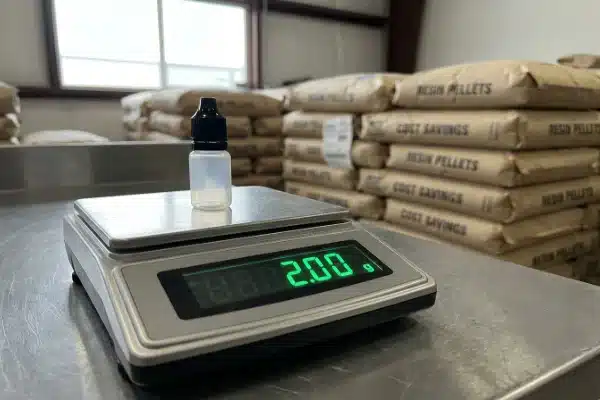
The Challenge of Light Weights
Producing a heavy jerrycan is easy. Producing a bottle that weighs less than a penny is hard.
In a hydraulic extruder, the screw rotation can vary slightly. If the voltage drops or the oil gets hot, the screw slows down. This changes how much plastic comes out. For a 2-gram bottle, a 5% variation makes the wall too thin. The bottle will collapse when the client squeezes it.
Servo Extrusion Accuracy
We use servo motors to turn the extruder screw. Servos are locked digitally to a specific RPM. They do not drift. This ensures the melt temperature remains stable within ±1°C.
This stability allows us to push the limits of lightweighting. We can run parisons for micro-bottles without "surging" (where the plastic comes out in pulses).
100-Point Parison Control
To get the best quality, we use a Parison Wall Distribution System (PWDS) 6. This is a moving pin inside the die head that changes the thickness of the plastic tube as it comes out.
- Tecnologia antiga: often used 30 or 50 points of control.
- Novas tecnologias: uses 100 points of control.
This allows us to map the plastic thickness to the bottle shape very precisely. We can thicken the corners of a square bottle and thin out the flat panels. This saves resin and ensures the bottle passes the top-load test.
Economic Impact of Weight Control
If you save just 0.1 grams per bottle on a high-speed line, the savings are massive.
- Annual Production: 20 Million bottles.
- Resin Savings: 0.1g per bottle = 2,000 kg of resin saved.
- Cost Savings: At $1.50/kg, that is $3,000 pure profit, just from better stability.
Conclusão
Evaluating all-electric EBM technology requires looking beyond the price tag. For small precision bottles, the investment guarantees cleanroom compliance, faster cycle times, and exact repeatability that hydraulics cannot match.
Notas de rodapé
1. Replaced with a Wikipedia article explaining closed-loop controllers, which are synonymous with closed-loop feedback systems. ↩︎
2. Explains the process, applications, and advantages of injection blow molding. ↩︎
3. Replaced with a Wikipedia entry providing a comprehensive overview of Extrusion Blow Molding. ↩︎
4. Replaced with an article providing a clear definition, working principle, and applications of AC servo motors. ↩︎
5. Replaced with a Wikipedia page detailing the ISO 14644 standards for cleanrooms, which are relevant to ‘ISO-certified rooms’. ↩︎
6. Replaced with a manufacturer’s page specifically detailing the ‘Partial Wall Thickness Distribution System (PWDS®)’ in blow molding. ↩︎


0 comentários