

Como posso garantir que a embalagem de transporte da máquina de moldagem por sopro de extrusão totalmente elétrica suporte o transporte marítimo de longa distância?
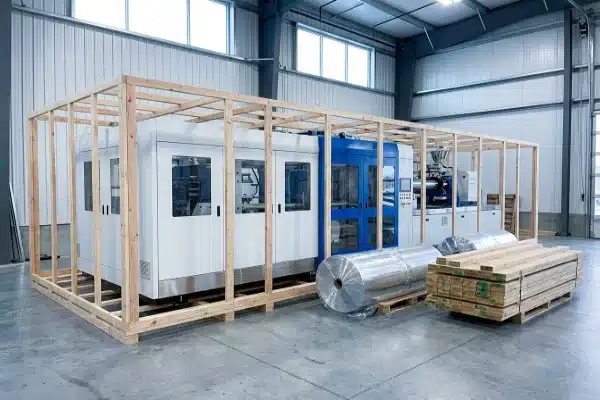
At our factory in Shantou, we have seen perfectly calibrated machines ruined before they ever produced a single bottle, simply because the packaging couldn’t handle the ocean voyage. Shipping high-precision all-electric equipment requires more than just a wooden box; it demands a defensive strategy against salt, humidity, and G-forces. If you don’t specify the packaging protocols, you are gambling with your investment.
To ensure safety during long-distance shipping, you must demand a multi-layered defense: vacuum-sealed aluminum barrier foil for moisture control, ISPM 15 heat-treated timber for structural integrity, and VCI emitters inside electrical cabinets. Furthermore, require specific "under deck" stowage to minimize exposure to extreme temperature cycles and condensation.
Below, I will guide you through the specific checkpoints we use to guarantee a safe arrival.
What anti-corrosion measures are essential for protecting sensitive servo motors at sea?
When we prepare our all-electric models for export to North America or Europe, we treat the servo motors with extreme caution. These components are the heart of the machine, and salt mist is their worst enemy. We never rely on standard shipping methods for these high-precision parts because we know that once corrosion starts on an encoder, the motor is effectively dead.
Essential anti-corrosion measures include wrapping individual motors in VCI paper and installing internal VCI emitters within drive housings to neutralize trapped air. Additionally, all unpainted metal surfaces must be coated with a dry-to-touch heavy-duty wax agent like Tectyl, rather than standard oil which often drips off in hot containers.

The environment inside a shipping container is aggressive. We often refer to the "rain container" effect, where temperature drops cause moisture to condense on the coldest metal surfaces—usually your expensive platens and motors. To combat this, you need a strategy that goes beyond simple plastic wrapping.
The Problem with Standard Oil
Many suppliers will simply spray standard machine oil on unpainted surfaces. In our experience, this is a failure point. During the voyage, container temperatures can exceed 50°C (122°F). At these temperatures, standard oil decreases in viscosity and runs off vertical surfaces like the tie bars and platens, pooling at the bottom of the machine and leaving the metal exposed to salty air. We insist on using a heavy-duty wax coating (such as Tectyl). This applies wet but dries to a waxy, self-healing film that stays in place regardless of heat.
Micro-Environments and VCI
External wrapping is not enough for complex electronics. Corrosion often starts inside the component due to trapped air. To prevent this, we utilize Volatile Corrosion Inhibitor (VCI) emitters.
- How it works: VCI chemicals vaporize and attach to metal surfaces at a molecular level, preventing oxygen from causing oxidation.
- Where to put them: We place VCI foam pads or emitters directly inside servo drive housings and PLC racks.
- Ball Screws: These are critical for all-electric precision. We wrap them in VCI paper and then encase them in split PVC piping or hard plastic sleeves. This "hard armor" protects them from physical impact if a strap snaps or a tool comes loose inside the crate.
Comparison of Corrosion Protection Methods
| Método | Nível de proteção | Risk Factor | Recommended For |
|---|---|---|---|
| Standard Machine Oil | Baixa | High: Runs off in heat; messy cleanup. | Domestic trucking only. |
| Shrink Wrap | Baixa | High: Traps moisture inside; no barrier to oxygen. | Dust protection only. |
| VCI Emitters + Film | Alta | Low: Active chemical protection; reaches crevices. | Electronics, Motors, PLCs. |
| Wax Coating (Tectyl) | Muito alta | Low: Thermal stability; stays vertical. | Platens, Tie Bars, Extruder Throat. |
How should the heavy clamping unit be secured to prevent shifting inside the container?
We know that the clamping unit is the heaviest, most dense part of the machine. If it moves during transit, it acts like a battering ram. In our loading bay, we have seen photos from customers where a poorly secured machine punched a hole right through the container wall. Preventing this requires physics-based blocking, not just hope.
International Standards for Phytosanitary Measures 1
The clamping unit must be immobilized using triangular wooden chocks nailed directly into the container floor or bolted to steel skids. Crucially, verify that servo motor shafts are secured with mechanical "rotor lock" brackets to prevent freewheeling, which generates back-EMF and damages internal bearings during rough sea states.
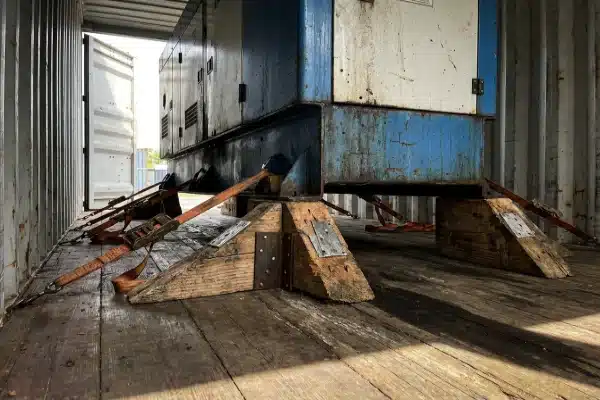
Securing a machine is about limiting degrees of freedom. You cannot rely on friction alone. When a ship pitches in a storm, the G-forces can be significant, causing heavy items to slide.
DIN 55474 standard 3
Floor Blocking Strategy
Straps keep the machine down, but they are poor at stopping lateral (side-to-side) movement.
- Triangular Chocks: We use heavy timber cut into triangles and nailed into the wooden floor of the container (for FCL shipments). These are placed tightly against the machine base.
- Steel Skids: For LCL (Less than Container Load), the machine must be bolted to a steel skid that is wider than the machine itself, preventing it from tipping over.
The "Rotor Lock" Necessity
This is a specific issue for all-electric machines that many general packers miss. Electric servo motors have very low friction. The vibration of the ship engines and the movement of the ocean can cause the heavy ball screws and motor shafts to rotate back and forth ("freewheeling").
- O risco: This rotation can generate Back Electromotive Force (Back-EMF), sending electricity back into the drive electronics which are powered off, potentially frying the board. It can also cause "false brinelling" on the bearings due to micro-vibrations.
- A solução: We install red-painted mechanical locking brackets. These physically clamp the motor shaft or the moving platen to the fixed frame, making movement impossible. You must remove these before starting the machine, which is why we paint them bright red.
Impact Monitoring
How do you know if the container was dropped at the port? We recommend a Dual-Layer Impact Recorder strategy.
- External: Stick a ShockWatch label on the outside of the crate. Note: These often get ripped off or ignored.
- Internal: This is the secret weapon. Place a ShockWatch or TiltWatch indicator inside the crate, directly on the machine frame. This provides irrefutable proof for insurance claims if internal damage occurs but the crate looks fine externally.
Do I need to request vacuum-sealed packaging for the electrical cabinets?
Our electrical engineers often debate this with logistics companies. Logistics providers like to use simple stretch wrap because it is cheap and fast. However, we have found that standard plastic wrap is actually dangerous for electronics at sea—it acts like a greenhouse, trapping humidity against your sensitive PCBs.
Bill of Lading 4
Yes, you absolutely need more than standard shrink wrap. You must mandate Aluminum Composite Barrier Foil vacuum-bagging for the entire electrical cabinet. This creates a hermetic seal. Standard plastic is permeable to moisture, whereas aluminum foil provides a true barrier against the salty, humid air common in ocean freight.

The electrical cabinet is the brain of your blow molding machine. If salt air penetrates the cabinet, it will corrode the contacts on the PLC and servo drives. This damage often doesn’t show up immediately but leads to "ghost" electrical faults six months after installation.
Back Electromotive Force (Back-EMF) 6
Vacuum Barrier Foil (Mil-Spec)
We insist on using Aluminum Composite Barrier Foil. Unlike clear plastic, this material is a laminate of polyester, aluminum, and polyethylene.
- Permeability: Clear plastic allows moisture vapor to pass through slowly. Aluminum foil has a moisture vapor transmission rate (MVTR) of essentially zero.
- The Seal: The bag is placed around the cabinet, air is sucked out (vacuumed), and the edges are heat-sealed. This creates a hermetic environment.
Calculated Desiccant Loading (DIN 55474)
Throwing a handful of silica gel packets into the cabinet is not engineering; it’s guessing. We calculate the desiccant requirement based on the DIN 55474 standard.
- The Formula: The calculation considers the volume of the barrier bag, the surface area, the duration of the voyage (typically calculated for 6-8 weeks to account for customs delays), and the climatic zone.
- O resultado: This ensures that even if a small amount of moisture is trapped during packing, the desiccant has enough capacity to absorb it all without becoming saturated.
The "Under Deck" Stowage Clause
This is a logistics tip that costs nothing but saves headaches. When booking the freight, we explicitly request "Under Deck" stowage in the Bill of Lading.
- On Deck: Containers on the top deck are exposed to direct sunlight during the day and freezing winds at night. This extreme cycling causes massive internal condensation.
- Under Deck: The temperature in the ship’s hold is relatively stable. This stability significantly reduces the stress on your vacuum seals and packaging materials.
Packaging Material Specs
| Material | Função | Necessity |
|---|---|---|
| Aluminum Barrier Foil | Stops moisture vapor ingress. | Mandatory |
| Desiccant (Clay/Silica) | Absorbs trapped moisture. | Mandatory |
| Humidity Indicator Card | Visual check of seal integrity upon arrival. | Recommended |
| Standard Shrink Wrap | Dust protection only. | Insufficient |
How can I verify the timber quality and crate construction before shipment?
Before we let a truck leave our factory gates, we inspect the wood stamps. It is a nightmare scenario: your machine arrives at the Port of Los Angeles or Rotterdam, and customs refuses entry because the wood packaging lacks proper certification. They can order the entire shipment to be fumigated (at your cost) or even destroyed.
Volatile Corrosion Inhibitor (VCI) 7
You must verify that every piece of timber bears a clearly visible ISPM 15 "Wheat Stamp" to prove heat treatment. Without this, customs may destroy the crate and machine. Additionally, inspect the crate construction to ensure the base can support the machine’s specific weight distribution without bowing.
Wood is a biological material. If untreated, it can carry pests like the Asian Longhorned Beetle. Global trade rules are strict, and enforcement is zero-tolerance.
container temperatures 9
ISPM 15 Certification Verification
The International Standards for Phytosanitary Measures No. 15 (ISPM 15) requires that wood be heat-treated to kill pests.
- The Stamp: Look for the "Wheat Stamp." It must contain the IPPC symbol, the country code (e.g., CN for China), the producer code, and the treatment code (HT for Heat Treated).
- Placement: The stamp should be visible on at least two opposite sides of the crate. We make sure our crate suppliers stamp the timber clearly, not in a faded ink that looks suspicious to customs officers.
Crate Construction Quality
A machine is only as safe as the floor it sits on. Extrusion blow molding machines are heavy and have uneven weight distribution (heavy at the clamping end, lighter at the frame).
- Skid Design: The bottom runners (skids) must be positioned under the machine’s load-bearing points. If the crate lifts the machine by the sheet metal panels instead of the frame, the panels will buckle.
- Fasteners: We check that the crate is assembled with screws or ring-shank nails, not smooth nails that can vibrate loose.
- Lifting Points: The crate must have clearly marked "Forklift Here" and "Center of Gravity" markings. If a forklift operator lifts from the center of the box, but the heavy clamp is on the left, the crate will tip and crash.
Pre-Shipment Virtual Inspection
We encourage our clients to do a "Virtual Crate Inspection." Before the lid goes on:
- Ask for photos of the machine bolted to the crate base.
- Ask for a close-up photo of the ISPM 15 stamp.
- Ask for a photo of the desiccant bags placed inside the barrier foil before it is sealed.
This 5-minute verification can save you 5 weeks of customs hell.
Conclusão
Shipping an all-electric blow molding machine is a high-stakes operation. By specifying vacuum barrier foils, Tectyl coatings, rotor locks, and ISPM 15 compliance, you protect your investment from the moment it leaves our factory until it powers up on your floor. Don’t let a million-dollar machine be compromised by a ten-dollar oversight in packaging.
VCI paper 10
Notas de rodapé
- Official international body governing the phytosanitary standards for wood. ↩︎
- Government species profile explaining the biological risk in timber. ↩︎
- Official page for the specific German desiccant calculation standard. ↩︎
- Official government definition of this critical shipping document. ↩︎
- Technical explanation of bearing damage from a leading manufacturer. ↩︎
- Academic overview of the electrical phenomenon affecting motors. ↩︎
- General definition of the chemical corrosion inhibition process. ↩︎
- Official site for the specific brand of wax coating recommended. ↩︎
- Industry data regarding climatic conditions inside shipping containers. ↩︎
- Official product page for the specific corrosion protection technology mentioned. ↩︎




0 comentários