
How can I determine if the control system of the all-electric extrusion blow molding machine is easy for European workers to operate?

When we commission machines in Europe, we often see how a confusing interface frustrates operators, leading to slower cycle times and costly errors during night shifts.
To determine ease of use, verify that the system runs on standard European hardware like Beckhoff or Siemens, supports full native language toggling for alarms, and utilizes a visual drag-and-drop parison editor. This ensures your local workforce can troubleshoot issues and adjust profiles intuitively without extensive training.
Here is a breakdown of the specific features that ensure smooth operation for your team.
Is the HMI interface available in local European languages?
Our service engineers know that a language barrier during a critical machine alarm can halt production instantly, causing unnecessary panic and downtime on the shop floor.
The HMI must support one-touch toggling between major languages like German, French, and Spanish. This capability must extend beyond simple menu headers to include all alarm descriptions and help files, ensuring operators fully understand diagnostic messages without needing an external translator.

Language barriers are one of the biggest friction points we encounter when exporting machinery. A control system is only "easy" if it speaks the language of the person standing in front of it.
True Native Language Scalability
It is not enough for a machine to simply have a button that changes English to German. We have found that many budget systems only translate the top-level buttons (like "Start" or "Stop") while leaving critical error messages in the original manufacturer’s language or poor English.
For a European workforce, the system must offer "deep translation." This means that when an alarm triggers—for example, a heater band failure—the diagnostic text, the troubleshooting guide, and the help file should all switch instantly to the local language. We implement systems that allow one-touch toggling. This lets a Polish-speaking operator run the machine during the day, and a French-speaking supervisor check the logs in the evening, all without restarting the system.
Visual Diagnostic Guidance
Even better than text is a system that uses a "Digital Twin" visualization. Instead of giving a cryptic code like "Error E-401," user-friendly systems display a graphic of the machine. If a heater fails, the specific zone on the screen turns red.
Comparison: Basic vs. Advanced Language Support
| Recurso | Basic Control System | Advanced European-Ready System |
|---|---|---|
| Menu Translation | Main buttons only. | Full menus, sub-menus, and settings. |
| Alarm Messages | Codes or poor English. | Native language with clear descriptions. |
| Switching Method | Requires restart/reboot. | Instant one-touch toggle. |
| Help Files | PDF manual (often English). | Integrated on-screen context help. |
This visual approach reduces the cognitive load on your workers. They do not need to memorize codes; they just need to look at the screen.
How intuitive is the parison control setup for new operators?
We often see new operators struggle with complex numerical charts, which results in uneven wall thickness and wasted resin during the initial learning curve.
Look for systems featuring a 100-point visual interface that allows operators to edit curves via touchscreen drag-and-drop. This replaces complex numerical data entry with a graphical profile, allowing new staff to visually match the parison shape to the bottle design immediately.
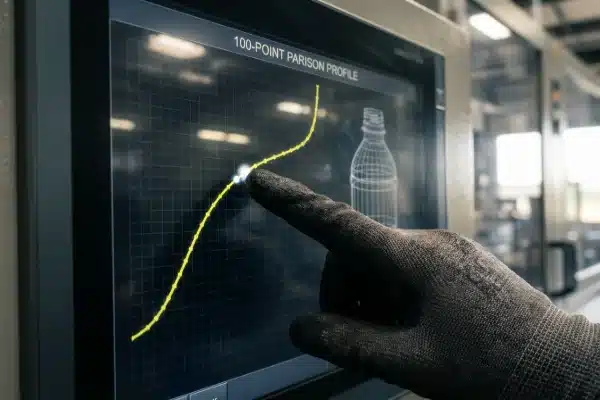
The parison controller is the brain of the blow molding process. In the past, setting the wall thickness involved typing hundreds of numbers into a spreadsheet-style table. This was slow and prone to typing errors.
comparação 1
Visualizing the Profile
Modern all-electric systems use a 100-point parison wall thickness control interface. Instead of typing, your operator sees a curve that represents the parison from top to bottom. If the bottle shoulders are too thin, they simply touch that part of the curve on the screen and drag it upward to add material.
This "drag-and-drop" functionality is critical for ease of use. It turns a mathematical task into a visual one. At our factory, we find that new operators grasp this concept in hours rather than weeks.
Unified Motion and Logic
Another key factor is whether the parison control is integrated. In older or cheaper designs, the parison controller is a separate "black box" unrelated to the main machine screen. This forces the operator to learn two different systems.
The most user-friendly machines integrate the Parison Controller and the Machine Sequence Logic (PLC) into a single CPU and screen. This unified approach simplifies the mental model for the worker. They don’t need to check one screen for temperatures and another for wall thickness; everything is in one place.
Recipe Portability
Ease of use also implies how fast you can switch jobs. A good system allows for the storage of over 200 mold recipes locally. More importantly, it should allow for simple USB or network import/export. If you have multiple machines, you should be able to copy a successful profile from Machine A to Machine B instantly, ensuring consistency across your production line without manual re-entry.
Can I restrict access to critical settings with password levels?
In our factory testing, we simulate how easily an untrained worker could accidentally alter a safety setting or erase a complex mold recipe, causing massive disruption.
You must ensure the system uses multi-level user hierarchies, such as Operator, Setter, and Admin, to protect critical process data. Ideally, this should integrate with RFID badge scanners to eliminate shared passwords and prevent unauthorized changes to safety logic.

Nothing makes a machine harder to manage than "phantom changes"—settings that drift because someone tweaked a value they shouldn’t have.
servo motor 2
Tiered Access Control
To maintain a stable process, you need to define who can touch what. We recommend a system that offers at least four distinct levels of access:
- View Only: For casual observation.
- Operator: Can start/stop the machine and clear basic jams.
- Setter/Technician: Can adjust parison profiles, temperatures, and timers.
- Admin: Full access to PID loops and system configuration.
This hierarchy protects your "golden recipe." Once a technician sets the machine perfectly, the operator should not be able to change the heating zones or the parison curve. This ensures that the machine runs exactly how you intended, shift after shift.
Manufacturing Execution System (MES) 3
RFID Integration
Passwords are often written on sticky notes and stuck to the screen, which defeats the purpose of security. Advanced systems use RFID badge readers. The operator simply taps their employee card to log in. The system automatically loads their specific permissions.
This also creates an accountability log. If a setting was changed at 3:00 AM, the system records exactly whose badge was used to make that change. This isn’t about punishment; it’s about identifying training gaps.
OPC UA 4
Security Level Breakdown
| User Level | Typical Permissions | Risk Prevention |
|---|---|---|
| Operator | Start/Stop, Alarm Reset. | Prevents accidental parameter shifts. |
| Setter | Temp zones, Parison Profile, Timers. | Allows tuning but protects safety logic. |
| Manutenção | Manual movements, I/O check. | prevents operators from forcing unsafe moves. |
| Admin | User management, System configs. | Total system control. |
Does the system use a standard PLC brand familiar to my engineers?
We choose globally recognized components because we know the panic of waiting weeks for a proprietary circuit board to arrive while orders pile up.
Euromap 77 5
Verify that the machine uses a standard European platform like Beckhoff, B&R, or Siemens rather than a proprietary "black box" controller. This ensures your local engineers can easily source spare parts, perform diagnostics, and integrate with factory MES systems.

The hardware inside the cabinet determines the long-term usability of the machine. If the controller is a proprietary board made by the machine builder, you are 100% dependent on them for support.
Beckhoff 7
The Advantage of Standard Ecosystems
We strongly advocate for systems built on Beckhoff, B&R, or Siemens. These are open industrial standards. If a servo drive or an I/O module fails five years from now, your maintenance manager can likely find a replacement from a local distributor in Europe within 24 hours.
Furthermore, European engineers are trained on these platforms. They understand the logic, the wiring, and the software. If you use a proprietary controller from a niche supplier, your engineers will be afraid to touch it, forcing you to pay for expensive remote support or service trips.
RFID badge readers 8
Euromap Connectivity
For European operations, Industry 4.0 is no longer a buzzword; it is a requirement. Your control system should natively support Euromap 77 (data exchange) or Euromap 84 (extrusion interfaces) via OPC UA.
This allows "plug-and-play" connection to your factory’s Manufacturing Execution System (MES). You can automatically track cycle counts, scrap rates, and downtime without installing aftermarket sensors. A system that requires custom coding to talk to your network is not "user-friendly."
PID loops 9
Energy Dashboards
Since all-electric machines are purchased for efficiency, the control system must prove it. User-friendly HMIs feature a dedicated "Sustainability Tab." This displays real-time energy consumption—kWh per kg of plastic or per cycle. In Europe, where energy costs are high and audits are strict, having this data visible on the main screen helps operators run the machine as efficiently as possible.
Clamping Force Visualization
Finally, usability involves translation between technologies. Hydraulic machine operators are used to pressure gauges. All-electric machines don’t have hydraulic pressure. A good control system calculates the servo motor torque and displays it as "Clamping Force" in tons or kN. This gives the operator a familiar metric, bridging the gap between old and new technology.
Conclusão
To ensure ease of use, prioritize systems with standard European hardware, deep visual diagnostics, and native language support. This empowers your workforce and minimizes downtime.
Digital Twin 10
Notas de rodapé
- Explains the specific plastic tube component being controlled. ↩︎
- Explains the motor technology used to calculate clamping force. ↩︎
- Defines the factory management system connected to the machine. ↩︎
- Official definition of the communication protocol used. ↩︎
- Official source for the plastics machinery data interface standard. ↩︎
- Provides context for the smart manufacturing standard. ↩︎
- Identifies the standard European automation hardware platform. ↩︎
- Explains the identification technology used for secure login. ↩︎
- Technical definition of the control loop mechanism. ↩︎
- Defines the visualization technology used for machine diagnostics. ↩︎


0 comentários