Como Calcular o Custo Real de uma Máquina de Sopragem (Download Gratuito de Checklist de CTO): Por Que uma Máquina “Barata” Pode Ser a Mais Cara“
Quando você está pronto para comprar uma nova máquina de sopragem, você quer obter o melhor valor, não apenas o menor preço.
Mas já vi muitas fábricas comprarem uma máquina “barata”, apenas para pagar por ela repetidamente nos anos seguintes.
O preço de compra é apenas o começo. O número real com o qual você precisa se preocupar é o “Custo Total de Propriedade”, ou CTO.
Vamos falar sobre a curva de custo real de uma máquina de baixo consumo de energia versus uma de alto consumo. (Também forneceremos um checklist para download para que você possa calcular o seu.)
Seção 1: A Armadilha do Alto Consumo de Energia (Alta Potência! Alto Ar!) – A Curva de Custo da Máquina “Barata”
Muitas pessoas olham apenas para o preço de compra. Vamos fazer as contas.
Imagine que você tem duas máquinas para escolher:
- Máquina A (Preço Baixo, Alto Consumo de Energia): Preço de Compra: $100.000
- Máquina B (Alta Eficiência, Estável): Preço de Compra: $180.000
Olhando apenas para o preço, a Máquina A parece economizar $80.000. Mas vamos incluir os custos de energia (com picos sazonais), manutenção, mão de obra e taxas de refugo (com problemas do mundo real). Veja o que acontece após 5 anos.
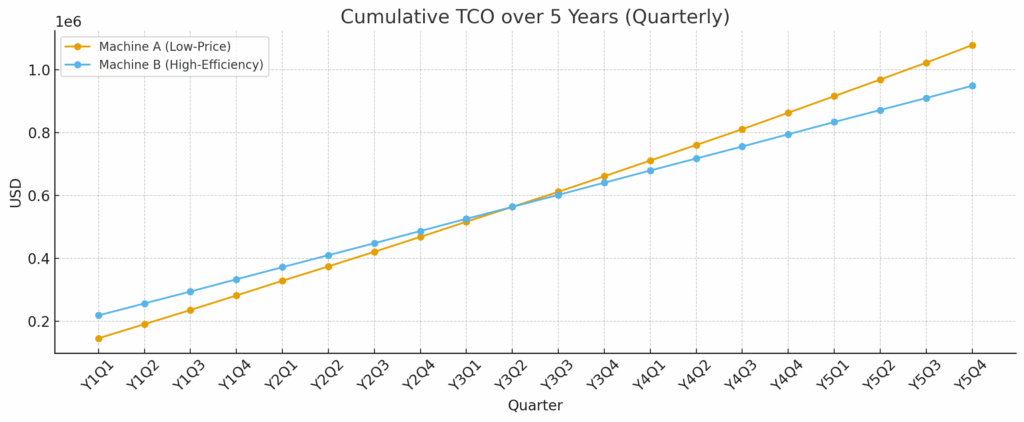
Observe esta Comparação de CTO (Custo Total de Propriedade) de 5 Anos (com picos do mundo real):
O que isso mostra: Estas são as duas curvas de custo. Você pode ver como a linha laranja “barata” (Máquina A) cruza a linha azul eficiente (Máquina B) por volta do 3º Ano. Depois disso, a diferença de custo explode.
| Máquina de Preço Baixo (Máquina A) | Máquina de Alta Eficiência (Máquina B) | |||||||||||||
|---|---|---|---|---|---|---|---|---|---|---|---|---|---|---|
| Trimestre | Custo de Energia ($) | Custo de Manut. ($) | Custo de Refugo ($) | Custo de Mão de Obra ($) | Tempo de Inatividade (Horas) | Produção (Milhões de Garrafas) | CTO Acumulado ($) | Custo de Energia ($) | Custo de Manut. ($) | Custo de Refugo ($) | Custo de Mão de Obra ($) | Tempo de Inatividade (Horas) | Produção (Milhões de Garrafas) | CTO Acumulado ($) |
| 1T1 | 12,375.00 | 2,000.00 | 1,424.30 | 30,000 | 20.00 | 1.48 | 145,799.30 | 7,425.00 | 550.00 | 737.01 | 30,000 | 5.00 | 1.79 | 218,712.01 |
| 1T2 | 11,250.00 | 2,200.00 | 1,580.87 | 30,000 | 22.00 | 1.48 | 190,830.16 | 6,750.00 | 561.00 | 721.80 | 30,000 | 5.10 | 1.79 | 256,744.81 |
| 1T3 | 11,250.00 | 2,420.00 | 1,323.51 | 30,000 | 24.20 | 1.48 | 235,823.67 | 6,750.00 | 572.22 | 702.69 | 30,000 | 5.20 | 1.79 | 294,769.72 |
| 1T4 | 12,375.00 | 2,662.00 | 1,278.05 | 30,000 | 26.62 | 1.47 | 282,138.71 | 7,425.00 | 583.66 | 733.22 | 30,000 | 5.31 | 1.79 | 333,511.60 |
| 2T1 | 12,375.00 | 2,928.20 | 1,515.33 | 30,000 | 29.28 | 1.47 | 328,957.25 | 7,425.00 | 595.34 | 726.36 | 30,000 | 5.41 | 1.79 | 372,258.30 |
| 2T2 | 11,250.00 | 3,221.02 | 1,256.69 | 30,000 | 32.21 | 1.47 | 374,684.95 | 6,750.00 | 607.24 | 737.58 | 30,000 | 5.52 | 1.79 | 410,353.12 |
| 2T3 | 11,250.00 | 3,543.12 | 1,610.63 | 30,000 | 35.43 | 1.46 | 421,088.71 | 6,750.00 | 619.39 | 704.92 | 30,000 | 5.63 | 1.79 | 448,427.42 |
| 2T4 | 12,375.00 | 3,897.43 | 1,321.57 | 30,000 | 38.97 | 1.46 | 468,682.71 | 7,425.00 | 631.78 | 703.62 | 30,000 | 5.74 | 1.79 | 487,187.82 |
| 3T1 | 12,375.00 | 4,287.18 | 1,371.55 | 30,000 | 42.87 | 1.46 | 516,716.44 | 7,425.00 | 644.41 | 718.25 | 30,000 | 5.86 | 1.79 | 525,975.48 |
| 3T2 | 11,250.00 | 4,715.90 | 1,423.18 | 30,000 | 47.16 | 1.45 | 564,105.52 | 6,750.00 | 657.30 | 708.15 | 30,000 | 5.98 | 1.79 | 564,090.93 |
| 3T3 | 11,250.00 | 5,187.48 | 1,496.72 | 30,000 | 51.87 | 1.45 | 612,039.72 | 6,750.00 | 670.45 | 701.56 | 30,000 | 6.09 | 1.79 | 602,212.94 |
| 3T4 | 12,375.00 | 5,706.23 | 1,352.96 | 30,000 | 57.06 | 1.44 | 661,473.91 | 7,425.00 | 683.86 | 711.27 | 30,000 | 6.22 | 1.79 | 641,033.07 |
| 4T1 | 12,375.00 | 6,276.86 | 1,418.29 | 30,000 | 62.77 | 1.44 | 711,544.06 | 7,425.00 | 697.53 | 729.22 | 30,000 | 6.34 | 1.79 | 679,884.82 |
| 4T2 | 11,250.00 | 6,904.54 | 1,302.03 | 30,000 | 69.05 | 1.43 | 761,000.63 | 6,750.00 | 711.48 | 717.51 | 30,000 | 6.47 | 1.79 | 718,063.81 |
| 4T3 | 11,250.00 | 7,595.00 | 1,463.53 | 30,000 | 75.95 | 1.42 | 811,309.16 | 6,750.00 | 725.71 | 697.33 | 30,000 | 6.60 | 1.79 | 756,236.85 |
| 4T4 | 12,375.00 | 8,354.50 | 1,462.15 | 30,000 | 83.54 | 1.42 | 863,500.81 | 7,425.00 | 740.23 | 702.60 | 30,000 | 6.73 | 1.79 | 795,104.68 |
| 5T1 | 12,375.00 | 9,189.95 | 1,224.37 | 30,000 | 91.90 | 1.41 | 916,290.12 | 7,425.00 | 755.03 | 736.01 | 30,000 | 6.86 | 1.79 | 834,020.72 |
| 5T2 | 11,250.00 | 10,108.94 | 1,594.32 | 30,000 | 101.09 | 1.40 | 969,243.39 | 6,750.00 | 770.13 | 729.90 | 30,000 | 7.00 | 1.79 | 872,270.76 |
| 5T3 | 11,250.00 | 11,119.83 | 1,307.40 | 30,000 | 111.20 | 1.39 | 1,022,920.62 | 6,750.00 | 785.54 | 699.27 | 30,000 | 7.14 | 1.79 | 910,505.57 |
| 5T4 | 12,375.00 | 12,231.82 | 1,453.83 | 30,000 | 122.32 | 1.38 | 1,078,981.26 | 7,425.00 | 801.25 | 713.93 | 30,000 | 7.28 | 1.79 | 949,445.74 |
Vamos analisar estes dados um por um:
1. O Panorama Geral: CTO, Ponto de Cruzamento e Economias

Estas são as duas curvas de custo. Você pode ver como a linha laranja “barata” (Máquina A) cruza a linha azul eficiente (Máquina B) por volta do 3º Ano. Depois disso, a diferença de custo explode.

Este gráfico dá um zoom no ponto de cruzamento. No 3T2 (Ano 3, Trimestre 2), a linha laranja ultrapassa o zero. Este é o exato momento em que sua economia inicial de $80.000 foi completamente eliminada pelos altos custos operacionais. A partir deste dia, você está perdendo dinheiro.

Este é o inverso da diferença de CTO. Ele mostra como as economias da compra da eficiente Máquina B (linha azul) são negativas no início (devido ao preço mais alto), mas tornam-se massivamente positivas com o tempo, terminando em $129.536.
2. Por Que Isso Acontece? Produção e Tempo de Inatividade
Logo após o título “2. Por Que Isso Acontece? Produção e Tempo de Inatividade”, insira

O que isso mostra: Aqui está a causa dos altos custos. O tempo de inatividade da máquina “barata” (linha laranja) dispara para cima, tornando-se incontrolável no 5º Ano. A máquina eficiente (linha azul) permanece estável e baixa.
Após o texto acima, insira:

O que isso mostra: Este é o resultado do tempo de inatividade. A produção da máquina “barata” (linha laranja) cai constantemente à medida que ela quebra mais. A Máquina B (linha azul) produz de forma confiável 1,79 milhão de garrafas a cada trimestre.
Após o texto acima, insira:

O que isso mostra: Over 5 years, the stable Machine B (blue bar) produced 35.8 million bottles, while the unreliable Machine A (orange bar) produced only 29.3 million. That’s 6.5 million fewer bottles.
Para Onde Foi o Dinheiro? Uma Análise dos Custos

O que isso mostra: This chart clearly shows when the costs accelerated. Look at the orange bars (Machine A): the total cost added in Year 5 alone was far greater than in Year 1. Machine B’s costs (blue bars) remained predictable.

O que isso mostra: This is the smoking gun. It shows what you paid for. The “cheap” Machine A (orange bar) forced you to pay enormous “Energy” and “Maintenance” costs, completely wiping out any initial savings.
4. O Veredito Final: Custo por Unidade

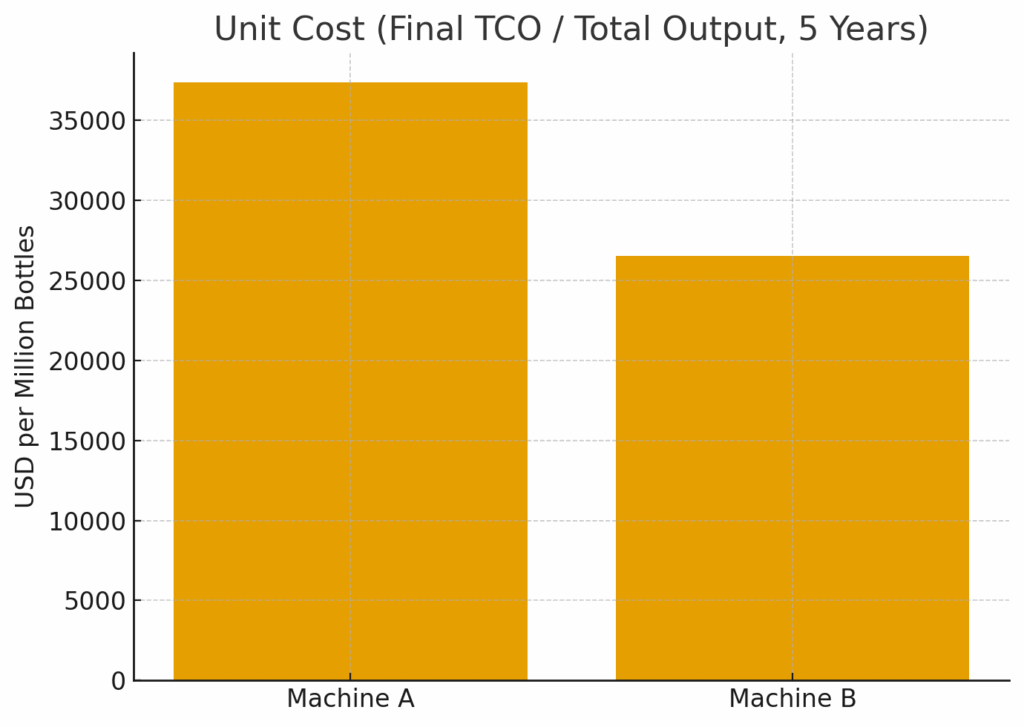
O que isso mostra: This might be the most important chart. When you divide the total 5-year cost by the actual bottles produced, the truth is clear:
- Machine A (Low-Price): Your cost to produce 1 million bottles was $36,800.
- Machine B (High-Efficiency): Your cost to produce 1 million bottles was only $26,400.The conclusion is clear:You thought you saved $80,000 up front. In reality, every single bottle you made with the “cheap” machine cost you almost 40% more to produce.
(Note: This doesn’t even count the air compressor…)
The “efficient” Machine B only cost $949,445 in total.
You ended up **paying $129,536 extra**.
(*Note: This doesn’t even count the air compressor. Bottle blowing uses a lot of air, and the compressor for an inefficient machine will also use a shocking amount of power.*)
In short: a cheap machine has a low return on efficiency because the money you “saved” up front is paid back twice over in future power and repair bills.
Section 2: The Efficiency Payoff (The High-Efficiency Machine’s Cost Curve)
A high-efficiency machine costs more up front. There’s no way around it.
This is because it’s built with better parts and better engineering.
But its cost curve is completely different. It starts higher, but it stays flat.
Month after month, your energy costs are far lower than your competitors.
Your maintenance is predictable, not a daily fire drill.
This is the machine that lets you confidently tell your clients “yes” when they need a fast delivery.
(To be frank, our most competitive OEM customers are the ones who focus on TCO.)
Section 3: What *Actually* Makes a Machine Efficient?
A machine isn’t efficient just because a salesperson says so.
You can’t just look at the price. You have to dig deeper into three key areas. This is what decides if a machine will save you money or cost you money:
1. The Configuration
This is the “heart” of the machine.
What kind of hydraulic system does it use? Is it an old-fashioned fixed pump, or a modern servo-motor system? (For example, many of our machines use servo-driven pumps to precisely control energy use).
Are the parts from no-name brands or well-known brands? A good configuration uses parts that are all designed to work together to save power, not just a random mix.
2. The Assembly Precision
This is extremely important. A machine that is assembled with high precision has parts that move smoothly.
Less friction means less wasted energy. It’s that simple.
If a machine is assembled badly, even with good parts, the parts will “fight” each other. This extra friction forces the motors to work harder, which pulls more power. It also means parts wear out much faster.
I want to share a “little story” about this:
We’ve tried many ways to process our parts, including expensive CNC machining. But we found two things: first, it raises the machine cost a lot. Second, for some key details, the “feel” of an experienced technician is something a cold machine just can’t replace.
So, our team is built on veteran technicians with years of hands-on experience. At the same time, we partner with outside institutes and even universities in China to research and train our team.
This teamwork helps us optimize some of our machine structures and assembly processes. It lets us make the machine’s assembly more accurate, snug, and “silky smooth” to operate, without dramatically raising the cost.
3. The Lubrication Design
This is related to assembly precision. A well-built machine with a smart lubrication system runs smoothly and doesn’t get too hot.
A poorly designed machine won’t get oil where it’s needed. Parts will grind and heat up. The machine wastes a ton of energy just fighting its own internal friction, before it even starts making a product.
For example: At LEKAmachine, we’ve put a lot of innovation into our hydraulic circuit and mechanical designs. Our goal is to make every push of the hydraulic system as efficient as possible. We want to use that energy to *actually* clamp the mold and extrude plastic, not waste it inside the pipes.
Section 4: Our View on Long-Term Value
At LEKAmachine, we design our machines for reliability and efficiency first.
We know our customers (you) care about output per hour and cost per hour.
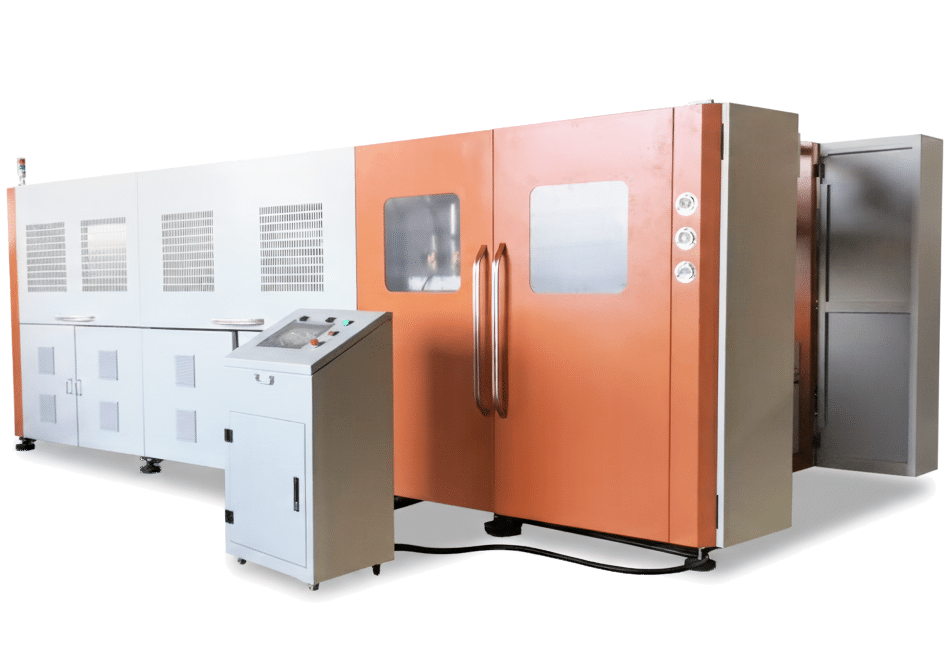
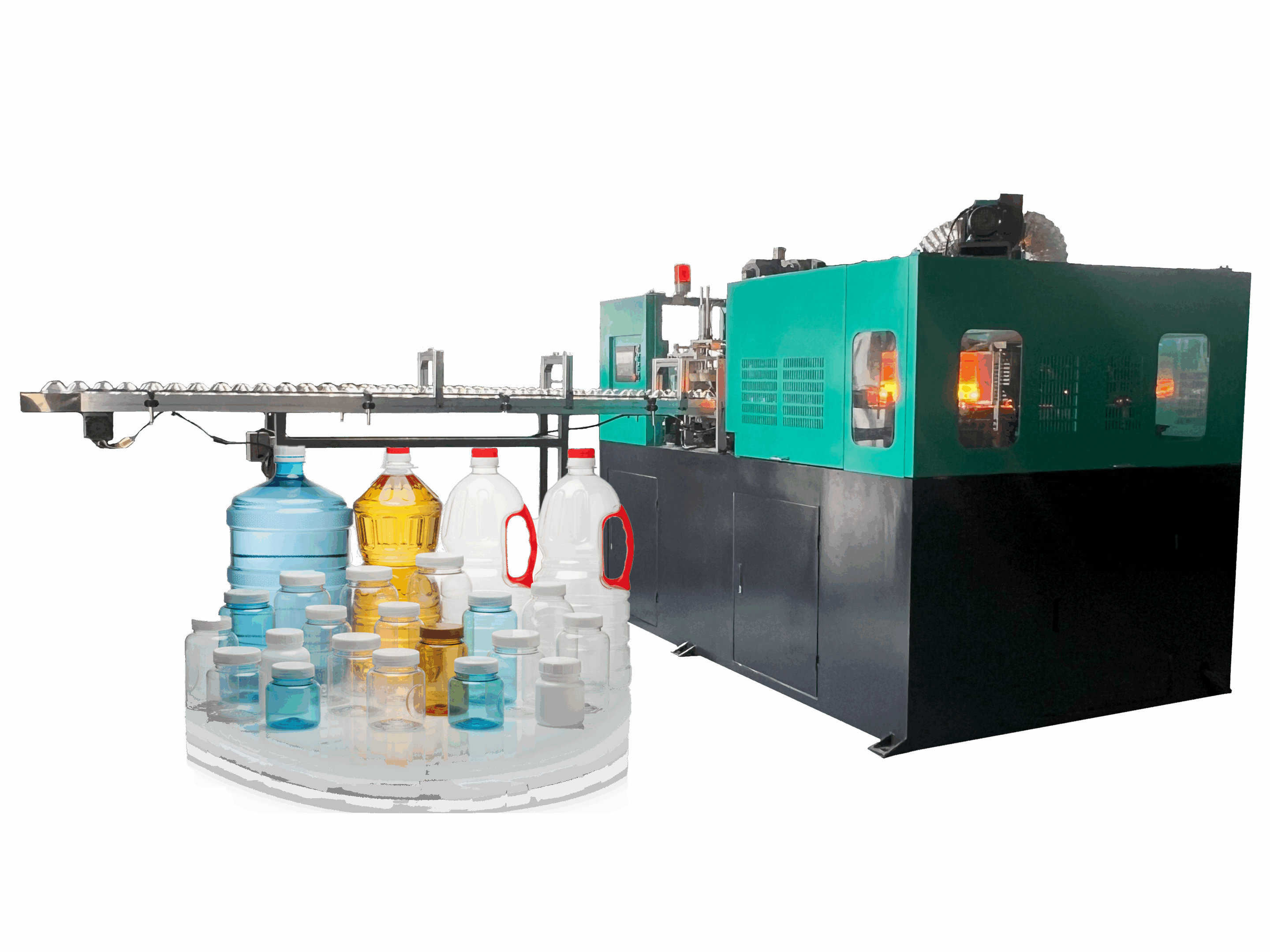
We focus on providing Sopro por Extrusão (EBM) e Sopro com Estiramento (SBM) machines. We don’t sell injection blow molding machines, because we only focus on what we do best.
Conclusion: Look at the 5-Year Cost, Not the Day-1 Price
A blow molding machine is a 10-year investment. Don’t let a Day-1 low price trap you into 10 years of high power bills and repair headaches.
When you’re ready to upgrade your production line, I suggest you ask about the “total cost.”
You need a machine that solves your production bottlenecks, not a machine that becomes one.
Call to Action:
[Click Here to Download: Blow Molding Machine TCO (Total Cost of Ownership) Checklist.pdf] <– (You can put your download link here)
If you are tired of high energy bills and constant downtime, take a look at our solutions.
- Explore as nossas Máquinas de moldagem por extrusão e sopro: `https://lekamachine.comextrusion-blow-molding-machines/`
- Explore as nossas Máquinas de Moldagem por Sopro-Estiramento: `https://lekamachine.comstretch-blow-molding-machine/`


0 comentários