
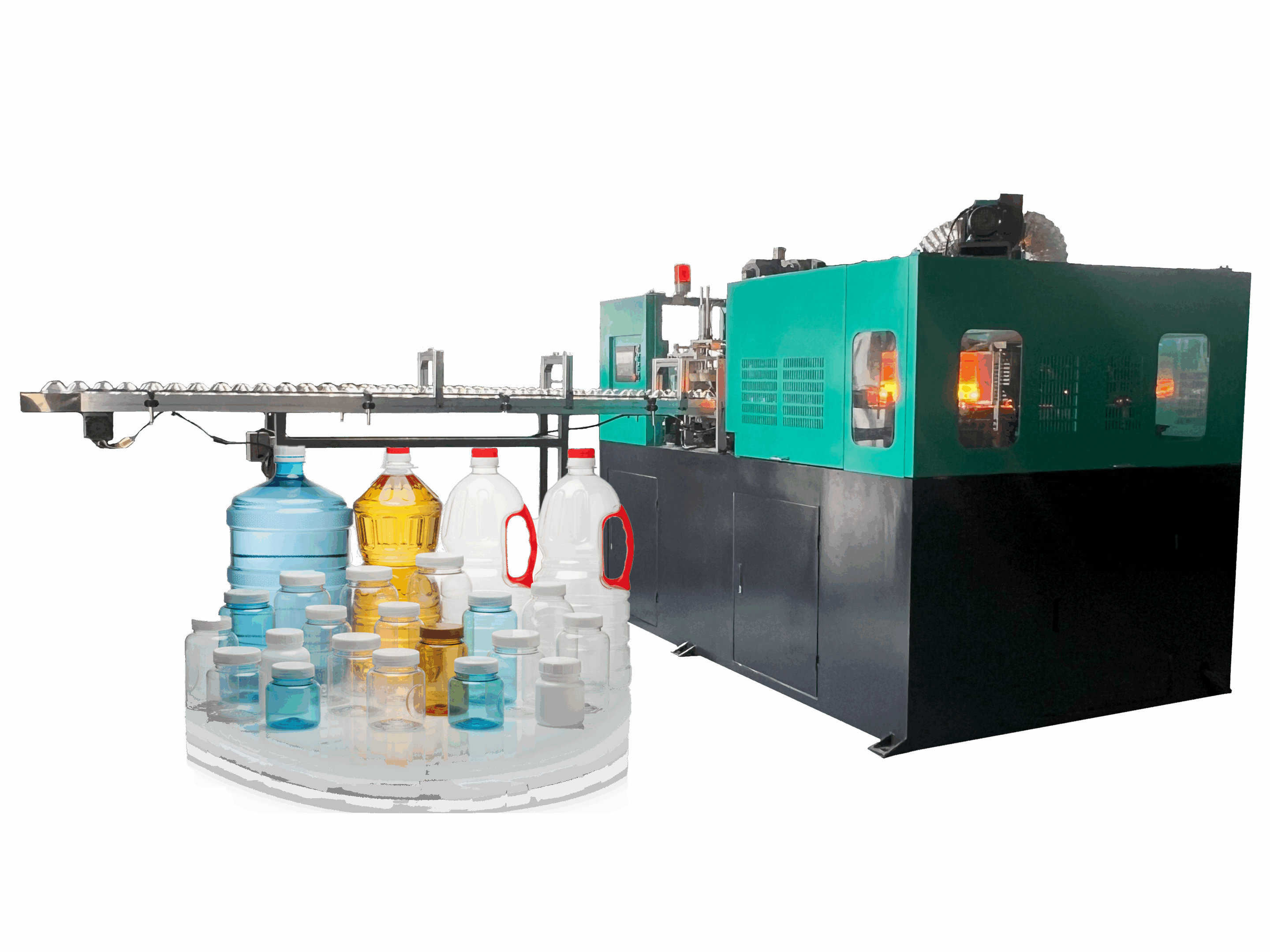
When signing the contract, how should I specify the warranty period for the core components of the ALL electric extrusion blow molding machine?
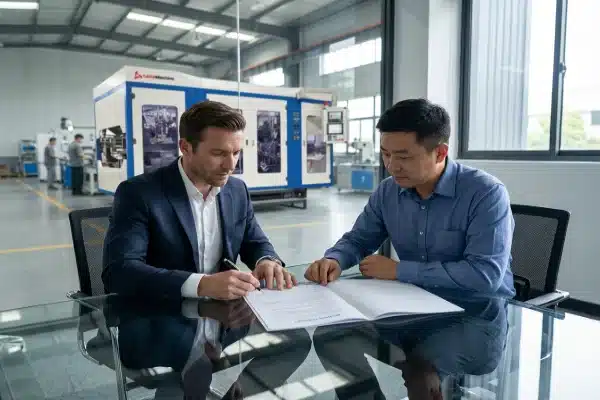
At our factory, we see clients struggle with vague contracts that leave them exposed. A weak warranty on a high-tech electric machine risks your profit, but specific, negotiated terms protect your long-term investment.
You must explicitly list core components like servo motors, PLCs, and ball screws with their own extended 3–5 year coverage distinct from the standard 12-month machine warranty. Furthermore, define "performance retention" metrics rather than just total failure, ensuring the machine maintains the precision required for tight-tolerance production.
Let’s break down the specific clauses you need to negotiate to secure your production line and avoid hidden costs.
Does the warranty cover expensive servo motors and drives specifically?
When we calibrate flight controllers and drives for our electric series, we know these components are costly. Vague terms here can lead to massive replacement bills if they are not specifically protected.
Standard warranties often group these as general electrical parts with limited coverage, but you should negotiate them as "Core Components." Ensure the contract explicitly lists servo motors and drives for 24 to 36 months of coverage, including protection against voltage fluctuations within a defined tolerance range.
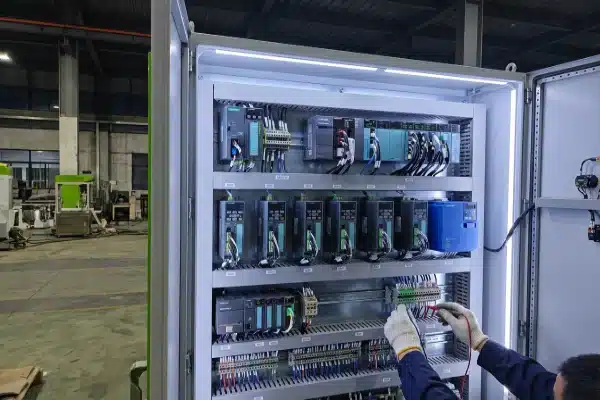
The High Stakes of Servo Components
In an all-electric extrusion blow molding machine, the servo system is the heart of the operation. Unlike hydraulic machines 1, where pumps can be repaired cheaply, a failed servo drive often requires a complete replacement. In our engineering department, we advise clients to treat these parts differently than simple switches or relays.
If your contract simply says "12-month warranty on electrical parts," you are taking a risk. Servo motors and drives are sensitive to power quality 2. Suppliers often deny claims by blaming your factory’s power grid. To prevent this, you must insist on a Power Quality Tolerance clause. This clause states that if your voltage fluctuates within a standard range (e.g., +/- 10%), the warranty remains valid.
Dealing with Obsolescence
Another issue we face in manufacturing is the rapid update cycle 3 of electronics. A servo drive model available today might be discontinued in three years.
You should negotiate a "Retrofit Labor" provision. If a drive fails under warranty but the specific model is no longer made, the manufacturer should not just give you credit for the old part. They must cover the engineering labor and cabling modifications required to install the newer generation drive. This ensures your machine remains compatible with modern standards without costing you extra.
Performance Retention vs. Total Failure
Electric machines are bought for precision. A servo motor might still spin but lose its ability to hold tight tolerances. Standard warranties usually only cover "total failure" (it stops working). You should push for a Performance Retention clause. This covers the component if it loses repeatability (e.g., platen position accuracy drifts beyond 0.05mm), ensuring your machine stays production-capable.
Component Cost Risk Analysis
| Componente | Standard Warranty | Recommended Negotiation | Fator de risco |
|---|---|---|---|
| Servo Motor | 12 Months | 36 Months | High (Costly replacement) |
| Servo Drive | 12 Months | 36 Months | High (Sensitive to voltage) |
| PLC | 12 Months | 5 Years | Medium (System brain) |
| Relays/Switches | 12 Months | 12 Months | Low (Cheap to replace) |
What is the difference between standard coverage and extended warranty options?
In our experience exporting to the US and Europe, buyers often confuse a longer timeframe with better service levels. It is crucial to understand what you are actually buying before signing.
Standard coverage typically protects against manufacturing defects for 12 months, whereas an extended warranty functions more like an insurance product. The latter often includes preventative maintenance visits, priority software patching, and longer protection on expensive hardware, justifying the extra upfront cost for high-utilization factories.

Understanding the "Defect" Limitation
A standard warranty is strictly a promise that the machine was built correctly. When we sell a machine with a standard warranty, we are saying, "If we made a mistake in assembly, we will fix it." This covers things like a loose connection, a faulty casting, or a software bug.
However, standard warranties do not cover the future health of the machine. They are reactive. If you run the machine 24/7, you might need more than just defect protection. This is where the Extended Warranty comes in. Think of it as an insurance policy mixed with a service plan.
The Value of the Extended Package
An extended warranty is usually a paid add-on. Is it worth it? That depends on your business model. If you have a strong in-house maintenance team, you might not need it. But for many clients, the extended warranty offers security.
It often includes preventative maintenance 4 visits. This means the manufacturer sends a technician once a year to check the machine, update software, and catch issues early. This is vital for electric machines, which rely heavily on software.
Software and Firmware Coverage
Standard warranties rarely cover software updates unless there is a critical failure. However, an extended warranty should include provisions for Software Labor. If a bug is found in the PLC code 5 three years down the line, or if the HMI 6 needs a security patch, the extended warranty ensures these remote services are free. Without this, you might pay high hourly rates for a software engineer to "debug" your machine remotely.
Warranty Type Comparison
| Recurso | Standard Warranty | Extended Warranty (Paid Add-on) |
|---|---|---|
| Duração | 12 Months | 24 – 60 Months |
| Scope | Manufacturing Defects Only | Defects + Wear & Tear (sometimes) |
| Software Support | Critical Bugs Only | Updates & Optimizations |
| Manutenção | Owner’s Responsibility | Includes Annual PM Visits |
| Priority | Standard Queue | Priority Dispatch |
Are labor costs included if a technician must visit on-site?
We often send our engineers overseas for installation and troubleshooting, so we know travel costs add up quickly. Ignoring this clause leaves you paying for flights, hotels, and daily rates.
Most base contracts are "Parts Only," meaning the manufacturer provides the free component, but you pay for the technician’s travel, accommodation, and hourly rate. You must negotiate a "Parts + Labor" clause or purchase an on-site service rider to avoid thousands of dollars in unexpected repair bills.

The "Parts Only" Trap
This is the most common surprise for buyers. You have a warranty claim. The manufacturer agrees the part is defective. They ship you a new servo motor for free. Great, right?
But then they tell you that you must hire their certified technician to install it to keep the warranty valid. You receive an invoice for:
- Round-trip airfare.
- Hotel and meals.
- Visa fees.
- Daily labor rate (often $500+ per day).
Suddenly, your "free" warranty claim costs you $3,000.
Negotiating "On-Site" Coverage
When you are buying the machine, you have leverage. We recommend asking for "Parts + Labor" coverage for the first 12 months at minimum. This forces the manufacturer to back their quality. If the machine breaks, it costs them money to fix it, not you. This incentivizes them to do a perfect installation.
Remote Troubleshooting Terms
For electric machines, 90% of issues can be solved via software. You must ensure the contract covers Remote Diagnostics 7 Labor.
Sometimes, a manufacturer will charge an hourly rate just to look at your machine’s data logs. You should specify that "Remote troubleshooting for software bugs or manufacturing defects is free of charge."
If the issue turns out to be operator error (e.g., your employee changed a setting they shouldn’t have), it is fair for the manufacturer to charge. But the initial investigation to find the root cause should be covered.
Remote vs. On-Site Cost Breakdown
| Expense Type | Standard "Parts Only" Warranty | "Parts + Labor" Warranty |
|---|---|---|
| Replacement Part | Free | Free |
| Shipping of Part | Buyer Pays | Manufacturer Pays |
| Remote Diagnosis | Often Billable | Free |
| Technician Airfare | Buyer Pays | Manufacturer Pays |
| Technician Hotel | Buyer Pays | Manufacturer Pays |
| Installation Labor | Buyer Pays | Manufacturer Pays |
Which specific wear parts are excluded from the main warranty terms?
When we design maintenance schedules, we categorize parts by their expected lifespan. You need to know which items the contract considers "consumables" versus "durable goods" to avoid disputes.
Contracts universally exclude consumables, but you must verify that high-value items like extrusion screws, heater bands, and trimming knives are not classified as "wear parts." Additionally, ball screws often have strict lubrication requirements; failing to document this maintenance can legally void your warranty coverage on these critical mechanical lifters.
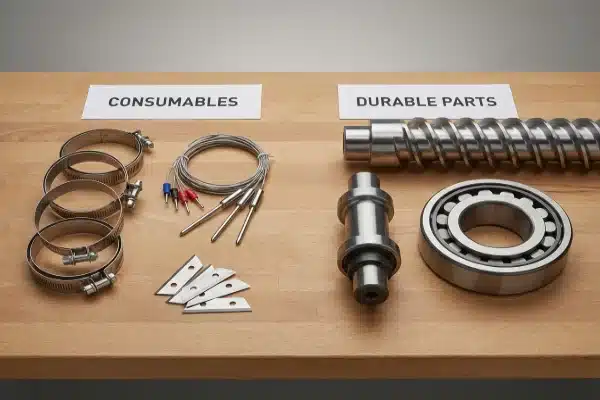
Defining the Exclusion List
Every contract has an "Exclusions" section. This is normal. You cannot expect a warranty to cover hydraulic oil or air filters. However, manufacturers sometimes sneak expensive items into this list.
For extrusion blow molding, the Extrusion Screw 8 and Barrel are critical. Over time, they wear down. But they should last years, not months. You must confirm these are treated as durable goods. If the screw snaps in half after six months, that is a defect, not wear. If the contract lists the screw as a "consumable," you have no recourse.
The Ball Screw Caveat
In all-electric machines, the Fuso de esferas 9 replaces the hydraulic cylinder. It moves the clamp and the carriage. It is a heavy-duty, expensive component.
Manufacturers often put strict conditions on ball screw warranties. They usually require proof of Automatic Lubrication 10. If your central lube system runs dry or uses the wrong grease, the manufacturer can void the warranty immediately.
We advise you to check the "Voiding Clauses." Ensure the contract states that warranty is only voided if the lack of lubrication caused the failure. If the ball screw snaps due to a material defect, the fact that you missed one day of greasing should not matter.
Environmental Conditions
Finally, check for Environmental Voiding Clauses. Electric components generate heat. The manual will specify a maximum operating temperature (e.g., 40°C). If your factory is hot and not air-conditioned, and a drive overheats, the manufacturer might deny the claim.
If you operate in a hot or humid region, negotiate this upfront. Ask for a "Tropicalized" package or a clause that allows for higher ambient temperatures.
Typical Consumable vs. Durable List
| Componente | Categoria | Should it be Warranty Covered? |
|---|---|---|
| Oil Filters | Consumable | No |
| Trimming Knives | Consumable | No |
| Heater Bands | Consumable/Durable | Negotiable (Ask for 6 months) |
| Ball Screws | Durable | Yes (Critical) |
| Extrusion Screw | Durable | Yes (Critical) |
| Tie Bars | Durable | Yes (Critical) |
Conclusão
Securing a strong warranty requires defining core components, labor terms, and wear exclusions before you sign. This foresight protects your ROI and ensures our machines deliver long-term value to your production line.
Notas de rodapé
1. Comparison of hydraulic systems versus electric actuation. ↩︎
2. Guide to understanding voltage fluctuations and power quality. ↩︎
3. Strategies for managing industrial component obsolescence. ↩︎
4. Overview of preventative maintenance strategies for manufacturing. ↩︎
5. Introduction to Programmable Logic Controllers (PLC). ↩︎
6. Definition and function of Human Machine Interfaces (HMI). ↩︎
7. Benefits of remote monitoring and diagnostics in manufacturing. ↩︎
8. Fundamentals of extrusion screw design and wear. ↩︎
9. Technical overview of ball screw mechanisms. ↩︎
10. Importance of automatic lubrication systems for machinery. ↩︎


0 comentários