Panduan Utama Mesin PET Blow Moulding: Biaya, Proses, dan Panduan Pembeli 2025

Waktu membaca: (Jumlah kata: )

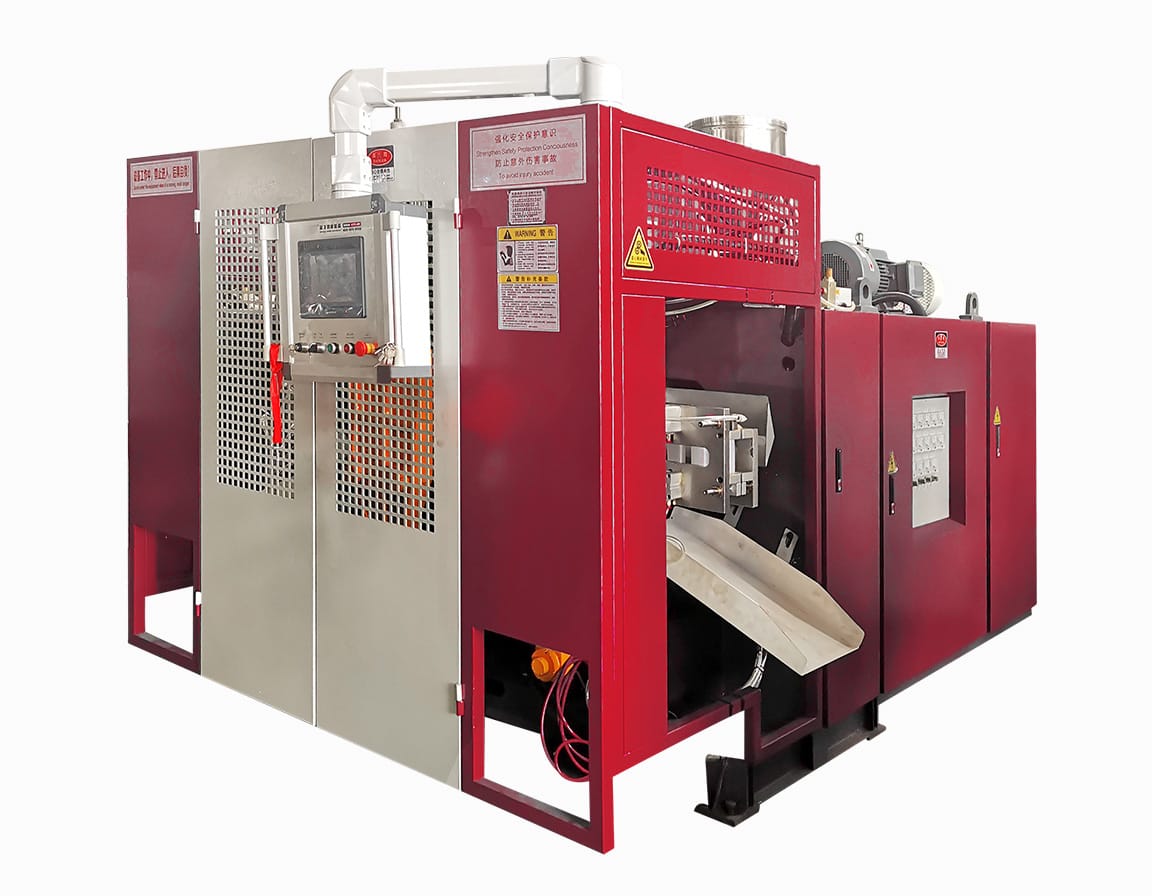
Lengan pengambil botol robotik overhead dengan cable chain, pneumatik, dan sistem posisi servo

Oktober 6, 2025


Panduan Utama Mesin PET Blow Moulding: Biaya, Proses, dan Panduan Pembeli 2025

Every minute, over a million plastic bottles are sold across the globe. Behind this staggering figure lies a vast, efficient, and technologically demanding industrial chain. For any business involved in beverages, food, cosmetics, pharmaceuticals, or chemicals, the container is just as crucial as the product itself. The core of efficient, stable, and cost-effective production all points to one key piece of equipment—the PET (Polyethylene Terephthalate) blow moulding machine. However, faced with a dazzling array of models, vastly different price points, and complex technical specifications, you might feel bewildered: How do I choose the right one? What is the true cost of investing in a machine? How is the production cost of a seemingly simple plastic bottle calculated? This is not just an equipment purchasing guide; it is a business decision blueprint meticulously prepared by our team at Leka Machine, based on over a decade of industry experience. We understand that you don’t need a cold data sheet, but rather a reliable partner who can answer all your questions, help you avoid potential risks, and ultimately guide you to success. Whether you’re an entrepreneur preparing to enter the bottling industry or a production manager looking to reduce costs and increase efficiency through an upgrade, this article will be your most comprehensive and practical resource. Now, let’s delve into the world of PET blow moulding machines and uncover all their secrets.

What is a PET Blow Moulding Machine? Understanding the Core Technology

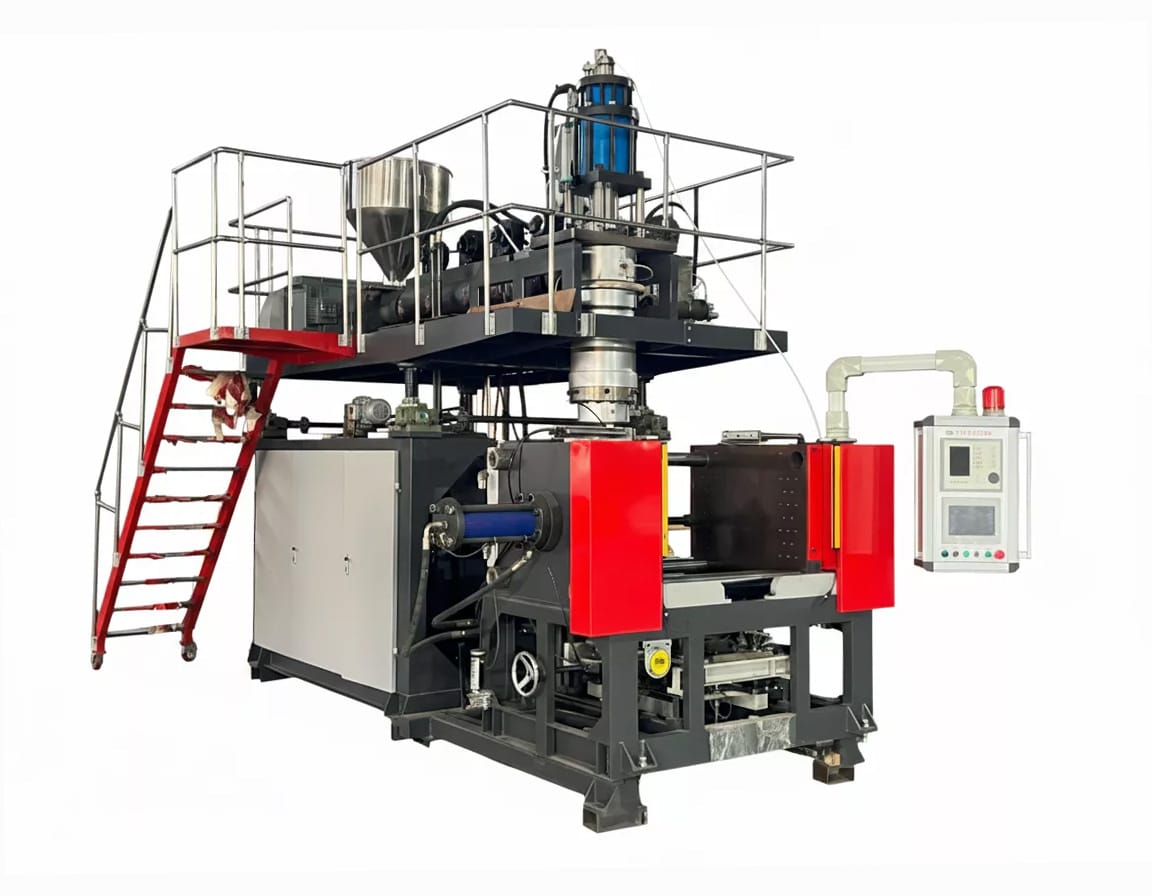
Muat Resin Plastik ke dalam Hopper dengan mesin blow moulding ekstrusi

Before we dive deep into costs and selection, we must first fundamentally understand how this equipment works. Simply put, the core task of a PET blow moulding machine is to transform a small, test-tube-shaped plastic “preform” into the various shapes of plastic bottles we see in our daily lives, through a process of heating and high-pressure air blowing. Behind this is a precise and efficient physical forming process known as “Reheat Stretch Blow Moulding.

From Preform to Product: The Magic of Reheat Stretch Blow Moulding

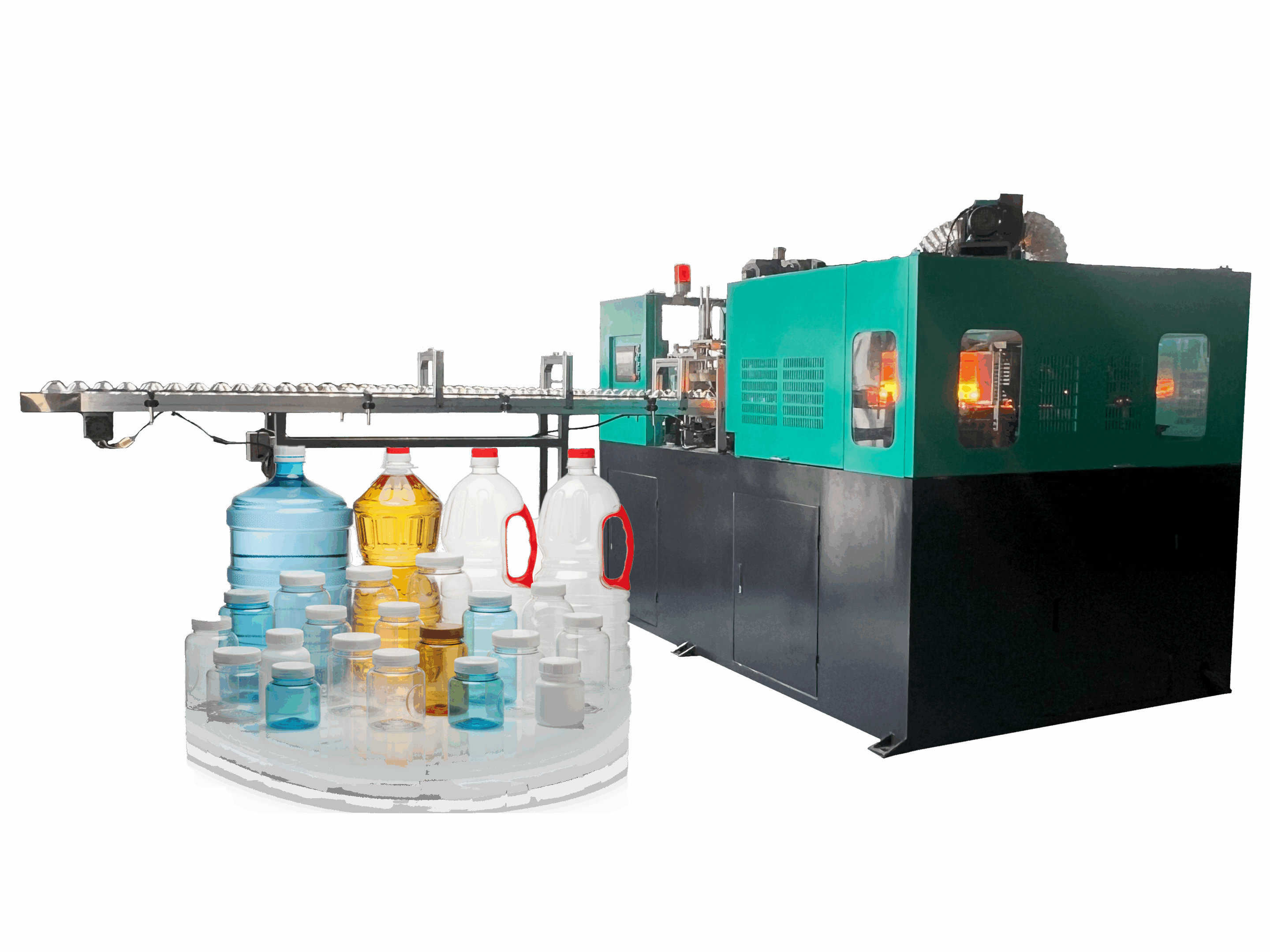
A mixed set of blow molded plastic bottles and jars used for liquid and dry goods packaging across production lines.

Imagine blowing up a long, thin balloon. You would first stretch it and then inflate it, resulting in a more uniform and stronger balloon. The principle of PET bottle blowing is very similar, but the process is far more precise. We call this entire process the “two-step method” because it divides production into two independent stages:

Stage One: Preform Manufacturing. The preforms are produced by a different piece of equipment called an “Injection Moulding Machine.” Manufacturers produce large quantities of preforms in advance based on the required neck finish, weight, and color. As a bottle producer, you could choose to invest in injection moulding equipment to make your own preforms, but this is typically only viable for factories with extremely high output. For the vast majority of small and medium-sized enterprises, the more economical and flexible approach is to purchase preforms directly from specialized suppliers.

Stage Two: Reheat Stretch Blow Moulding. This is the area where we at Leka Machine specialize and the core topic of this article. Our PET blow moulding machines perform this stage, taking purchased preforms and transforming them into finished bottle products.

The Material’s Secret: Why PET (Polyethylene Terephthalate)?

Among the many plastic materials, why has PET emerged as the gold standard for bottle containers? This is due to its unparalleled combination of physical and chemical properties:

  • Exceptional Clarity & Gloss: PET possesses a glass-like transparency that perfectly showcases the color and purity of the product inside, significantly enhancing its shelf appeal.
  • Incredible Strength & Lightweight Nature: It has a very high strength-to-weight ratio. A 500ml PET bottle typically weighs less than 20 grams, yet it can withstand the internal pressure of carbonated beverages, which is several times atmospheric pressure. It is also resistant to breakage during transport, significantly reducing logistics costs.
  • Excellent Gas Barrier Properties: PET material effectively prevents oxygen from entering and carbon dioxide from escaping. This is crucial for preserving the “fizz” in carbonated drinks, the vitamins in fruit juices, and the freshness of food products.
  • Chemical Stability & Safety: PET itself is very stable and does not react with most contents (like water, beverages, edible oils, etc.), complying with strict food safety standards worldwide.
  • 100% Recyclability: In today’s increasingly environmentally conscious world, PET is one of the plastics with the most mature recycling systems and highest recycling value. Recycled rPET can be used to produce new bottles, fibers, packaging materials, and more, aligning with the trend of a circular economy.

It is this superior combination of properties that has made PET the ideal container material for our modern, convenient lifestyle.

The PET Bottle Blowing Process Explained: Seven Core Steps

To give you a more intuitive understanding, we will break down the complete workflow of a fully automatic PET blow moulding machine into the following seven core steps. Imagine countless tiny preforms embarking on a magical “transformation journey.”

  1. Step 1: Automatic Preform unscrambling and Loading
    The journey begins in a large storage hopper. The operator pours thousands of preforms into it. Below the hopper, a sophisticated preform elevating and unscrambling system works automatically, orienting the disorganized preforms into a uniform, neck-up position and arranging them in a neat line to enter the heating chain. On a fully automatic line, this process requires no manual intervention.
  2. Step 2: Precision Heating (Reheating Stage)
    The preforms travel in a line through a long oven tunnel. On both sides of the tunnel are multiple sets of high-intensity infrared heating lamps. This is an extremely critical stage. The goal is not to melt the plastic, but to heat it to the optimal stretching temperature (typically between 90°C and 120°C). To ensure uniform wall thickness in the final bottle, the heating must be precise and even. Our machines use multi-zone temperature control, allowing for differential heating of various parts of the preform. Simultaneously, the preforms rotate continuously as they move along the track, ensuring uniform 360-degree heat exposure. It’s important to note that the neck finish (the threaded part) is shielded and kept cool throughout this process to maintain its dimensional accuracy for a perfect seal with the cap.
  3. Step 3: Rapid Transfer to the Mould
    The preforms, now heated to a soft, malleable state like dough, are immediately and precisely gripped by high-speed mechanical hands and transferred into the cold metal blow mould. Timing is everything; any delay during transfer can cause the preform temperature to drop, affecting the final moulding kualitas.
  4. Step 4: Stretching and Pre-Blowing
    The moment the mould closes, a slender metal stretch rod rapidly descends from the top, entering the preform and stretching it vertically (axially). Almost simultaneously, low-pressure air (around 10-15 bar) is introduced. This is called the “pre-blow.” The purpose of the pre-blow is to cause the stretched preform to expand slightly, ensuring its inner wall evenly approaches the mould’s inner contours, preparing it for the final high-pressure blowing. This “stretch-then-blow” action is what’s known as “biaxial orientation,” which re-aligns the PET molecular chains, giving the bottle its exceptional strength and clarity.
  5. Step 5: Final High-Pressure Blow Moulding
    Immediately after the pre-blow, the system switches to high-pressure air (typically up to 25-40 bar). The powerful air pressure instantly injects into the bottle, forcing the soft plastic to expand at high speed and conform to every corner and detail of the mould cavity, thus creating the bottle’s final, precise shape. Whether it’s the texture on the bottle’s body or the reinforcing ribs on the base, everything is perfectly replicated in this fraction of a second.
  6. Step 6: Pressure Holding, Cooling, and Exhausting
    The high-pressure air is held for a very brief period (known as pressure holding), allowing the bottle, pressed against the cold mould walls (which are internally cooled by circulating water), to rapidly cool and solidify. Once the bottle is set, the high-pressure air is instantly vented, a process often accompanied by a loud “pop” sound.
  7. Step 7: Mould Opening and Ejection
    With the air exhausted, the mould quickly opens, and a crystal-clear, perfectly formed bottle is born. A robotic arm or an air conveyor system removes the finished bottle and sends it to the next station (such as the filling line), while the next set of heated preforms is already in position, entering the closed mould to begin a new cycle. This process repeats continuously; an efficient 4-cavity fully automatic machine can complete thousands of such cycles every hour.

Berapa Biaya Mesin Tiup PET? Analisis Keuangan Terperinci

Ini tanpa duda merupakan pertanyaan paling mendesak bagi setiap calon investor. Namun, pertanyaan “Berapa biaya blow moulding machine sebuah mesin?” sangat mirip dengan bertanya, “Berapa harga sebuah mobil?” Jawabannya sangat bervariasi. Harganya dapat berkisar dari puluhan ribu dolar AS untuk mesin tingkat pemula hingga ratusan ribu dolar AS untuk lini produksi kelas atas. Harga akhir bukanlah satu “harga tempel” tunggal, melainkan ditentukan oleh serangkaian faktor kunci. Sebagai seorang produsen peralatan, yang bertanggung jawab, tugas kami adalah membantu Anda memahami dengan jelas setiap faktor ini untuk membuat keputusan investasi yang paling bijaksana.

Lima Faktor Inti yang Menentukan Harga

Factor 1: Level of Automation – Semi-Automatic vs. Fully Automatic

Ini adalah garis pemisah utama dan paling mendasar yang mempengaruhi harga.

Mesin Tiup Botol PET Semi-Otomatis Blowing Machine

  • Alur Kerja: Jenis mesin ini biasanya terdiri dari dua unit terpisah: oven pemanas dan stasiun peniupan. Seorang operator memuat preform secara manual ke dalam pemegang di oven. Setelah dipanaskan, operator dengan cepat memindahkan preform panas secara manual ke dalam cetakan di stasiun peniupan dan menekan tombol untuk memulai proses peniupan.
  • Kelebihan:
    • Investasi Awal yang Sangat Rendah: Harganya seringkali hanya sebagian kecil dari harga mesin full otomatis, menjadikannya ideal untuk startup dengan anggaran terbatas.
    • Jejak Kecil: Desainnya yang kompak membutuhkan ruang pabrik yang lebih sedikit.
    • Fleksibilitas Tinggi: Mengganti cetakan relatif sederhana, sehingga cocok untuk produksi batch kecil, multi-varietas atau sampling pengembangan produk.
  • Kekurangan:
    • Output Rendah: Dibatasi oleh kecepatan operasi manual, mesin semi-otomatis one-out-of-two biasanya memiliki output teoritis 800-1000 botol per jam (BPH).
    • Biaya Tenaga Kerja Tinggi: Membutuhkan setidaknya satu atau dua operator terampil yang bekerja terus menerus. Dalam jangka panjang, biaya tenaga kerja per botol jauh lebih tinggi dibandingkan dengan mesin otomatis.
    • Kualitas Tidak Konsisten: Waktu transfer manual dari pemanasan ke meniup peniupan dapat bervariasi, menyebabkan fluktuasi suhu pada preform dan mempengaruhi konsistensi kualitas botol jadi.
  • Kisaran Harga Khas: $8,000 – $20,000 USD

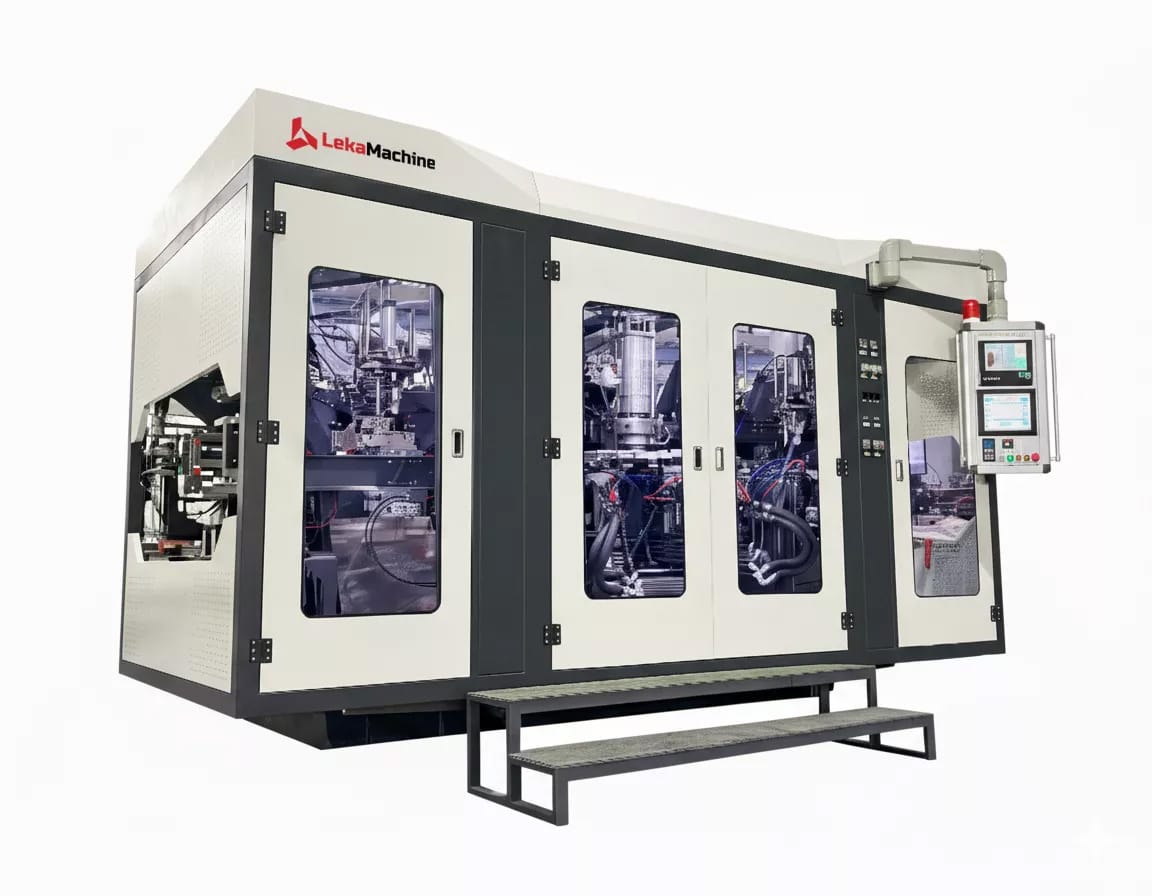
Mesin Tiup Botol PET Full Otomatis

  • Alur Kerja: Dari pemuatan preform, penyusunan, dan pemanasan otomatis hingga memasuki cetakan untuk ditiup dan pengeluaran produk akhir, seluruh proses berlangsung mulus dan tidak memerlukan intervensi manual. Peran operator terutama adalah memantau peralatan dan mengisi ulang preform.
  • Kelebihan:
    • Efisiensi Produksi yang Sangat Tinggi: Output dapat berkisar dari 2,000 BPH hingga puluhan ribu BPH, memenuhi tuntutan produksi skala besar.
    • Kualitas Produk yang Sangat Konsisten: Semua proses dikendalikan secara presisi oleh PLC (Programmable Logic Controller), menghilangkan kesalahan manusia dan memastikan setiap botol memenuhi standar.
    • Biaya Tenaga Kerja Per Unit yang Sangat Rendah: Satu lini produksi biasanya hanya membutuhkan satu orang untuk inspeksi, secara drastis mengurangi biaya operasional jangka panjang.
    • Skalabilitas: Dapat diintegrasikan secara mulus dengan lini pengisian, penutupan, pelabelan, dan pengemasan otomatis hilir.
  • Kekurangan:
    • Investasi Awal yang Jauh Lebih Tinggi: Harganya beberapa kali, atau bahkan puluhan kali, lipat dari mesin semi-otomatis.
    • Jejak yang Lebih Besar: Membutuhkan lebih banyak ruang pabrik untuk menampung seluruh lini produksi.
    • Persyaratan Perawatan yang Lebih Tinggi: Sistemnya lebih kompleks dan membutuhkan tim perawatan dengan tingkat keterampilan teknis tertentu.
  • Kisaran Harga Khas: $30,000 – $200,000+ USD

Production Capacity (Number of Cavities)

Untuk mesin full otomatis, indikator kapasitas intinya adalah “jumlah rongga”. Satu “rongga” berarti satu botol dapat diproduksi per siklus tiup. Semakin banyak rongga, semakin tinggi output per satuan waktu, dan konsekuensinya, semakin tinggi harga mesin.

Di bawah ini adalah tabel yang menunjukkan hubungan umum antara jumlah rongga, output, dan perkiraan harga. (Harap dicatat bahwa ini adalah perkiraan industri; hubungi kami untuk penawaran yang tepat.)

Jumlah RonggaOutput Teoritis (untuk 500ml)Kisaran Harga (USD)Cocok Untuk
2-Rongga2,000 – 3,000 BPH$30,000 – $45,000Perusahaan kecil hingga menengah, fase startup
4-Rongga4,000 – 6,000 BPH$50,000 – $75,000Perusahaan menengah, merek regional
6-Rongga6,000 – 9,000 BPH$80,000 – $120,000Fast-growing medium to large enterprises
8-Cavity and above12,000+ BPH$130,000+Large beverage producers, national brands

When choosing the number of cavities, we usually advise clients to not only consider their current order volume but also to plan for business growth over the next 3-5 years.

Factor 3: Bottle Specifications (Volume, Neck Size, Shape)

  • Bottle Volume: Machines are typically designed with a maximum supported bottle volume. For example, a machine designed for bottles under 2 liters cannot be used to produce large 5-liter water jugs. Machines for large-capacity bottles (like 5-gallon PC/PET barrels) have completely different clamping forces, stretching strokes, and machine structures, naturally leading to higher prices.
  • Bottle Neck Finish: Different neck standards (e.g., 28mm, 30mm, 38mm) require different preforms and mould designs, which can slightly affect the cost.
  • Bottle Shape: Standard round bottles are the simplest to manufacture. If your design is very unique, such as a square bottle, a bottle with a handle, or an irregularly shaped bottle with complex embossed patterns, it may require more sophisticated mould processing techniques and more advanced machine control systems (like servo drives), all of which will increase the corresponding costs.

Factor 4: Brand and Configuration Level

Just as cars have different brands and configurations, so do blow moulding machines. The stability and lifespan of a machine are determined by the quality of its core components.

  • Core Component Brands: A high-quality blow moulding machine will use electrical and pneumatic components from internationally renowned brands. For example, its PLC might be from Siemens (Germany) or Mitsubishi (Japan), and its cylinders and solenoid valves from Festo (Germany) or SMC (Japan). Although these high-quality components increase the manufacturing cost of the machine, they ensure long-term stability and an extremely low failure rate under high-intensity operation, saving you from huge losses caused by frequent downtime.
  • Manufacturer’s Brand and Service: A manufacturer with a good reputation and a long history, like Leka Machine, includes years of R&D investment, a strict quality control system, and a comprehensive after-sales service commitment in its pricing. When you choose us, you are not just buying a machine, but a long-term reliable technical support and partnership.

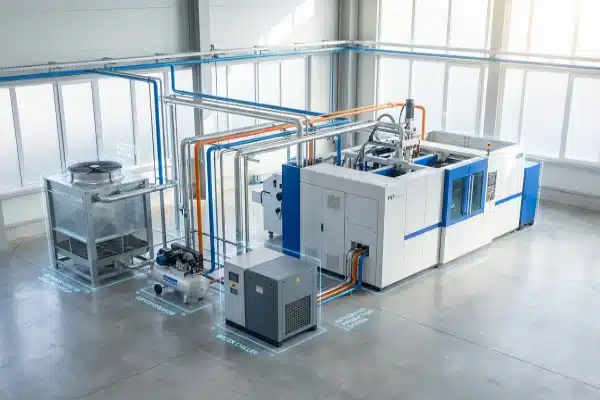
Factor 5: The “Hidden” Costs: Essential Auxiliary Equipment

This is the point most first-time investors easily overlook. A PET blow moulding machine cannot work in isolation; it requires a complete “ecosystem” to support it. This auxiliary equipment is usually not included in the quotation for the main blowing machine and must be configured separately.

  • High-Pressure Air Compressor (30-40 Bar): This is the power source for blowing, providing the gas for the final high-pressure forming. Its investment ranges from $5,000 to $25,000, depending on the required air volume.
  • Refrigerated Air Dryer and Filters: The high-pressure air must be clean and dry. Moisture and oil in the air can severely affect the transparency and quality of the bottles and even damage the machine’s pneumatic valves. This purification system costs approximately $2,000 to $10,000.
  • Industrial Water Chiller: Used to circulate and cool the blow mould, ensuring the bottles can set quickly and maintaining an efficient production cycle. The cost is around $3,000 to $15,000.
  • Blow Moulds: Custom-made for your bottle design. The cost of a mould depends on its number of cavities, complexity, and the material used (usually aviation aluminum or steel). A high-quality mould can cost from $2,500 to over $10,000 per cavity.

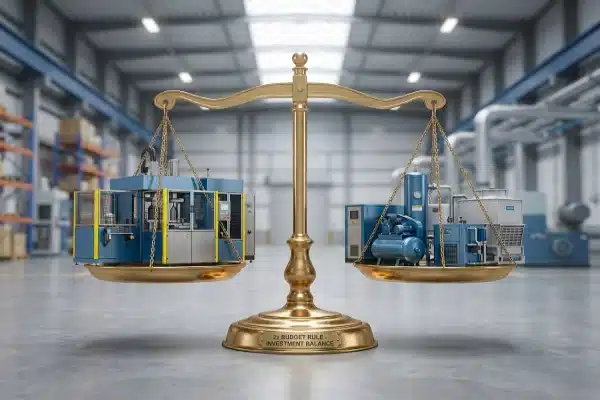
Therefore, when making your budget, you must consider the total project investment as “Main Blowing Machine + Full Set of Auxiliaries + Moulds.”

The Savvy Investor’s Dilemma: Is Buying a Used Blow Moulding Machine a Good Deal?

When you search for “Used Mesin Cetak Tiup for sale,” you’ll find that the prices of second-hand equipment are extremely tempting, perhaps half the price of a new machine or even less. For an entrepreneur on a tight budget, this might seem like a shortcut. But as industry experts, we must warn you that this could be a path fraught with risks.

  • Potential Advantage:
    • Extremely Low Initial Capital Outlay: This is the sole and greatest attraction of used equipment.
  • Significant Risks to Consider:
    • No Warranty or Technical Support: Once the equipment has a problem, you are on your own. Repairs, troubleshooting, and finding suitable spare parts will be your challenges, and the production losses during this time can be incalculable.
    • Unpredictable Wear and Tear: You cannot know the previous usage intensity and maintenance condition of the machine. Its core components, such as cylinder seals, bearings, and heating lamps, may be near the end of their service life and could fail at any time, leading to expensive repairs.
    • Outdated Technology and Inefficiency: Older equipment is far inferior to modern new machines in terms of energy consumption, production speed, and control precision. It may consume more electricity and have a higher scrap rate, leading to higher operating costs in the long run.
    • Difficulty in Finding Spare Parts: For older models that are no longer in production, finding original replacement parts can be a nightmare.
    • No Professional Training: Suppliers of new machines usually provide on-site installation, commissioning, and operator training services to ensure your team can get up to speed quickly. With used equipment, you have to figure everything out on your own.

Our Recommendation: While used equipment may seem to save on initial purchase costs, its potential repair costs, production losses, and low operational efficiency will often make you pay a heavier price later on. Investing in a brand-new machine from a reputable manufacturer like Leka Machine gives you not just a piece of equipment, but also production stability, technological reliability, and worry-free comprehensive service support. This is a safer and more valuable long-term investment.

The Ultimate Question: What is the True Cost to Manufacture a Single Plastic Bottle?

After understanding the investment cost of the machine, the next, more in-depth question is: How much does it cost for my factory to produce a single bottle? Accurately calculating the per-bottle cost is central to pricing, profit assessment, and operational optimization. This cost is not determined by the plastic alone but is a composite figure.

The Four Core Components of Per-Bottle Production Cost

We can summarize it with a simple formula:

Cost per Bottle = (Material Cost + Energy Cost + Labor Cost + Depreciation Cost) / Total Production Volume

Let’s break down each of these four core components.

Component 1: Raw Material Cost (PET Preform)

This is the largest and most significant variable cost in production. The price of a preform is mainly determined by three factors:

  • Weight (in Grams): Komitmen design of the bottle dictates the weight of the plastic required. A standard 500ml mineral water bottle preform might weigh 18 grams, while a preform for a soda bottle that needs to withstand carbonation pressure might need to be 22 grams. The heavier the gram weight, the higher the price.
  • Market Price of PET Resin: PET is derived from petroleum, and its price fluctuates like a commodity with international crude oil prices and market supply and demand. This is an external factor you need to monitor continuously.
  • Color and Additives: Clear, natural-colored preforms are the least expensive. If you need to produce colored bottles (like brown beer bottles or green beverage bottles) or preforms with special additives (like UV inhibitors), the price will increase accordingly.

Example Calculation:
Assuming that at the current PET resin price, the purchase price of an 18-gram clear preform is $0.022. This is the starting point for calculating your per-bottle cost.

Component 2: Operational Costs (Energy & Labor)

  • Konsumsi Energi: This is a significant daily expense. Your electricity bill will primarily come from the following sources:
    • The blow moulding machine itself (heating lamps, servo motors, control systems).
    • The high-pressure air compressor, which is notoriously an “energy hog” and the most power-intensive piece of equipment in the production line.
    • The water chiller and air dryer, which also need to run continuously to ensure production.

    Modern new equipment, like our products at Leka Machine, is designed to minimize energy consumption per unit of output through optimized heating systems, servo-drive technology, and energy recovery systems.

  • Labor Cost: This is where the cost difference between semi-automatic and fully automatic lines is most pronounced.
    • For a semi-automatic line, you need to calculate the wages, benefits, etc., for one or two operators and then amortize that cost over the hourly output.
    • For a fully automatic line, it may only require the cost of half a worker’s time (as one worker can supervise two lines). The higher the level of automation, the closer the labor cost per bottle approaches zero.

Component 3: Equipment and Mould Depreciation Cost

This is a capital expenditure, treated as a fixed cost. You need to amortize the total investment in the equipment (main machine + auxiliaries) and moulds over their expected service life and total production volume.

Example:
Suppose you invested a total of $80,000 in a fully automatic production line with an expected effective service life of 10 years. Using simple linear calculation, the annual depreciation expense is $8,000. If this production line can produce 20 million bottles per year, then the depreciation cost allocated to each bottle is $8,000 / 20,000,000 = $0.0004.

Comprehensive Sample Calculation: The Cost Journey of a 500ml Water Bottle

Now, let’s put all the pieces together and simulate the calculation of the per-bottle production cost for a 500ml water bottle using a clear table.
(*The following data are reasonable estimates based on industry averages and are for reference only.*)

Cost ComponentCalculation Basis & ExplanationCost per Bottle (USD)
1. Raw Material CostPurchase of one 18-gram clear PET preform$0.0220
2. Energy CostA 4-cavity line (with auxiliaries) has a total power of ~60kW, electricity at $0.12/kWh, output of 4500 BPH. Calc: (60 * 0.12) / 4500$0.0016
3. Labor CostOne operator at $20/hour manages 2 lines (0.5 person per line), output of 4500 BPH. Calc: (20 * 0.5) / 4500$0.0022
4. Depreciation CostTotal investment $80,000, depreciated over 10 years, annual production 20 million bottles. Calc: ($80,000/10) / 20,000,000$0.0004
5. Other OverheadsAmortization of factory rent, maintenance parts, administrative costs, etc.$0.0003
Total Estimated Cost(Sum of all components)$0.0265

Conclusion: Through this calculation, we arrive at a production cost of approximately 2.65 cents for a 500ml bottle. This figure clearly illustrates that bottle production is a typical “high-volume, low-margin” industry. Profits come from economies of scale and meticulous cost control in every production link. Whether your machine is energy-efficient, stable, and has a low scrap rate will directly affect the thousandths place of this final number. And when multiplied by an annual output of millions or even tens of millions, that difference in the thousandths place translates into a huge difference in corporate profit.

Technical Deep Dive and Making the Right Choice

After understanding the cost structure, we need to move into a deeper technical realm to address some common questions and provide you with a scientific method for equipment selection.

PET, PP, HDPE: Is it the Same Blowing Machine?

This is a very common misconception. The answer is: absolutely not. Although they all fall under the umbrella of “blow moulding,” the processing methods for different plastics are fundamentally different.

  • PET (Polyethylene Terephthalate): As detailed earlier, it uses “Stretch Blow Moulding.” The core of this process is the “biaxial stretching” of the preform after heating. Without this stretching process, PET cannot achieve its characteristic high strength and transparency.
  • PP (Polypropylene) & HDPE (High-Density Polyethylene): These two materials are commonly used to make opaque bottles for household chemicals (like shampoo bottles), milk jugs, and motor oil containers. They primarily use the “Extrusion Blow Moulding” process. This process involves melting plastic pellets and extruding a hollow, toothpaste-like tube called a “parison.” A mould then quickly closes around the parison, and air is blown in from the top to inflate it into the final shape. This process lacks the “stretching” element that is critical for PET.

Key Takeaway: You must choose the correct equipment for your product. If you are going to produce clear beverage or water bottles, you need a PET Stretch Blow Moulding Machine. Attempting to process PET preforms with an mesin extrusion blow moulding will be completely unsuccessful. When consulting with suppliers, be sure to clearly specify the exact plastic material you will be using for your bottles.

What About Preforms? What is the Best Machine for Making PET Preforms?

This is another key point that needs clarification. The machine that makes the bottle is completely different from the one that makes the preform.

The equipment used to produce PET preforms is called a “PET Preform Injection Moulding Machine.” Its working principle is entirely different from a blow moulding machine. It involves injecting molten PET resin under high pressure into a precision mould, which is then cooled to form the preform.

As a bottle producer, you face a strategic choice:

  • Purchase Preforms Externally: This is the model we recommend for the vast majority of small to medium-sized businesses.
    • Advantages: Avoids the high investment cost of an injection moulding line; eliminates the need for complex injection process management and technical personnel; allows for flexible purchasing of different weights and specifications of preforms based on order demand, reducing inventory pressure.
  • Establish an In-House Preform Production Line:
    • Suitable for: Generally, only very large-scale producers with an annual demand of tens of millions or even hundreds of millions of units would consider setting up their own preform production line. Only massive production volumes can amortize the huge investment in injection moulding machines and precision moulds and achieve a lower unit cost than purchasing externally.

Your 2025 Buying Checklist: How to Choose the Perfect Machine for Your Business

Now that you are equipped with sufficient knowledge, let’s translate that knowledge into an actionable procurement decision process. Please follow these five steps, which will help you clearly define your needs and communicate effectively with equipment suppliers.

  1. Step 1: Clearly Define Your Product
    Before contacting any supplier, first answer the following questions clearly:
    • Bottle Volume Range: What are the minimum and maximum volumes of the bottles you plan to produce? (e.g., 250ml to 1.5L)
    • Neck Finish Specification: Which standard neck finish will you use? (e.g., PCO 1881, 30/25, 38mm)
    • Bottle Shape and Design: Will it be a standard round bottle, or a square, or irregularly shaped bottle?
    • Bottle Application: Is it for purified water, carbonated beverages, hot-fill juices, or alcoholic beverages? (Different applications have different requirements for pressure and heat resistance.)
  2. Step 2: Accurately Calculate Your Capacity Needs
    • Current Demand: Based on your current orders and market forecasts, how many bottles per hour (BPH) do you need to produce?
    • Future Planning: Be forward-thinking. A good equipment investment should support your development for the next 5-10 years. Estimate your business growth rate for the next 3-5 years and plan your capacity accordingly. We have seen too many clients choose insufficient capacity initially and face the dilemma of a second investment when their business grows rapidly. A common rule of thumb is to choose a machine with a capacity between 1.5 to 2 times your current demand.
  3. Step 3: Match Capacity to Machine Type
    Match your calculated BPH requirement with the machine types we discussed earlier:
    • Demand < 1,500 BPH: A semi-automatic blow moulding machine may be your most cost-effective starting point.
    • Demand between 2,000 – 3,000 BPH: A 2-cavity fully automatic machine is the ideal choice.
    • Demand between 4,000 – 6,000 BPH: You should consider a 4-cavity fully automatic machine.
    • Demand > 6,000 BPH: Look at high-speed production lines with 6 or more cavities.
  4. Step 4: Deeply Evaluate Technical Specifications
    When a supplier provides you with a quotation, don’t just look at the price. Scrutinize the key technical parameters like an expert:
    • Clamping Force: Measured in tons, this represents the force with which the mould is held closed. Sufficient clamping force is key to ensuring a clean parting line on the bottle with no flash.
    • Theoretical vs. Actual Stable Output: Many manufacturers will list a maximum “theoretical output.” You need to ask what the actual, stable output is during long-term, steady operation, taking various factors into account.
    • List of Core Components: Request a detailed configuration list from the supplier to check the brands and models of key components like the PLC, touch screen, frequency inverter, servo motors, and pneumatic elements. This is the most direct way to judge the quality of the machine.
    • Energy Consumption Parameters: Inquire about the total installed power of the machine and its actual running power consumption under normal production conditions. This will directly impact your future operating costs.
  5. Step 5: Comprehensively Assess the Manufacturer’s Overall Strength
    Choosing a machine is also about choosing a long-term partner. Be sure to conduct a thorough assessment of the manufacturer:
    • After-Sales Service Response Mechanism: Do they have a local or regional service team? What is their response time when a machine has a problem?
    • Warranty Policy: How long is the warranty for the entire machine? Which are the wearing parts that are not covered by the warranty?
    • Installation and Training: Does the quotation include on-site installation, commissioning, and comprehensive training for your operation and maintenance teams?
    • Spare Parts Availability: Do they have an adequate stock of common spare parts? Can they supply replacement parts quickly when you need them?
    • Customer Cases and Reputation: Ask them to provide references from customers of a similar scale to yours. If possible, conduct a site visit to one of their customer’s factories to hear feedback from real users.

 Common Production Issues and Maintenance Guide

Owning a top-tier machine is only half the battle. Knowing how to deal with potential daily production issues and performing scientific maintenance are what ensure your production line continues to create value for you efficiently.

Common Bottle Defects and Their Likely Causes

  • Issue 1: Pearlescence or Whiteness in the Bottle Body
    • Likely Cause 1: Overheating of the corresponding preform area, causing the PET material to crystallize.
    • Likely Cause 2: Over-stretching, where the material is stretched beyond its physical limits.
    • Likely Cause 3: Excessive high-pressure blowing air.
  • Issue 2: Heavy or Off-Center Gate at the Bottle Base
    • Likely Cause 1: Incorrect speed or timing settings for the stretch rod, failing to sufficiently stretch the material at the preform base.
    • Likely Cause 2: Insufficient heating temperature at the preform base, leading to poor ductility in that area.
    • Likely Cause 3: Pre-blow pressure is too low or starts too late.
  • Issue 3: Uneven Wall Thickness
    • Likely Cause 1: Uneven heating of the preform in the oven, possibly due to an aging or malfunctioning heating lamp or poor preform rotation.
    • Likely Cause 2: Incorrect pre-blow pressure or timing, preventing the material from distributing evenly before the final blow.
  • Issue 4: Incomplete Formation with Unclear Corners
    • Likely Cause 1: Insufficient high-pressure blowing air; check the high-pressure air source.
    • Likely Cause 2: Blowing time is too short.
    • Likely Cause 3: Poor mould venting, causing an air cushion to form between the mould and the bottle wall.

Understanding these basic principles will help your technicians adjust parameters more systematically when problems arise, rather than relying on trial and error.

Maintenance Checklist to Extend Equipment Lifespan

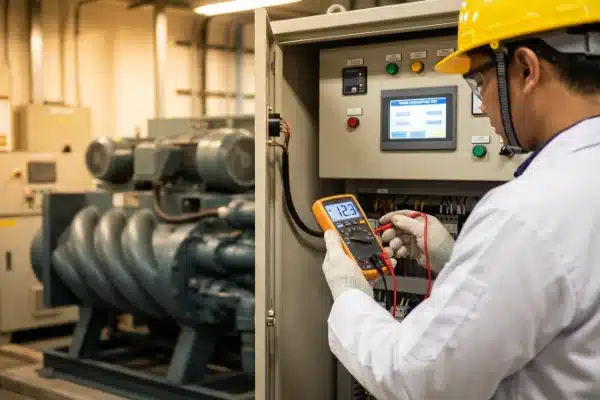
We always emphasize to our clients: “The best repair is preventive maintenance.” A simple and effective maintenance plan can help you avoid over 90% of sudden breakdowns.

  • Daily Maintenance (Before Startup / After Shutdown):
    • Clean: Wipe the equipment surfaces, especially the mould and sensor areas, with a clean cloth to keep them free of dust and oil.
    • Check Pressures: Confirm that the high and low-pressure air sources are within the normal range. Check the water level and temperature of the chiller.
    • Drain Filters: Drain any accumulated water from the air filters and air tanks.
    • Listen for Abnormal Noises: During operation, pay attention to any unusual mechanical sounds or air valve leaks.
  • Weekly Maintenance:
    • Lubricate: Clean and lubricate the moving parts of the machine, such as guide rails, bearings, and the mould clamping mechanism.
    • Tighten Screws: Check for any loose screws on the main components of the machine and tighten them.
    • Inspect Heating Lamps: Visually check if all heating lamps in the oven are functioning correctly and replace any damaged ones promptly.
    • Clean Ventilation Filters: Clean the ventilation filters on the electrical cabinet and motors to ensure good heat dissipation.
  • Monthly / Quarterly Maintenance:
    • Thoroughly Inspect Air and Water Lines: Check all air and water pipe fittings for leaks.
    • Replace Filter Elements: Replace the filter elements of the air filters according to the frequency of use.
    • Check Seals: Inspect the seals of all cylinders and valves for signs of aging or wear.
    • Perform a Full Performance Diagnostic: Have a professional technician check and calibrate the various operating parameters of the machine.

By consistently following this maintenance plan, your Leka Machine equipment will serve you in optimal condition, year after year.

The Leka Machine Advantage: Your Strategic Partner in PET Bottle Production

After understanding the market’s complexity and the technology’s depth, you will find that choosing a supplier is about much more than comparing prices. You need a partner who can deeply understand your needs, provide high-quality products, and offer continuous support on your path to business growth. This is the core value of Leka Machine.

Why Top Producers Choose Leka Machine

  • Uncompromising Quality, Competitive Price
    We understand that the stability of your equipment is the lifeline of your production. Therefore, we insist on using industry-leading international brand core components in every machine—whether it’s the stable control provided by Siemens PLCs and touch screens or the precise and rapid response from Festo pneumatic components. Through efficient supply chain management and lean production, we enable you to enjoy the same level of reliability and durability as European brands without paying the premium price.
  • A Solusi for Every Scale
    No matter what stage of development your business is in, we have a solution for you.
    • For Startups: Our robust and easy-to-operate semi-automatic machines are the ideal choice to launch your project with minimal investment.
    • For Growing Businesses: Our 2-cavity to 4-cavity fully automatic production lines will help you achieve a leap in capacity and seize market opportunities.
    • For Mature, Large-Scale Enterprises: We offer high-speed, high-efficiency, highly automated turnkey solutions with 6 or more cavities, which can be customized to your special requirements, helping you maintain a leading edge in a competitive market.
  • One-Stop Turnkey Project Services
    We offer more than just a blow moulding machine. We can act as your technical consultant to plan the layout of your entire production workshop. From the selection and configuration of high and low-pressure air compressors, chillers, and dryers, to the design and manufacturing of blow moulds, and seamless integration with downstream filling lines, we provide a complete one-stop turnkey solution. This saves you the hassle of communicating with multiple suppliers and ensures the entire system operates in a coordinated and efficient manner.
  • Customer Success Story: How XYZ Beverage Co. Increased Production Capacity by 200% with our 4-Cavity Fully Automatic Machine
    One of our clients, XYZ Beverage Co., was using two semi-automatic machines in their initial stage, requiring four workers in shifts to operate, with a daily output of only 15,000 bottles and a high scrap rate. As their order volume surged, the capacity bottleneck and high labor costs severely restricted their growth. After in-depth consultation with us, they decided to invest in a Leka Machine 4-cavity fully automatic production line. After our engineering team completed on-site installation, commissioning, and employee training, the new line required only one worker for inspection, with a stable daily output of over 40,000 bottles, and the scrap rate dropped from 5% to below 0.5%. Their overall production efficiency increased by more than 200%, and the labor cost per bottle was reduced by 85%. They recovered their equipment investment in just nine months. This is the real value brought by choosing the right partner.
  • World-Class Support That Goes Beyond the Sale
    Our commitment to you truly begins the moment you sign the contract. Our professional engineering team will be responsible for the installation and commissioning of the equipment until it produces qualified products that satisfy you. We will provide systematic training for your front-line operators and maintenance personnel to ensure they can operate and maintain the equipment skillfully. We have established a rapid-response after-sales service system and an ample spare parts inventory. No matter where you are in the world, when you need help, we will provide a solution at the earliest possible time to ensure your production never stops.

Conclusion and Next Steps

We have journeyed together through the entire process, from understanding the technology and analyzing costs to learning about selection and mastering maintenance. By now, you should have a clear understanding that investing in a PET blow moulding machine is a major business decision that requires a comprehensive consideration of technology, finances, and long-term development. Choosing the right equipment means you will gain a powerful engine to control your supply chain, reduce operating costs, expand production scale, and ultimately enhance your brand’s competitiveness.

Your production goals are unique, and your business blueprint deserves the most professional treatment. The theoretical learning is complete; now it is time to take the first practical step.

Take action now: Contact the expert team at Leka Machine for a free, no-obligation consultation and a detailed quotation tailored to your needs. Let’s work together to turn your production vision into an efficiently running reality.

Pertanyaan yang Sering Diajukan (FAQ)

Q: How much does a complete bottling line cost, not just the blow moulding machine?
A: A complete line typically includes the blowing system, filling system, capper, labeler, coder, and conveyor systems. Depending on the level of automation and speed, the total investment for a small semi-automatic line might start around $80,000, while a medium-speed fully automatic line could range from $200,000 to $500,000 or more.
Q: What is the average power consumption of a PET blowing machine?
A: Power consumption is directly related to the machine’s size and configuration. A small semi-automatic machine might have a total power consumption of around 15-20 kW. A medium-sized 4-cavity fully automatic line, including all auxiliary equipment (air compressor, chiller, etc.), could have a total running power of 80-120 kW. We provide precise energy consumption data with our proposals.
Q: What is the lifespan of a blow mould?
A: Under normal use and with proper maintenance, a high-quality mould made from aviation-grade aluminum can typically last for 3 to 5 million cycles. If made from steel, the lifespan will be even longer.
Q: Do you have blow moulding machines in stock?
A: We often maintain a stock of popular standard models or have short production lead times. For customized or large-scale production lines, production is scheduled based on specific orders. Please contact our sales team with your specific requirements to get the most accurate delivery time.
Q: Can I purchase and receive your machine and services in California or Texas, USA?
A: Yes, absolutely. Leka Machine’s business is global, and we supply equipment to all countries and regions, including the United States. We can handle all international logistics to safely deliver the machine to your factory in California, Texas, or any other state. Additionally, we can arrange for experienced engineers to provide on-site installation, commissioning, and training services to ensure your project starts smoothly.


Buka Proses Pengadaan Mesin Blow Molding Profesional Sekarang!

    Slany Cheung

    Slany Cheung

    Penulis

    Halo, saya Slany Cheung, Manajer Penjualan di Lekamachine. Dengan pengalaman 12 tahun di industri mesin blow moulding, saya memiliki pemahaman yang mendalam tentang tantangan dan peluang yang dihadapi bisnis dalam mengoptimalkan produksi dan meningkatkan efisiensi. Di Lekamachine, kami berspesialisasi dalam menyediakan solusi blow moulding yang terintegrasi dan sepenuhnya otomatis, melayani industri mulai dari kosmetik dan farmasi hingga wadah industri besar.

    Melalui platform ini, saya bertujuan untuk berbagi wawasan berharga tentang teknologi blow moulding, tren pasar, dan praktik terbaik. Tujuan saya adalah untuk membantu bisnis membuat keputusan yang tepat, meningkatkan proses produksi mereka, dan tetap kompetitif dalam industri yang terus berkembang. Bergabunglah dengan saya saat kita mengeksplorasi inovasi dan strategi terbaru yang membentuk masa depan blow molding.

    Anda mungkin juga menyukai...

    0 Komentar

    Kirim Komentar

    Alamat email Anda tidak akan dipublikasikan. Ruas yang wajib ditandai *