


How do I verify a supplier’s engineering capability before placing an order?

At our factory, we often see clients burned by trading companies posing as real manufacturers. Don’t risk your capital on a glossy catalog; you must validate the technical depth behind the sales pitch to avoid costly production delays later.
To verify engineering capability, demand a "native file test" where the supplier modifies a dummy CAD file you provide. Additionally, require a guaranteed "Net Sellable Output" calculation rather than theoretical numbers, and ask for specific software version numbers to ensure their engineering ecosystem matches yours.
Here is exactly how to separate the authentic engineering teams from the middlemen.
What specific questions should I ask about after-sales support and spare parts availability?
We know that a blow molding machine without parts is just a heavy paperweight. When we export to North America or Europe, we prioritize support infrastructure, yet many suppliers don’t. You cannot afford weeks of downtime waiting for a simple seal.
Total Cost of Ownership 1
Ask for a fully priced Bill of Materials (BOM) for the top 50 critical wear parts attached to the contract. Verify they maintain a global warehouse with 24-48 hour shipping, and explicitly ask if they can remotely access servo drive logs for deep-level troubleshooting.

When evaluating a supplier, vague promises about "good service" are dangerous. You need concrete proof of their infrastructure. At LEKA Machine, we advise digging into three specific areas to ensure you aren’t left stranded.
gray market 3
The Specific "Bill of Materials" (BOM) Mandate
Do not accept a general promise of parts availability. Instead, require a fully priced BOM for the top 50 critical wear parts—such as heaters, thermocouples, and seals—attached directly to your purchase contract. This locks in prices for at least two years, preventing post-sale price gouging. Authentic manufacturers will have this data ready; traders will struggle to provide it because they have to ask their suppliers.
Remote Rescue Infrastructure
Modern support goes beyond a phone call. Ensure the machine includes a dedicated VPN or 4G/5G module. Ask this specific question: "Can your team remotely access the servo drive logs, not just the HMI?" Accessing drive logs allows engineers to troubleshoot deep-level motion errors without flying a technician to your facility. This capability can resolve 30-40% of issues within hours rather than days.
Testing the "Gray Market" Supply Chain
Suppliers often cut costs by using "gray market" components—entry-level versions of top brands that lack global warranties. Don’t just accept "Siemens PLC" as an answer. Audit the specific series numbers.
| Fitur | Manufacturer Response | Trader/Red Flag Response |
|---|---|---|
| Warehouse Location | "We ship from our depot in [Your Region] within 24 hours." | "We ship directly from the factory in China." |
| Emergency Stock | "We maintain a surge stock of screws and barrels." | "We order parts as needed." |
| Remote Tech | "We use VPN to access servo logs and PLC logic." | "We can video call you on WhatsApp." |
How can I ensure the machine passes a strict Factory Acceptance Test (FAT)?
We insist on rigorous testing before crating any machine, yet many buyers accept "it moves" as sufficient proof. A weak FAT leads to years of production headaches, hidden costs, and machines that cannot meet their promised cycle times.
thermal camera 4
Mandate the Euromap 46 standard for dry cycle validation to prevent inflated speed metrics. Insist on a "Cold Start" test to witness heating efficiency and stability from a powered-down state, and use thermal imaging on electrical cabinets to detect overheating components before shipment.
The FAT is your last line of defense. Once the machine ships, your leverage disappears. To ensure verifiable quality, you must move beyond a simple visual inspection and demand scientific validation of the machine’s performance.
Euromap 46 6
The Euromap 46 Standard
Many suppliers use loose internal timing methods to calculate dry cycle time, often excluding pressure build-up or platen deceleration. This inflates speed metrics. You must strictly mandate the Euromap 46 standard for measuring dry cycle time (clamp lock-to-open-to-lock). This provides an honest baseline for the machine’s mechanical speed capability.
The "Cold Start" Stability Test
Standard FATs usually occur on pre-warmed machines. This hides issues. Insist on a "Cold Start" test. You want to witness the machine go from completely powered down to producing spec-compliant bottles. This reveals the true efficiency of the heating software and exposes how much material is wasted during the startup phase. If a machine takes 4 hours to stabilize, that is daily profit lost.
Thermal Imaging Inspection
During the FAT, use a thermal camera to inspect the electrical cabinet after the machine has run for at least 4 hours. You are looking for hotspots (>60°C) on relays or drive heat sinks. These indicate poor cabinet ventilation or undersized components—"silent killers" of electronics that won’t show up in a standard function test but will cause failure months later.
| Test Parameter | Acceptance Criteria | Common Failure Mode |
|---|---|---|
| Dry Cycle Time | ≤ Spec ± 2% (Euromap 46) | Inflated speed claims by excluding lock time. |
| Vibration | ≤ 2.8 mm/sec RMS (ISO 10816-3) | Poor frame rigidity or unbalanced motors. |
| Servo Temp | ≤ 60°C after 4 hours | Undersized cooling fans or motors. |
| Kontrol Parison | Thickness consistency ±0.05 mm | Unstable die head pressure or hydraulics. |
What are the red flags I should avoid when comparing quotes from different manufacturers?
When we quote against competitors, we sometimes see pricing that is impossibly low. Cheap upfront often means expensive later. You need to verify the technical reality behind the numbers to spot hidden traps in those "too good to be true" offers.
Siemens PLC 7
Avoid quotes that are more than 30% below market average, as this often indicates "gray market" components or undersized motors. Watch for vague inclusions like "standard cooling" without capacity specifics, and reject suppliers who refuse to provide unlocked PLC source code.
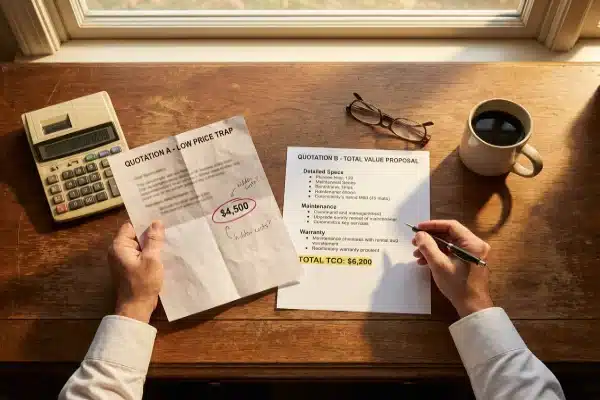
Comparing quotes is not just about the bottom line number. You must analyze the Total Cost of Ownership (TCO) over five years. A cheap machine often carries hidden costs in energy, downtime, and expensive proprietary repairs.
Bill of Materials 9
The PLC Source Code Trap
Explicitly ask if the PLC logic is "open" or "password protected/compiled." Many low-cost suppliers lock the code to force you to rely on their service team for even minor logic changes. Demand unlocked source code or a "right to repair" clause. If you don’t own the code, you don’t really own the machine.
The "Theoretical vs. Net" Output Trap
Manufacturers love to quote "Theoretical Maximum Output" based on 100% efficiency and ideal cooling. This is fantasy. Demand a guaranteed "Net Sellable Output" calculation. This figure must factor in realistic downtime (3-5%), scrap rates (1-2%), and mold maintenance windows. This prevents you from under-sizing your machine capacity based on unrealistic sales data.
Analyzing Total Cost of Ownership (TCO)
Do not just look at the purchase price. Run a 5-year TCO calculation. A "cheap" machine often costs significantly more when you factor in downtime and parts.
| Cost Factor (5 Years) | Supplier A (Premium) | Supplier B (Discount) | Dampak |
|---|---|---|---|
| Purchase Price | $350,000 | $250,000 | Save $100k upfront. |
| Spare Parts | $20,000 | $60,000 | Cheap parts fail faster. |
| Downtime Cost | $50,000 (10 days/yr) | $150,000 (30 days/yr) | Huge operational loss. |
| Total Biaya 5 Tahun | $500,000 | $505,000 | Discount machine costs more. |
Kesimpulan
Finding the right partner requires asking tough technical questions about engineering, support, and testing. We hope this guide helps you secure a reliable machine that drives your business growth.
native file test 10
Catatan kaki
- Educational resource explaining TCO analysis in supply chains. ↩︎
- Major industrial automation company discussing security and IP protection. ↩︎
- General background information on the concept of gray market goods. ↩︎
- Major manufacturer guide on using thermal imaging for electrical maintenance. ↩︎
- Link to the specific ISO standard for vibration evaluation. ↩︎
- Official source for the specific industry standard mentioned. ↩︎
- Official manufacturer page for the specific brand mentioned. ↩︎
- Official government guidance on securing remote access for industrial systems. ↩︎
- Industry organization defining BOM standards in procurement. ↩︎
- Government resource on CAD interoperability and data exchange standards. ↩︎


0 Komentar