
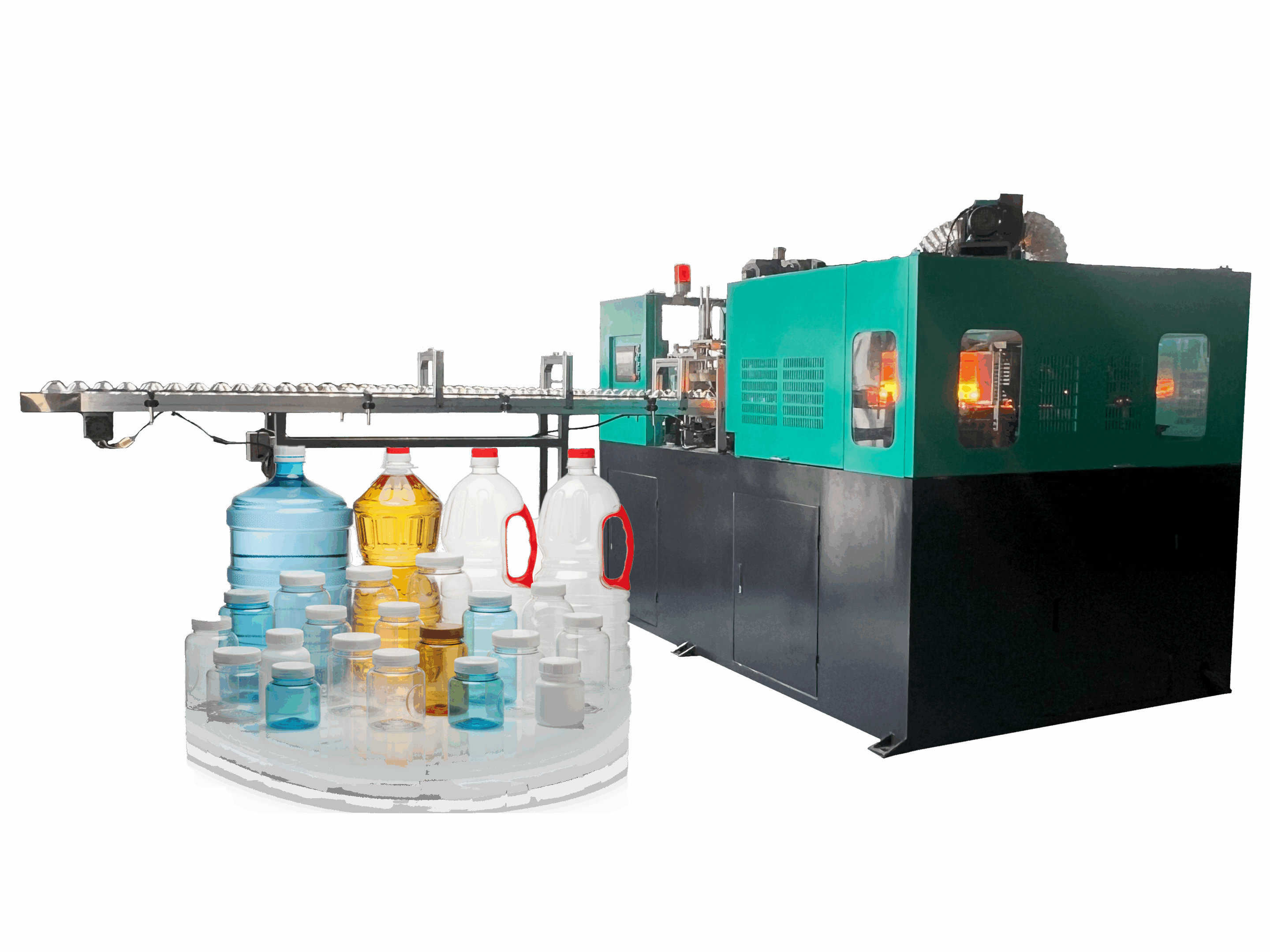
Panduan Utama untuk Plastik Teregang: Sebuah Revolusi dari Ilmu Polimer hingga Kemasan Berkinerja Tinggi

PETG container
Have you ever picked up a crystal-clear, durable PET water bottle and wondered: why is this bottle so strong, yet so thin and light? How can it withstand the internal pressure of a carbonated beverage and survive an accidental drop?
The answer isn’t magic, but a sophisticated manufacturing science centered around a technology known as “Stretched Plastic”.
Hello, I’m Slany Cheuang, the Technical Sales Manager at Leka Machine. With years of experience in this industry, I’ve found that many potential partners are not fully clear on the fundamental principles of plastics molding, which often leads to confusion when selecting equipment. The purpose of this guide is to completely demystify stretched plastic.
In simple terms, the essence of “Stretched Plastic” is the physical process of transforming the chaotic, tangled polymer chains within the plastic into a highly oriented, aligned state. This alignment bestows the plastic with unprecedented physical properties. Through this technology, we achieve three core advantages:
- Enhanced Mechanical Strength: Stretched plastic containers possess amazing top-load strength, drop resistance, and creep resistance.
- Superior Clarity: The orderly alignment of polymer chains reduces light scattering, giving the product a glass-like transparency.
- Excellent Barrier Properties: The neatly arranged molecular chains form a denser barrier, effectively preventing the escape of carbon dioxide (CO₂) and the ingress of oxygen (O₂), making it the ideal choice for preserving beverages and food.
The core process that makes all of this possible is Stretch Blow Moulding (SBM).
In this ultimate guide, we will take you on a journey from microscopic polymer science to macroscopic industrial production. Whether you are a manufacturer seeking packaging solutions, an engineer curious about material science, or a manager making equipment purchasing decisions, this guide will provide you with a comprehensive, one-stop resource.
Daftar isi
- The Science Behind It: The Principles of Stretched Plastic
- The Core Process Explained: Stretch Blow Moulding (SBM)
- A Manufacturer’s Perspective: Stretched Plastic vs. Other Processes
- Core Material Selection
- Applications: How Stretched Plastic is Transforming Industries
- B2B Purchasing Guide: How to Choose the Right Stretch Blow Moulding Machine
- Future Trends and Sustainability
- Conclusion: Your Reliable Partner in Stretched Plastic Manufacturing
- Pertanyaan yang Sering Diajukan (FAQ)
Part 1: The Science Behind It: The Principles of Stretched Plastic
The Magic of Polymer Orientation
To understand why stretching makes plastic stronger, we must dive into the molecular level. Plastics are composed of thousands of long-chain polymer molecules. In their raw, unprocessed state, these chains are randomly entangled, much like a plate of cooked spaghetti. It’s this disordered state that limits the material’s macroscopic performance. The magic of “polymer orientation” is the process of combing through this messy plate of spaghetti, aligning the strands to unlock their maximum potential.
Amorphous vs. Crystalline Polymers
Let’s continue with the spaghetti analogy.
- Amorphous Polymer: This is like a plate of cooked spaghetti where the molecular chains are randomly entangled with no fixed structure. Materials in this state are typically transparent but have average physical strength. The PET preforms we use for stretch blow moulding are a classic example of an amorphous structure in their initial state.
- Crystalline Polymer: This is more like a box of uncooked spaghetti, where the molecular chains are tightly packed and arranged in an orderly, parallel fashion. This structure gives the material higher rigidity, strength, and opacity (due to light scattering at the boundaries between crystalline and amorphous regions).
The wonder of stretched plastic is that it transforms an amorphous polymer, through mechanical force, into a highly “oriented” state that is not fully crystalline, thereby achieving both transparency and high strength.
The Critical Glass Transition Temperature ($T_g$)
This is the most critical physical parameter in the entire stretching process. Every polymer has a specific temperature point known as the Glass Transition Temperature ($T_g$).
- Below $T_g$: The material is in a hard, brittle “glassy state.” If you try to stretch it, it will shatter like glass.
- Above $T_g$: The material transitions to a soft, elastic “rubbery state.” In this state, the molecular chains can be stretched and realigned without breaking. This is the ideal temperature window for our stretching operation.
For PET, its $T_g$ is approximately 70-80°C (158-176°F). In the SBM process, the preform is precisely heated to a temperature above this (typically 95-115°C or 203-239°F) to ensure it is malleable enough for stretching but not so hot that it loses its shape. Precise temperature control is an absolute prerequisite for successful biaxial stretching and the kualitas of the final product.
Uniaxial vs. Biaxial Stretching: Core Differences & Applications
- Uniaxial Stretching: As the name implies, the material is stretched in only one direction, like pulling on a rubber band. The polymer chains align along the direction of the stretch. This process is mainly used for products where strength is required in a single direction, such as strapping tapes, fibers, and certain types of films.
- Biaxial Stretching: This is the core technology for manufacturing high-performance hollow containers. The material is stretched in two perpendicular directions, either simultaneously or sequentially. For a bottle, these two directions are:
- Axial Direction: The stretch produced by a stretch rod moving down the length of the bottle.
- Radial Direction: The stretch produced by high-pressure air inflating the bottle outwards, along its circumference.
Through biaxial stretching, the polymer chains form an interlocking, “net-like” structure. This structure gives the container superior strength and toughness in all directions, enabling it to perfectly handle challenges from both internal pressure (like carbonation) and external forces (like dropping and stacking). Nearly every PET bottle you see in daily life is a masterpiece of biaxial stretching technology.
Part 2: The Core Process Explained: Stretch Blow Moulding (SBM)
Now that we understand the science, let’s look at how these principles are put into practice on an industrial scale. Stretch Blow Moulding (SBM) is the stage where theory becomes reality.
What is Stretch Blow Moulding? An Authoritative Definition
Stretch Blow Moulding (SBM) is a manufacturing process for producing hollow plastic parts (primarily bottles and jars). It combines mechanical force (a stretch rod) and pneumatic force (high-pressure air) to biaxially stretch a pre-molded polymer piece (a “preform”) that has been heated above its glass transition temperature ($T_g$), shaping it into the final form defined by a mold.
In short, you first injection mold a small “test tube” (the preform), and then you heat it and blow it up into a bottle. The SBM process is the global gold standard for producing high-quality, high-performance PET bottles.
The Two-Step SBM Process: The Industry Gold Standard
Within the world of SBM, the Two-Step process dominates the market due to its unparalleled efficiency, flexibility, and stability. It’s estimated that over 95% of all PET bottles worldwide are made this way. As the name suggests, it divides the entire operation into two independent steps.
Step One: Injection Moulding the Preform
This is the starting point of the entire value chain. In this stage, dried PET resin pellets are melted and injected under high pressure into a precision, multi-cavity mold. After cooling, they form the “preforms,” which resemble small, thick-walled test tubes with a finished neck.
Komitmen kualitas of the preform is the cornerstone of the final product’s success. A high-quality preform must have:
- Precise Weight: Directly determines the final bottle weight and cost.
- Uniform Wall Thickness: Ensures even material distribution during blowing, preventing weak spots.
- Perfect Clarity: Free from bubbles, black specks, or any other defects.
- High-Precision Neck Finish: The neck and threads are fully formed during pencetakan injeksi, and their dimensional accuracy is critical for a perfect seal.
Because preform production can be separated from the bottle blowing stage, this process offers tremendous flexibility. Manufacturers can purchase standardized preforms from specialized suppliers or produce them in-house, depending on market demand.
Step Two: Reheat Stretch Blow Moulding (RSBM)
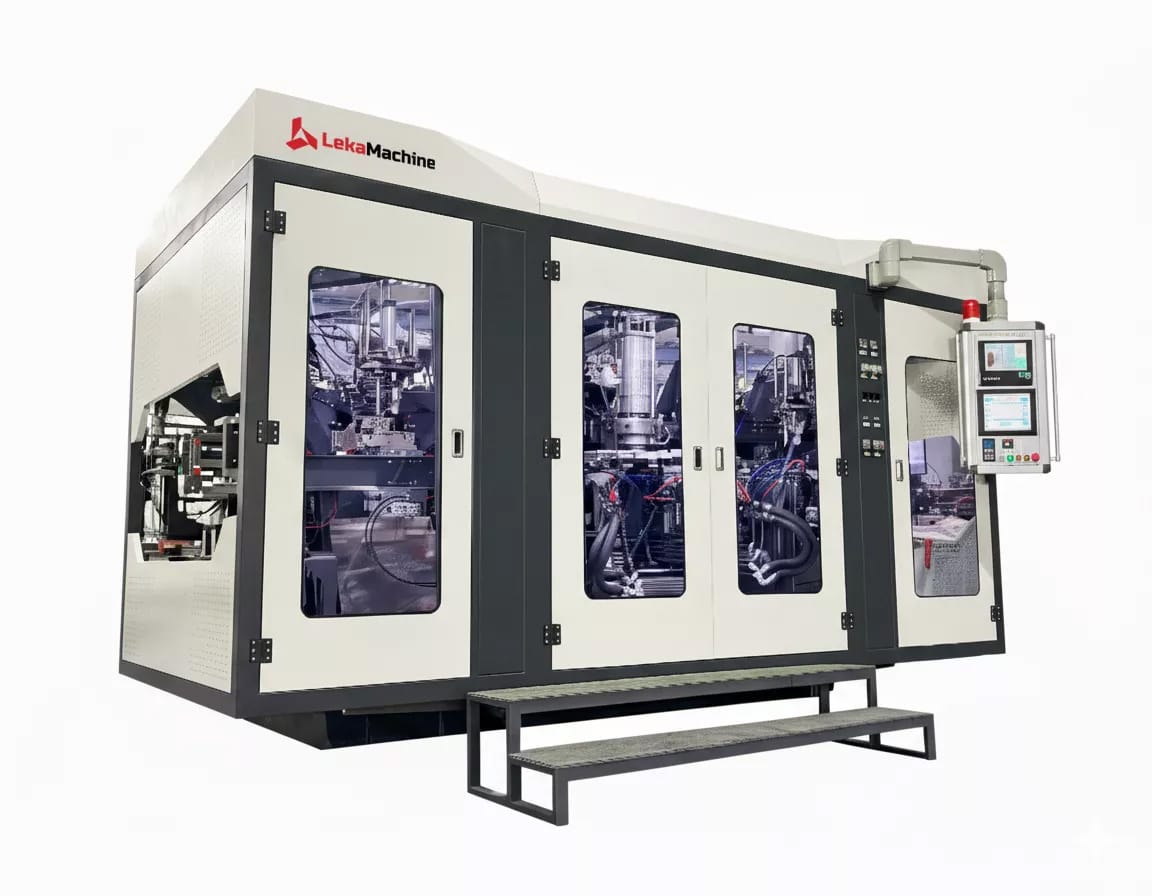
This is where the magic happens, as the preform is transformed into the familiar bottle. This process is carried out on a machine like the fully automatic PET stretch blow moulding machine offered by Leka Machine, and involves several key stages:
- Preform Feeding & Unscrambling: Preforms are loaded into a hopper, automatically sorted, and fed onto the heating conveyor.
- Reheating: The preforms rotate as they travel through a heating oven composed of multiple banks of infrared (IR) lamps. This heating process is meticulously controlled to ensure the body of the preform is evenly heated to the ideal stretching temperature (around 100°C / 212°F), while the already-formed neck area is kept cool to maintain its shape. Advanced machines allow for zone-by-zone temperature control to accommodate the demanding material distribution requirements of different bottle shapes.
- Peregangan & Peniupan: This is the heart of the process.
- The heated preform is quickly transferred into a cool blow, which then closes.
- A stretch rod descends into the preform at high speed, stretching it vertically (axial stretch).
- Almost simultaneously, a low-pressure “pre-blow” of air is introduced, slightly inflating the preform to ensure it doesn’t touch the cold mold walls prematurely.
- Immediately following, high-pressure “final blow” air (up to 40 bar / 580 psi) is injected, forcing the stretched preform to expand and conform tightly to the inner contours of the mold, completing the horizontal (radial stretch) and forming the bottle’s final shape and details.
- Pendinginan & Pembuangan: The high-pressure air is held for a short period to allow the newly formed bottle to cool and solidify against the cold mold walls. The mold then opens, and the finished bottle is ejected. A perfect PET bottle is born.
On a fully automatic machine, this entire cycle repeats at incredible speeds, with outputs ranging from a few thousand to tens of thousands of bottles per hour (BPH).
The One-Step SBM Process: Advantages for Niche Applications
As a complementary process, One-Step SBM, also known as Injection Stretch Blow Moulding (ISBM), holds its own in specific market segments.
As the name implies, the one-step process completes both preform injection and stretch blow moulding on a single machine in a continuous sequence. Molten plastic is first dicetak injeksi into a preform, which is then transferred—without being fully cooled—to the stretch-blowing station for forming.
Advantages:
- Energy Savings: It uses the residual heat from the injection process, eliminating the need for a reheat oven.
- Finishing Berkualitas Tinggi: Preform tidak tersentuh selama proses, mencegah goresan yang dapat terjadi selama transportasi dan penyimpanan, menjadikannya ideal untuk botol kosmetik kelas atas.
- Baik untuk Leher Non-Standar: Menawarkan fleksibilitas lebih besar untuk desain leher kustom.
Kekurangan:
- Waktu Siklus Lebih Panjang: Waktu siklus keseluruhan dibatasi oleh langkah pencetakan injeksi yang lebih lambat.
- Fleksibilitas Lebih Rendah: Jumlah rongga injeksi harus sesuai dengan jumlah rongga peniupan, menyulitkan perubahan jadwal produksi.
- Biaya Modal Lebih Tinggi: Untuk output yang sama, mesin one-step seringkali lebih kompleks dan mahal dibandingkan mesin two-step.
Aplikasi Khas: Produksi volume rendah, material non-PET (seperti PC, Tritan), wadah berbentuk tidak beraturan, toples mulut lebar, dan kemasan kosmetik/farmasi dengan tuntutan finishing permukaan yang sangat tinggi.
Bagian 3: Perspektif Produsen: Stretched Plastic vs. Proses Lainnya
Salah satu pertanyaan paling umum yang Anda hadapi sebagai produsen atau manajer pembelian adalah: “Teknologi mana yang harus saya pilih? Stretch Blow Moulding atau Extrusion Blow Moulding?” Kedua teknologi ini pada dasarnya berbeda dan cocok untuk produk dan pasar yang sama sekali berbeda. Sebagai perusahaan yang menyediakan kedua Stretch Blow Moulding Machines yang keluar Extrusion Blow Moulding Machines, Leka Machine dapat menawarkan perbandingan yang tidak memihak dan ahli untuk membantu Anda membuat keputusan yang paling terinformasi.
Stretch Blow Moulding (SBM) vs. Ekstrusi Blow Moulding (EBM): Matriks Keputusan Kritis
Mari kita rangkum perbedaan intinya dalam tabel yang jelas.
| Fitur | Stretch Blow Moulding (SBM) | Extrusion Blow Moulding (EBM) |
|---|---|---|
| Prinsip Inti | Peregangan biaxial dari preform hasil injeksi | Pengembangan dari sebuah parison mirip tabung yang diekstrusi |
| Material Umum | PET, PP (grade khusus) | HDPE, LDPE, PP, PVC |
| Kejernihan Produk | Sangat tinggi, transparansi seperti kaca | Biasanya buram atau transparan |
| Kekuatan Mekanik | Sangat tinggi (tahanan terhadap tekanan, jatuh, dan rayuan yang sangat baik) | Baik (dikenal karena fleksibilitas dan ketahanan kimia) |
| Presisi Leher/Ulir | Sangat tinggi (dari pencetakan injeksi presisi), ideal untuk segel karbonasi | Cukup (dibentuk dengan pemotongan atau di dalam cetakan), presisi lebih rendah |
| Pegangan Terintegrasi | Tidak dapat dicetak secara integral | Mudah dicapai sebagai bagian dari pencetakan |
| Kontrol Ketebalan Dinding | Lebih sulit mencapai kontrol ketebalan yang presisi pada bentuk kompleks | Fleksibel, dapat disesuaikan secara presisi melalui pemrograman parison |
| Aplikasi Khas | Botol minuman bersoda, botol air, botol minyak goreng, botol kosmetik, botol jus | Jerigen susu, botol sampo, wadah oli motor, drum kimia, jerigen plastik |
| Investasi Peralatan | Relatif lebih tinggi, terutama untuk sistem otomatis beroutput tinggi | Relatif lebih rendah, dengan hambatan masuk yang lebih rendah |
Diving Deeper into the Comparison:
- Prinsip & Material: Ini adalah perbedaan paling mendasar. “Peregangan” SBM memberikan PET sifat-sifatnya yang tak tertandingi, menjadikannya pilihan yang tak terbantahkan untuk aplikasi penahan tekanan dan transparan. Proses “Ekstrusi” EBM lebih seperti meniup balon plastik; proses ini membutuhkan material dengan kekuatan leleh tinggi, menjadikan HDPE fleksibel sebagai pasangan sempurnanya.
- Kejernihan & Kekuatan: Apakah Anda ingin konsumen melihat produk di dalam botol? Jika ya, SBM adalah jawabannya. Apakah need packaging that can withstand the internal pressure of carbonation? The biaxially oriented structure from SBM provides the necessary strength. Conversely, if your product is milk or detergent, an opaque package can protect the contents from light, making EBM a better fit. HDPE’s toughness also makes it ideal for packaging hazardous chemicals.
- Neck Precision: Think of a bottle of soda. If the cap doesn’t seal perfectly, the CO₂ will leak out. SBM uses injection-molded preforms where the threads are formed with extremely tight tolerances, ensuring a perfect seal every time. The necks of EBM containers are typically cut or pinched off by the mold during the process, and they cannot match the precision of SBM.
- Design Freedom – The Importance of Handles: This is a major advantage for EBM. Do you need an easy-to-grip handle for a 5-liter motor oil container or laundry detergent bottle? The EBM process can easily form a handle as an integral part of the container by manipulating the shape of the parison. SBM starts with a fixed, tube-like preform and cannot achieve this. This is why you will never see a PET cola bottle with an integrated handle. If your goal is to learn how to make plastic jerry cans, EBM is the only correct technology.
- Investment Decision: Generally, the initial investment for a fully automatic SBM line is higher than for an EBM machine of similar output. However, for mass-produced, standardized products like bottled water, SBM’s extremely high production speed and efficient material usage result in a highly competitive unit cost.
The bottom line: Your product dictates the technology.
- If your products are water, beverages, edible oils, sauces, or high-end cosmetics, and you prioritize clarity, strength, and a high-quality seal, then a Stretch Blow Moulding Machine is your ideal choice.
- If your products are milk, detergents, chemicals, or automotive fluids, or if you require irregular shapes, integrated handles, and superior chemical resistance, then an Extrusion Blow Moulding Machine will be the more suitable solution.
Part 4: Core Material Selection
While several thermoplastic materials can theoretically be stretched, two have come to dominate commercial applications.
PET (Polyethylene Terephthalate): The King of Stretched Plastics
If SBM is the stage, then PET is the undisputed star performer. It is so popular because its properties are a perfect match for the SBM process:
- Excellent Stretch Performance: PET has a wide and stable processing window, making it easy to form uniform and strong biaxially oriented structures.
- Unmatched Clarity: Stretched PET has a crystal-like gloss and transparency that maximizes product visibility on the shelf.
- Superior Barrier Properties: Its resistance to CO₂ and O₂ is far superior to other general-purpose plastics, making it ideal for carbonated beverages and products with a sensitive shelf life.
- Lightweight & Strong: A PET bottle weighs only about 10% of a glass bottle of the same volume, significantly reducing transportation costs and carbon footprint.
- Extremely Safe: PET is chemically stable and approved by major food safety agencies worldwide (like the FDA and EFSA) for direct hubungi with food and beverages.
- 100% Recyclable: PET is one of the most recycled plastics in the world. Recycled PET (rPET) can be used to make new bottles, playing a key role in the circular economy.
From 500ml water bottles to 5L edible oil containers, PET’s applications are ubiquitous.
PP (Polypropylene): The Champion for Hot-Fill Applications
Polypropylene (PP) is another important player in the SBM field, especially in niche markets requiring heat resistance.
Stretched PP (often called OPP, Oriented Polypropylene) has significantly improved clarity and rigidity compared to standard PP, though it typically cannot match the crystal clarity of PET. Its single greatest, irreplaceable advantage is its excellent heat resistance.
- High-Temperature Resistance: PP has a higher melting point and can withstand hot-fill processes up to 120°C (248°F) without deforming. This is crucial for products that require pasteurization or hot filling, such as functional drinks, sports drinks, jams, and certain syrups.
However, processing stretchable PP presents challenges. Its processing window is narrower than PET’s, and its molecular structure is more complex, meaning it requires more precise process control and machinery specifically designed for the task.
Part 5: Applications: How Stretched Plastic is Transforming Industries
Thanks to its superior performance, stretched plastic technology has deeply integrated into every aspect of our daily lives. It is more than just packaging; it is a value-added solution for a wide range of industries.
The Beverage Industry: The Clear Choice for Carbonated Drinks, Water, and Juices
This is the largest application field for SBM technology. For carbonated drinks, the excellent CO₂ barrier of stretched PET means the fizz stays in the bottle longer, guaranteeing product taste and shelf life. For pure water, PET’s clarity and pristine appearance convey health and safety. This is the core technology behind every 5L water bottle manufacturing solusi.
Food & Edible Oil Packaging: The Perfect Union of Preservation and Shelf Appeal
Large-volume edible oil bottles are another classic application. The excellent oxygen barrier prevents the oil from oxidizing and going rancid, extending its shelf life. The crystal-clear bottle showcases the oil’s color and purity, directly influencing consumer purchasing decisions.
Cosmetics & Personal Care: Uniting Exquisite Appearance with Functionality
Think of the shampoo or body wash bottle on your shower shelf. SBM technology, especially with PET, can create beautifully designed containers that rival the look and feel of glass while offering the lightweight and shatterproof benefits of plastic. A successful lini produksi botol sampo is often powered by high-quality SBM equipment.
Pharmaceuticals & Healthcare: Safe, Clean, and Precise Containers
In the medical field, safety, cleanliness, and precision are paramount. Stretched plastics (mainly PET) are widely used for their chemical inertness and high purity to make items like eye drop bottles, oral liquid containers, and disinfectant bottles. The high-precision necks produced by the SBM process also ensure a perfect fit with functional closures like droppers and spray pumps.
Part 6: B2B Purchasing Guide: How to Choose the Right Stretch Blow Moulding Machine
Once you’ve decided to invest in SBM technology, selecting the right machine is critical to your success. This is more than just buying a piece of equipment; it’s choosing a long-term partner who can grow with you.
As the Technical Sales Manager at Leka Machine, I, Slany Cheuang, frequently discuss these points with clients. Based on my years of experience, here are the faktor kunci to consider.
Key Factors to Consider Before Buying an SBM Machine
- Product Requirements:
- Bottle Volume: Are you producing small 300ml bottles or large 5L containers?
- Bottle Shape: Is it a standard round bottle, or a more complex square or oval shape? Complex shapes require more advanced process control.
- Output Requirements: What is your target production capacity? 2,000 bottles per hour (BPH) or 10,000 BPH? This will determine whether you need a linear or rotary machine and the number of mold cavities.
- Material Type: Will you be running primarily PET, or do you have a need for hot-fill PP bottles? As mentioned, PP requires a more specialized machine configuration.
- Degree of Automation:
- Fully Automatic Stretch Blow Moulding Machine: The entire process, from preform loading to bottle discharge, is automated. It is ideal for large-scale, high-efficiency production. While the initial investment is higher, it significantly reduces long-term labor costs and ensures consistent quality.
- Semi-automatic Machine: Requires an operator to manually load preforms into the heater and then transfer the heated preforms to the blowing station. It’s suitable for start-ups, small-scale operations, or businesses with a diverse range of products and limited budgets.
- Budget and Return on Investment (ROI): Don’t just look at the machine’s price tag. You must consider the total cost of ownership:
- Konsumsi Energi: Advanced machines use servo drives and optimized heating systems for lower power usage.
- Mold Costs: Molds are a significant investment, and their quality directly impacts product quality and efficiency.
- Maintenance Costs: Consider the machine’s durability and the availability and price of spare parts.
Understanding Machine Specifications: The Meaning Behind the Numbers
- Number of Cavities: Directly determines how many bottles are produced per cycle. A key indicator of output.
- Max. Container Volume: Defines the largest bottle size the machine can produce (e.g., 2L or 5L).
- Neck Diameter Range: Shows the range of preform neck sizes the machine is compatible with.
Why Choosing a Reliable Manufacturer is Crucial (The Leka Machine Advantage)
- Technical Expertise and Experience: Leka Machine has been deeply involved in the blow moulding industry for years. We don’t just sell equipment; we provide complete solutions, from bottle design to process optimization.
- Machine Quality and Stability: We use world-class components, such as Siemens PLCs and Festo pneumatic parts, to ensure our machines operate stably and efficiently for the long term.
- After-Sales Service and Technical Support: Purchasing a machine is just the beginning of our partnership. We provide comprehensive support, including installation, training, 24/7 technical assistance, and a reliable supply of spare parts.
- Transparent Delivery Time: A reliable delivery schedule is crucial for industrial projects. We operate with integrity and state clearly that our standard delivery time is 60-90 days. This transparency helps you plan your project with confidence.
If you are looking for the right SBM solution for your project, I would be delighted to assist you. As the Technical Sales Manager at Leka Machine, I, Slany Cheuang, can provide you with a customized technical proposal and quotation based on your specific needs. Please feel free to visit our website at www.lekamachine.com atau contact us directly.
Part 7: Future Trends and Sustainability
As members of this industry, we are focused not only on current production efficiency but also on future sustainability. Stretched plastic technology is continuously evolving to become more environmentally friendly and efficient.
The Driving Force of the Circular Economy: The Use of rPET
The application of recycled PET (rPET) is a key step for the packaging industry toward a circular economy. Modern SBM machines, like those from Leka Machine, are already well-equipped to handle high percentages (even 100%) of rPET material, helping you add a “green” label to your products.
Peringan: Berbuat Lebih Banyak dengan Lebih Sedikit
Peringan adalah tema abadi dalam industri kemasan. Ini berarti mengurangi jumlah plastik yang digunakan tanpa mengorbankan kinerja botol. Hal ini tidak hanya menurunkan biaya material tetapi juga mengurangi energi transportasi dan limbah akhir.
Bio-plastik dan Proses Peregangan
Menggunakan sumber daya terbarukan untuk membuat plastik adalah tren penting lainnya. Bio-plastik seperti PLA (Polylactic Acid), yang berasal dari pati jagung, juga dapat dicetak tiup regang. Meskipun mereka masih menghadapi tantangan dalam ketahanan panas dan biaya, masa depan mereka di bidang ini menjanjikan.
Conclusion: Your Reliable Partner in Stretched Plastic Manufacturing
Dari penyelarasan mikroskopis rantai polimer hingga solusi kemasan global yang makroskopik, kita telah menjelajahi dunia menakjubkan dari plastik regang bersama-sama.
Kita telah mempelajari bahwa prinsip inti dari peregangan biaxial -lah yang memberikan material seperti PET kekuatan superior, kejernihan, dan sifat penghalang. Dan Stretch Blow Moulding (SBM), terutama proses dua langkah, yang efisien dan fleksibel, adalah teknologi kunci yang mengubah sains ini menjadi miliaran wadah berkualitas tinggi.
Apakah Anda siap untuk meningkatkan lini plastik wadah (*container*) Anda Anda? Memilih peralatan yang tepat dan mitra yang andal adalah langkah pertama Anda menuju kesuksesan.
Hubungi tim ahli di Leka Machine hari ini untuk konsultasi gratis tentang solusi cetak tiup regang. kami yang canggih.
Pertanyaan yang Sering Diajukan (FAQ)
Mari bekerja sama untuk membentuk masa depan produk Anda!
A: T: Apa perbedaan utama antara plastik regang dan plastik biasa?.
Perbedaan utamanya adalah susunan molekuler internal. Plastik regang menjalani proses peregangan fisik yang menyelaraskan rantai polimernya secara teratur dan berorientasi. Struktur ini memberikannya kekuatan mekanik, kejernihan, dan sifat penghalang gas yang jauh lebih unggul dibandingkan dengan plastik biasa dengan struktur molekul acaknya.
A: T: Dapatkah semua plastik diregangkan?.
Tidak. Hanya polimer spesifik seperti PET dan tingkat PP tertentu yang memiliki sifat peregangan yang baik. Mereka harus dipanaskan ke suhu tertentu (di atas suhu transisi gelas mereka, T_g) untuk diregangkan secara efektif tanpa rusak. T: Haruskah saya memilih mesin
A: cetak tiup regang satu langkah atau dua langkah? proses dua langkah Untuk sebagian besar produksi botol standar (seperti botol air, minuman, dan minyak) dalam skala besar, proses dua langkah adalah standar emas industri dan pilihan terbaik karena efisiensi, fleksibilitas, dan biaya unitnya yang lebih rendah.
Proses satu langkah mesin extrusion blow moulding lebih cocok untuk bentuk khusus dengan volume rendah, atau aplikasi dengan persyaratan ekstrem untuk hasil permukaan, seperti kosmetik kelas atas.
A: T: Dapatkah Ekstrusi Blow Cetakan Tiup Ekstrusi (EBM) Stretch Blow menghasilkan botol PET yang jernih?.
Sama sekali tidak. Ini adalah kesalahpahaman umum. Proses
A: Cetakan Tiup Ekstrusi (EBM).
tidak dapat meregangkan material secara biaxial. Mencoba memproses PET dengan EBM akan menghasilkan produk yang keruh, rapuh, dan berkualitas sangat buruk. Untuk menghasilkan botol PET berkekuatan tinggi dan kejernihan tinggi yang ikonis, Anda harus menggunakan mesin Cetak Tiup Regang (SBM)
A: . T: Apa typical return on investment (ROI) untuk mesin SBM otomatis penuh? ROI tergantung pada banyak faktor, termasuk output mesin, biaya tenaga kerja dan energi lokal, biaya bahan baku, dan harga jual produk Anda. Tidak ada jawaban tunggal. Namun, tim teknis kami di Leka Machine dapat memberikan Anda analisis ROI terperinci berdasarkan proyek spesifik Anda untuk membantu Anda membuat keputusan investasi yang tepat.


0 Komentar