
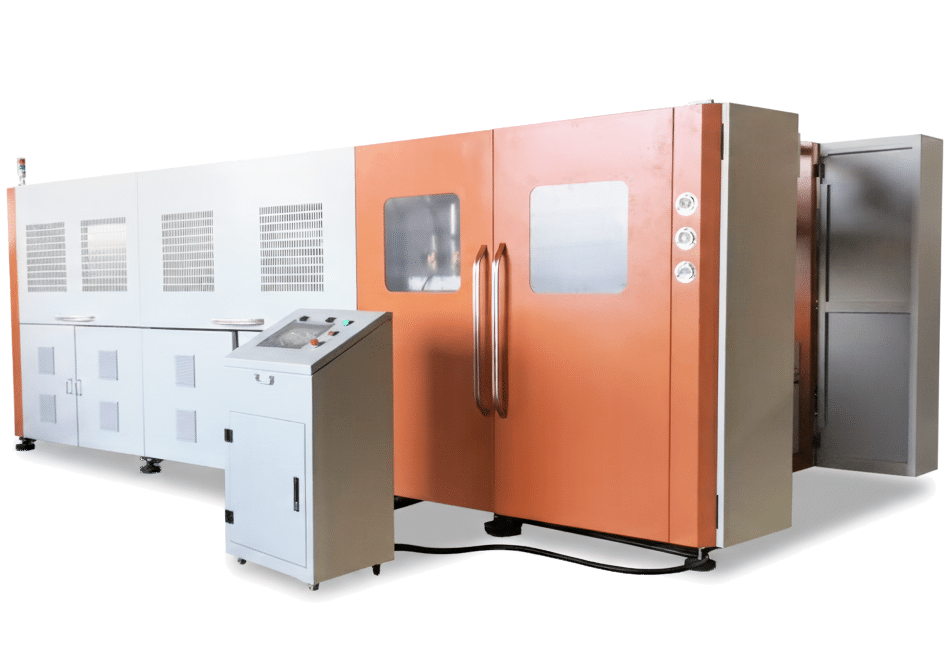
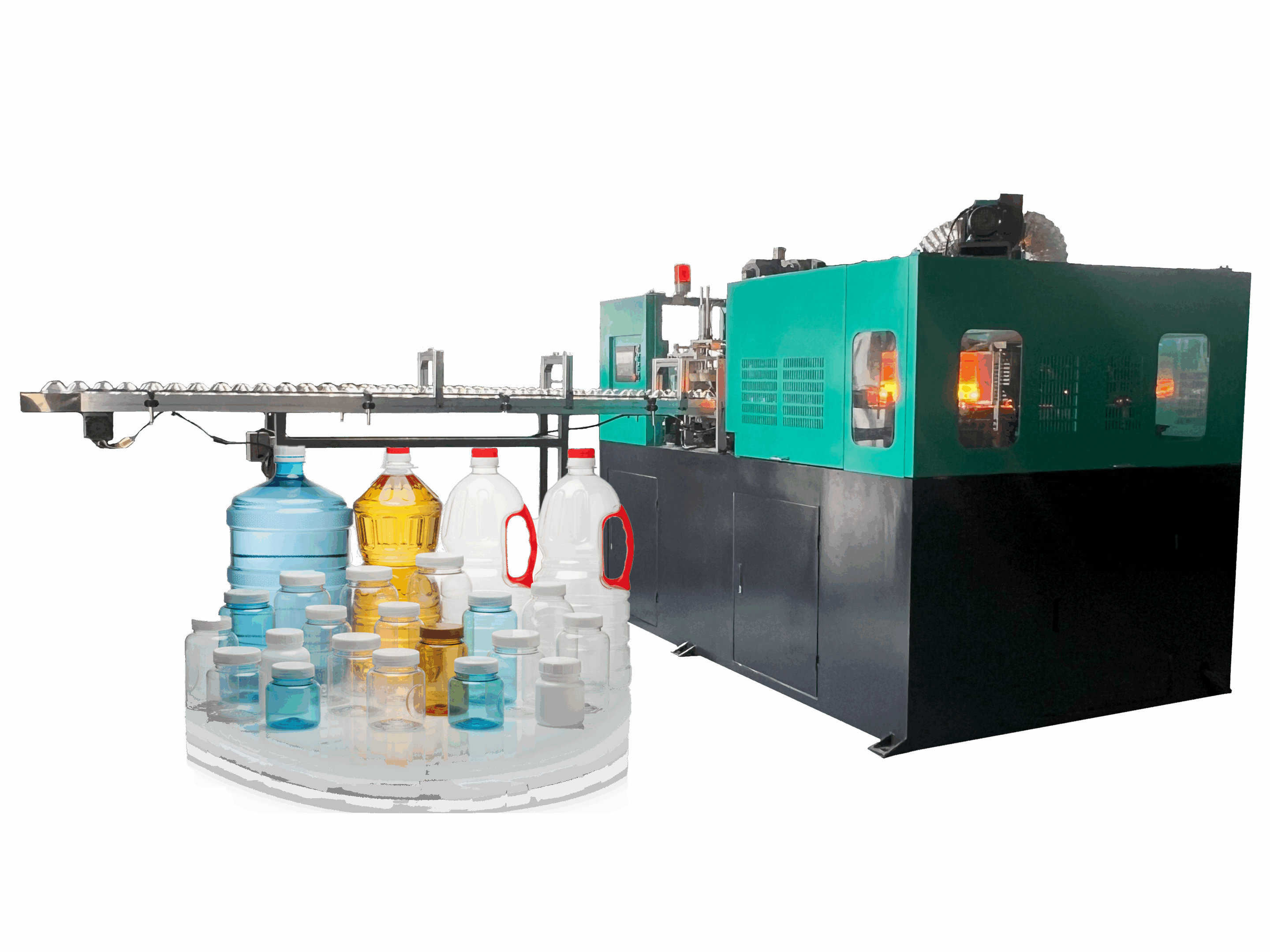
In the European market, what specific safety standards must I comply with when importing an all-electric extrusion blow molding machine?
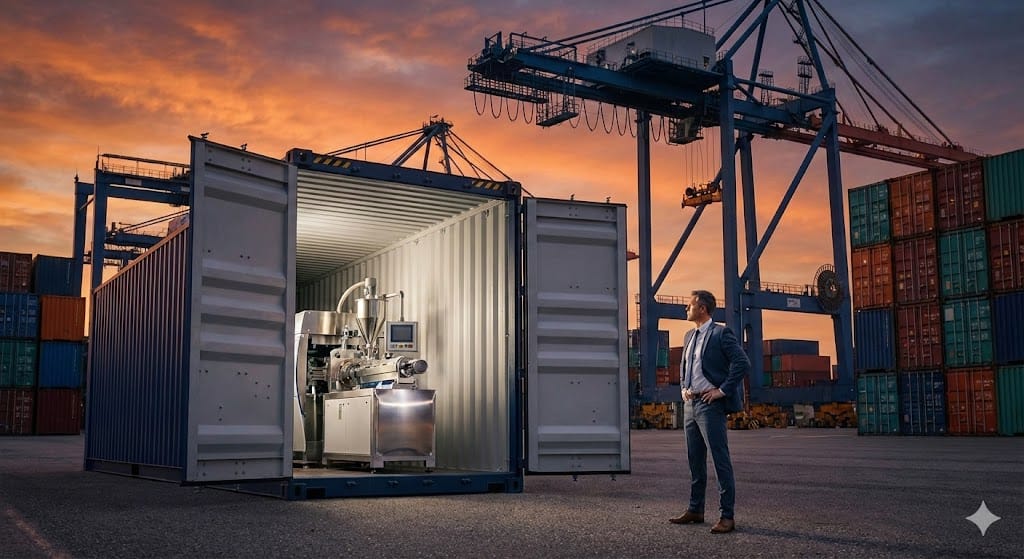
We know the stress involved in exporting heavy machinery to Europe. You spot a high-performance machine that fits your budget, but you worry that a failed safety audit or customs blockade could turn that investment into a liability.
To import an all-electric extrusion blow molding machine into Europe, you must strictly comply with the Machinery Directive 2006/42/EC and Harmonized Standard EN 422:2009. Additionally, you need Electromagnetic Compatibility (EMC) Directive 2014/30/EU certification, a comprehensive Technical Construction File (TCF), and a valid EU Authorized Representative.
Let’s break down exactly what you need to look for to ensure your new equipment runs legally and safely on your factory floor.
Is the machine fully CE certified and compliant with the Machinery Directive?
When we build machines for our European partners, we see how confusing "CE" can be. A fake sticker looks real but can cost you thousands in fines and lead to dangerous accidents on your production floor.
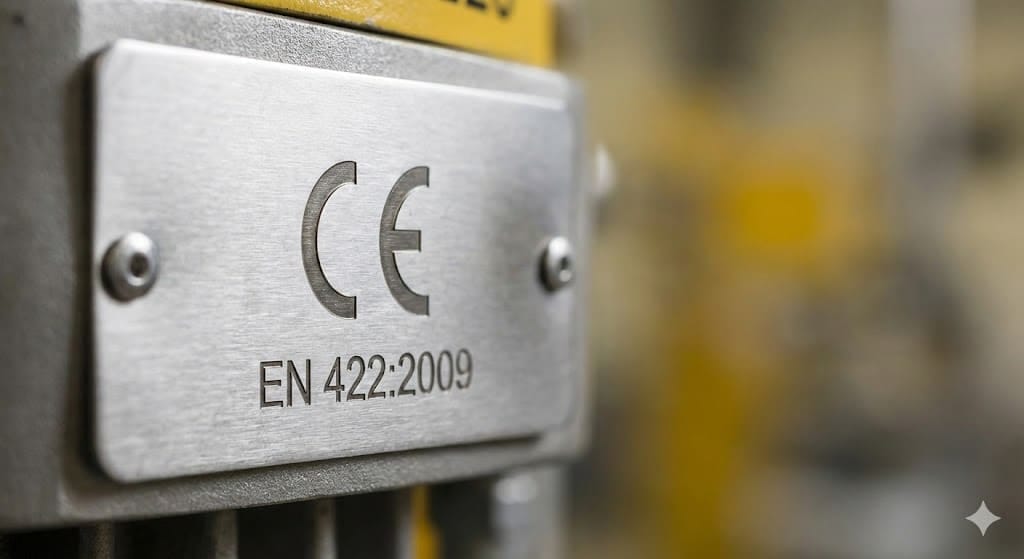
Full CE certification requires adherence to the Machinery Directive 2006/42/EC, specifically following the EN 422:2009 standard for blow molding safety. This includes essential health and safety requirements for guarding, emergency stops, and risk assessments, verified by a legitimate Declaration of Conformity and not just a generic sticker.
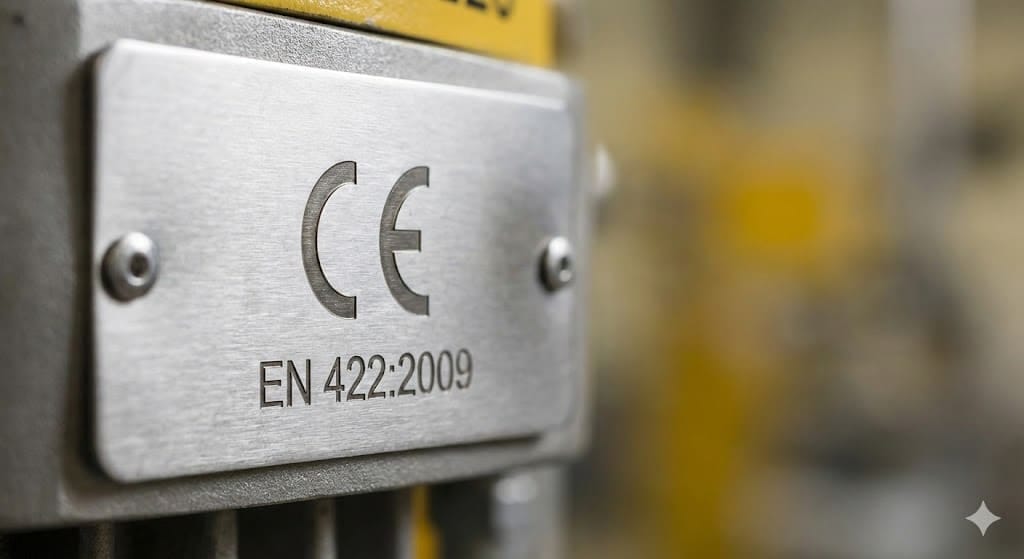
To ensure your machine is truly compliant, you must look beyond the surface. The Machinery Directive 2006/42/EC is the broad law, but for our industry, the specific "Bible" of safety is EN 422:2009. This harmonized standard dictates exactly how an extrusion blow molding machine must be built.
The "Presumption of Conformity" Trap
Many suppliers will claim their machine is "CE Certified" based on general industrial standards. However, if they do not design specifically to EN 422, they do not have the "presumption of conformity." This means if an accident happens, the burden of proof falls entirely on you to prove the machine was safe.
At our factory, we design our guarding specifically for the hazards listed in EN 422. This includes the movement of the clamping unit and the blow pin mechanism. These areas must be interlocked. If a gate opens, the machine must stop immediately.
Why Generic CE Isn’t Enough
A generic CE certificate usually only covers low-voltage electrical components. It ignores the mechanical crushing hazards of a 20-ton clamping force. You must verify that the Declaration of Conformity explicitly lists EN 422:2009.
Furthermore, you need to check the quality of the safety components themselves. A safety relay from an unknown brand might fail to cut power when needed. We use globally recognized brands for safety relays and sensors to ensure reliability.
Verifying Your Supplier
Use the table below to quickly assess if a supplier’s CE claim is legitimate or risky.
| Fitur | Legitimate CE Compliance | "Fake" or Insufficient CE |
|---|---|---|
| Standard Cited | Explicitly lists EN 422:2009 | Lists generic EN 60204-1 only |
| Risk Assessment | Available in Technical File | "Not available" or "Trade secret" |
| Safety Logic | Dedicated Safety PLC or Relays | Standard PLC handles safety (Illegal) |
| Guarding | Fixed, interlocked per EN ISO 14120 | Removable without tools / No interlocks |
What safety components are required to meet Italian workplace regulations?
Our installation teams in Italy often face strict local audits. Missing specific safety guards or logic can shut down your production line before it even produces one bottle, causing massive schedule delays.
To satisfy Italian Decree 81/2008 and Functional Safety standards, all-electric machines must use certified servo drives with Safe Torque Off (STO) or Safe Stop 1 (SS1). You also need specific guarding interlocks and a full Italian translation of the manual to integrate into your DVR safety document.
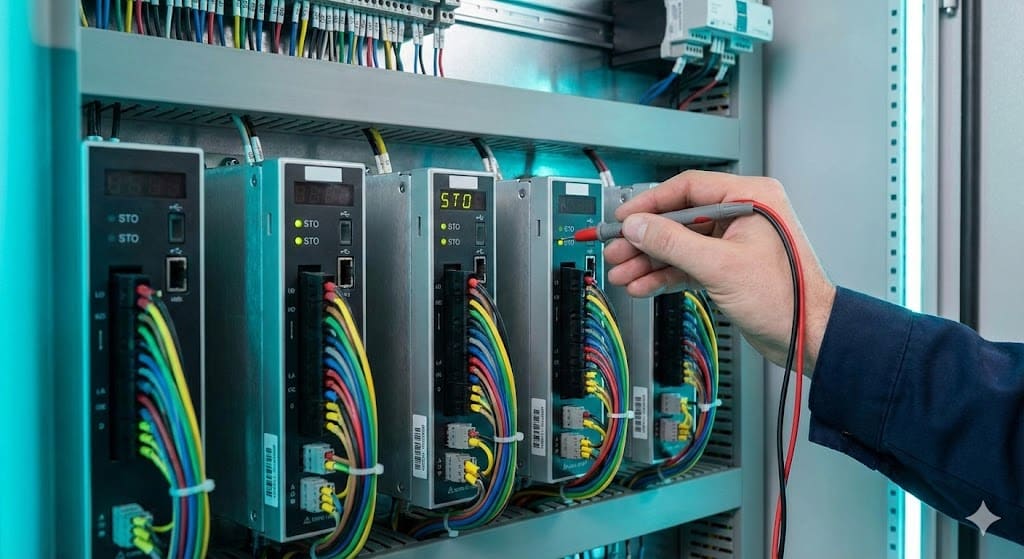
Italy has some of the strictest workplace safety laws in Europe, governed by Legislative Decree 81/2008 (Testo Unico sulla Sicurezza). As an employer, you are required to integrate any new machine into your Document for Risk Evaluation (DVR). If the machine lacks the right components, you cannot legally operate it.
Functional Safety for Electric Axes (STO/SS1)
This is the most critical difference between hydraulic and all-electric machines. In a hydraulic machine, safety is often achieved by cutting power to a physical hydraulic valve. In an all-electric machine, the motors are directly connected to the mold movement.
You cannot simply cut the main power, as this might damage the complex electronics or leave the machine in an uncontrolled state. Instead, we use servo drives with built-in Safe Torque Off (STO) atau Safe Stop 1 (SS1).
- STO: Ensures that no torque-generating energy can continue to act upon a motor. The motor coasts to a stop.
- SS1: The drive initiates a controlled deceleration to stop the motor, then activates STO.
These functions must be certified to EN ISO 13849-1 (Performance Level d or e). If your supplier uses cheap inverters without these certified safety functions, the machine is illegal to run in Italy.
Remote Access Safety Protocols
Modern all-electric machines feature remote troubleshooting, which we use to support our clients instantly. However, safety standards strictly regulate this.
Under European regulations, a remote user (like our engineers in China) must never be able to initiate a hazardous movement (like closing the mold) remotely. The machine must require a local confirmation. An operator standing at the machine must physically press a button to authorize the movement. This ensures no one is inside the machine when a remote test begins.
Comparison: Hydraulic vs. All-Electric Safety
| Safety Aspect | Mesin Hidrolik | Mesin Serba Listrik |
|---|---|---|
| Energy Source | Hydraulic Oil Pressure | Electrical Current |
| Stopping Method | Dump valve / Block valve | Safe Torque Off (STO) in Drive |
| Coast Risk | Low (friction stops it) | High (low friction, needs braking) |
| Lock Out/Tag Out | Lock main electrical + Dump pressure | Lock main electrical + Verify STO |
Does the electrical system comply with European voltage and safety standards?
We rigorously test our electrical cabinets because power issues can destroy sensitive servo drives. Incompatible voltage or poor filtering leads to expensive downtime and rejected warranty claims due to "dirty" power.
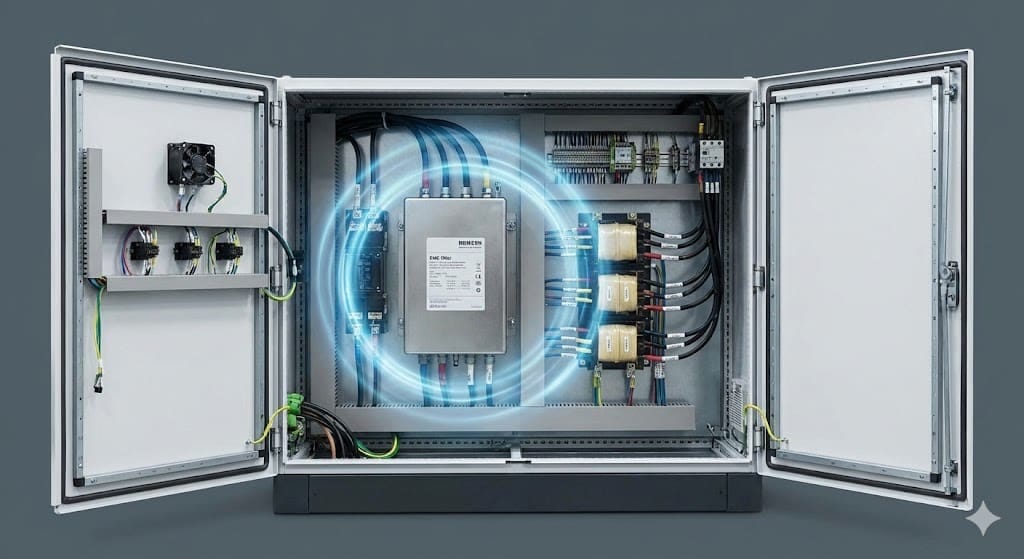
Your electrical system must meet the Low Voltage Directive 2014/35/EU and EMC Directive 2014/30/EU. This involves using CE-marked components, proper grounding, and installing line filters to prevent harmonic distortion on the grid, ensuring the machine does not disrupt other equipment or violate local connection codes.
EU Authorized Representative 1
All-electric blow molding machines are powerful, but they are also electrically "noisy." They use high-power AC/DC converters and multiple servo motors that switch currents at very high frequencies. Without proper design, this creates electromagnetic interference (EMI).
Total Harmonic Distortion (THD) 2
Electromagnetic Compatibility (EMC) Directive 2014/30/EU
You must provide evidence that the machine complies with the EMC Directive. This has two parts:
- Immunity: The machine will not crash if a nearby forklift generates a static spark or if the grid voltage fluctuates slightly.
- Emission: The machine does not send "noise" back into the electrical grid that could crash your neighbor’s computers or interfere with other sensors in your factory.
We install specific EMC filters yang keluar line reactors on the incoming power supply. We also use shielded cables for all motor connections. If you import a machine without these, you may fail the electrical inspection required by your Italian utility provider (CEI 0-16 standards).
Handling Harmonic Distortion
Harmonic distortion is a silent killer of efficiency. It causes transformers to overheat and can trip circuit breakers randomly. European grids are strict about the Total Harmonic Distortion (THD) allowed.
EMC Directive 3
Cheaper machines often skip the expensive active front-end units or passive filters needed to clean up this power. We recommend asking for an EMC test report before shipment. This report proves the machine was tested and falls within the limits defined by EN 61000-6-4 (Industrial Environment).
Essential Electrical Checklist
| Komponen | Function | European Requirement |
|---|---|---|
| Main Disconnect | Cuts all power | Must be lockable (red/yellow handle) |
| Wire Colors | Identification | Black (AC power), Blue (DC), Green/Yellow (Earth) |
| EMC Filter | Reduces noise | Mandatory for CE compliance |
| Grounding | Safety | Continuity test < 0.1 Ohm |
| Labeling | Pemeliharaan | Every wire must be numbered |
What technical documentation must accompany the shipment for customs clearance?
We have seen containers stuck at customs for weeks due to missing paperwork. Delay costs pile up quickly while your machine sits idle and gathering dust, simply because a file was missing.
Low Voltage Directive 2014/35/EU 4
Customs clearance requires a complete Technical Construction File (TCF) containing the Declaration of Conformity, risk assessments, electrical schematics, and test reports. Crucially, if the manufacturer is non-EU, you must appoint an EU Authorized Representative to hold this file and legally represent the machinery within the European Union.
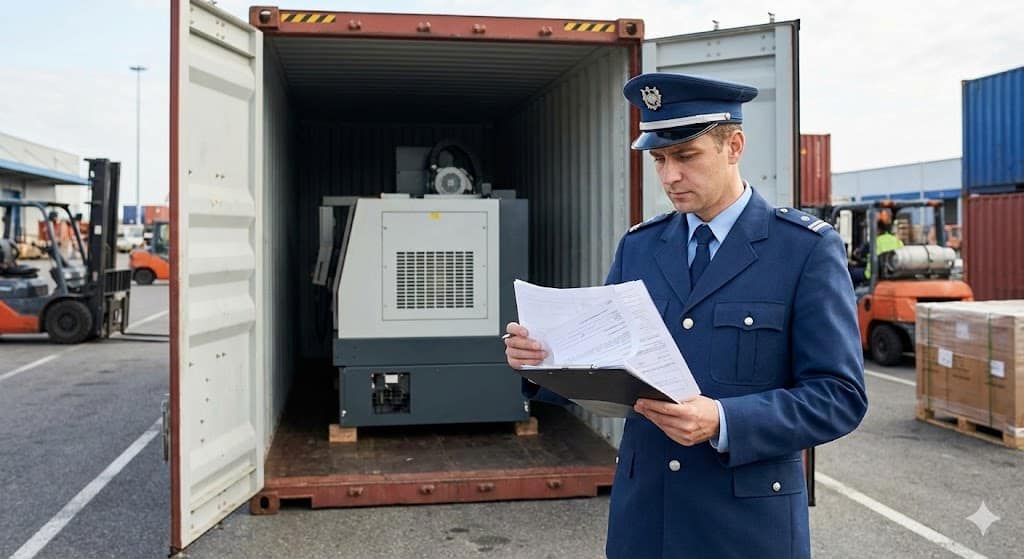
Paperwork is not just a formality; it is part of the product. The Machinery Directive legally defines the documentation as a component of the machine. If the documentation is incomplete, the machine is considered defective.
The Technical Construction File (TCF)
Customs authorities have the right to demand the Technical Construction File. This is not just the user manual. It includes:
- Detailed mechanical drawings.
- Electrical, hydraulic, and pneumatic schematics.
- Calculations for stability and noise levels.
- The Risk Assessment (showing how hazards were identified and mitigated).
Safe Torque Off (STO) 6
We maintain digital copies of the TCF for all our clients, but you must ensure physical copies or immediate digital access is available upon arrival.
Legislative Decree 81/2008 7
The EU Authorized Representative
This is a critical point that many buyers overlook. Since we are a manufacturer based in China, we are outside the EU jurisdiction. To legally place a machine on the market in Europe, we must mandate an Authorized Representative established within the Community.
This person or company (often a third-party service or your own European branch) is named on the Declaration of Conformity. They are responsible for keeping the Technical File available for inspection by authorities for 10 years. If your Declaration of Conformity does not list an EU address for the representative, customs can block the entry.
EN ISO 14120 8
Why "English Only" Fails in Italy
While English is the language of international business, the Machinery Directive is clear: the Original Instructions must be provided. If the machine is used in Italy, a translation into Italian is mandatory.
This is a strict safety requirement. The operators and maintenance staff must be able to read the safety warnings in their native language. We provide professional translations for our Italian clients to ensure compliance with this rule. Providing only an English manual to Italian workers is a violation of D.Lgs. 81/2008.
harmonized standard 9
Kesimpulan
Importing an all-electric machine doesn’t have to be a gamble. By ensuring compliance with EN 422, verifying electric safety, and securing the right documentation, you protect your business and your people.
Machinery Directive 2006/42/EC 10
Catatan kaki
- EU Commission page defining the roles of economic operators, including representatives. ↩︎
- Defines the electrical engineering concept discussed in the text. ↩︎
- European Commission overview page for the Electromagnetic Compatibility Directive. ↩︎
- Official legal text of the EU directive cited. ↩︎
- Official ISO page for the safety control system standard mentioned. ↩︎
- Provides a clear definition of this specific safety function. ↩︎
- Official Italian Ministry of Labour page regarding this specific safety decree. ↩︎
- Official ISO catalog page for the guarding standard cited. ↩︎
- Official European Commission page explaining the concept of harmonized standards. ↩︎
- Official legal text of the directive mentioned in the article. ↩︎


0 Komentar