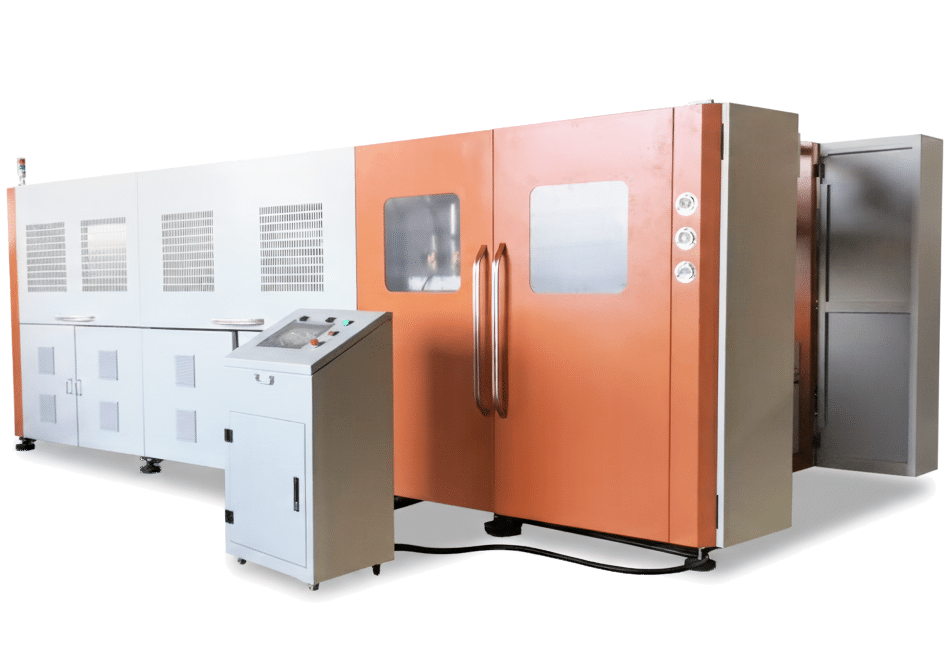
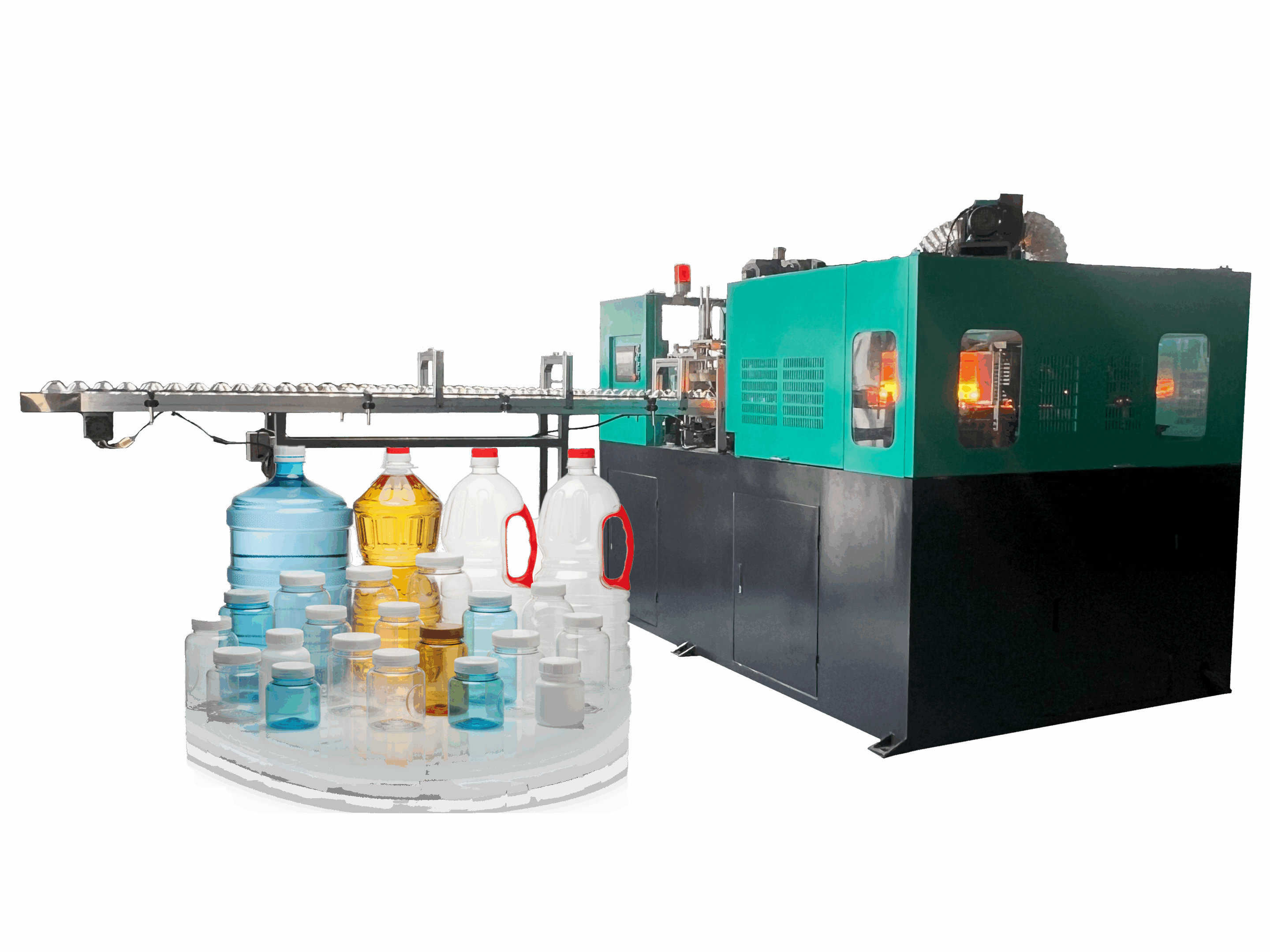
How to Calculate the Real Cost of a Blow Molding Machine (Free TCO Checklist Download): Why a “Cheap” Machine Can Be Your Most Expensive: Why a “Cheap”
When you’re ready to buy a new blow molding machine, you want to get the best value, not just the lowest price.
But I’ve seen too many factories buy a “cheap” machine, only to pay for it over and over again in the following years.
The purchase price is just the beginning. The real number you need to care about is the “Total Cost of Ownership,” or TCO.
Let’s talk about the real cost curve of a low-energy machine versus a high-energy one. (We’ll also give you a checklist to download so you can calculate your own.)
Section 1: The High-Energy Trap (High Power! High Air!) – The “Cheap” Machine’s Cost Curve
A lot of people only look at the purchase price. Let’s run the numbers.
Bayangkan Anda memiliki dua mesin untuk dipilih:
- Mesin A (Harga Rendah, Energi Tinggi): Harga Pembelian $100.000
- Mesin B (Efisiensi Tinggi, Stabil): Harga Pembelian $180.000
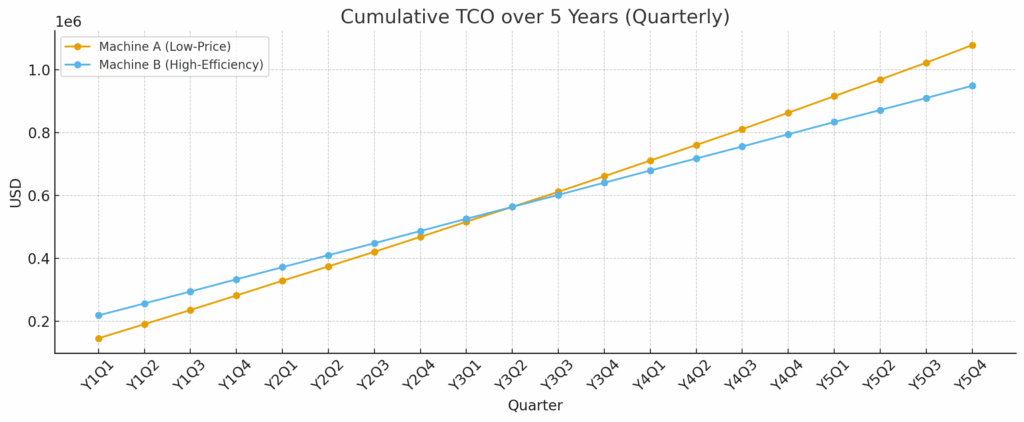
Looking only at the price, Machine A seems to save you $80,000. But let’s factor in energy costs (with seasonal spikes), maintenance, labor, and scrap rates (with real-world problems). See what happens after 5 years.
Perbandingan TCO (Total Biaya Kepemilikan) 5 Tahun (dengan fluktuasi dunia nyata):
Yang ditunjukkan oleh ini: These are the two cost curves. You can see how the “cheap” orange line (Machine A) crosses over the efficient blue line (Machine B) right around Year 3. After that, the cost gap explodes.
| Mesin Harga Rendah (Mesin A) | Mesin Efisiensi Tinggi (Mesin B) | |||||||||||||
|---|---|---|---|---|---|---|---|---|---|---|---|---|---|---|
| Kuartal | Biaya Energi ($) | Biaya Perawatan ($) | Biaya Scrap ($) | Biaya Tenaga Kerja ($) | Downtime (Jam) | Output (Juta Botol) | TCO Kumulatif ($) | Biaya Energi ($) | Biaya Perawatan ($) | Biaya Scrap ($) | Biaya Tenaga Kerja ($) | Downtime (Jam) | Output (Juta Botol) | TCO Kumulatif ($) |
| T1K1 | 12,375.00 | 2,000.00 | 1,424.30 | 30,000 | 20.00 | 1.48 | 145,799.30 | 7,425.00 | 550.00 | 737.01 | 30,000 | 5.00 | 1.79 | 218,712.01 |
| T1K2 | 11,250.00 | 2,200.00 | 1,580.87 | 30,000 | 22.00 | 1.48 | 190,830.16 | 6,750.00 | 561.00 | 721.80 | 30,000 | 5.10 | 1.79 | 256,744.81 |
| T1K3 | 11,250.00 | 2,420.00 | 1,323.51 | 30,000 | 24.20 | 1.48 | 235,823.67 | 6,750.00 | 572.22 | 702.69 | 30,000 | 5.20 | 1.79 | 294,769.72 |
| T1K4 | 12,375.00 | 2,662.00 | 1,278.05 | 30,000 | 26.62 | 1.47 | 282,138.71 | 7,425.00 | 583.66 | 733.22 | 30,000 | 5.31 | 1.79 | 333,511.60 |
| T2K1 | 12,375.00 | 2,928.20 | 1,515.33 | 30,000 | 29.28 | 1.47 | 328,957.25 | 7,425.00 | 595.34 | 726.36 | 30,000 | 5.41 | 1.79 | 372,258.30 |
| T2K2 | 11,250.00 | 3,221.02 | 1,256.69 | 30,000 | 32.21 | 1.47 | 374,684.95 | 6,750.00 | 607.24 | 737.58 | 30,000 | 5.52 | 1.79 | 410,353.12 |
| T2K3 | 11,250.00 | 3,543.12 | 1,610.63 | 30,000 | 35.43 | 1.46 | 421,088.71 | 6,750.00 | 619.39 | 704.92 | 30,000 | 5.63 | 1.79 | 448,427.42 |
| T2K4 | 12,375.00 | 3,897.43 | 1,321.57 | 30,000 | 38.97 | 1.46 | 468,682.71 | 7,425.00 | 631.78 | 703.62 | 30,000 | 5.74 | 1.79 | 487,187.82 |
| T3K1 | 12,375.00 | 4,287.18 | 1,371.55 | 30,000 | 42.87 | 1.46 | 516,716.44 | 7,425.00 | 644.41 | 718.25 | 30,000 | 5.86 | 1.79 | 525,975.48 |
| T3K2 | 11,250.00 | 4,715.90 | 1,423.18 | 30,000 | 47.16 | 1.45 | 564,105.52 | 6,750.00 | 657.30 | 708.15 | 30,000 | 5.98 | 1.79 | 564,090.93 |
| T3K3 | 11,250.00 | 5,187.48 | 1,496.72 | 30,000 | 51.87 | 1.45 | 612,039.72 | 6,750.00 | 670.45 | 701.56 | 30,000 | 6.09 | 1.79 | 602,212.94 |
| T3K4 | 12,375.00 | 5,706.23 | 1,352.96 | 30,000 | 57.06 | 1.44 | 661,473.91 | 7,425.00 | 683.86 | 711.27 | 30,000 | 6.22 | 1.79 | 641,033.07 |
| T4K1 | 12,375.00 | 6,276.86 | 1,418.29 | 30,000 | 62.77 | 1.44 | 711,544.06 | 7,425.00 | 697.53 | 729.22 | 30,000 | 6.34 | 1.79 | 679,884.82 |
| T4K2 | 11,250.00 | 6,904.54 | 1,302.03 | 30,000 | 69.05 | 1.43 | 761,000.63 | 6,750.00 | 711.48 | 717.51 | 30,000 | 6.47 | 1.79 | 718,063.81 |
| T4K3 | 11,250.00 | 7,595.00 | 1,463.53 | 30,000 | 75.95 | 1.42 | 811,309.16 | 6,750.00 | 725.71 | 697.33 | 30,000 | 6.60 | 1.79 | 756,236.85 |
| T4K4 | 12,375.00 | 8,354.50 | 1,462.15 | 30,000 | 83.54 | 1.42 | 863,500.81 | 7,425.00 | 740.23 | 702.60 | 30,000 | 6.73 | 1.79 | 795,104.68 |
| T5K1 | 12,375.00 | 9,189.95 | 1,224.37 | 30,000 | 91.90 | 1.41 | 916,290.12 | 7,425.00 | 755.03 | 736.01 | 30,000 | 6.86 | 1.79 | 834,020.72 |
| T5K2 | 11,250.00 | 10,108.94 | 1,594.32 | 30,000 | 101.09 | 1.40 | 969,243.39 | 6,750.00 | 770.13 | 729.90 | 30,000 | 7.00 | 1.79 | 872,270.76 |
| T5K3 | 11,250.00 | 11,119.83 | 1,307.40 | 30,000 | 111.20 | 1.39 | 1,022,920.62 | 6,750.00 | 785.54 | 699.27 | 30,000 | 7.14 | 1.79 | 910,505.57 |
| T5K4 | 12,375.00 | 12,231.82 | 1,453.83 | 30,000 | 122.32 | 1.38 | 1,078,981.26 | 7,425.00 | 801.25 | 713.93 | 30,000 | 7.28 | 1.79 | 949,445.74 |
Let’s analyze these data one by one:
1. Gambaran Besar: TCO, Titik Persilangan, dan Penghematan

These are the two cost curves. You can see how the “cheap” orange line (Machine A) crosses over the efficient blue line (Machine B) right around Year 3. After that, the cost gap explodes.

This chart zooms in on the crossover. At Y3Q2 (Year 3, Quarter 2), the orange line breaks through zero. This is the exact moment your initial $80,000 in “savings” has been completely erased by high operating costs. From this day forward, you are losing money.

Ini adalah kebalikan dari selisih TCO. Ini menunjukkan bagaimana penghematan dari membeli Mesin B yang efisien (garis biru) awalnya negatif (karena harga yang lebih tinggi) namun menjadi sangat positif seiring waktu, berakhir pada $129.536.
2. Mengapa Ini Terjadi? Produksi & Downtime
Right after the heading “2. Why Does This Happen? Production & Downtime”, insert

Yang ditunjukkan oleh ini: Inilah penyebab of the high costs. The “cheap” machine’s downtime (orange line) spirals upward, becoming uncontrollable by Year 5. The efficient machine (blue line) stays stable and low.
Setelah teks di atas, sisipkan:

Yang ditunjukkan oleh ini: Ini adalah hasil of downtime. The “cheap” machine’s output (orange line) constantly drops as it breaks down more. Machine B (blue line) reliably produces 1.79 million bottles every quarter.
Setelah teks di atas, sisipkan:

Yang ditunjukkan oleh ini: Over 5 years, the stable Machine B (blue bar) produced 35.8 million bottles, while the unreliable Machine A (orange bar) produced only 29.3 million. That’s 6.5 million fewer bottles.
Kemana Uangnya Pergi? Tinjauan Biaya

Yang ditunjukkan oleh ini: Bagan ini dengan jelas menunjukkan when the costs accelerated. Look at the orange bars (Machine A): the total cost added in Year 5 alone was far greater than in Year 1. Machine B’s costs (blue bars) remained predictable.

Yang ditunjukkan oleh ini: This is the smoking gun. It shows what you paid for. The “cheap” Machine A (orange bar) forced you to pay enormous “Energy” and “Maintenance” costs, completely wiping out any initial savings.
4. The Final Verdict: Cost Per Unit

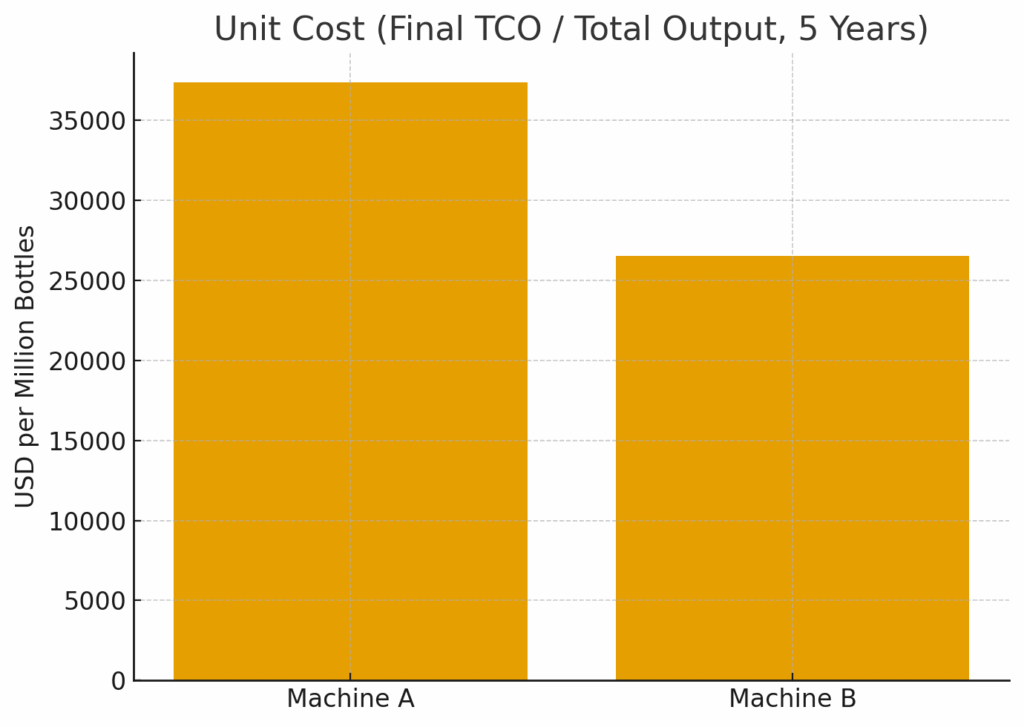
Yang ditunjukkan oleh ini: This might be the most important chart. When you divide the total 5-year cost by the actual bottles produced, the truth is clear:
- Machine A (Low-Price): Your cost to produce 1 million bottles was $36,800.
- Machine B (High-Efficiency): Your cost to produce 1 million bottles was only $26,400.The conclusion is clear:You thought you saved $80,000 up front. In reality, every single bottle you made with the “cheap” machine cost you almost 40% more to produce.
(Note: This doesn’t even count the air compressor…)
The “efficient” Machine B only cost $949,445 in total.
You ended up **paying $129,536 extra**.
(*Note: This doesn’t even count the air compressor. Bottle blowing uses a lot of air, and the compressor for an inefficient machine will also use a shocking amount of power.*)
In short: a cheap machine has a low return on efficiency because the money you “saved” up front is paid back twice over in future power and repair bills.
Section 2: The Efficiency Payoff (The High-Efficiency Machine’s Cost Curve)
A high-efficiency machine costs more up front. There’s no way around it.
This is because it’s built with better parts and better engineering.
But its cost curve is completely different. It starts higher, but it stays flat.
Month after month, your energy costs are far lower than your competitors.
Your maintenance is predictable, not a daily fire drill.
This is the machine that lets you confidently tell your clients “yes” when they need a fast delivery.
(To be frank, our most competitive OEM customers are the ones who focus on TCO.)
Section 3: What *Actually* Makes a Machine Efficient?
A machine isn’t efficient just because a salesperson says so.
You can’t just look at the price. You have to dig deeper into three key areas. This is what decides if a machine will save you money or cost you money:
1. The Configuration
This is the “heart” of the machine.
What kind of hydraulic system does it use? Is it an old-fashioned fixed pump, or a modern servo-motor system? (For example, many of our machines use servo-driven pumps to precisely control energy use).
Are the parts from no-name brands or well-known brands? A good configuration uses parts that are all designed to work together to save power, not just a random mix.
2. The Assembly Precision
This is extremely important. A machine that is assembled with high precision has parts that move smoothly.
Less friction means less wasted energy. It’s that simple.
If a machine is assembled badly, even with good parts, the parts will “fight” each other. This extra friction forces the motors to work harder, which pulls more power. It also means parts wear out much faster.
I want to share a “little story” about this:
We’ve tried many ways to process our parts, including expensive CNC machining. But we found two things: first, it raises the machine cost a lot. Second, for some key details, the “feel” of an experienced technician is something a cold machine just can’t replace.
So, our team is built on veteran technicians with years of hands-on experience. At the same time, we partner with outside institutes and even universities in China to research and train our team.
This teamwork helps us optimize some of our machine structures and assembly processes. It lets us make the machine’s assembly more accurate, snug, and “silky smooth” to operate, without dramatically raising the cost.
3. The Lubrication Design
This is related to assembly precision. A well-built machine with a smart lubrication system runs smoothly and doesn’t get too hot.
A poorly designed machine won’t get oil where it’s needed. Parts will grind and heat up. The machine wastes a ton of energy just fighting its own internal friction, before it even starts making a product.
For example: Di LEKAmachine, kami telah menghadirkan banyak inovasi dalam desain sirkuit hidrolik dan mekanis kami. Tujuan kami adalah membuat setiap tekanan sistem hidrolik seefisien mungkin. Kami ingin menggunakan energi tersebut untuk *benar-benar* menjepit cetakan dan mengekstrusi plastik, bukan menyia-nyiakannya di dalam pipa.
Bagian 4: Pandangan Kami tentang Nilai Jangka Panjang
Di LEKAmachine, kami mendesain mesin dengan mengutamakan keandalan dan efisiensi.
Kami memahami bahwa pelanggan kami (Anda) memperhatikan output per jam dan biaya per jam.
Kami berfokus pada penyediaan Cetak Tiup Ekstrusi (EBM) yang keluar Cetak Tiup Regang (SBM) mesin. Kami tidak menjual mesin blow molding injeksi, karena kami hanya berkonsentrasi pada apa yang paling kami kuasai.
Kesimpulan: Perhatikan Biaya 5 Tahun, Bukan Harga Hari Pertama
Mesin blow molding adalah investasi 10 tahun. Jangan biarkan harga rendah di Hari Pertama menjebak Anda dalam 10 tahun tagihan listrik tinggi dan sakit kepala akibat perbaikan.
Ketika Anda siap untuk meningkatkan lini produksi, saya sarankan untuk menanyakan tentang “total biaya”.”
Anda membutuhkan mesin yang memecahkan kemacetan produksi Anda, bukan mesin yang menjadi penghambat.
Seruan untuk Bertindak:
[Klik Di Sini untuk Mengunduh: Daftar Periksa TCO (Total Biaya Kepemilikan) Mesin Blow Molding.pdf] <– (Anda dapat menempatkan tautan unduhan Anda di sini)
Jika Anda lelah dengan tagihan energi tinggi dan downtime terus-menerus, lihat solusi kami.
- Pelajari tentang Mesin Cetak Tiup Ekstrusi: `https://lekamachine.comextrusion-blow-molding-machines/`
- Pelajari tentang Mesin Cetak Tiup Regang (Stretch Blow Molding Machines): `https://lekamachine.comstretch-blow-molding-machine/`


0 Komentar