

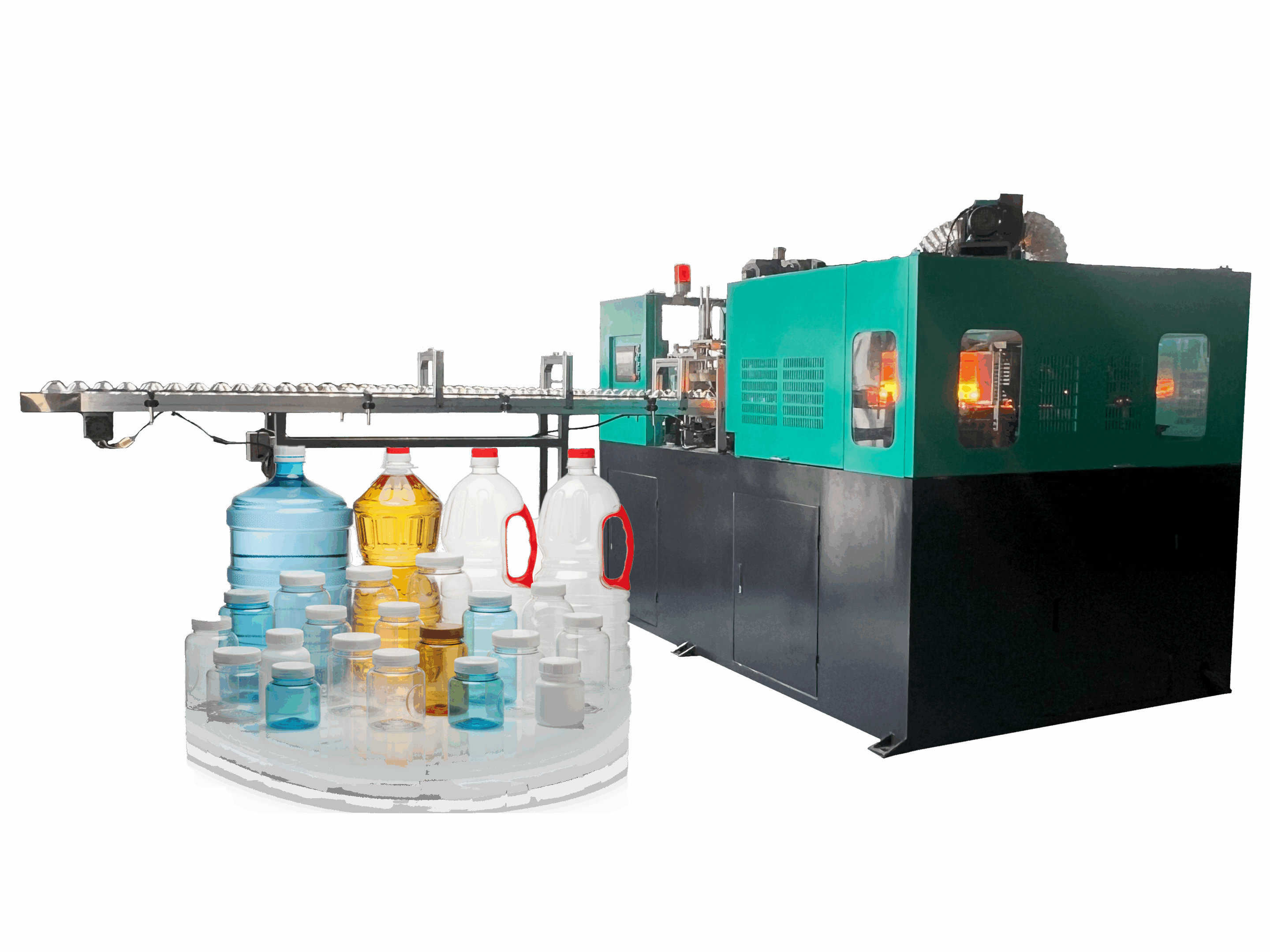
How Do You Calculate kWh/kg and ROI for EBM Machines in 2026?

At our factory, we know that rising electricity rates keep plant managers awake at night. You worry about profit margins shrinking while production targets rise, leaving you searching for efficiency in your molding line.
To calculate true efficiency, divide total kilowatt-hours by the weight of good saleable bottles, excluding flash. In 2026, competitive HDPE production requires specific energy consumption (SEC) below 0.35 kWh/kg. Mastering this metric and factoring in labor savings allows you to accurately forecast an ROI payback period of 18 to 24 months.
Below, we break down the math and the machinery specifications you need to secure a profitable future.
How do I calculate the actual kWh/kg energy consumption for my HDPE bottle production?
When we test machines before shipment, we often see clients misjudge their energy costs. You might struggle with vague utility bills that do not reveal which machine is draining your profits.
Calculate Specific Energy Consumption (SEC) by measuring total energy input over one hour and dividing it by the mass of good bottles produced, not total throughput. This distinction removes the illusion of efficiency caused by heavy flash, giving you a real-world cost per kilogram that directly impacts your bottom line.
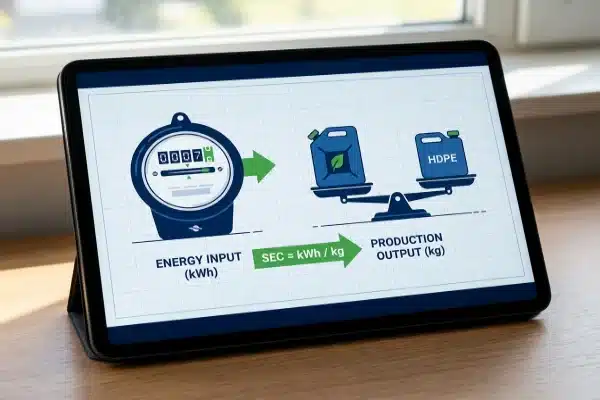
Understanding your energy profile is the first step toward profitability. In the blow molding industry, manufacturers often quote "installed power," but this does not reflect reality. To get the truth, you must measure the Specific Energy Consumption (SEC). This metric tells you exactly how much electricity it costs to process one kilogram of plastic into a sellable product.
The Formula for Success
We recommend installing a simple power meter on your main incoming line. Run the machine for at least one hour under stable production conditions. Use this formula:
$$ \text{SEC} = \frac{\text{Total Energy Consumed (kWh)}}{\text{Weight of Good Bottles (kg)}} $$
Do not include flash or scrap in the bottom number. If you include flash, your efficiency looks better than it actually is because you are "processing" more plastic. However, you cannot sell flash. You are paying to melt it, cool it, and grind it. True efficiency comes from the net weight of the final bottles.
The Hidden Load of Auxiliaries
When we configure lines for our clients, we remind them that the EBM machine is not the only energy consumer. Your calculation must include the peripheral equipment required to keep that machine running. If you ignore these, your ROI calculations will be off by 20% to 30%.
- Chillers: A hydraulic machine heats up your hydraulic oil, forcing your chiller to work harder.
- Compressors: Pneumatic movements and blowing air require massive amounts of energy.
- Granulators: Grinding heavy flash consumes high torque.
Benchmarking Your Equipment
To help you evaluate your current setup or potential new purchase, we have compiled data from our field installations.
Table 1: Energy Consumption Benchmarks for HDPE Processing
| Machine Technology | Typical SEC (kWh/kg) | Energy Cost Impact | Cooling Load Requirement |
|---|---|---|---|
| Standard Hydraulic | 0.60 – 0.90 | Tinggi | High (Oil + Mold cooling) |
| Hybrid (Inverter) | 0.40 – 0.55 | Sedang | Sedang |
| Full Electric (Servo) | 0.28 – 0.35 | Rendah | Low (Mold cooling only) |
If your current numbers are above 0.60 kWh/kg, you are likely losing significant margin compared to competitors using all-electric platforms. Upgrading to a servo-driven system reduces the parasitic load because motors only consume power when they move, rather than idling constantly like a hydraulic pump.
servo-driven system reduces 1
How can I estimate the ROI timeline for a new EBM machine investment in 2026?
We often see business owners hesitate to upgrade because the initial price tag looks daunting. You fear tying up capital in equipment that might take too long to pay for itself.
A precise ROI timeline requires summing equipment, tooling, and installation costs, then dividing by annual savings from energy, scrap reduction, and labor. High-efficiency servo machines typically deliver a return on investment within 1.5 to 2.5 years by reducing cycle times and cutting electricity usage by up to 40% compared to hydraulic systems.

prevent operators from touching 2
Calculating Return on Investment (ROI) requires looking beyond the purchase price. At LEKA Machine, we encourage buyers to look at the Total Biaya Kepemilikan (TCO). A cheaper machine often hides expensive operational costs that bleed your cash flow over time.
Step 1: Define Total CapEx
Your initial investment includes more than the invoice for the machine.
- Machine Cost: The base price.
- Perkakas: Molds and die heads.
- Auxiliaries: Chillers, compressors, and leak testers.
- Logistik: Shipping, installation, and staff training.
Step 2: Calculate Operational Savings
This is where the payback happens. Compare your current production data against the guaranteed specs of the new machine.
- Energy Savings: Use the SEC formula from the previous section. If you save $0.05 per kg and process 500 tons a year, that is $25,000 straight to the bottom line.
- Material Savings: Better parison control means thinner, more uniform bottles. Saving just 2 grams per bottle on a 5-liter jerrycan running 24/7 adds up to tons of resin saved annually.
- Cycle Time Reduction: If a new machine runs 12 seconds instead of 15, you produce 20% more revenue in the same timeframe.
The "Crash Kit" Factor
Downtime is the silent killer of ROI. When we deliver a machine, we recommend a "Crash Kit" of essential spare parts. If a heater band fails or a sensor breaks, waiting two weeks for a replacement destroys your ROI timeline. Having parts on the shelf keeps your utilization rate high.
Sample ROI Scenario
Here is a simplified comparison based on a client replacing an old hydraulic machine with a new hybrid/electric model for 1L detergent bottles.
Table 2: 1-Year Operational Savings Analysis
| Cost Category | Old Hydraulic Machine | New Servo EBM Machine | Annual Savings |
|---|---|---|---|
| Energy Bill | $45,000 | $22,500 | $22,500 |
| Resin Waste (Scrap) | $12,000 (3% rate) | $2,000 (0.5% rate) | $10,000 |
| Pemeliharaan | $5,000 (Oil leaks/Valves) | $1,000 (Grease) | $4,000 |
| Labor (Deflashing) | $30,000 (Manual) | $0 (Auto-deflashing) | $30,000 |
| Total Annual Gain | – | – | $66,500 |
If the new machine costs $130,000, the payback period is roughly 2 years. After that point, the machine generates pure profit compared to the old line.
Will this EBM machine handle my specific HDPE bottle weight and design specifications?
Our design team frequently receives inquiries where the client is unsure if a standard machine can handle their unique bottle geometry. You worry that buying the wrong size will lead to capacity bottlenecks or quality issues.
inconsistent melt temperature 3
Ensure the machine’s clamping force and platen size exceed your bottle’s projected area and stack height. Crucially, verify the extruder’s plasticizing capacity is at least 30% higher than your target hourly output to maintain melt stability and prevent motor strain during continuous production runs of heavy HDPE containers.
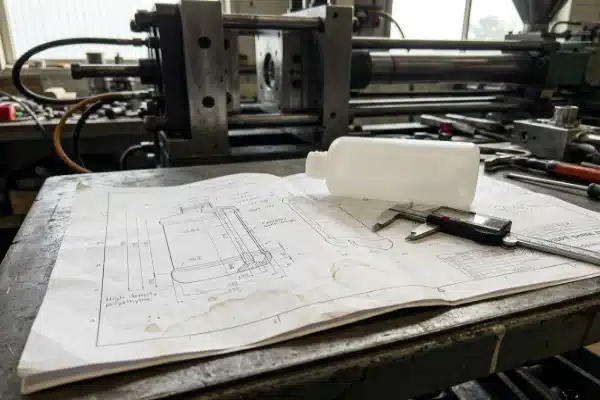
Selecting the right machine size is not just about fitting the mold between the platens. It involves a technical matching of the machine’s "muscle" to your product’s requirements. We prioritize engineering-led sales to prevent you from buying a machine that is either underpowered or wastefully oversized.
memproses satu kilogram plastik 5
Plasticizing Capacity vs. Output
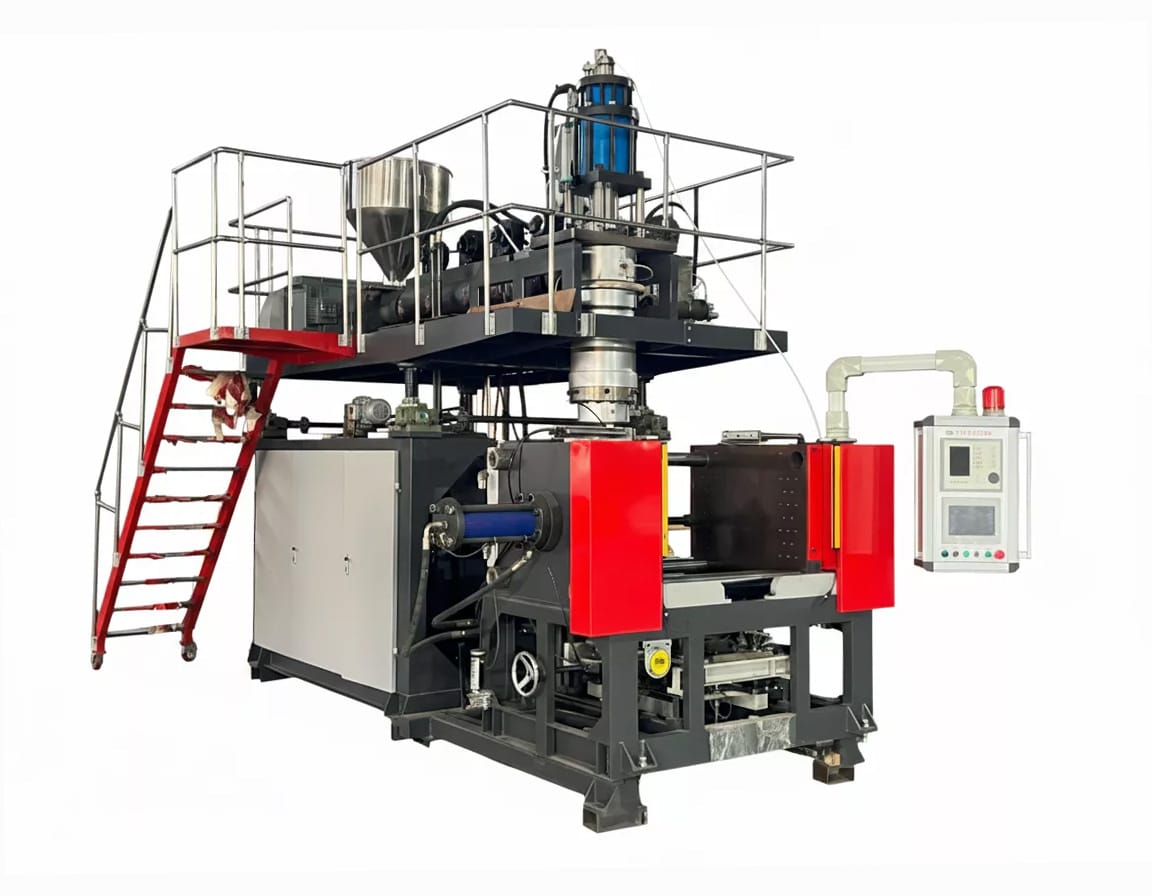
The extruder is the heart of the machine. It melts the HDPE granules. If your target output is 100 kg/hour, you should not buy a machine with a max capacity of 100 kg/hour. You need headroom. Running an extruder at 100% capacity leads to poor mixing, inconsistent melt temperature, and premature wear on the screw and barrel.
Rule of Thumb: Aim for a machine where your required output is about 70% of the maximum plasticizing capacity.
Clamping Force and Platen Size
Your bottle design dictates these numbers.
- Projected Area: The wider the bottle, the more "push back" force the air pressure creates inside the mold. If the clamping force is too low, the mold will breathe, creating heavy parting lines and flash.
- Carriage Stroke: For deep containers or jerrycans, you need enough clearance for the robot or operator to remove the part without getting stuck.
Single vs. Double Station
This decision depends on your volume. A double-station machine (carriages on both sides) doubles your output but increases complexity.
- Single Station: Great for lower volume, large containers (10L – 30L), or frequent mold changes.
- Double Station: Essential for high-volume small bottles (200ml – 5L) to compete on price per unit.
Matching Guide
We use the following matrix to guide our customers during the initial consultation.
Table 3: General Machine Selection Based on Bottle Specs
| Bottle Volume | Target Output (Bottles/Hour) | Recommended Configuration | Critical Feature |
|---|---|---|---|
| 100ml – 1L | 2,000+ | Double Station / Multi-Cavity | Auto-Deflashing |
| 1L – 5L | 500 – 1,000 | Single Station / 2-Cavity | 100-Point Parison Control |
| 10L – 25L | 100 – 300 | Single Station / Accumulator | High Melt Strength Screw |
| 30L – 200L | < 60 | Kepala Akumulator | Servo Hydraulic System |
If you send us your bottle drawing and target weight, we can simulate the cycle time and recommend the exact screw diameter and die head size. This removes the guesswork.
Total Biaya Kepemilikan (TCO) 6
What specific features should I look for to ensure my EBM equipment stays competitive in 2026?
We are constantly upgrading our technology because we know the market does not stand still. You fear that the machine you buy today will be obsolete in three years, leaving you unable to meet new compliance or efficiency standards.
forcing your chiller to work 7
Prioritize machines equipped with full servo-electric drive systems for precision and energy savings. Look for remote diagnostic capabilities, automatic parison wall thickness control, and quick-change mold systems to adapt to smaller batch runs. These features ensure your production line remains agile and profitable as market demands shift in 2026.
The manufacturing landscape is shifting toward "Low Volume, High Mix" production. The days of running one bottle shape for six months are fading. To stay competitive in 2026 and beyond, your equipment must be flexible and intelligent.
Specific Energy Consumption (SEC) 9
Precision Parison Control
Raw material costs are your biggest expense. Old machines produce bottles with thick bottoms and thin corners. Modern machines use 100-point Parison Wall Thickness Control. This technology allows you to program the thickness profile of the plastic tube (parison) as it extrudes.
- Benefit: You can lightweight the bottle by shaving off grams from non-critical areas while reinforcing the corners for drop-test strength. This saves massive amounts of money on resin.
Remote Diagnostics and IoT
In the past, if a machine stopped, you waited days for a technician. Now, we equip machines with remote access modules.
- How it works: Our engineers can log into your PLC from our office to troubleshoot alarms, adjust parameters, or update software.
- Value: This reduces downtime from days to minutes. It also allows for predictive maintenance, warning you before a part fails.
Safety and Compliance
As you look to export or meet stricter local labor laws, safety is non-negotiable. Competitive machines in 2026 must meet CE standards or equivalent safety logic.
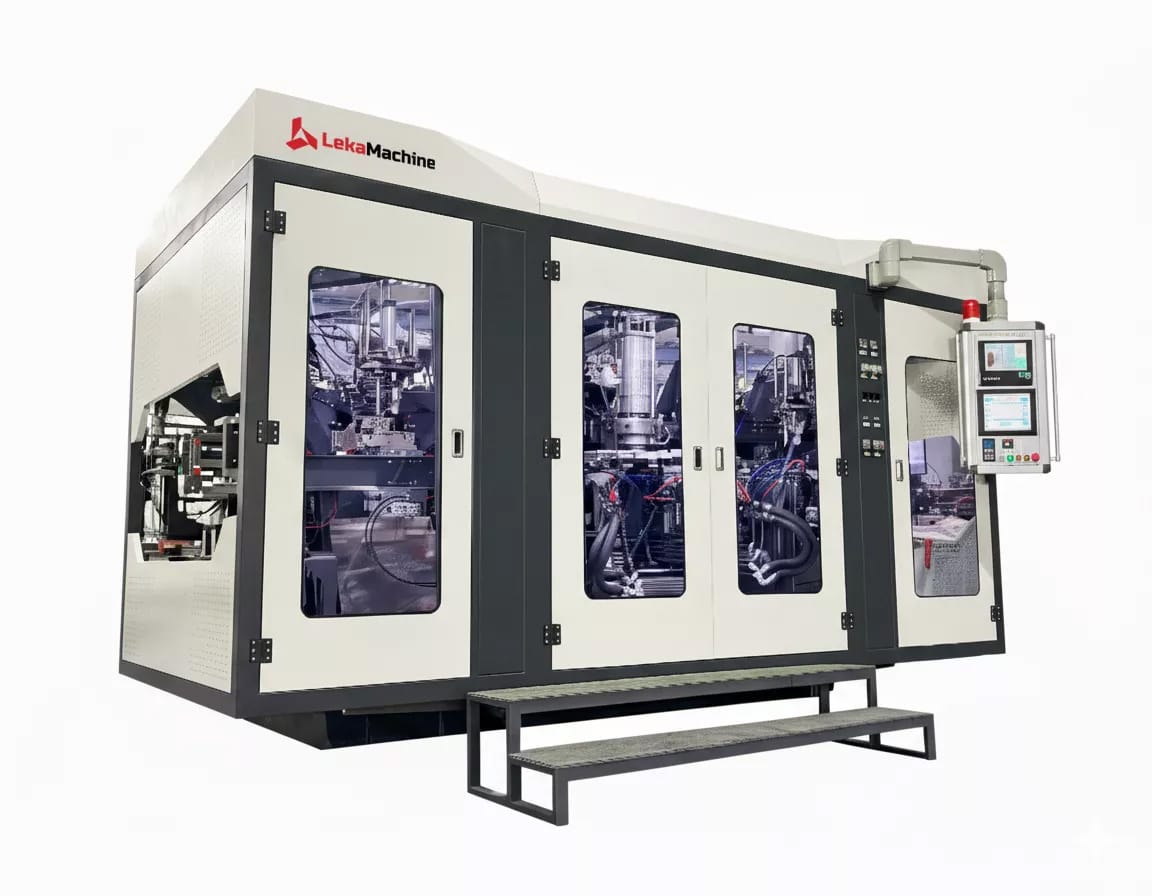
- Guarding: Full enclosure to prevent operators from touching moving parts.
- Logic: Safety relays that cut power immediately if a door is opened.
- Ergonomics: Screens and buttons placed at working height to reduce operator fatigue.
Quick Changeover Design
If you have multiple SKUs, changeover time is lost money. Look for machines designed with accessible tie-bars and quick-connect water manifolds. We find that reducing mold change time from 4 hours to 1 hour can save effectively one week of production time per year.
Kesimpulan
To succeed in 2026, you must look beyond the sticker price. By calculating your true SEC, accurately forecasting ROI, and selecting a machine that fits your specific bottle geometry, you secure a competitive advantage. Focus on servo technology and smart controls to keep your operational costs low. If you are ready to evaluate your production line, send us your bottle drawings and output targets—we will help you build the right solution.
industri blow molding 10
Catatan kaki
- Major manufacturer documentation on servo motor energy efficiency. ↩︎
- Regulatory standards for industrial machine safety guarding. ↩︎
- Academic context on polymer science and melt behavior. ↩︎
- Defines the core mechanism of the plasticizing unit. ↩︎
- Industry leader detailing HDPE material processing requirements. ↩︎
- Official government guide on calculating manufacturing investment costs. ↩︎
- Authoritative source on industrial cooling and thermal management. ↩︎
- Government data highlighting the economic impact of plastic waste. ↩︎
- Links to ISO 14955 standard for machine tool energy efficiency. ↩︎
- Provides general background context on the manufacturing process. ↩︎


0 Komentar