





At our factory, we often see production lines struggle with consistency simply because they treat modern all-electric machines exactly like legacy hydraulic equipment Condition-Based Maintenance 1. all-electric extrusion blow molding machine 2 Without specific protocols, the precision of servo-driven systems is wasted, and the risk of operator error increases significantly.
To establish SOPs for all-electric EBM machines, map the specific electromechanical workflow rather than copying hydraulic templates. Define strict pre-startup safety reviews for servo drives, codify sequential homing routines, and replace oil-check steps with lubrication schedules for ball screws and linear guides to ensure consistent cycle times.
Let’s break down the essential steps to standardize your production and protect your investment.
Does the supplier provide customizable SOP templates based on the machine's specific configuration?
When we deliver a LEKA machine to a new facility, clients frequently ask for "plug-and-play" documentation to immediately hand over to their operators. However, relying solely on a generic manual often leaves critical gaps in your daily operations.
Most suppliers provide technical operation manuals rather than process-specific SOPs. While OEMs offer electrical schematics and HMI guides, you must customize these into actionable templates. We recommend adapting generic safety and quality frameworks to match your specific servo configurations and factory floor safety regulations.
The Difference Between Manuals and SOPs
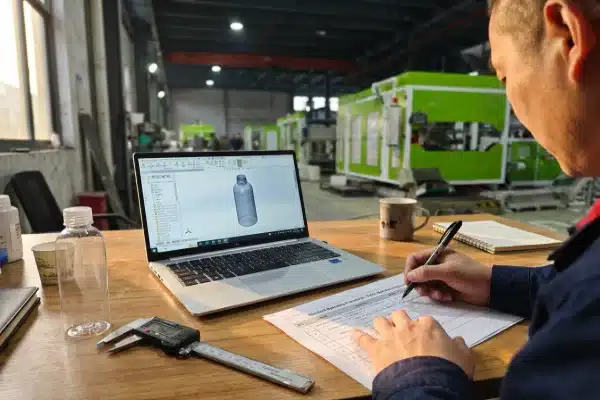
It is crucial to understand that the documentation we provide as an OEM is fundamentally technical. It details cara the machine works—wiring diagrams, PLC logic, and mechanical assembly. However, an SOP details how your team should work with the machine. We can provide the technical specifications, but you must define the workflow.
Creating an SOP from a blank page is inefficient. We recommend starting with a baseline structure and adapting it. Generic plastics industry templates often include steps for hydraulic fluid checks or oil filter replacements. For an all-electric machine, these are obsolete. You must systematically excise these steps and replace them with electromechanical verifications.
Adapting the Template for Electric Architecture
In our experience, the most effective SOPs are those that have been aggressively edited. A standard template might say "Check system pressure." On our all-electric models, this is vague. Your customized SOP should read: "Verify Servo Drive A current draw is <15A on the HMI."
Below is a comparison of what we provide versus what you need to build:
| Document Type | Source | Focus | Typical Content |
|---|---|---|---|
| Operation Manual | OEM (e.g., LEKA Machine) | Technical Functionality | Electrical Schematics, Servo Parameter Lists, HMI Navigation Trees, Parts Lists. |
| Generic Template | Compliance Platforms | General Structure | "Check Safety Guards," "Log Material Batch," generic hydraulic checks. |
| Factory SOP | You (The User) | Workflow & Behavior | "Operator A presses Reset," "Clean Feed Throat at 8:00 AM," specific Quality Control tolerances. |
By bridging this gap, you turn a technical manual into a living document that guides operator behavior, reducing the risk of purchasing the wrong solution or misusing the equipment.
What are the critical safety checks that must be included in the daily startup procedure?
In our testing facility, rushing the startup sequence is the fastest way to damage high-torque servo motors or shear a screw. We train our engineers to treat the startup as a flight check—ignoring it risks costly downtime and equipment failure.
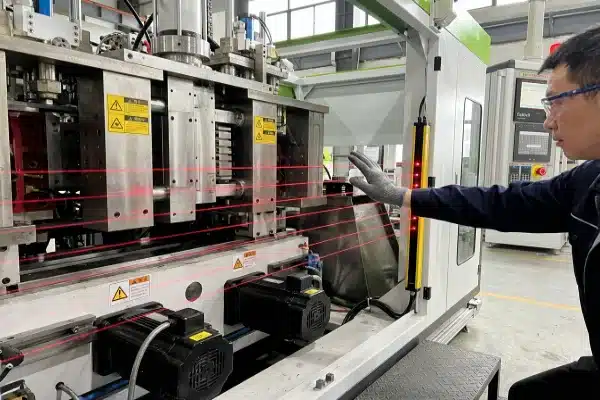
Critical startup checks must verify that all safety interlocks and light curtains function before enabling servo power. Operators must confirm the extruder has completed its heat soak to prevent screw shear and ensure the cooling water flow is active to protect the barrel and mold from thermal shock.
The Pre-Startup Safety Review (PSSR)
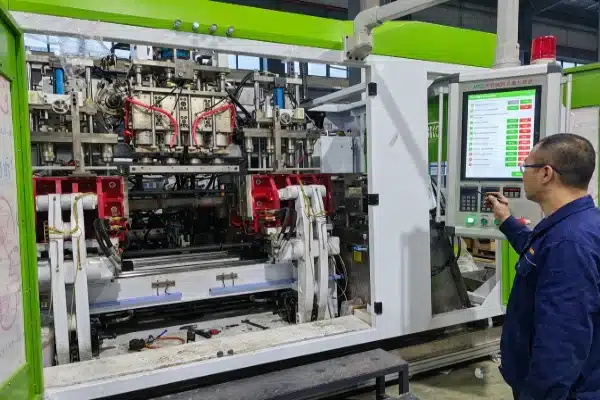
The initiation of an all-electric machine from a cold state is a period of peak vulnerability. Unlike hydraulic systems that might just stall if blocked, electric servo motors deliver instant, immense torque. A mechanical bind can cause rapid damage. Therefore, your SOP must enforce a "Pre-Startup Safety Review 3."
Environmental and Physical Integrity
Before the main power isolator is even turned, the operator must conduct a visual sweep. The work area must be clear of tools, purging scrap, or maintenance equipment. The SOP must explicitly ban loose clothing and jewelry, which pose severe entanglement risks near the high-speed rotating components.
The "Heat Soak" Mandate
One of the most critical technical checks involves thermal expansion. The extruder screw and barrel must be fully heated to process temperature. We often see operators try to start the screw immediately after the temperature zones hit the setpoint. This is dangerous. The metal needs time to expand uniformly, and the plastic inside must be fully melted. Your SOP must mandate a "Heat Soak" period—typically 20 to 30 minutes after reaching temperature—before any screw rotation is attempted.
Startup Verification Matrix
To ensure nothing is missed, we recommend embedding a pass/fail matrix into your daily log:
| Inspection Category | Specific Component | Pass/Fail Criteria | Hazard Mitigated |
|---|---|---|---|
| Safety Interlocks | Sliding Gates / Light Curtains | Gates move freely; breaking light curtain triggers immediate software halt. | Crushing / Amputation from mold clamp. |
| Thermal Protection | Extruder Barrel Guards | Insulating blankets and metal guards are securely fastened over heater bands. | Severe thermal burns from 200°C+ surfaces. |
| Pneumatic Supply | Air Hoses and Regulators | No audible hissing; regulators locked at 105-140 kPa. | Parison blow-outs; high-pressure hose whipping. |
| Electrical Homing | Servo Zero Position | Homing sequence completes without binding or excessive noise. | Mechanical collision of mold halves. |
How do I integrate the manufacturer's maintenance intervals into my factory's standard workflow?
We find that many operators wrongly assume "all-electric" means "maintenance-free." While you don't have oil leaks, neglecting the greasing schedule leads to seized bearings and catastrophic failure of the ball screws.
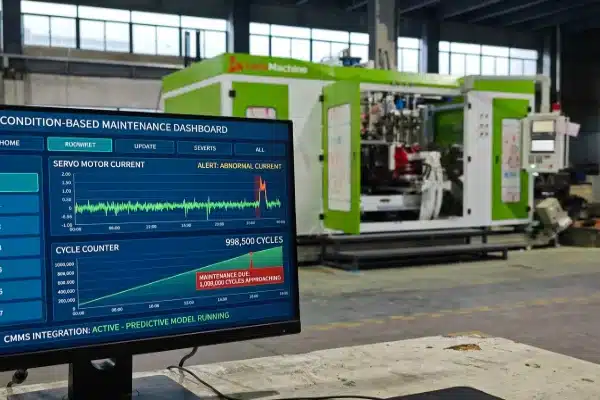
Integrate maintenance by shifting from calendar-based oil changes to usage-based lubrication for ball screws and bearings. Connect your CMMS to the machine's cycle counter to trigger work orders based on actual run-hours, ensuring that OEM-specified greasing intervals are met precisely to prevent electromechanical wear.
Shifting from Hydraulic to Electromechanical Maintenance
The transition to all-electric drives requires a total recalibration of your maintenance philosophy. The historical burden of hydraulic maintenance—managing hundreds of gallons of oil and fighting leaks—is gone. However, it is replaced by the need for high-precision lubrication.
The primary points of failure in an electric EBM machine are the heavy-duty ball screws and linear guide rails 4. These components rely on a thin film of grease to prevent metal-on-metal contact. Your SOP must specify the exact grease type (e.g., Lithium vs. Polyurea). Mixing incompatible greases is a common error we see; the thickeners react, causing the grease to harden into a solid block, destroying the bearing.
Condition-Based Maintenance (CBM)
We strongly advise against using simple calendar dates (e.g., "Grease every month") for maintenance. A machine running 24/7 wears out four times faster than one running a single shift. Instead, integrate your SOP with a Computerized Maintenance Management System 5 (CMMS).
Modern all-electric machines track every cycle. Your workflow should use this data.
Maintenance Strategy Comparison
| Maintenance Paradigm | Trigger Mechanism | Application to All-Electric EBM | Efficiency / Impact |
|---|---|---|---|
| Time-Based (TBM) | Calendar Dates (e.g., Monthly) | Routine cleaning, filter checks. | Low. Often results in over-greasing or missed wear on high-output lines. |
| Condition-Based (CBM) | Cycle Counters / Runtime | Relubricating ball screws every 1,000,000 cycles. | High. Links maintenance directly to mechanical fatigue and usage. |
| Predictive (PDM) | Real-Time IoT Sensors | Monitoring servo current spikes to detect friction before failure. | Maximum. Eliminates unplanned downtime by fixing issues before they stop production. |
By using the machine's own data to drive your SOPs, you ensure that maintenance happens exactly when required—neither too early (wasting resources) nor too late (causing damage).
Are there visual guides or flowcharts available for common troubleshooting steps?
During remote support calls, we often notice operators struggling to diagnose defects because they lack a visual reference. Without a clear guide, they resort to guesswork, adjusting random settings and usually making the problem worse.
Visual troubleshooting guides are essential for rapid diagnosis, organizing defects like parison curl or flash into decision trees. These flowcharts prioritize non-invasive adjustments, such as air pressure or cooling time, before suggesting mechanical interventions, helping operators solve root causes scientifically rather than relying on trial and error.
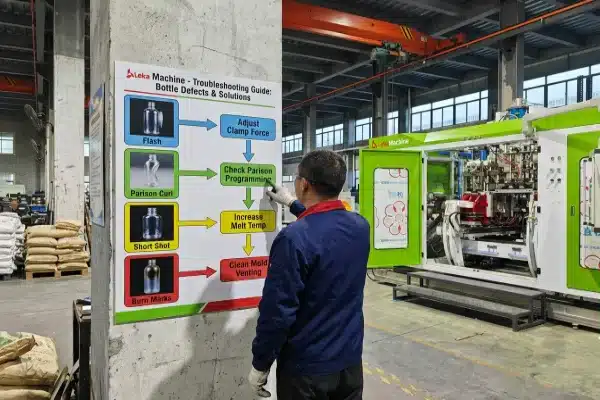
The Scientific Troubleshooting Approach
Troubleshooting is not an art; it is a science. When a bottle comes out deformed, there is a specific physical reason. We encourage our clients to use "Scientific Molding" principles. Scientific Molding principles 6 The SOP should guide the operator to isolate variables (Heat, Pressure, Flow, Cooling) rather than guessing.
A good flowchart forces the operator to start with the simplest solution. For example, if there is flash (excess plastic) on the bottle, the first step shouldn't be "Machine the mold." It should be "Check the blowing pressure" or "Verify mold closing force."
Common EBM Defects and Logic Flow
To help you build your own visual guide, here is a breakdown of common defects we encounter and the logical steps to resolve them. You can print this table and place it near the HMI.
Diagnostic Matrix
| Cacat | Visual Description | Root Causes | Corrective Action Sequence |
|---|---|---|---|
| Parison Curl | The plastic tube hooks or bends as it drops. | 1. Uneven die temperature. 2. Dirty die gap. 3. Misaligned tooling. | 1. Check heater bands for cold spots. 2. Clean the die gap. 3. Adjust die ring bolts (Last resort). |
| Part Blow-out | Plastic ruptures during inflation. | 1. Blow pressure too high. 2. Material too hot. 3. Pinch-off too sharp. | 1. Reduce pre-blow pressure. 2. Lower melt temperature. 3. Check mold cooling at pinch-off. |
| Die Lines | Vertical scratches along the bottle. | 1. Contamination in die. 2. Damaged tooling. 3. Cold material. | 1. Purge material to flush debris. 2. Increase back pressure. 3. Disassemble and polish tooling (Requires Shutdown). |
Documentation as a Tool
We recommend taking photos of "Good" vs. "Bad" parts specific to your mold and adding them to the SOP. Operators process visual information much faster than text. If they can match the defect to a picture on the wall, they can follow the flowchart to fix it, reducing your scrap rate and downtime significantly.
Kesimpulan
Standardizing your all-electric EBM workflow requires more than just a manual; it demands a culture of precision. By implementing rigorous safety checks, data-driven maintenance, and visual troubleshooting, you ensure your machinery delivers consistent profits.
Catatan kaki
1. Defines CBM as a preventive strategy using asset monitoring for maintenance. ↩︎
2. Compares electric and hydraulic EBM machines, highlighting electric advantages. ↩︎
3. Outlines the purpose, requirements, and steps for conducting a PSSR. ↩︎
4. Explains the function and applications of linear guides in motion systems. ↩︎
5. Provides a comprehensive definition and explanation of CMMS software. ↩︎
6. Explains scientific molding and its benefits. ↩︎


0 Komentar