
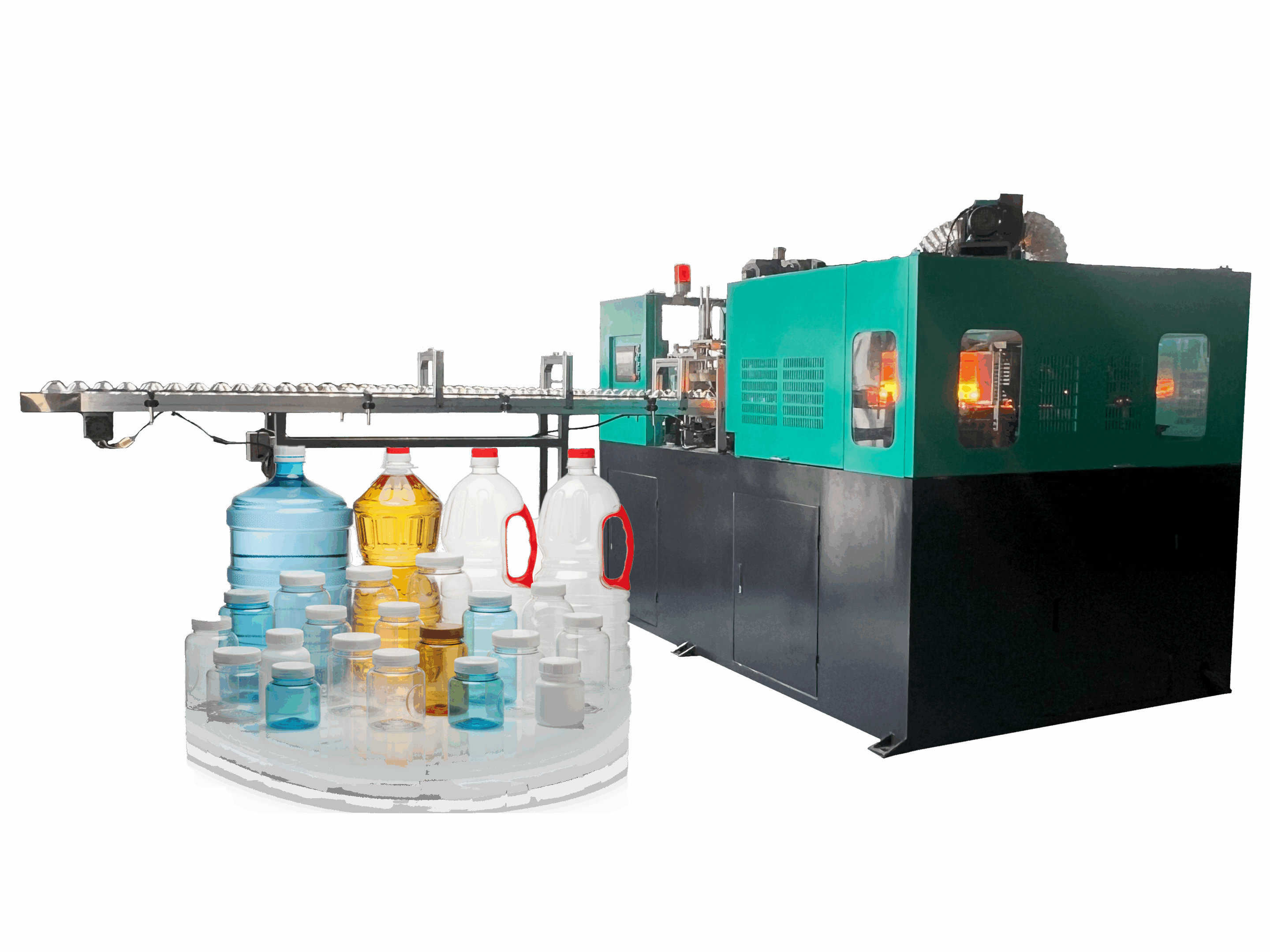
PET Blowing Machine for 500ml and 1L Bottle Production: Complete Buyer’s Guide
500ml and 1L PET water bottles look simple. In production, they are not.
These two formats carry most of the volume in many water and beverage plants. They decide how stable your line is, how much resin you waste, and whether your margin survives small changes in energy price or preform cost.
Choose the wrong PET blowing machine, and every bottle quietly eats into your profit. Choose the right one, and the line runs for years with predictable costs and very few surprises.
This guide is written for OEM PET bottle manufacturers, beverage brands, and plant engineers who are comparing automatic 500ml and 1L PET bottle blowing machines and want practical, experience-based guidance instead of marketing slogans.
This guide walks through how to think about a PET blowing machine for 500ml and 1L bottle production, based on what happens in real factories and how modern stretch blow molding solutions are designed.
Why 500ml and 1L PET Water Bottles Deserve Their Own Blowing Machine Strategy
Most OEM bottle factories and water brands have many SKUs. But if you check the yearly numbers, two formats usually dominate: 500ml and 1L.
500ml is the impulse and everyday bottle. 1L is the family, office, or travel size. They are often the base load of the factory. When these formats run well, your plant feels calm. When they do not, everything becomes a fire drill.
How the right PET blowing machine protects your margin on every bottle
Your real margin does not come from the brochure speed. It comes from a combination of:
- Stable output: good bottles per hour, with real preforms, on hot days
- Energy use per bottle: kWh and high-pressure air per 1,000 bottles
- Scrap rate: how many bottles you throw away to keep kualitas
- Waktu pergantian: how many hours you lose when switching molds or formats
A good automatic PET blowing machine for 500ml and 1L keeps these four numbers under control. Even a small improvement, like 3–5% less scrap or 0.02 kWh/kg lower energy, becomes very visible when you run millions of bottles per month.
What this guide will help you decide before you invest in new equipment
By the end, you should be able to answer, in simple terms:
- What exactly your 500ml / 1L project needs from a PET blowing machine
- How many cavities and what output range makes sense
- What utilities (air, power, cooling) you really need
- How to compare different suppliers beyond just “max BPH”
- When a two-stage stretch blow molding solution is a fit, and when your existing blower is enough
Untuk Siapa Panduan Ini
This guide is written for people who live with bottle lines every day, not just for buyers reading a spec sheet.
OEM PET bottle factories supplying water, juice, and edible oil brands
If you are an OEM bottle maker with long-term contracts, you care about stable output, predictable total cost of ownership, easy maintenance, and fast mold changes. You probably serve multiple brands at the same time. Your 500ml and 1L bottles are the bread and butter that keep the plant full.
Beverage brands bringing 500ml and 1L bottle production in-house
If you run a growing water, juice, or tea brand, you may be tired of depending fully on OEM suppliers. An in-house automatic 500ml PET bottle blowing machine gives you more control over lead time, freedom to test new shapes or lighter preforms, and better visibility of cost per bottle. But it is often your first big capital equipment project, so the risk feels higher.
Engineering and maintenance teams upgrading from semi-automatic to automatic PET blowers
Many factories start with semi-automatic PET blowers and then hit a ceiling: too much labour per 1,000 bottles, inconsistent heating between operators, and unstable kualitas on lightweight bottles. If that sounds familiar, this guide will help you understand what changes when you move to fully automatic two-stage stretch cetakan tiup.
Entrepreneurs planning a first 500ml / 1L PET bottling line
If you are planning your first line, a lot of machine quotes may sound like a different language. You do not need to become a process engineer overnight. You just need a clear checklist of what matters and what to ignore.
How a 500ml and 1L PET Bottle Blowing Machine Really Works
You start with a PET preform that looks like a thick test tube. The machine heats it, stretches it, and blows it into the final bottle shape.
From preform to finished bottle: two-stage stretch blow molding in simple language
- Preforms are made and delivered, or injected in another area of the factory.
- Preforms are loaded into the blowing machine hopper.
- They pass through an infrared oven, where each preform is heated from the outside.
- A stretch rod goes inside the hot preform and pulls it down.
- High-pressure air blows the preform against the mold wall.
- The bottle cools, is ejected, and moves to the conveyor.
The key is how evenly the preform is heated and stretched. This is what gives you consistent wall thickness and good top-load strength.
Single-stage vs two-stage PET blowing for 500ml and 1L bottles
There are two main routes:
- Single-stage (one-step ISBM): the preform is injected, then stretched and blown in one machine.
- Two-stage: preforms are made elsewhere, then blown on a dedicated stretch mesin cetak tiup.
For 500ml and 1L water and beverage bottles, two-stage is usually the workhorse. It is easier to run at higher speeds with 4–12 cavities, more flexible if you change preform suppliers, and often lower cost per bottle for large volumes.
Why two-stage stretch blow molding is the workhorse for high-speed beverage lines
Two-stage stretch cetakan tiup allows you to run different preform weights for 500ml and 1L on the same platform, scale from 2 to 12 cavities as your output grows, and optimise energy and air use with better heating control and air recovery. For standard 500ml water bottles, a 6–8 cavity machine often hits the sweet spot between investment and speed.
Key components you should actually care about
When you look at a PET blowing machine, focus on these key parts:
- Oven and heating control – number of lamps, zoning, and how precisely you can adjust each zone.
- Stretch rods – material, surface finish, guidance, and repeatability.
- High-pressure air circuits – valves, manifolds, and any air-recovery system.
- Mold clamping and transfer – stability at speed, cleanliness, and access for mold changes.
- HMI and control system – how easy it is for operators to adjust recipes without breaking the process.
If these five areas are solid, the machine is usually much easier to live with.
Defining Your 500ml / 1L PET Bottle Project Before Choosing a Machine
The worst way to start a project is: “Send me your best price for a 6-cavity machine.” The better way is: “Let me first define my bottle, my neck, and my output.”
What will you fill – pure water, CSD, juice, tea, or edible oil?
Different liquids mean different bottle requirements:
- Still water: focus on lowest weight and clarity.
- Carbonated drinks (CSD): need a stronger base and higher top-load.
- Juice / tea: may need better barrier and sometimes hot-fill resistance.
- Edible oil: heavier bottles, sometimes square shapes or integrated handles.
This guide mainly looks at still water and standard beverages, but many principles also apply to oil.
Neck finishes and closures: 28 mm, 30 mm, 38 mm and regional standards
Neck choice affects cap cost, line compatibility, and preform availability. Common options include 28 mm PCO or similar for 500ml water, 28–30 mm for 1L water or juice, and 38 mm for some 1L edible oil or functional drinks. Agree on your standard necks early. This keeps change parts and inventory under control.
Preform weight targets for 500ml and 1L: how light you can go safely
Everyone wants lightweight bottles, but you need to balance shelf feel, stack strength, transport, and squeezing behaviour. As rough starting points, 500ml water bottles often run in the 9–14 g range and 1L water bottles in the 16–24 g range, depending on design and market.
A good PET bottle blowing machine for 500ml and 1L lets you experiment with lighter preforms over time, without becoming unstable every time you shave off 1 gram.
Output planning: realistic bottles-per-hour targets instead of brochure numbers
Brochures love perfect conditions. Real life is different. Think in net bottles per hour, including micro-stops, label or filler stoppages, and normal mold changes. If a machine is rated at 12,000 BPH for 500ml water, a realistic net might be 9,000–10,500 BPH, depending on your factory discipline.
500ml vs 1L PET bottle blowing: what really changes on the machine side
Key differences when you switch from 500ml to 1L include cavity count, preform weight and heating, and cycle time. Thicker preforms for 1L need different oven recipes, and 1L bottles often run slightly slower because there is more material to stretch and cool. A well-designed machine and mold package lets you switch between 500ml and 1L with planned recipes, not guesswork.
Core Specs of an Automatic PET Blowing Machine for 500ml and 1L Bottles
When you compare quotes, you will see a long list of technical points. Here is how to read them.
Cavity number vs output
Typical configurations for 500ml and 1L water bottles include:
- 2–4 cavities: suitable for small plants or niche brands.
- 4–6 cavities: a good balance for many regional OEM bottle factories.
- 8–12 cavities: high-speed lines supplying big retailers or multiple brands.
More cavities mean more output, but also more preforms per hour, higher compressor and chiller demand, and higher mold cost.
Oven design and heating control
Good heating is the heart of the process. Look for multiple zones with separate temperature control, the ability to fine-tune neck, body, and base heating, and stable lamp power with good shielding to avoid hot spots. Energy-saving oven designs and good insulation help cut kWh per kilogram of PET processed.
Stretching and blowing
In the stretching and blowing area, you care about stretch rod speed and position control, blow pressure levels and timing curves, and how evenly material is distributed across the shoulder, label panel, and base. Good control reduces pearlescence, thin spots, and random bottle deformations under pallet load.
Changeover flexibility
If you run both 500ml and 1L bottles, ask very clearly how long a mold change takes hot to hot, how many tools are needed, and how much of the neck equipment and transfer system must be adjusted. A realistic target for an organised team is under 2 hours for a full change from 500ml to 1L, including checks.
Air, power, and cooling requirements
A 500ml / 1L PET blowing machine will specify high-pressure air (often 30–40 bar), low-pressure air for cylinders, chilled water temperature and flow, and connected electrical load. Confirm that your utilities can handle both 500ml and 1L at full speed, not just one format.
Designing Bottle and Preform Together for Smooth 500ml / 1L Production
Machine and mold are married for life. Bottle design is the third partner.
How bottle shape and label panels affect blow stability and scrap rate
Simple, round bottles with clean label panels usually blow easily. As soon as you introduce deep ribs, square corners, or large grip areas, the process becomes more sensitive. This can increase scrap and make lightweighting harder.
Matching preform design to 500ml vs 1L bottle performance
Preform design controls where material goes when you stretch and blow. The shoulder needs enough material to avoid collapse under stacking, the base needs thickness to handle pressure and impact, and the label panel needs enough stiffness not to dent too easily.
When you set up a new project, it is smart to review preform drawings together with your mold and machine suppliers so all three sides stay aligned.
Typical defects in 500ml and 1L PET bottles – and what they tell you
Some quick examples:
- Thin, see-through base – base heating or blow timing issue.
- Bent necks or oval openings – problems in transfer or preform handling.
- Pearlescence or white stress marks – over-stretching or preforms too cold.
- Soft sidewalls – too aggressive lightweighting or insufficient material in the body.
Your future machine should make these issues easy to identify and fix, not mysterious.
Working with preform and mold suppliers
Best projects feel like this: you provide clear bottle drawings and output targets, the preform supplier proposes suitable weight and neck standard, the mold supplier and machine supplier discuss cooling, venting, and molding details, and everyone agrees on a test plan for the factory acceptance test. This reduces surprises during installation and speeds up ramp-up time at your site.
Typical Use Cases for 500ml and 1L PET Bottles
Even if you only blow water bottles today, the machine you choose can open doors for other products later.
Still and mineral water bottles
For still and mineral water, the pressure is always on gram reduction. Your 500ml PET bottle blowing machine must keep wall thickness stable even when you push down weight. One or two grams saved on a high-volume SKU can pay for the machine over time.
Carbonated drinks in 500ml and 1L
For carbonated soft drinks, the rules change slightly. You need a stronger base design, higher preform weight, and more focus on CO₂ retention and creep over shelf life. The machine must be able to control stretch and blow more tightly to avoid stress cracking.
1L edible oil and functional drink bottles
For edible oil, clarity still matters, but bottle walls are often thicker and shapes are more complex. Standard PET oil bottles can be handled by a flexible mesin cetak tiup regang. For integrated plastic handles, *ekstrusi blow molding* is usually a better choice.
Regional preferences
Different markets like different shapes. Some regions prefer tall, slim 500ml bottles, while others prefer shorter, wider shapes for stability. Caps and neck finishes also vary by country and retailer standard. A good supplier will show you past projects in markets similar to yours, not just generic catalog pictures.
Integrating the PET Blowing Machine into Your 500ml / 1L Bottling Line
The blowing machine never works alone. It lives inside a full ecosystem.
Standalone PET blowing machine feeding an existing filling line
This is common when you are upgrading only the blowing section or feeding multiple fillers from one preform and blowing area. Focus on bottle transfer, buffering to decouple the blower from the filler, and synchronisation of speeds between machines.
Fully automatic PET line from preform hopper to packed cases
For new plants or complete line upgrades, you may choose a full PET line from preform unscrambler to palletiser. In this case, check carefully who is the line integrator, who takes responsibility if output targets are not met, and how acceptance tests are specified.
Conveyors, air rinsers, leak testers, and inspection systems
For 500ml and 1L formats, you may also need air rinsers, leak testers to confirm bottle integrity, and vision inspection for neck and thread quality. Make sure the PET blowing machine controls offer the right signals and data to talk to these devices.
Planning layout, operator flow, and maintenance access
When you plan the layout, keep in mind clear access to electrical and pneumatic cabinets, space to remove molds safely, and logical operator paths between preform loading, blower, and filler. Smart U-shaped layouts make life easier for both operators and maintenance teams.
My Experience with 500ml and 1L PET Bottle Lines
I spend a lot of time inside real plants, not just behind a desk.
What I consistently see in 500ml and 1L PET water bottle plants
Whether it is a regional OEM or a fast-growing water brand, 500ml and 1L lines have similar stories. One or two lines are always running these formats. Management talks about resin and energy cost every month. Operators know exactly which mold behaves nicely and which one is a headache.
The lines that run smoothly usually have clear recipes for each bottle, simple, repeatable changeover routines, and stable compressors and chillers with a safety margin.
Common failure modes on real projects
Some typical problems include under-sized compressors, oven mis-tuning where every shift changes settings, and weak changeover processes with no checklist. Most of these issues are not mysterious. They are planning gaps that can be fixed with better specs and training.
Projects that quietly run for 5–10 years
The most profitable lines are often the most boring ones. They run the same 500ml and 1L bottles for years, make occasional lightweight upgrades that are planned and tested properly, and operate machines below their absolute maximum speed but with high overall equipment effectiveness.
When an upgrade is really worth it
Sometimes it makes sense to keep an older blower. Other times, scrap rate is too high, energy per 1,000 bottles is painful, or changeovers waste too much time. In those cases, a newer automatic PET blowing machine with better heating control and air recovery can pay for itself faster than expected.
Real-World Configuration Scenarios for 500ml / 1L PET Blowing Machines
OEM bottle factory upgrading from semi-automatic to fully automatic 500ml PET blowing
A typical situation is an OEM running two or three semi-auto machines with heavy labour and 3–5% scrap. The target is to move to a single 4–6 cavity automatic blower with automatic preform loading. Key benefits include lower labour per 1,000 bottles, more consistent heating and quality, and easier multi-shift operation without depending on star operators.
New water brand starting with 500ml bottles and planning future 1L SKUs
A new brand might start with 500ml bottles using 4–6 cavities, then add 1L molds and recipes on the same machine later. Utility sizing for the future 1L speed, a layout that leaves space for a second blower, and bottle and preform design that can be reused across SKUs all help reduce long-term cost.
Edible oil producer switching from HDPE to 1L PET bottles
An edible oil producer may want better shelf appearance and more transparent packaging. In this case, they need to consider new neck and cap standards, different handling of PET preforms versus HDPE parisons, and possibly integrating a PET line next to existing HDPE equipment.
Co-packer adding 500ml and 1L PET bottles for multiple brand customers
A contract packer may handle many labels and cap colours but rely on stable core bottle designs. The PET blowing machine must be flexible on changeovers without exploding the spare parts stock or change part complexity.
Common Mistakes in Buying a PET Blowing Machine for 500ml and 1L Bottles
There are some patterns that appear again and again.
Choosing a machine purely on maximum speed
High BPH numbers look attractive on a technical sheet. But if your filler, labeller, or palletiser cannot keep up, you will never see that number in daily production. It is better to buy a machine whose realistic speed matches the rest of your line, with some safe margin.
Underestimating compressor and chiller capacity
If high-pressure air or chilled water is not stable, bottle quality jumps up and down, the machine trips on alarms, and your team loses trust in the line. Always check utility requirements at full cavity count and with future lightweighting in mind.
Ignoring neck standardisation
If every customer wants a different neck finish, you may end up with many sets of neck parts, frequent changeovers, and higher risk of mistakes. Try to align customers around one or two standard necks per volume range.
Jumping to ultra-light preforms too early
Lightweighting should be a phased process, not a big leap. First run a stable bottle at a safe weight. Then reduce weight slowly, with proper testing, not because a competitor says they use a very low gram weight.
Skipping proper factory and site acceptance tests
Many problems could be avoided if both sides followed a clear factory and site acceptance checklist: checking output with your real preforms, measuring actual kWh and air consumption, and verifying leak tests and visual inspection results.
How to Evaluate PET Blowing Machine Suppliers for 500ml and 1L Projects
A good supplier for 500ml and 1L projects is not just a machine builder. They are a long-term technical partner.
Technical evaluation: samples, test reports, and demos
Ask for bottles blown on similar machines and molds, basic data on wall thickness and top-load, and, if possible, a demo run with your preforms and bottle design. This shows how the machine behaves with your real conditions.
Comparing energy and air consumption fairly
Do not only ask for installed power. Ask for measured kWh per 1,000 bottles at a given output and high-pressure air consumption per 1,000 bottles. This is where oven design and air-recovery options make a big long-term difference.
Controls, HMI, and training
Your operators will spend years with this HMI. Look for clear screens with logical navigation, recipe storage with version control, and easy alarm messages that explain the problem. Also check what training is included during installation and start-up.
Spare parts, service response, and remote support
For 500ml and 1L lines that run nearly all year, downtime is expensive. Ask where spare parts are stocked, typical response time for remote support, and how fast an engineer can reach your site if needed.
Red flags in quotations and special offers
Be careful when you see very high maximum speed numbers with no test basis, no line-level responsibility, or vague wording around spare parts and warranty. A slightly higher honest quote is better than a cheap one that hides future problems.
Where LEKA Machine Fits: Two-Stage PET Stretch Blow Molding for 500ml and 1L Bottles
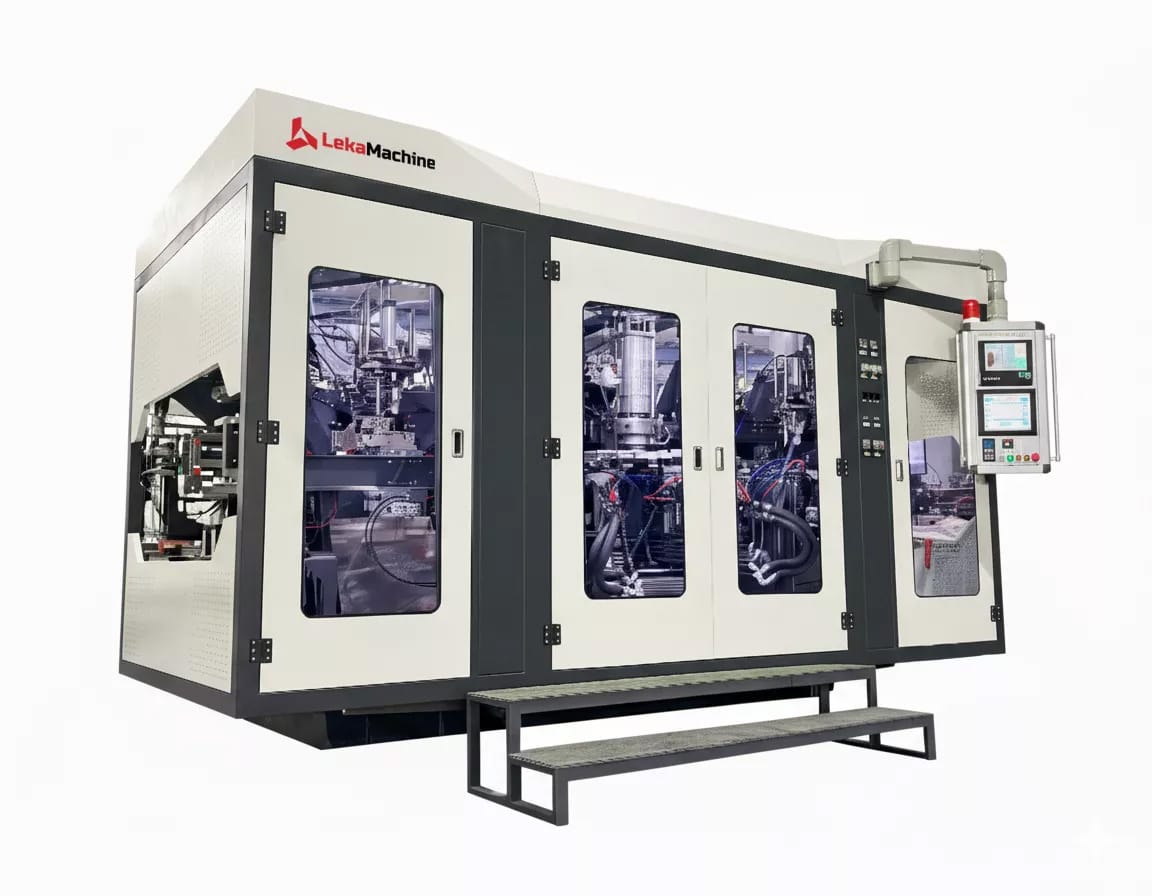
LEKA Machine focuses on blow molding equipment for PET, HDPE, and PP, including dedicated stretch blow molding machines for PET bottles.
The AQUA-type two-stage stretch Lekamachine are designed for typical beverage and water bottles in the 0.3–5 L range, with cavity options that match different output levels. They are built around stable heating, solid mechanical structure, and options for air recovery and energy saving.
You can learn more about the full lineup here: LEKA Machine Stretch Blow Molding Machines.
LEKA is not just a machine seller. The business model is to act as a full-supply-chain partner. That means helping you with factory layout, line integration, finding reliable preform suppliers, and full project management from your first call to your first successful production run.
Technical Specification Snapshot for a 500ml / 1L PET Blowing Machine
Here is a typical spec for a 4-cavity automatic PET blower suitable for 500ml and 1L projects:
- Rongga: 4
- Target Output (500ml): approximately 4,000–6,000 bottles per hour
- Bottle Volume Range: 100 ml – 2,000 ml
- Supported Neck Finishes: 28 mm – 38 mm
Required Utilities:
- High-Pressure Air: 30–40 bar (ask each supplier to specify m³/min clearly)
- Low-Pressure Air: 8–10 bar
- Chilled Water: 10–15 °C, with stable flow and pressure
Common Options:
- Air recovery system (often saves around 20% of high-pressure air)
- Vision inspection (for neck, thread, and body)
- Inline leak testing
Use this snapshot as a reference when you compare different quotations. It will help you see which numbers are realistic and which ones are only brochure-level.
Ready-to-Use RFQ Checklist for 500ml and 1L PET Bottle Projects
Before you ask for a quotation, have this information ready. It makes your RFQ clearer and your offers easier to compare:
- Your bottle drawings (500ml, 1L, and any other sizes you plan).
- Your preform drawings and weights.
- Target bottles per hour for each size.
- What you are filling: water, CSD, oil, juice, tea, or other products.
- Your available floor space and ceiling height.
- What filler you are connecting to, if any.
- Milikmu layanan and warranty expectations.
If you send this in the first email, you skip a lot of back-and-forth and usually get more accurate proposals from each supplier.
Watch: 500ml and 1L PET Blowing Machine Running in Production
A video is worth a thousand spec sheets. While every project is different, watching a real machine in action helps you imagine how it will look in your own factory.
Below is an example of an automatic PET bottle blowing line running water bottles:
When you watch the video, pay attention to three things:
- The smooth transfer of preforms into the oven – steady, controlled preform handling without jams or shocks.
- The fast, consistent cycle of the blowing station – molds opening and closing in a stable rhythm at speed.
- The smooth exit of finished bottles onto an air conveyor – bottles exiting without scuffing, crashing, or piling up.
Use the same lens when you review any supplier’s video. It often tells you more than a long list of numbers.
FAQ: PET Blowing Machine for 500ml and 1L Bottle Production
What output should I expect from a 4–8 cavity 500ml PET blowing machine?
A 4-cavity machine often delivers around 4,000–6,000 good 500ml bottles per hour. A 6–8 cavity unit can go significantly higher, as long as your filler and downstream equipment can match that speed.
How fast can I change over between 500ml and 1L bottles on the same machine?
With a clear procedure and trained team, 1.5–2 hours hot-to-hot is a realistic early target. With good quick-change tooling and practice, many plants reduce this further.
Can the machine handle lightweight bottles and high rPET content for 500ml water?
Yes, as long as preform quality is consistent and heating control is precise. A modern two-stage mesin cetak tiup regang with good oven zoning is designed for lightweight bottles and higher rPET content.
What compressor and chiller size do I need for a typical 500ml / 1L water line?
It depends on cavity count and target speed. Always ask each supplier to state high-pressure air and cooling demand at your target output, then add a safety margin when you size your utilities.
Is it better to buy just the PET blowing machine or a complete PET line?
If you already have a strong filler and packaging area, upgrading only the blower can make sense. For new plants, a complete line from a trusted integrator usually reduces risk and coordination headaches.
About the Author and Next Steps
About the author – Slany Cheung, Technical Sales Manager at LEKA Machine
My name is Slany Cheung, and I work as Technical Sales Manager at LEKA Machine, focusing on mesin cetak tiup ekstrusi and stretch blow molding machines for international OEMs and brand owners.
I spend my time visiting factories that produce PET and HDPE bottles, helping engineers define projects for 0.3–5 L bottles in water, edible oil, and home-care markets, and matching real-world requirements with practical machine configurations.
The goal is simple: help you choose equipment that you can live with for many years, not just impress you with one document.
How to request a 500ml / 1L PET bottle feasibility check and model recommendation
If you want a quick second opinion on your project, you can share your 500ml / 1L bottle drawings, send your current or target preform specs, and tell me your target net output and available utilities.
From there, you can receive a suitable two-stage PET blowing machine configuration, utility requirements and layout suggestions, and possible steps for lightweighting over time.
Simple next step
Prepare a short project brief with your product type (still water, CSD, juice, oil), 500ml and/or 1L bottle drawings, and target output per hour. Then request a proposal so you can see clearly what a PET blowing machine for 500ml and 1L bottle production would look like in your factory, on your floor, with your numbers.
::contentReference[oaicite:0]{index=0}


0 Komentar