

At our factory, we often see clients struggle with inconsistent bottle weights caused by invisible clamping issues. Ignoring uneven force distribution leads to high scrap rates 1 and wasted resin.
To verify uniform clamping force distribution, use Fuji Prescale film across the mold face to visualize pressure density. Alternatively, perform a "solder wire crush test" at the corners and center, or analyze real-time tie-bar strain gauge readings on the HMI to ensure variance remains under 5%.
Let’s look at the specific methods we recommend to ensure your machine isn't warping your profit margins.
Does the platen design minimize deflection under high pressure?
When we design our LEKA machines, we know that a weak platen ruins even the best mold. Don't let deflection destroy your output or damage your expensive tooling.
Platen deflection is minimized through "box" or "ribbed" casting structures verified by Finite Element Analysis (FEA). You should demand engineering reports showing center deflection stays under 0.05mm at full tonnage and verify parallelism dynamically using dial indicators on the moving platen edge under load.

The foundation of uniform force starts with the platen structure. If the platen bends, the force concentrates on the edges and disappears from the center.
Reviewing the FEA Report
Before you even touch the machine, ask to see the manufacturer's Finite Element Analysis (FEA) deflection maps. At our engineering department, we look for a "box" or heavily "ribbed" structure. Flat steel plates are not enough for high-tonnage applications. The report must prove that under maximum clamping load, the deflection at the center of the platen does not exceed 0.05mm. If it bows more than this, your bottles will have thick flash in the middle and potentially fail drop tests due to poor seam welding.
The "Loaded" Parallelism Test
Many buyers make the mistake of trusting a static parallelism check—measuring the distance between platens when the mold is open. This is deceptive. The real test happens under load.
We recommend a dynamic test:
- Mount dial indicators on the edge of the moving platen.
- Bring the machine to full clamping tonnage.
- Measure how much the structure shifts or "racks."
If the machine structure twists when pressure is applied, your clamping force will never be uniform, regardless of the motor size.
Tie-Bar Strain Analysis
Modern electric machines should monitor the strain on each tie bar. If the design is poor, the top two bars might take 60% of the load while the bottom two take 40%. This imbalance causes the platens to tilt.
| Feature to Check | Acceptable Standard | Warning Sign |
|---|---|---|
| Center Deflection | < 0.05mm at full tonnage | Flash is always thicker in the center of the mold. |
| Tie-Bar Balance | < 5% variance between bars | One tie bar consistently runs hotter or requires more grease. |
| Platen Structure | Box/Ribbed Cast Iron | Solid flat plate (prone to bowing). |
How can I check for consistent flash thickness across the mold?
In our testing center, we consider flash thickness the heartbeat of the machine. Irregular flash signals expensive trouble ahead and creates havoc for automated trimming systems.
Consistent flash thickness is verified by collecting 10 consecutive shots during a live run and measuring the neck, bottom, and handle areas. Significant thickness variation, such as paper-thin bottoms versus thick tops, indicates the clamping force is not uniformly counteracting the blowing pressure.

If you cannot access high-tech sensors, the product itself tells the story. Flash thickness is the most honest indicator of what is happening inside the machine.
servo motor 2
The Solder Wire Crush Test
This is a classic method we use during Factory Acceptance Tests (FAT). It is simple, cheap, and undeniably accurate.
- Preparation: Tape lengths of soft lead solder wire to the four corners of the mold parting line and one in the absolute center.
- Execution: Set the machine to clamp without blowing air. You do not want to inflate the bottle; you only want to crush the wire.
- Measurement: Open the mold and measure the flattened thickness of each wire with a micrometer.
Interpreting the Results:
Ideally, all five wires should have the same flattened thickness.
- Center is thicker: The platen is bowing (deflecting) outward. The force is good at the edges but weak in the middle.
- Top is thicker than bottom: The platens are not parallel vertically, or the toggle linkage is applying force unevenly.
- Diagonal variance: The machine structure is twisting.
Live Run Analysis
Solder wires test the "shut-off," but you also need to test against the blowing pressure. During a live run, collect 10 consecutive shots. Measure the flash thickness at the neck, handle, and bottom.
If the flash at the bottom is paper-thin (0.1mm) but the flash at the top is thick (0.4mm), the clamping force is not holding the mold shut against the air pressure at the top. This often leads to inconsistent bottle weights and "rocker bottoms" where the bottle won't stand flat.
Table: Diagnosing Flash Thickness Variations
| Observation | Likely Mechanical Issue | Operational Consequence |
|---|---|---|
| Thick Center Flash | Platen Deflection (Bowing) | Weak seam strength; bottle bursts on impact. |
| Thick Top / Thin Bottom | Vertical Misalignment | Neck calibration issues; air leaks during blowing. |
| Random Variation | Unstable Toggle Locking | Inconsistent bottle weights; high scrap rate. |
Is the toggle system designed to apply force evenly to all cavities?
We advise buyers to look past the motor brand and inspect the linkage geometry. Poor toggle design guarantees uneven force, especially in multi-cavity production lines.
parting lines 3
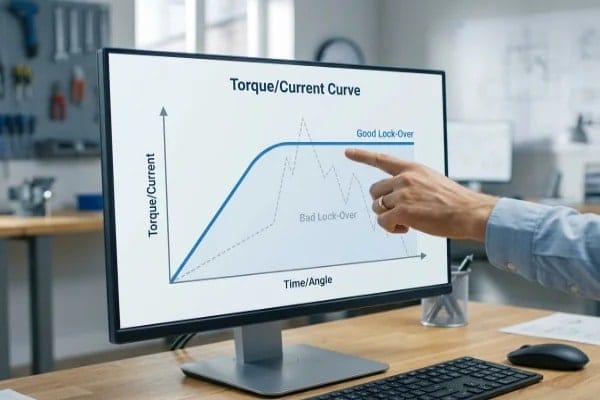
A well-designed toggle system applies force directly behind the mold center or uses a "scissor" mechanism to spread load, rather than relying on perimeter tie-bar tension. You can verify this by analyzing the servo "lock-over" current signature; jagged peaks indicate mechanical binding or non-parallel contact.
The toggle system is the muscle of the machine. In an all-electric machine, the servo motor drives this toggle. However, geometry determines where that force actually goes.
Factory Acceptance Tests (FAT) 5
Center-Press Architecture
We have found that the best designs use a "Center-Press" architecture. This means the final linkages push directly behind the mold area, or use a scissor design to distribute force across the platen face.
Avoid machines that rely solely on pulling the tie bars to create pressure. This "perimeter tension" method leaves the center of the mold unsupported. If you are running a 4-cavity mold, the inner two cavities will have weaker parting lines than the outer two.
Analyzing the Servo "Lock-Over" Curve
Because electric machines are driven by software, you can see the health of the mechanics on the screen. Ask the engineer to show you the Torque/Current Curve of the clamping motor during the lock-over phase.
- The Good Curve: It should be a smooth, steep rise that plateaus as the toggle locks.
- The Bad Curve: A "jagged" line or a double-peak signature. This indicates mechanical binding. It means the mold is hitting on one side first, forcing the toggle to twist before it snaps shut. This destroys molds over time.
Preventing Premature Mold Wear
Uneven toggle force wears out the "shut-off" edges of your mold. If the force is concentrated on the bottom left corner, that area of the mold steel will compress and degrade faster. Eventually, you will get flash in that corner even when the machine is set correctly. By verifying the toggle geometry and servo signature, you protect your mold investment.
Does the machine offer real-time clamping force monitoring?
At our factory, we believe you cannot manage what you cannot measure. Real-time data is the only way to catch issues early and prevent thousands of defective bottles.
strain 6
Modern electric machines must display real-time tonnage for each tie bar independently via the HMI. Look for features like "mold breathing" detection via high-resolution encoders and thermal expansion auto-compensation loops that adjust clamp position by microns as the mold heats up during production.

One of the biggest advantages of ALL electric machines over hydraulic ones is the ability to use data for quality control.
drop tests 8
Tie-Bar Strain Gauges
Does the HMI show one total number (e.g., "100 Tons") or four separate numbers? We strongly recommend machines that display individual tie-bar readings.
If the screen shows:
- Top-Left: 26 Tons
- Top-Right: 24 Tons
- Bottom-Left: 25 Tons
- Bottom-Right: 25 Tons
This is acceptable (balanced).
If it shows:
- Top-Left: 35 Tons
- Bottom-Right: 15 Tons
You have a serious diagonal twist. Without individual sensors, you would just see "100 Tons" total and never know why your bottles are crooked.
Finite Element Analysis (FEA) 9
Mold Breathing and Encoder Feedback
"Mold breathing" happens when the blowing pressure (8-10 bar) forces the mold open slightly—by microscopic amounts—during the cycle.
High-quality electric machines use the servo motor's high-resolution encoder to detect this position change. If the encoder sees movement after the lock is set, the machine should alert you. A rigid system with uniform force should show zero encoder movement during the blow phase.
Thermal Expansion Auto-Compensation
This is a feature we love. As you run the machine for 4 hours, the mold gets hot (40-60°C). Metal expands. If the machine does not adjust, the clamping force effectively increases, potentially crushing the mold vents or warping the platen.
Intelligent electric machines have an "Auto-Compensation" loop. The system detects the increased load and automatically backs off the clamp position by a few microns to maintain the exact set tonnage. This ensures the force distribution remains uniform from the first shot in the morning to the last shot at night.
Table: Essential Monitoring Features for Uniformity
| Feature | Function | Why It Ensures Uniformity |
|---|---|---|
| Individual Tie-Bar Monitoring | Measures strain on 4 bars separately. | Detects twisting or non-parallelism immediately. |
| Mold Breathing Detection | Uses servo encoder to detect separation. | Ensures force is sufficient to resist blow pressure everywhere. |
| Auto-Compensation | Adjusts position based on heat expansion. | Prevents over-clamping and platen warping over long shifts. |
Conclusion
Uniform clamping force prevents flash, saves resin 10, and protects your molds. By demanding FEA reports, performing the solder wire test, and using real-time monitoring, you ensure your machine delivers reliable profits.
Footnotes
1. Government resource on sustainable materials management and waste reduction. ↩︎
2. Technical documentation from a major servo manufacturer. ↩︎
3. Research publication overviewing mold design concepts. ↩︎
4. Official government standards for dimensional metrology and tools. ↩︎
5. General definition of this standard engineering validation process. ↩︎
6. Government standards body for force and strain calibration. ↩︎
7. Major manufacturer of precision measurement instruments. ↩︎
8. Official industry standard for drop impact resistance of blow-molded containers. ↩︎
9. Leading software provider explaining structural analysis technology. ↩︎
10. Major industry association representing the plastics supply chain. ↩︎


0 Comments