
At our facility, we know that inconsistent parison temperature is the silent killer of production yields. If you have ever battled "sawtooth" temperature cycling or struggled with uneven wall thickness, you understand that the barrel heating system is the heart of the machine. An unstable thermal profile leads to scrap, downtime, and frustration.
To determine precision, verify the PLC utilizes "Fuzzy Logic" PID control with solid-state relays for non-contact switching. Ensure the machine features at least one control zone for every 4–5 L/D of screw length, active air cooling fans, and mandatory cold-start interlocks to prevent screw damage.
Below, we break down the specific technical checkpoints you need to inspect to ensure your investment delivers consistent melt quality.
Does the PLC use advanced PID logic to prevent temperature overshoot?
When we calibrate our flight controllers and extruders, we often see older systems struggle with the thermal lag 1 inherent in large steel barrels. We look for a control system that anticipates heat rather than just reacting to it.
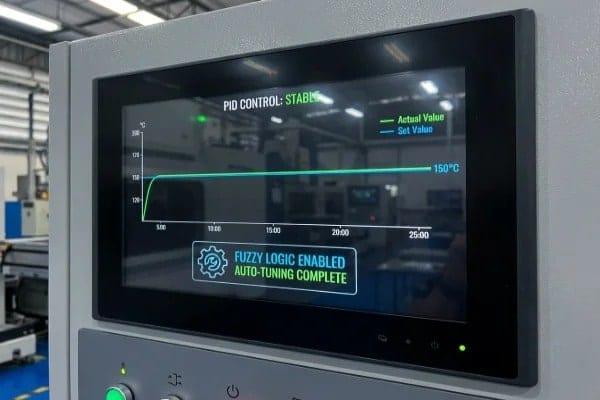
Advanced PLCs must employ "Auto-Tuning" with Fuzzy Logic algorithms to learn the barrel's thermal inertia. This prevents temperature overshoot by predicting heat trends. Additionally, verify the use of Solid State Relays (SSRs) for millisecond-speed switching, ensuring far tighter control than traditional magnetic contactors.
The Importance of "Self-Learning" Algorithms
Standard PID (Proportional-Integral-Derivative) control is often insufficient for extrusion blow molding 2 because of the massive thermal mass of the barrel. A standard controller reacts only after the temperature has deviated. In our engineering tests, we found that this causes a "sawtooth" wave pattern where the temperature constantly overshoots and undershoots the setpoint.
To ensure precision, you must verify the machine uses "Fuzzy Logic" or "Auto-Tuning" capabilities. This allows the PLC to "learn" the specific heating and cooling characteristics of the barrel sections. For example, the feed zone heats up differently than the metering zone. A smart controller adjusts its mathematical model to smooth out the curve, keeping the melt temperature stable within +/- 1 degree.
Solid State Relays (SSR) vs. Magnetic Contactors
The hardware switching the power is just as critical as the software controlling it. You should inspect the electrical cabinet to determine if the manufacturer uses Solid State Relays (SSRs).
- Magnetic Contactors: These are mechanical switches. They are slow, noisy, and wear out physically. Because they cannot switch rapidly, the temperature tends to drift significantly before the heater turns back on or off.
- Solid State Relays (SSR): These are electronic, non-contact switches. They can pulse heaters on and off in milliseconds. This allows for smooth, continuous power regulation (similar to a dimmer switch) rather than a crude on/off blast.
Comparison of Switching Technologies
| Feature | Solid State Relay (SSR) | Magnetic Contactor |
|---|---|---|
| Precision | High (Millisecond pulsing) | Low (Slow reaction) |
| Wear & Tear | None (No moving parts) | High (Mechanical contacts burn) |
| Temperature Stability | Excellent (+/- 1°C) | Poor (+/- 5°C or more) |
| Noise | Silent | Loud clicking sound |
If your potential machine uses magnetic contactors for barrel heating, it is not a precise "All Electric" standard machine.
Are the heater bands insulated to save energy and improve safety?
In our experience exporting to strict markets like Europe and North America, energy efficiency and operator safety are non-negotiable. Walking past a running extruder shouldn't feel like opening a furnace door.
High-precision machines utilize ceramic heater bands encased in thick thermal insulation jackets. This configuration is essential for energy efficiency, reducing power consumption by up to 30%. It also keeps the external surface temperature safe for operators, while preventing ambient airflow from destabilizing the barrel temperature.
The Critical Role of Active Cooling
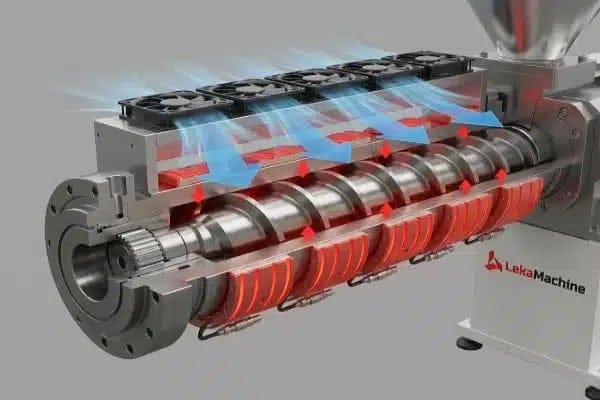
It is a common misconception that a heating system only needs to add heat. In reality, the rotating screw generates massive amounts of friction (shear heat). Once the machine is running at speed, the plastic can easily overheat even if the heaters are turned off completely.
solenoid valve 3
To verify controllability, inspect the barrel for Active Air Cooling.
- Look for high-velocity blowers paired with each heating zone.
- Check for "cast aluminum" finned heater bands designed to dissipate heat.
- The PLC must control these fans to actively remove excess shear heat to prevent material degradation. Without this, you lose control of the melt viscosity.
Runaway Temperature Safety
When we design our electrical schematics, we always account for component failure. SSRs, while precise, have a failure mode where they can fuse in the "Closed" (On) position. If this happens, the heater will run continuously until it burns out or damages the machine.
HMW-HDPE 4
You must ask the supplier about their "Watchdog" or Safety Loop. A precise system will have a secondary independent safety contactor. If the thermocouple reads a temperature exceeding a critical limit (e.g., 300°C), this safety circuit physically cuts the main power to the heaters, protecting your facility from fire risks and your machine from ruined barrel linings.
Energy Efficiency and Insulation
For an "All Electric" machine, efficiency is a primary selling point. Standard mica bands leak heat into the factory environment. We recommend and use ceramic heater bands with integrated thermal insulation jackets.
fire risks 5
Benefits of Insulated Jackets
| Benefit | Description |
|---|---|
| Energy Savings | Reduces heater energy consumption by 25-30% by retaining heat. |
| Startup Time | Faster startup times as less heat is lost to the air. |
| Safety | External surface remains touch-safe, preventing operator burns. |
| Process Stability | Protects the barrel from drafts (e.g., open doors, fans) that cause fluctuations. |
How many independent heating zones are there for precise profile control?
We have found that processing sensitive materials like HMW-HDPE or PCR (Post-Consumer Recycled) requires granular control over the melt. A "flat" temperature profile rarely yields the best bottle strength.
melt viscosity 6
A controllable system requires a specific "Zone Density," typically one independent control zone for every 4 to 5 L/D of screw length. Furthermore, look for dedicated, separate heating controls for the screen changer, adapter, and die head to ensure a uniform melt delivery without cold spots.
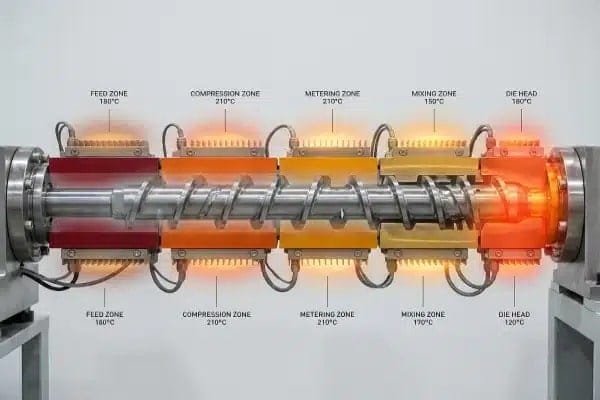
Assessing Zone Density (L/D Ratio)
The "Length to Diameter" (L/D) ratio determines how much processing length the screw has. A standard blow molding screw might be 24:1 or 30:1.
- If you have a long screw but only 3 heating zones, you cannot effectively control the transition from solid pellets to molten plastic.
- The Rule of Thumb: Look for one zone for every 4-5 L/D. For a 24:1 screw, you ideally want 5 barrel zones, plus the adapter and die head zones.
"Deep Well" vs. Surface Thermocouples
How the machine measures temperature is just as important as how it heats. When we inspect budget machines, we often see thermocouples just touching the outside surface of the heater band. This tells you the temperature of the heater, not the plastic.
thermal inertia 8
To determine precision, ask if the machine uses "Deep Well" or Bayonet Thermocouples. These sensors are spring-loaded and sit deep within a drilled well in the barrel wall, stopping just millimeters from the molten plastic. This provides a reading that reflects the actual processing condition of the material, not just the surface steel temperature.
Feed Throat Temperature Control
One often overlooked area is the feed throat—where the pellets enter the screw. If this area gets too hot, pellets melt prematurely and stick together, causing "bridging" which stops production.
- A precise system will have a dedicated water-cooled circuit for the feed throat.
- It should include a temperature sensor and a solenoid valve controlled by the PLC, not just a manual water tap that the operator has to guess at.
Recommended Zone Configuration
| Component | Minimum Zones (Standard) | Ideal Zones (Precision) | Reason |
|---|---|---|---|
| Barrel | 3 Zones | 5+ Zones | Allows precise "ramp" profiles (Feed -> Metering). |
| Screen Changer | 1 Zone | 1 Zone | Prevents pressure spikes due to cold metal. |
| Adapter/Neck | 1 Zone | 1 Zone | Maintains melt flow into the head. |
| Die Head | 1 Zone | 2-4 Zones | Complex heads need separate body and nozzle control. |
Does the system have cold-start protection to prevent screw damage?
The most expensive sound in a plastics factory is the "bang" of a screw snapping inside the barrel. We engineer strict logic into our machines to ensure that human error cannot destroy the most expensive component of the extruder.
solid-state relays 9
The system must feature a mandatory "Soak Timer" interlock logic. This physically prevents the screw from rotating until the barrel has maintained the setpoint temperature for a defined period, usually 20 minutes. This ensures the screw core is fully heat-soaked, preventing catastrophic metal failure.
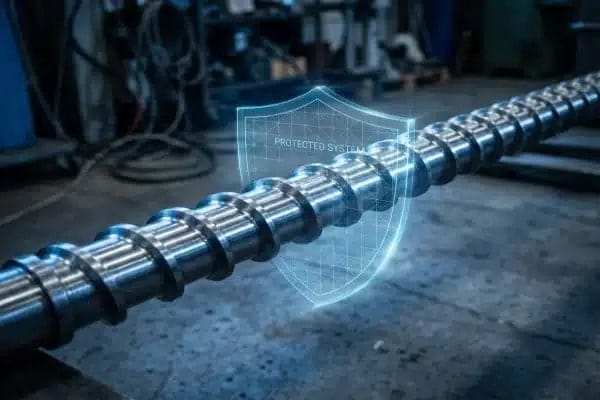
The Mechanics of Cold Start Damage
Why is this necessary? Even if the thermocouple reads 190°C, that might only be the temperature of the steel barrel wall. The screw inside, and the plastic packed around it, may still be solid or semi-solid.
- If an operator tries to turn the screw before the core is heated, the torque will exceed the metal's yield strength.
- The Solution: A "Soak Timer." Once the zones reach the setpoint, a countdown timer (e.g., 20 or 30 minutes) must start. The PLC acts as a gatekeeper—it simply will not allow the motor to turn on until that timer hits zero.
Current Monitoring for Maintenance
Beyond protection, a smart heating system helps with maintenance. High-end controllers utilize Amperage (Current) Monitoring.
- The system monitors the electrical draw of every individual heater band.
- If a heater band burns out, the amperage drops to zero.
- Instead of waiting for the temperature to drop and producing bad bottles, the HMI triggers a specific alarm: "Zone 3 Heater Failure."
- This allows your maintenance team to replace the specific band immediately, often before product quality is affected.
Analyzing the Logic
When evaluating a machine, ask to see the "Alarms and Safety" screen on the HMI. Look for these specific settings:
- Low Temperature Lockout: Prevention of motor start if temp is < Setpoint – X degrees.
- Soak Time Delay: Adjustable timer ensuring heat saturation.
- Sensor Break Protection: If a thermocouple wire breaks, the system should shut down that zone's heater (fail-safe) rather than assuming it is cold and applying 100% power (which causes overheating).
Conclusion
Determining the precision of a barrel heating system requires looking beyond simple temperature displays. You must verify the presence of Fuzzy Logic PID control, active cooling, proper zone density, and safety interlocks. These features separate a machine that merely melts plastic from one that guarantees consistent, profitable production for years to come.
Footnotes
1. Explains the physics behind why heating large steel barrels requires advanced predictive control systems. ↩︎
2. Provides an overview of the primary manufacturing process the article is discussing for context. ↩︎
3. Defines the electromechanical component used in the feed throat cooling circuit described. ↩︎
4. Wikipedia link for the specific high-molecular-weight material mentioned as sensitive to temperature. ↩︎
5. Relates industrial safety and thermal runaway to broader environmental safety and risk management. ↩︎
6. Technical definition of the fluid property affected by temperature control in plastic manufacturing. ↩︎
7. Connects industrial power consumption to broader global sustainability and environmental health goals. ↩︎
8. Scientific context for how the barrel’s material properties affect temperature regulation and overshoot. ↩︎
9. Provides technical background on the electronic switching component mentioned as critical for precision control. ↩︎
10. Corrected malformed URL to valid Wikipedia article ↩︎


0 Comments