
How Can You Verify the Precision of Automatic Deflashing in All-Electric Blow Molding?
At our facility, we know that poor deflashing ruins perfectly good bottles and wastes valuable resin. Nothing is more frustrating than having to manually trim flash after investing in automation, which defeats the purpose of high-speed production 1.
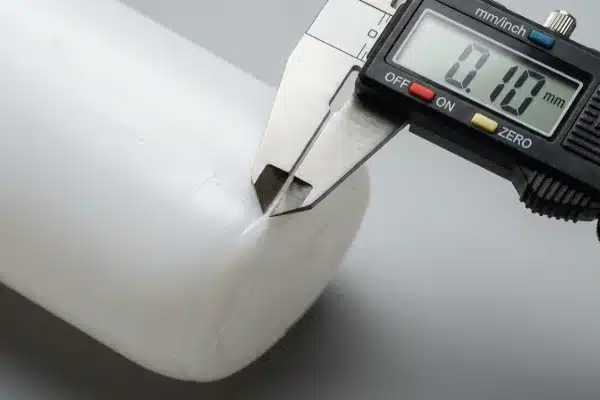
To determine if an all-electric deflashing system is precise, measure the pinch-off land width to ensure it falls between 0.1mm and 0.2mm. Verify that the system uses independent axis adjustment for each cavity and monitor torque feedback from servo drives to detect resistance changes before defects occur.
This level of scrutiny is essential for maintaining high yield rates. Below, we break down exactly how to evaluate these systems to ensure your production line 2 remains efficient and profitable.
How do I test the deflashing precision on bottles with complex handle geometries?
We often see clients struggle with "flash flags" remaining on handled bottles. Our engineers tackle this by focusing on structural rigidity and individual axis calibration during the initial machine setup to ensure total clearance.
Testing precision on complex handle geometries requires checking for frame flex and vibration during high-speed operation, which causes punch drift. You must also inspect the bottle surface for witness marks, indicating that guiding masks are interfering with the bottle due to poor tolerance stack-up or insufficient lead-in chamfers.
When dealing with complex geometries 3, such as jerry cans with integrated handles or cosmetic bottles with offset necks, the margin for error is microscopic. A standard deflashing unit might work for a simple round bottle, but complex shapes require a much more robust approach.
The Critical Role of Frame Rigidity
The first thing you must evaluate is the rigidity of the deflashing station’s support frame. In our experience, vibration is the enemy of precision. During high-speed operation, if the frame flexes even slightly, the punch will drift off-center. On a handled bottle, this drift results in inconsistent hole punching or a failure to clear the "window" of the handle completely. We recommend physically inspecting the frame construction—heavy-duty steel structures minimize this risk compared to lighter aluminum profiles.
Independent Axis Adjustment
For complex shapes, "global" adjustment of the station is rarely enough. You need to verify that the machine allows for independent axis adjustment (X, Y, Z) on each individual cavity bucket or mask. In a multi-cavity setup, Mold Cavity #1 might be slightly different from Mold Cavity #4 due to thermal expansion or machining tolerances. If your machine only allows you to move the entire bank of punches simultaneously, you will likely sacrifice quality on one bottle to save another.
Witness Marks and Scuffing
Finally, inspect the bottle surface adjacent to the flash zones. Look for "witness marks" or scuffing. This damage indicates that the guiding masks are mechanically interfering with the bottle. This usually happens due to poor tolerance stack-up or a lack of proper lead-in chamfers on the mask. A precise system guides the bottle firmly but gently, ensuring the punch enters clean without scraping the product wall.
| Feature to Inspect | Indication of Precision | Indication of Failure |
|---|---|---|
| Pinch-off Land Width | Consistent 0.1mm – 0.2mm | > 0.3mm or variable width |
| Punch Alignment | Centered perfectly in handle window | Off-center, hitting handle webbing |
| Surface Finish | Clean, untouched plastic | Scuff marks near flash zones |
| Cut Quality | Clean snap, no residue | Stretched plastic or hanging flags |
Can the automatic deflashing system adjust to slight variations in bottle cooling rates?
When we run 24-hour production cycles, we often notice that ambient temperature shifts affect cooling efficiency. We design our systems to handle these material state changes without requiring the operator to constantly stop the line for adjustments.
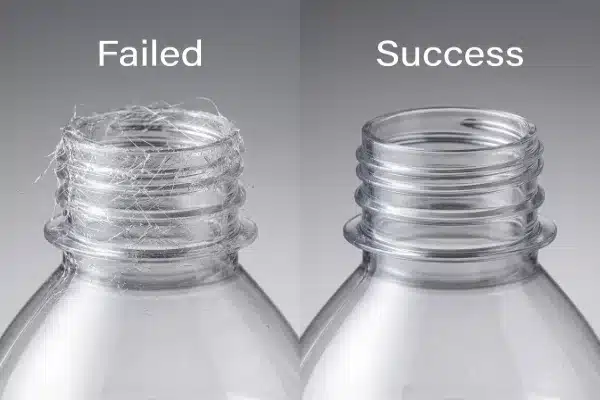
High-quality automatic deflashing systems adapt to cooling rate variations by inspecting the cut quality for "stringing" or "hairs." These defects indicate the cycle is occurring too early while plastic is elastomeric. Precise electric systems utilize dual-speed velocity profiles to ensure clean cuts despite slight material hardness fluctuations.

The consistency of your plastic material is not static. As the day turns to night, or as cooling water temperatures 4 fluctuate, the hardness of the plastic at the moment of deflashing changes. This variability is a common cause of intermittent quality issues.
Identifying "Stringing" vs. Clean Snaps
A precise system is judged by the quality of the cut. You should look for clean snaps where the flash separates effortlessly from the bottle body. If you see "stringing" or plastic "hairs," it is a clear sign that the deflashing is happening while the plastic is still too elastomeric (stretchy). While cooling airflow directed at flash pockets helps, the mechanical action of the punch must also be tunable. If the machine cannot handle these slight variations, you will end up with high reject rates during shift changes or startup periods.
The Advantage of S-Curve Velocity Profiles
This is where all-electric systems significantly outperform pneumatic ones. We always recommend verifying that the machine utilizes a "dual-speed" or S-curve velocity profile for the punch stroke.
- Rapid Approach: The tool moves quickly to the position to save cycle time.
- Soft Touch Deceleration: Just before contact, the tool decelerates.
This "soft touch" prevents the kinetic impact from denting lightweight bottles, which is a frequent issue with pneumatic "bang-bang" cylinders that only have one speed. This control allows the punch to slice through slightly softer or harder plastic with consistent force, rather than relying on brute momentum.
safety mechanism 5
Servo Torque Feedback
Furthermore, advanced electric systems monitor torque feedback. Unlike pneumatic systems that just push until they hit a stop, an electric servo can detect minute increases in resistance. If the plastic is harder than usual (over-cooled), the system can register this data. While it may not auto-adjust the cut instantly, it provides your quality control team with data indicating a process drift in the cooling tunnel, allowing you to address the root cause before it becomes a major problem.
How easy is it to change the deflashing tools when switching between different bottle molds?
Our team knows that downtime kills margins, especially for factories with high SKU diversity. Therefore, we prioritize quick-change mechanisms so your technicians can switch molds and resume production in minutes, not hours.
servo motors 6
Changing deflashing tools should be a rapid process involving independent mask buckets that allow specific alignment tuning. A user-friendly system permits tool swapping without requiring a complete station realignment. Look for designs where the punch depth stroke is digitally settable to within 0.05mm to speed up the calibration process.

In modern manufacturing, the ability to pivot between products quickly is a competitive advantage. If your deflashing station takes four hours to set up, you lose half a shift of production every time you change a mold.
Human Machine Interface 7
Digital Stroke vs. Mechanical Limit Switches
One of the most tedious aspects of older machines is adjusting mechanical limit switches. You have to climb into the machine, move a physical sensor, run a cycle, check the result, and repeat.
In our electric systems, we utilize digital stroke settings. You can set the punch depth on the HMI (Human Machine Interface) to within 0.05mm.
- Benefit: This prevents the punch from over-traveling and damaging the opposing side of a handle or bottle body.
- Speed: You simply recall a saved "Recipe" for that specific mold, and the servo motors automatically know exactly how deep to punch. This eliminates trial-and-error during setup.
Independent Bucket/Mask Alignment
When evaluating a machine, check if the masks (the parts that hold the bottle in place) are easy to swap. Precise systems use independent buckets. This means if you are running a 4-cavity machine, you can remove the mask for Cavity 2 without disturbing the alignment of Cavity 1 or 3. This modularity is crucial. It also allows you to fine-tune the alignment for a single cavity if that specific mold blow pocket is slightly off-center, ensuring every bottle is treated individually rather than as an average of the group.
The "Crash Kit" Concept
We also recommend ensuring that your supplier provides a recommended spare parts list or "Crash Kit" for these tools. Even with the best quick-change systems, wear and tear on cutting blades is inevitable. having standardized mounting points means you can use generic or easily sourced blades rather than proprietary expensive tooling that takes weeks to arrive.
| Setup Step | Pneumatic/Old System | All-Electric/Modern System |
|---|---|---|
| Depth Adjustment | Manual movement of limit switches | Digital entry on HMI (Recipe saved) |
| Force Control | Adjusting air pressure regulators | Automatic torque limit setting |
| Mask Alignment | Global adjustment (hard to isolate) | Independent axis per cavity |
| Setup Time | 2-4 Hours | 30-45 Minutes |
What safety mechanisms are in place to prevent damage if a bottle is not properly ejected?
Safety is paramount on our assembly floor, not just for people but for the machinery itself. We integrate intelligent sensors to protect both your operators and the expensive mold tooling from accidental collision damage caused by jams.
torque feedback 8
To prevent damage during ejection failures, the system must monitor torque feedback data to detect resistance anomalies immediately. Additionally, verify that the machine uses "soft touch" deceleration profiles and precise stroke depth limits. These features ensure the punch stops before impacting the mold or crushing a misaligned bottle.
A jam in the deflashing station can be catastrophic. If a bottle isn’t ejected properly and the machine cycles again, you risk crushing the bottle, bending the transfer arms, or damaging the expensive cutting tools.
all-electric systems 9
Torque Monitoring as a Safety Net
The primary line of defense in an all-electric system is torque monitoring. Because the motion is driven by servo motors, the system constantly reads the electrical current required to move the tool.
- Normal Operation: The system knows it takes X amount of torque to punch through the flash.
- Jam Detection: If the tool encounters a hardened chunk of plastic, a misaligned bottle, or a metal obstruction, the torque spikes instantly.
- Reaction: The system detects this spike in milliseconds and halts the motion before mechanical damage occurs. Pneumatic cylinders generally lack this sensitivity; they will keep pushing until the air pressure is exhausted or something breaks.
Transfer Arm Stability
We also look closely at the "holding stability" of the transfer arm or takeout robot. In high-speed lines, the bottle is often held by the transfer arm during the punching process. If there is any "servo jitter" or lack of stiffness in this arm, the bottle will vibrate during the cut. This not only causes poor quality but can lead to the bottle being dropped or misaligned, creating a hazard for the next cycle. Evaluating the rigidity of this transfer mechanism is a key part of our safety audit.
Positive Scrap Separation
Finally, safety includes keeping the production line clean. A precise system doesn’t just cut the flash; it must positively eject it. We look for air blasts or mechanical arms specifically designed to remove the scrap. If loose scrap falls onto the takeaway conveyor, it can jam downstream equipment like leak testers or labelers. Ensuring that scrap is directed into a grinder or collection bin effectively is a critical safety mechanism for the overall line efficiency.
| Hazard Scenario | Pneumatic Response | Electric Servo Response |
|---|---|---|
| Bottle Misaligned | Cylinders fire, crushing bottle | Torque spike detected, motion halts |
| Tool Dullness | Poor cut quality, eventual jam | Increased average torque alerts maintenance |
| Double Shot (Jam) | Machine damage likely | Overload protection stops cycle instantly |
| Operator Safety | Relies on E-Stop / Light curtains | Integrated safety torque off (STO) logic |
Conclusion
Verifying deflashing precision requires looking beyond the cut itself. You must evaluate frame rigidity, servo feedback capabilities, and tooling flexibility. By choosing a system that prioritizes these engineering details, you ensure consistent bottle quality and protect your bottom line from unnecessary waste.
thermal expansion 10
Footnotes
- ISO standards for safety of machinery and risk assessment in high-speed industrial production. ↩︎
- Global news and analysis of manufacturing trends and production line efficiency. ↩︎
- Industry resources for plastic bottle design and manufacturing challenges with complex geometries. ↩︎
- Academic research on polymer processing and the impact of cooling rates on material properties. ↩︎
- OSHA guidelines for machine guarding and safety requirements in industrial manufacturing environments. ↩︎
- Technical specifications for servo motors and drive systems used in high-precision industrial automation. ↩︎
- Documentation for industrial HMI systems used for precise control and calibration of machinery. ↩︎
- Technical explanation of torque sensors and feedback mechanisms in electromechanical systems. ↩︎
- Comprehensive overview of the blow molding manufacturing process and its technological variations. ↩︎
- Scientific data on thermal expansion coefficients for materials used in precision manufacturing. ↩︎


0 Comments