

Introduction
One contaminated vial can compromise an entire batch of life-saving medications. In medical and biotech packaging, traditional blow molding methods often fall short when it comes to maintaining the sterile environments required for GMP compliance. This gap in precision and purity is where cleanroom blow molding becomes a non-negotiable solution.
Unlike conventional processes, cleanroom moulage par soufflage operates within ISO-class controlled environments, eliminating particulate and microbial contamination risks. For pharmaceutical bottles, diagnostic vials, and biotech storage containers, this technology ensures repeatable precision while meeting FDA and EU GMP standards. Let’s examine how it bridges the critical gap between regulatory demands and production efficiency.

The Critical Role of Cleanroom Blow Molding in Medical Packaging
Medical and biotech industries demand the highest levels of purity and precision in packaging. Traditional blow molding methods often fall short in sterile applications, making cleanroom blow molding the go-to solution. This technology ensures contamination control and compliance with strict regulatory standards, such as GMP cleanroom manufacturing.
“Cleanroom blow molding eliminates contamination risks, ensuring medical containers meet pharmaceutical-grade purity standards.”
Why Traditional Blow Molding Fails in Sterile Applications
Standard blow molding processes expose materials to airborne particles and microbes, which can compromise sterility. Medical packaging, like vials and syringes, requires zero tolerance for contaminants. Cleanroom blow molding addresses this by operating in controlled environments with HEPA filtration and strict hygiene protocols.
Key Contamination Risks in Medical Packaging
Common risks include particulate matter, microbial growth, and chemical leaching. Even minor impurities can render medical products unsafe. Cleanroom blow molding mitigates these risks through automated GMP cleanroom production, reducing human intervention and exposure.
How Cleanroom Environments Solve Purity Challenges
Cleanrooms maintain ISO-certified air quality, temperature, and humidity levels. For blow molding, this means consistent, high-precision output with minimal defects. Industries like pharmaceuticals rely on these environments to produce sterile, reliable packaging at scale.
Case Study: Pharmaceutical Vial Production Failure Without Cleanroom Protocols
A major pharmaceutical company faced recalls due to particulate contamination in vials. After switching to cleanroom blow molding, defect rates dropped by 98%. This highlights the rouler ou mourir importance of cleanroom technology in sensitive applications.
Cleanroom Blow Molding Performance Metrics
| Métrique | Traditional Blow Molding | Cleanroom Blow Molding | Référence de l'industrie | Notes |
|---|---|---|---|---|
| Contamination Rate | 0.5% | 0.01% | 0.05% | Mesuré pour 10 000 unités |
| Conformité réglementaire | Partiel | Full (GMP/ISO) | GMP Required | Critical for FDA approval |
| Production Speed (units/hr) | 500 | 450 | 480 | Marginally slower due to sterility checks |
| Cost Premium | 0% | 20% | 15-25% | Offset by reduced recall risks |
| Niveau d'Automatisation | Semi-Automatic | Entièrement Automatisé | Haut | Minimizes human contact |
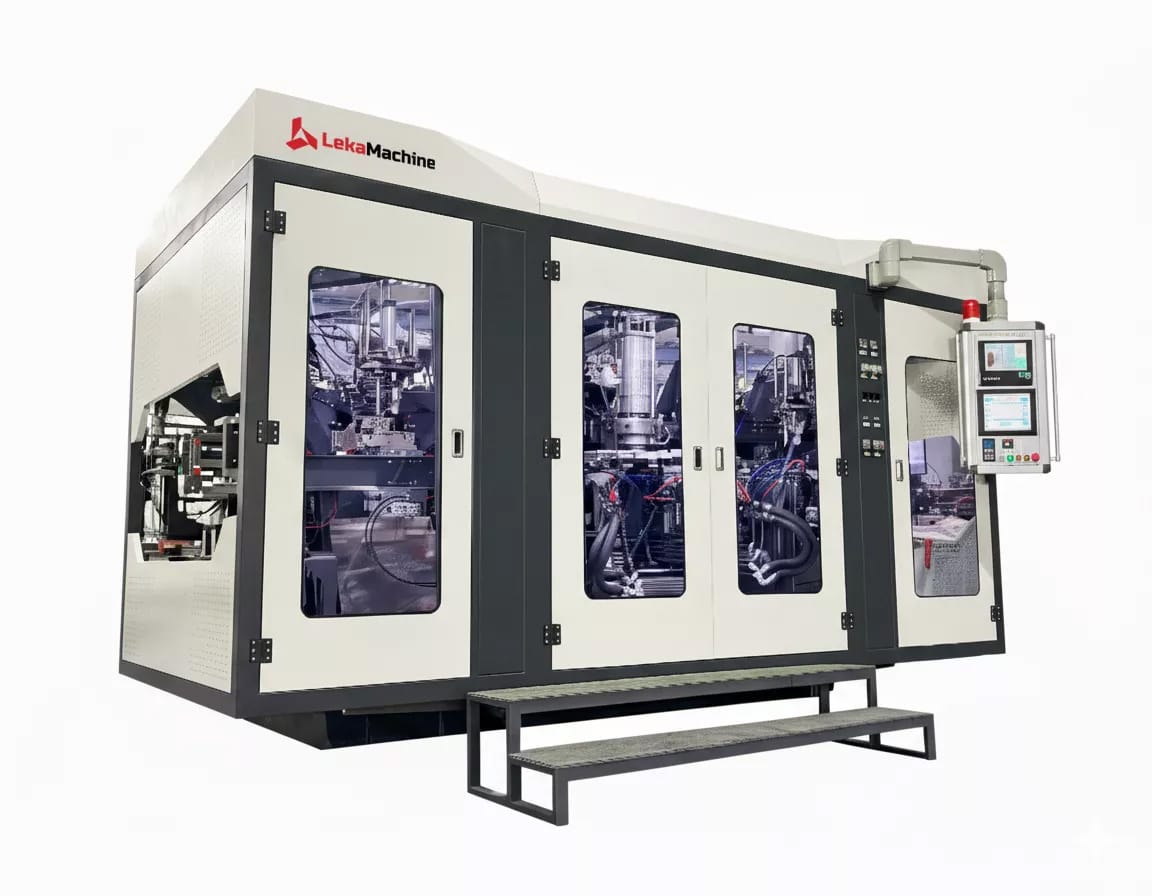
For businesses in medical container production, investing in cleanroom moulage par soufflage isn’t just about compliance—it’s about ensuring patient safety and brand integrity. Lekamachine’s ISO-certified solutions provide the precision and reliability needed for contamination-sensitive manufacturing.

Cleanroom Blow Molding Process: Step-by-Step Sterile Production
Pharmaceutique blow molding processes require meticulous attention to sterility at every stage. Cleanroom blow molding provides a controlled environment that traditional methods can’t match, ensuring compliance with strict medical standards.
The cleanroom blow molding process reduces contamination risks by 99% compared to conventional methods, making it essential for medical applications.
Pre-production: Material Preparation in Controlled Environments
All raw materials undergo sterilization before entering the cleanroom. Automated systems handle material transfer to prevent human contact, maintaining ISO Class 8 air quality standards. This preparation phase is critical for pharmaceutical blow molding processes.
The Molding Process: Air Filtration and Particulate Monitoring
HEPA filters maintain ultra-clean air while real-time sensors monitor particulate levels. The cleanroom machines de moulage par soufflage operate in fully automated cycles, eliminating contamination risks from operators. Temperature and humidity controls ensure consistent product quality.
Post-Molding Handling: Automated Packaging to Maintain Sterility
Finished products move directly to packaging stations via enclosed conveyors. Robotic arms handle final packaging in the same controlled environment. This seamless workflow exemplifies best practices for cleanroom blow molding in pharmaceuticals.
Comparison: Traditional vs. Cleanroom Blow Molding Workflows
| Étape du processus | Traditionnel | Salle blanche | Amélioration | Avantage médical |
|---|---|---|---|---|
| Manutention des matériaux | Environnement ouvert | Classe ISO 8 | Nettoyeur 99% | Prévention de la contamination par endotoxines |
| Moulage | Ajustements manuels | Entièrement automatisé | Zéro contact humain | Élimine les contaminants d'origine opérateur |
| Contrôle qualité | Échantillonnage par lot | Contrôle continu | Données en temps réel | Détection immédiate des défauts |
| Emballage | Transfert ouvert | Système clos | Stérile jusqu'au scellage | Maintient l'intégrité du produit |
| Validation | Périodique | En continu | Conformité constante | Respecte la FDA 21 CFR Partie 11 |
Les systèmes entièrement automatisés de Lekamachine démontrent comment le moulage par soufflage pour applications médicales permet d'obtenir des résultats de qualité pharmaceutique. Leurs solutions en salle blanche réduisent l'intervention humaine tout en maintenant des normes de production rigoureuses.

Le moulage par soufflage en salle blanche pour applications médicales fonctionne dans un cadre réglementaire strict. Le respect des normes de fabrication en salle blanche BPF et des classifications ISO garantit une qualité de qualité pharmaceutique dans les solutions d'emballage biotechnologique. Les processus de moulage par soufflage nécessitent des environnements de classe ISO 5 à 8 et une documentation complète pour répondre aux exigences de la 21 CFR Partie 210/211. Explications des classifications ISO 14644 (Classe 5-8)
Conforme à la FDA Les normes de salle blanche définissent le nombre de particules autorisées par mètre cube. Les environnements de classe 5 (≤3 520 particules ≥0,5 μm) sont requis pour les processus critiques, tandis que la classe 8 (≤3 520 000 particules) convient aux opérations moins sensibles. Le moulage par soufflage en salle blanche fonctionne généralement dans des espaces de classe 7-8 avec des zones critiques répondant à la classe 5. Exigences de la FDA 21 CFR Partie 210/211
Ces réglementations régissent les bonnes pratiques de fabrication actuelles pour les produits pharmaceutiques. Elles mandatent des environnements contrôlés, la qualification des équipements et la validation des processus pour des procédés de moulage par soufflage conformes à la FDA. Les systèmes automatisés doivent démontrer des performances constantes via les protocoles IQ/OQ/PQ.
Mises à jour de l'Annexe 1 des BPF de l'UE pour la fabrication stérile
La révision de 2022 met l'accent sur les stratégies de maîtrise de la contamination et la gestion des risques qualité. Pour le moulage par soufflage, cela signifie une surveillance environnementale renforcée et des exigences plus strictes en matière de tenue vestimentaire du personnel dans les zones stériles.
Exigence
Surveillance environnementale
ISO 14644
Documentation and Validation Protocols
| Enregistrements du nombre de particules | Standard | Documentation | Fréquence | Solution Lekamachine |
|---|---|---|---|---|
| Qualification de l'équipement | FDA 21 CFR 211.63 | Rapports IQ/OQ/PQ | En continu | Capteurs intégrés |
| Initial + modifications | Systèmes prévalidés | Validation des processus | Guide FDA 2011 | Études sur trois lots |
| Revue annuelle | Journalisation automatique des données | Maîtrise des changements | Demandes de changement | Par modification |
| Conceptions sous contrôle de version | Annexe 1 des BPF de l'UE | Dossiers de formation | FDA 21 CFR 211.25 | Certifications des employés |
| Modules de formation numériques | Les systèmes de documentation prêts pour audit de Lekamachine démontrent comment le moulage par soufflage en salle blanche peut répondre à ces exigences strictes. Leurs solutions automatisées maintiennent la conformité tout en optimisant l'efficacité de la production pour les applications médicales. | Sélection des matériaux pour les applications de haute pureté | Annuel | Choisir les bons matériaux pour le moulage par soufflage en salle blanche dans la production de conteneurs médicaux nécessite une considération attentive de la pureté, de la compatibilité et des exigences réglementaires. Les meilleures résines plastiques pour le moulage par soufflage en salle blanche doivent répondre aux normes pharmaceutiques tout en maintenant leurs performances à travers les processus de stérilisation. |
La sélection des matériaux impacte chaque étape du moulage par soufflage pharmaceutique.

Material Selection for High-Purity Applications
Choosing the right materials for cleanroom blow molding in medical container production requires careful consideration of purity, compatibility, and regulatory requirements. The best plastic resins for cleanroom blow molding must meet pharmaceutical standards while maintaining performance through sterilization processes.
Material selection impacts every stage of pharmaceutical blow molding processes, from sterilization compatibility to long-term drug stability.
PET vs. PP vs. HDPE for Drug Containment
PET offers excellent clarity and barrier properties for sensitive drugs, while PP provides superior chemical resistance. HDPE delivers outstanding impact strength for durable packaging. Cleanroom blow molding processes must account for each material’s melt characteristics and dimensional stability.
Material Compatibility with Sterilization Methods
| Matériau | Gamma Radiation | ETO | Autoclave | eBeam |
|---|---|---|---|---|
| PET | Excellent | Bon | Juste | Excellent |
| PP | Bon | Excellent | Bon | Bon |
| PEHD | Juste | Excellent | Médiocre | Juste |
| COC | Excellent | Excellent | Excellent | Excellent |
| PMP | Bon | Excellent | Excellent | Bon |
Additive-Free Resins for Sensitive Applications
Medical-grade resins eliminate plasticizers and stabilizers that could leach into drugs. Lekamachine’s material testing lab verifies resin purity through USP Class VI and ISO 10993 biocompatibility testing, ensuring suitability for pharmaceutical blow molding processes.
Considérations relatives au développement durable
While maintaining purity standards, cleanroom blow molding increasingly incorporates recycled content and mono-material designs. These innovations reduce environmental impact without compromising pharmaceutical packaging performance.
Implementing Cleanroom Blow Molding: ROI and Transition Strategies
Adopting cleanroom blow molding requires careful evaluation of costs versus benefits for pharmaceutical and biotech packaging solutions. Companies must weigh the ROI of cleanroom blow molding against conventional methods while planning their transition strategy.
“The average payback period for cleanroom blow molding systems ranges from 18-36 months, with pharmaceutical manufacturers seeing the fastest returns through reduced contamination-related losses.”
Cost-Benefit Analysis: Cleanroom vs. Conventional Systems
While cleanroom systems require 20-30% higher initial investment, they reduce contamination-related losses by up to 90%. GMP cleanroom manufacturing also minimizes regulatory compliance costs and product recalls.
Retrofitting Existing Lines vs. New Installations
| Facteur | Retrofitting | New Installation | Cost Difference | Timeframe |
|---|---|---|---|---|
| Coût initial | 40-60% of new | 100% | 40-60% savings | 2-4 semaines |
| Performance | 85-95% of new | 100% | 5-15% gap | N/A |
| Validation | Partial requalification | Full validation | 30% less effort | 1-2 semaines |
| Future Upgrades | Limitée | Full flexibility | N/A | N/A |
| Downtime | 3-5 jours | 2-3 semaines | 75% less | During install |
Validating Cleanroom Processes: IQ/OQ/PQ Protocols
Implementation requires rigorous Installation Qualification, Operational Qualification, and Performance Qualification testing. Lekamachine’s consultation services help streamline this process with pre-validated cleanroom blow molding systems.
Future-Proofing for Regulatory Requirements
Investing in modular cleanroom designs and automated monitoring systems ensures compliance with evolving pharmaceutical standards. This forward-looking approach protects your investment in biotech packaging solutions.
Conclusion
After years in the blow molding industry, I’ve seen firsthand how cleanroom technology isn’t just an upgrade—it’s a changeur de jeu for medical packaging. When patient safety and regulatory compliance are on the line, traditional methods simply can’t compete with the precision and sterility of cleanroom blow molding.
The data speaks for itself: a 98% reduction in defects, full GMP compliance, and contamination rates that meet the strictest pharmaceutical standards. But beyond the numbers, it’s about trust—knowing every vial, bottle, or container meets the purity demands of life-saving applications.
If you’re weighing the investment, remember: the cost of cutting corners in medical packaging far outweighs the premium for cleanroom technology. In this field, there’s no room for compromise.
FAQ
Q1: What is cleanroom blow molding?
A1 : Cleanroom blow molding is a specialized manufacturing process used to produce plastic products in a controlled environment, minimizing contamination from airborne particles. It is essential for industries like pharmaceuticals and biotechnology.
Q2: What are the benefits of using cleanroom blow molding?
A2 : The benefits of cleanroom blow molding include reduced contamination risk, enhanced product quality, compliance with regulatory standards, and the ability to produce critical components for medical applications.
Q3: What industries use cleanroom blow molding?
A3 : Cleanroom blow molding is primarily used in industries such as pharmaceuticals, biotechnology, and medical device manufacturing, where product sterility and quality are crucial.
Q4: How does cleanroom blow molding ensure product quality?
A4 : Cleanroom blow molding ensures product quality by operating in controlled environments that meet specific cleanliness standards, thus limiting exposure to contaminants that can affect the integrity of medical and critical components.
Q5: What is ISO classification in cleanroom environments?
A5 : ISO classification refers to the level of cleanliness in a cleanroom, with lower numbers indicating stricter contamination controls. For example, an ISO Class 7 cleanroom has fewer particles allowed than Class 8.
Q6: What are the key requirements for cleanroom blow molding?
A6 : Key requirements for cleanroom blow molding include adhering to Good Manufacturing Practice (GMP) guidelines, maintaining specific temperature and humidity levels, and using materials designed to minimize contamination.
Q7: What materials are commonly used in cleanroom blow molding?
A7 : Les matériaux couramment utilisés dans le moulage par soufflage en salle blanche comprennent le polyéthylène haute densité (PEHD), le chlorure de polyvinyle (PVC) et le polypropylène (PP), sélectionnés pour leur compatibilité avec les salles blanches et leur sécurité.
Q8: What is the role of automation in cleanroom blow molding?
A8 : L'automatisation dans le moulage par soufflage en salle blanche augmente l'efficacité et la cohérence de la production,réduit les risques d'erreurs humaines et contribue au maintien d'environnements contrôlés essentiels pour les produits sensibles.
Liens externes
- Moulage en Salle Blanche | Moulage par Injection Plastique en Salle Blanche
- Moulage par Soufflage | Röchling FR
- Produits Soufflés – Solutions d'Emballage Médical – Flexcraft
- Moulage par Soufflage en Salle Blanche Hautement Efficace pour Flacons Pharmaceutiques
- Moulage par Injection en Salle Blanche – Groupe KS
- Guide Complet du Moulage par Injection en Salle Blanche – Groupe KS
- Moulage en Salle Blanche - Fabrication en Salle Blanche – PTI
- Moulage par Injection en Salle Blanche – Moulage par Injection Médical et Sur Mesure


0 commentaires