
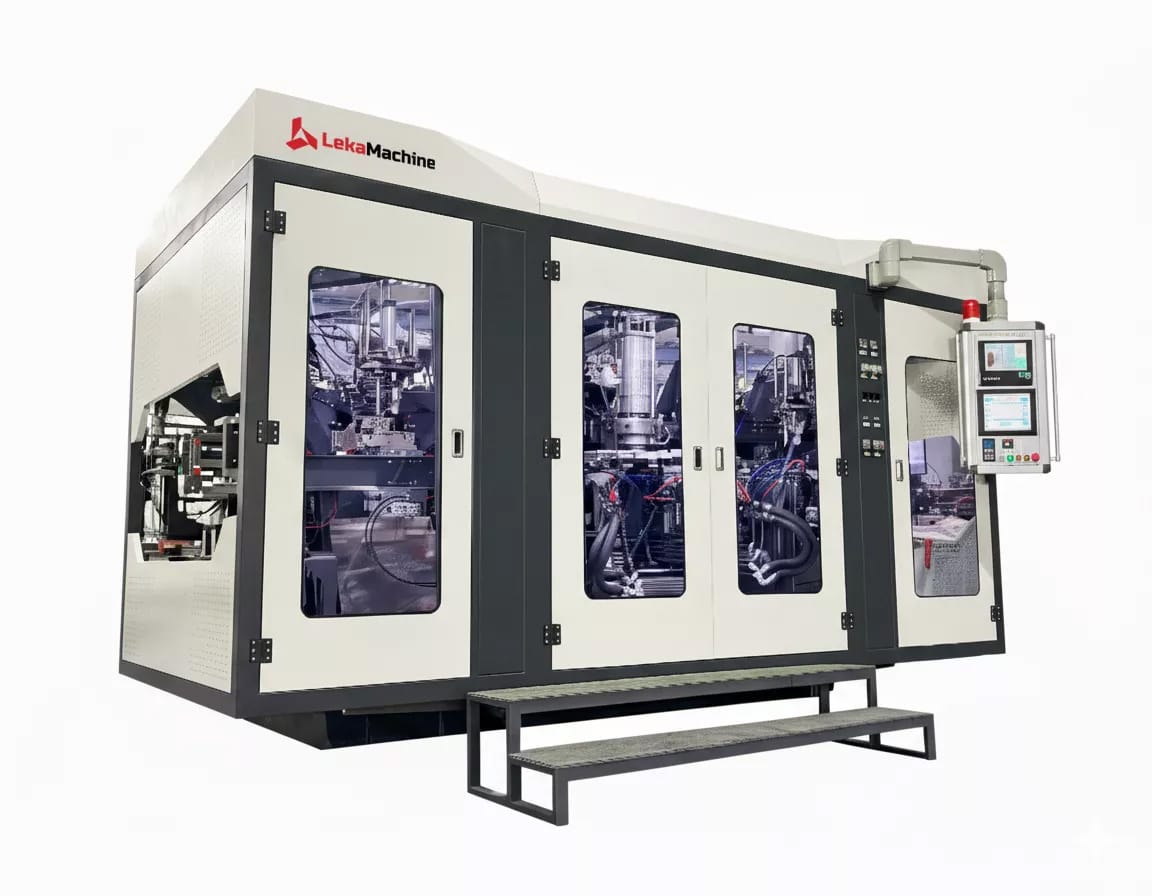
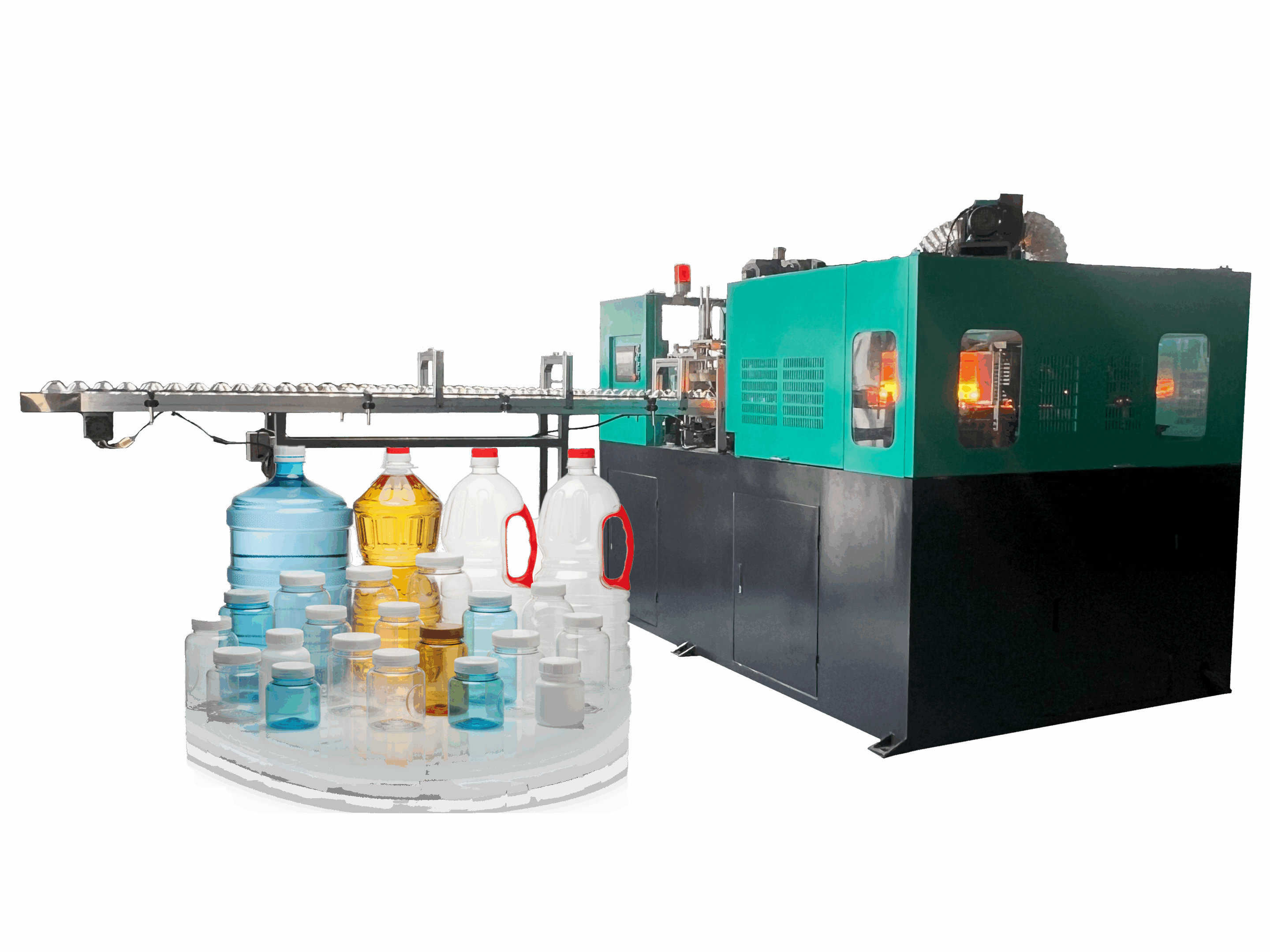
If I have specific production capacity requirements for the ALL electric extrusion blow molding machine, how should I communicate them to the supplier?

At our facility in Shantou, we often see clients frustrated because the machine they bought doesn’t match the speed they imagined. It is painful to watch a factory owner realize their profit margins are vanishing due to vague contracts and theoretical promises. The solution lies in defining the physics of production before signing the deal. You need to push past the sales pitch and demand engineering validation based on your specific product reality.
To effectively communicate capacity requirements, you must provide the supplier with a 3D CAD file, specific resin grade data, and target bottle weight tolerances. This allows engineers to calculate precise cycle times rather than relying on estimates, ensuring your contract reflects a binding "cycle guarantee" rather than a theoretical maximum.
Once you have your data prepared, you need to break down the conversation into four critical technical areas.
What data do I need to provide to get an accurate cycle time guarantee?
When we analyze a client’s project, receiving a blurry photo of a bottle makes it impossible for our engineering team to promise a specific output. We need precise inputs to simulate the molding process accurately. Without specific density and geometry data, any number a supplier gives you is just a guess.
You must supply the 3D STEP file, specific resin density and melt flow index, and the exact target weight with tolerances. Providing these three data points allows the supplier to simulate cooling thermodynamics and machine movements, converting a rough estimation into a binding contractual performance guarantee.
The "Cycle Guarantee" Data Pack
To get a binding contract, you must move beyond 2D drawings. A 2D drawing tells us the shape, but a 3D CAD file (STEP format) tells us the volume distribution. This distinction is critical. If we don’t know where the plastic is thickest (usually the neck or bottom corners), we cannot calculate the cooling limit.
You should provide a "Data Pack" containing three specific items:
- The 3D File: For volume and surface area calculation.
- Resin Grade: Specifically Density and Melt Flow Index (MFI).
- Weight Tolerances: Can the bottle vary by ±1g or ±5g?
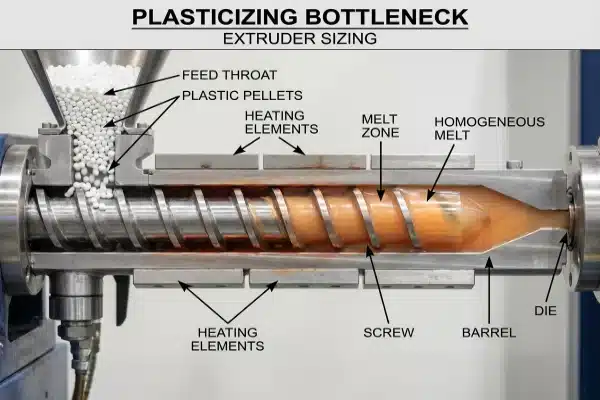
The Plasticizing Bottleneck
Many buyers focus on "bottles per hour," but the machine’s extruder cares about "kilograms per hour." At our factory, we verify if the extruder size matches your total throughput. You must calculate your required throughput using this formula:
$Total \ Throughput (kg/hr) = (Bottle \ Weight + Flash \ Weight) \times Cavities \times Cycles \ per \ Hour$
If your calculated throughput is 100kg/hr, do not accept a machine rated for exactly 100kg/hr. You need a buffer. We recommend ensuring the extruder is rated for 120% of your required figure. If the screw has to run at 100% RPM to keep up, you will lose melt homogeneity. This forces you to slow the machine down to save quality, killing your capacity target.
Leveraging Simultaneous Motion
Since you are buying an ALL electric machine, you are paying for independent servo motors. Use this to your advantage. Unlike hydraulic machines, an all-electric unit can lift the carriage, open the mold, and recover the screw (dose the plastic) all at the exact same moment. When asking for a cycle time breakdown, ask specifically: "Which axes are configured for simultaneous interpolation?" If they list these steps sequentially, they are underestimating the machine’s potential speed.
| Data Point Required | Why It Matters for Capacity | Risk of Not Providing It |
|---|---|---|
| 3D STEP File | Calculates volume distribution and cooling hot spots. | Supplier assumes "ideal" wall thickness; actual cooling takes longer. |
| Resin MFI & Density | Determines how fast the screw can melt plastic. | Extruder cannot keep up with the mold; cycle time increases. |
| Flash Ratio | Accounts for waste material weight in throughput. | Extruder undersized; machine must slow down to melt enough plastic. |
How does the number of cavities affect the overall hourly output calculation?
In our engineering meetings, we often debate whether a client should choose a 4-cavity or 8-cavity setup. It is not just simple multiplication. We have found that larger molds add weight and mechanical inertia that can slow down the dry cycle. You need to balance the "Yield per Capital" against the mechanical limits of the frame.
While increasing cavities multiplies output per cycle, it often requires a larger machine frame with a slower dry cycle time due to heavier platen movement. You must ask the supplier to calculate the "Yield per Capital" to ensure the increased cycle time of a larger machine doesn’t negate the benefit of adding more cavities.

The "Dry Cycle" Trade-off
It is easy to assume that an 8-cavity machine produces exactly double the output of a 4-cavity machine. In reality, this is rarely true. To fit 8 cavities, we must use a larger machine frame with wider platens. These larger platens are heavier.
According to Euromap 46 standards, moving a heavier mass takes more time.
- A small machine might have a dry cycle of 2.8 seconds.
- A larger machine for double cavities might have a dry cycle of 4.2 seconds.
This 1.4-second difference adds up. Over a 24-hour shift, the larger machine might run fewer total cycles. You must ask the supplier to provide the Euromap 46 Dry Cycle time for the specific chassis size they are proposing.
Yield per Capital Calculation
When we advise clients on ROI, we look at the total cost of the system versus the actual output. Sometimes, two smaller, faster machines are better than one massive, slower machine.
Consider the "Yield per Capital" metric. If an 8-cavity machine costs 2.5 times as much as a 4-cavity machine but only yields 1.8 times the output (due to slower mechanics), it is a bad investment. You should ask the supplier to simulate the output for both scenarios.
Servo Motor Sizing for Heavy Molds
For all-electric machines, the weight of the mold directly impacts the servo motor’s life. If you choose high cavitation, the mold becomes very heavy. You must ask for the RMS (Root Mean Square) load calculation for the clamp servo.
If the simulation shows the motor running at >90% torque to move that heavy 8-cavity mold, you have a problem. In our experience, summer heat combined with high loads will cause overheating and machine trips. A robust system should operate at 70-80% capacity. This ensures your "theoretical" capacity is actually achievable 24/7.
Should I specify a minimum efficiency rate or scrap rate in the contract?
We always tell our partners that a machine running at top speed is useless if it produces 10% scrap. Focusing solely on speed without defining acceptance standards is a recipe for disputes during the Factory Acceptance Test (FAT). You need to define what "capacity" actually means in terms of sellable bottles.
You should mandate a Factory Acceptance Test (FAT) requiring an Overall Equipment Effectiveness (OEE) of ≥95% over a continuous run. Additionally, explicitly define the "Flash Ratio" and scrap rate in the contract, ensuring the extruder capacity accounts for the waste material trimmed from the handle and tail.
Defining OEE in the Contract
Never sign a contract that defines capacity based on "Dry Cycle" or short burst speeds. We recommend defining "Capacity" strictly as the count of defect-free, sellable bottles produced divided by the run time.
You should require a Factory Acceptance Test (FAT) protocol. A standard protocol might look like this:
- Duration: Continuous 4-to-8-hour run.
- Target: Overall Equipment Effectiveness (OEE) of ≥95%.
- Scrap Limit: Maximum 2% scrap rate during the test.
If the machine stops for an alarm, that counts against the time. If a bottle has a black spot, it does not count as capacity. This protects you from buying a machine that is fast but unstable.
The Flash Ratio Impact
Flash is the waste material trimmed from the bottle (tail and handle). Many buyers forget to account for this in their capacity request. A 100g bottle might actually require a 140g parison (tube of plastic). The 40g is flash.
If you tell us "I need 100g bottles," we might size the extruder for 100g. But in reality, the machine needs to melt 140g per cycle. If you don’t specify the expected "Flash Ratio," the extruder will be undersized. This creates a hard ceiling on your production speed. You will have to wait for the screw to recover, adding seconds to every cycle.
Downstream Synchronization
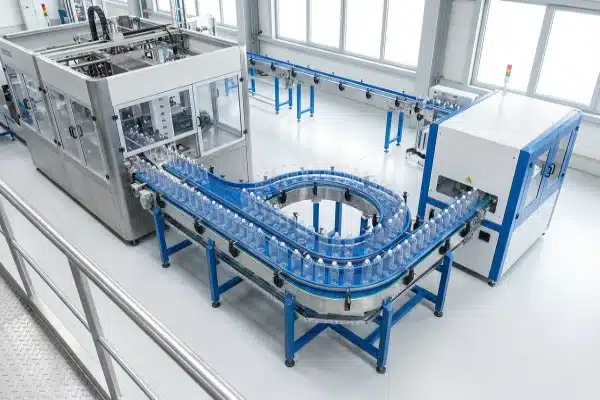
Your machine is only as fast as the slowest equipment in the line. We often see the blow molder running fast, but the leak tester or trimmer keeps stopping.
Computational Fluid Dynamics 1
In your requirements, specify that the machine’s "Take-Out" system must allow for a "Buffer Zone". This integration ensures that minor downstream micro-stops (like a jammed conveyor) do not force the primary molding machine to stop its cycle. A machine that stops and starts loses heat stability, which leads to more scrap.
| Metric | Definition | Recommended Contract Value |
|---|---|---|
| OEE | Availability x Performance x Quality | ≥ 95% during FAT |
| Scrap Rate | Percentage of rejected bottles | < 1% for standard HDPE |
| Flash Ratio | Weight of flash / Total Shot Weight | Typically 20-40% (Must be specified) |
How do cooling time constraints impact the realistic production capacity?
Our thermal engineers spend days running simulations because they know you cannot cheat physics. No matter how fast the servo motors move, the plastic needs a fixed amount of time to solidify. If a supplier promises a speed that ignores these laws, they are setting you up for failure.
cooling thermodynamics 2
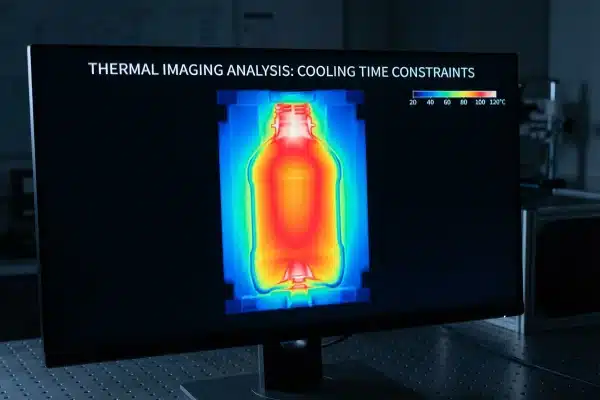
Cooling time is the primary physical limit on production speed, governed by wall thickness and material thermodynamics. If a supplier promises a cycle time that implies cooling faster than the physics approximation formula allows, the guarantee is invalid unless they propose advanced technologies like internal air cooling or liquid CO2.
The Physics Limit Verification
You can validate a supplier’s honesty using a simple check. Cooling time roughly follows the square of the wall thickness ($t \approx h^2$). This means if you double the wall thickness, the cooling time quadruples.
Overall Equipment Effectiveness 4
If a supplier promises a production rate that implies a cooling time of 4 seconds for a thick 3mm detergent bottle, they are likely lying. Unless they are using internal air cooling (IAC) or liquid nitrogen/CO2, there is a physical limit to how fast heat can move through plastic.
Root Mean Square 5
Ask the supplier to show their math. Compare their quoted cooling time against standard industry benchmarks for your material.
Euromap 46 standards 6
CFD Thermal Simulation
For high-capacity projects, we recommend asking for a CFD (Computational Fluid Dynamics) thermal simulation. This is a digital proof that the mold design works.
High-speed electric machines often run so fast that the mold cannot get rid of the heat. The mold temperature starts to creep up. The first 100 bottles are fine, but by bottle 500, they are soft and deformed. A CFD report proves that the cooling channels can dissipate the heat load at the guaranteed cycle time.
independent servo motors 7
Material Specifics Matter
Different materials release heat at different rates. HDPE holds heat longer than PP. If you are running PCR (Post-Consumer Recycled) material, it often requires slightly longer cooling due to inconsistencies.
Melt Flow Index 8
When communicating requirements, do not just say "Plastic." Specify "HDPE with 30% PCR." This allows our engineers to derate the cooling capacity appropriately. Being honest about the material prevents the machine from struggling to meet the cycle time later on.
specific resin density 9
Conclusion
Communicating production capacity is about more than just asking "How fast?" It requires a technical dialogue built on specific data: 3D files, flash ratios, and material grades. By demanding a data-backed "Cycle Guarantee" and validating it against physical limits like cooling time and dry cycle inertia, you protect your investment. A vague contract leads to excuses; a specific, data-driven specification leads to a profitable production line.
extrusion blow molding machine 10
Footnotes
- Major software provider used for the thermal simulations described. ↩︎
- Leading educational institution specializing in plastics engineering and thermal properties. ↩︎
- Official government definitions and guidelines on recycled materials. ↩︎
- Government manufacturing program that promotes efficiency metrics like OEE. ↩︎
- Mathematical definition of the load calculation method mentioned. ↩︎
- Official industry body providing the standards mentioned in the text. ↩︎
- Government resource on high-efficiency electric machine technologies. ↩︎
- Official ISO standard defining how melt flow is measured. ↩︎
- Example of a major manufacturer’s technical data sheet for HDPE. ↩︎
- General definition of the core manufacturing process discussed. ↩︎


0 Comments