
How should I calculate the total landed cost of importing an all-electric extrusion blow molding machine from China?

When we discuss budget with clients, we notice many overlook the gap between the sticker price and the final cost. Ignoring logistics and taxes can ruin your projected ROI.
To calculate the total landed cost for Italy, add the machine’s CIF price, import duties, and 22% VAT. You must also include port handling fees, inland transportation to your facility, installation labor, and operator training expenses. A typical €200,000 machine often reaches €265,000 after all fiscal and logistical obligations are met.
Understanding these numbers upfront ensures your project remains profitable from day one.
We frequently assist Italian buyers with paperwork, yet we still see surprises regarding local fiscal requirements. Missing a tax detail can severely impact your cash flow during the critical startup phase.
SGS or BV verification 1
Import duties typically range from 1.7% to 4.5% depending on specific HS codes, while Italy mandates a 22% VAT on the CIF value. Beyond taxes, budget €8,000 to €15,000 for installation and training. Utilizing deferred VAT payment schemes can significantly protect your initial working capital during this process.

Breaking Down the Landed Cost Formula
When we ship machinery from our factory in Shantou to ports like Genoa or Venice, the "Ex-Works" price is just the beginning. You need a granular approach to budgeting. The total landed cost is not a single number but a sum of three distinct categories: fiscal costs, logistical costs, and service costs.
Italian Legislative Decree 81/08 3
Fiscal Obligations: VAT and Duties
The largest addition to your budget will be the Value Added Tax (VAT). In Italy, this is currently set at 22%. It is calculated not just on the machine price, but on the CIF (Cost, Insurance, and Freight) value.
For example, if you purchase a machine for €200,000 and shipping costs €4,000, your taxable base is €204,000. The VAT alone will be nearly €45,000. However, our experienced clients often use a Deferred VAT Payment Strategy. If you provide a bank guarantee, Italian importers can often defer this payment to the end of the following month. This keeps €45,000 in your bank account for an extra 30 to 45 days, which is vital for liquidity.
Hidden Service Costs
Many buyers assume the machine simply gets plugged in. This is rarely the case. Through our experience setting up production lines, we know that "plug and play" still requires skilled labor.
- Port Handling: Local charges at Italian ports usually run between €150 and €300.
- Inland Transport: Moving a 40ft container from the port to your factory can cost €800 to €1,500 depending on the distance.
- Installation: You need to budget for technicians. Even if we send our engineers, you are responsible for their visa, accommodation, and daily allowances.
- Training: Allocating 3-4 days for operator training ensures you hit peak efficiency faster.
Cost Simulation Table
To help you visualize this, here is a breakdown of a typical project we handled recently.
| Cost Component | Description | Estimated Value (€) | Notes |
|---|---|---|---|
| Machinery Price | Ex-Works China | €200,000 | Base capital investment |
| Sea Freight | Shipping to Genoa | €4,000 | Variable based on season |
| Insurance | Marine Cargo Insurance | €300 | Essential risk mitigation |
| Import Duty | Approx 1.7% – 2.2% | €4,500 | Check HS Code |
| VAT (22%) | On CIF + Duty | €45,936 | Recoverable later, but cash flow impact |
| Port & Transport | Local handling | €1,500 | Trucking to factory |
| Install & Training | 7 Days on-site | €8,000 | Labor, flights, hotels |
| Total Landed Cost | Final Budget | €264,236 | +32% over base price |
How do operational savings and technical specifications impact the long-term budget?
Our engineering team often sees buyers choose oversized machines, thinking "bigger is better." This actually drains your budget through wasted energy and higher material costs over time.
EN 60204-1 4
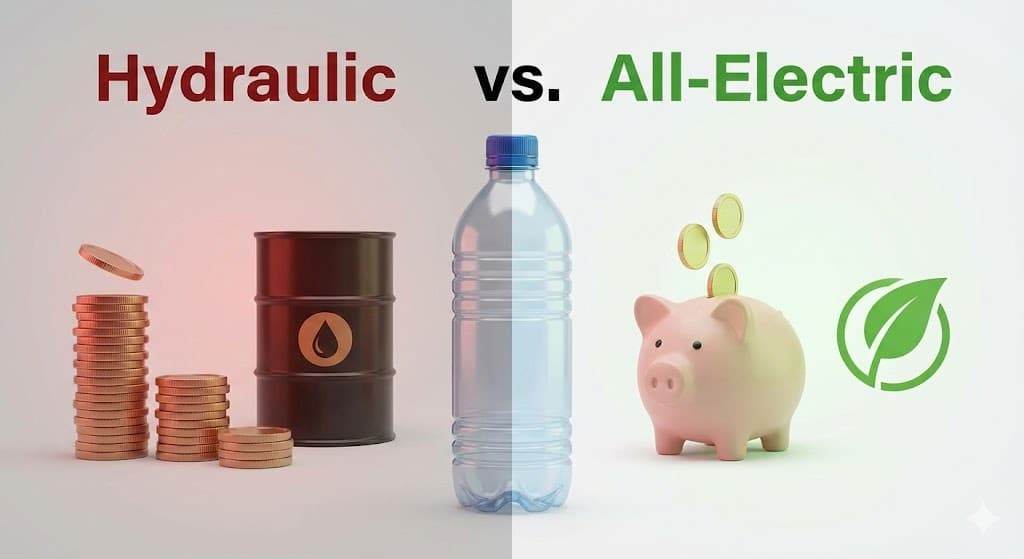
Operational budgets benefit significantly from all-electric models, which reduce energy use by 50-70% compared to hydraulic systems. Proper tonnage selection further protects your budget; calculating clamping force based strictly on projected mold area prevents over-spending on unnecessary capacity, saving upwards of €50,000 in initial capital investment.
Machinery Regulation 2023/1230 5
The ROI of All-Electric Technology
When we design our machines, we focus on the Total Cost of Ownership (TCO). While an all-electric blow molding machine may have a higher upfront cost than a hydraulic one, the math changes when you look at a 3-year timeline.
HACCP Compliance 6
Energy Consumption Analysis
Hydraulic systems are energy-intensive because the pumps must run continuously to maintain pressure, even when the machine is idle during cooling cycles. In contrast, our all-electric machines use servo motors that only consume power when movement is required.
- Hydraulic consumption: High baseline usage.
- Electric consumption: 50% to 70% lower.
- Financial Impact: For a standard production line, this difference translates to €10,000 to €20,000 in savings annually. This means the extra cost of electric technology pays for itself in just 2 to 4 years.
Material Savings via Parison Control
The biggest hidden cost in blow molding is plastic resin. If your wall thickness is uneven, you must make the whole bottle heavier to ensure the thinnest point meets the standard. This wastes material.
We utilize advanced MOOG 100-point wall thickness controllers. This technology allows you to optimize the distribution of plastic across the bottle’s height. By shaving off just 1-2 grams per bottle without sacrificing strength, you can reduce resin costs by 20-30%. For high-volume production, this is a massive operational saving.
MOOG 100-point wall thickness controllers 7
Tonnage Selection Formula
Don’t guess your tonnage. We see factories buying 60-ton machines for small 5L bottles that only need 30 tons.
The Formula: Clamping Force = Projected Mold Area × Cavity Pressure.
Over-specifying doesn’t just cost more to buy; it costs more to run. A right-sized machine saves you capital immediately.
Food Safety and Maintenance
If you produce food or pharma bottles, all-electric is a budget protector.
- No Hydraulic Oil: Eliminates the risk of contamination.
- HACCP Compliance: Easier to achieve without oil.
- Lower Maintenance: No oil changes, no filter replacements, and no leakage cleanups.
| Fonctionnalité | Hydraulic Machine | All-Electric Machine | Annual Impact |
|---|---|---|---|
| Efficacité énergétique | Low (60% waste) | High (90% efficient) | Save €15k/year |
| Oil Maintenance | High cost & mess | Zero | Save €2k/year |
| Noise Level | High (>80dB) | Low (<65dB) | Better worker safety |
| Précision | Variable | Exact (0.01mm) | Lower scrap rate |
What logistics, compliance, and risk management costs must I factor in?
When we prepare machines for export, we ensure every compliance document is perfect to prevent customs delays. Ignoring standards or cheaping out on shipping can destroy your project timeline.
specific HS codes 8
Budget €3,000 to €5,000 for a 40ft container from Guangdong to Italian ports. Compliance is critical; costs must include verifying EN 422 and EN 60204-1 standards. Additionally, allocate funds for legal review of IP protection agreements and explicit MOUs to safeguard your bottle designs and mold specifications.

Navigating Logistics and Compliance
The journey from our factory floor to your facility involves more than just a crane and a truck. It involves strictly regulated international standards.
CIF price 10
Sea Freight Optimization
Shipping costs fluctuate. Currently, shipping a 40ft container from Guangdong to Genoa or Venice takes about 32-35 days and costs between €3,000 and €5,000.
Pro Tip: If you are buying auxiliary equipment (like leak testers or chillers), ask us to consolidate the shipment. Loading everything into one container reduces your per-unit shipping cost by 20-30%. It also simplifies the insurance process.
European Compliance Standards
You cannot legally operate non-compliant machinery in Italy. The EU has strict directives.
- Machinery Regulation 2023/1230: The overarching safety standard.
- EN 422: Specific safety requirements for blow molding machines.
- EN 60204-1: Electrical equipment safety.
We ensure our machines carry valid CE marking. However, as the buyer, you are responsible for workplace safety under Italian Legislative Decree 81/08. This might require a local safety inspector to certify the installation, a cost you should anticipate.
Intellectual Property (IP) Protection
China has improved IP laws, but we still advise caution. Your bottle design is your competitive advantage.
- Le risque : Sending drawings without protection.
- La solution : Sign a specific Memorandum of Understanding (MOU) or NNN Agreement (Non-Use, Non-Disclosure, Non-Circumvention).
- The Cost: A legal review of these documents might cost €500-€1,000, but it prevents your unique design from ending up in a competitor’s catalog.
Supplier Verification
Finally, factor in the "cost of trust." Don’t rely on a website alone.
- Ask for ISO 9001 certificates.
- Request SGS or BV verification reports.
- Demand references from at least 3 international customers.
| Risk Area | Potential Cost of Failure | Prevention Cost |
|---|---|---|
| Non-Compliant Electric | Machine seized at customs | €0 (Included in reputable machine price) |
| Shipping Damage | €10,000+ repair | €300 (Marine Insurance) |
| IP Theft | Loss of market share | €1,000 (Legal contracts) |
| Safety Audit Failure | Production shutdown | €1,500 (Local safety inspection) |
Conclusion
Calculating the true cost of an all-electric blow molding machine requires looking beyond the price tag to taxes, energy savings, and compliance. Would you like us to generate a detailed Landed Cost Estimation specific to your bottle volume and location?
notes de bas de page
- Official service page for one of the third-party verification bodies. ↩︎
- Official page explaining the quality management standard mentioned. ↩︎
- Official Italian government gazette containing the workplace safety law. ↩︎
- Official standard page for electrical safety of machinery. ↩︎
- Direct link to the official EU legal text cited for machinery safety. ↩︎
- Authoritative definition of the food safety management standard. ↩︎
- Official manufacturer page for the specific parison control technology mentioned. ↩︎
- Explains the classification system that determines import duty rates. ↩︎
- Official EU source confirming Value Added Tax rates and rules. ↩︎
- Defines the standard international shipping term used for cost calculation. ↩︎


0 commentaires