


How can I verify that the screw design of the all-electric extrusion blow molding machine is suitable for my raw material characteristics?

At our factory, we often see clients worried that a standard machine won’t handle their specific resin blend or recycled content efficiently. This anxiety is well-founded, as poor screw compatibility kills profit margins.
To verify screw design suitability, you must audit the Length-to-Diameter (L/D) ratio (aiming for 24:1 or higher), demand a barrier flight geometry for melt consistency, and request a specific energy consumption (SEC) test. Always validate these metrics through a material trial using your specific resin grade.
Let’s break down the technical specifics you need to check before signing the contract.
technical specifics 1
How does the screw geometry affect the processing of PCR or recycled materials?
When we export machines to Europe, clients frequently ask if our equipment can handle 100% Post-Consumer Recycled (PCR) material without clogging or surging.
Recyclé post-consommation (PCR) 2
Screw geometry is critical for PCR; you must ensure the screw utilizes a Barrier Design to separate solids from melt, alongside a bi-metallic barrel lining to resist abrasion. A higher L/D ratio ensures sufficient mixing time, preventing unmelted "gels" and streaks from ruining your final container quality.

Processing PCR or recycled material is fundamentally different from running virgin resin. In our engineering meetings, we emphasize that simply increasing heat isn’t the solution; the hardware must change. The first parameter you must verify is the Length-to-Diameter (L/D) Ratio. For standard virgin HDPE, a 20:1 or 22:1 ratio might suffice. However, for PCR applications, we insist on a minimum L/D ratio of 24:1 or 25:1. Shorter screws simply do not provide enough "residence time" to thoroughly mix the inconsistent melt of recycled plastics and blend in the masterbatch. If the screw is too short, you will see color streaks or inconsistencies in the bottle wall.
Secondly, you need to move away from simple metering screws. You should verify the machine uses a Barrier Flight Geometry. A barrier screw features a secondary flight that separates the channel into two paths: one for solids and one for melt. This ensures that only fully molten plastic can pass forward to the die head. Without this, unmelted particles (gels) often slip through, blocking the thin die gap and causing blowouts.
Finally, consider the wear factor. PCR contains contaminants like paper fibers, silica, and metal fragments. Standard nitrided steel will wear out in under 12 months. We strongly recommend specifying Bi-Metallic Armoring—a tungsten-carbide hard-facing on the flights.
Table: Screw Features for Virgin vs. PCR Resin
| Fonctionnalité | Standard Virgin HDPE Screw | Optimized PCR/Recycled Screw |
|---|---|---|
| L/D Ratio | 20:1 to 22:1 | 24:1 to 26:1 |
| Flight Design | Standard Metering | Barrier Flight (Solid/Melt Separation) |
| Material Hardness | Nitrided Steel | Bi-Metallic Lining & Tungsten Carbide |
| Mixing Tip | High Shear (Dispersive) | Low Shear (Distributive – e.g., Saxton) |
What specific questions should I ask about shear heat generation in all-electric systems?
During our R&D phase for electric models, we discovered that electric drives are so torque-dense they can easily overheat sensitive resins if the screw design is uncontrolled.
You must ask if the screw design creates excessive friction-based heat, known as shear sensitivity. Verify this by running the screw at 80% RPM with heater bands off; if the melt temperature spikes significantly above the setpoint, the geometry is too aggressive for your resin.
In hydraulic machines, the inefficiency of the system often masked screw design flaws. In all-electric extrusion blow molding machines, the direct drive is incredibly efficient, but this means the screw design must be precise to avoid "over-shearing" the material. Shear heat is the temperature rise caused purely by the friction of the plastic pellets rubbing against each other and the barrel.
Shear heat 4
If a screw is designed with a compression zone that is too aggressive, it will generate excessive heat regardless of your heater band settings. We call this the Melt Temperature Override. To test this, ask the manufacturer to run the machine at operating speed (after a heat soak) and then turn the heater bands off. If the melt temperature continues to climb, the screw is mechanically fighting the material. This degrades the polymer chains, leading to brittle bottles that fail drop tests.
Furthermore, you need to check the Feed Throat Thermal Isolation. In many compact electric designs, the servo motor is directly coupled to the gearbox and screw. We have found that motor heat can transfer into the feed section. If the screw design doesn’t account for this with an insulated or aggressively water-cooled feed bushing, you will experience "premature melting" or bridging, where pellets clump together before entering the compression zone, stopping production entirely.
Table: Diagnosing Shear Heat Issues
| Symptom | Probable Screw Cause | Impact on Production |
|---|---|---|
| Temp Override | Compression ratio too high | Brittle bottles, black specks in clear parts. |
| Feed Bridging | Poor feed throat cooling | Machine stops feeding, requires teardown to clean. |
| Motor Trip | Torque requirement > S1 Rating | Frequent downtime during cold starts or purging. |
How can I test if the screw design provides consistent melt homogeneity for my resin?
We calibrate our flight controllers to ensure stability, but the screw itself must deliver a chemically uniform melt to prevent wall thickness variations.
melt index 5
Testing melt homogeneity requires monitoring backpressure stability; a good design maintains the readout within +/- 3 bar. Additionally, inspect the parison for "sharkskin" or ripples under a stroboscope to ensure the screw design isn’t creating harmonic resonance that the electric servo motor cannot absorb.
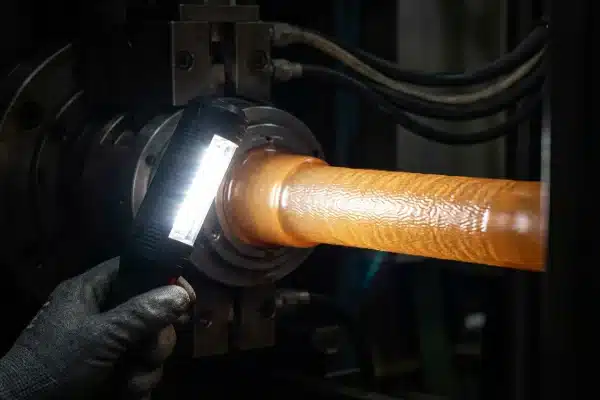
Melt homogeneity is not just about temperature; it is about pressure stability. When we test machines at our facility, we look closely at the Backpressure Stability Metric on the HMI (Human-Machine Interface). A properly designed screw should maintain backpressure within +/- 3 bar of the setpoint. If you see the pressure fluctuating by 10 or 20 bar, it indicates "surging." Surging means the screw is grabbing material inconsistently. This results in parisons of varying lengths—one shot is too long, the next is too short—causing waste and machine alarms.
Another critical factor in all-electric machines is Resonance and Ripple Detection. Hydraulic motors act as a dampener, absorbing vibration. Stiff electric direct-drives do not; they transmit every oscillation of the screw directly to the plastic. If the screw design creates harmonic resonance, you will see "sharkskin" or fine ripples on the parison. You often cannot see this with the naked eye while the machine is running. We recommend using a stroboscope to freeze the image of the parison as it extrudes. If ripples are present, the screw design is incompatible with the servo tuning.
You should also inquire about the Mixing Tip Geometry. For temperature-sensitive resins commonly used in EBM, a Distributive Mixer (like a Saxton or Pin mixer) is often superior to a high-shear Dispersive Mixer (like a Maddock). Distributive mixers split and re-combine the flow to blend colors and temperature variations without spiking the heat, ensuring a homogeneous melt.
Table: Mixer Type Selection Guide
| Mixer Type | Mechanism | Meilleure application | Risk Factor |
|---|---|---|---|
| Maddock (Dispersive) | High Shear | Breaking down agglomerates, hard masterbatch. | Can overheat sensitive resins. |
| Saxton (Distributive) | Flow Splitting | Color blending, PCR, temperature uniformity. | Lower cleaning ability. |
| Pin Mixer | Flow Disturbance | General purpose, simple blending. | Can create flow lines if poorly designed. |
Should I request a material trial run using my specific resin grade before finalizing the design?
Our engineering team always advises against buying based on catalog specs alone; theoretical output rarely matches reality without a real-world test using your actual materials.
Bi-Metallic Armoring 7
You should absolutely mandate a material trial run using your exact resin grade. This allows you to verify the specific energy consumption targets (0.25–0.32 kWh/kg for HDPE) and confirm the machine can handle your specific masterbatch or additives without color streaking or dispersion issues.

contaminants like paper fibers 8
A generic trial with the manufacturer’s clean, virgin material hides many sins. We encourage clients to ship their specific resin—especially if it is regrind or has a unique melt index—to our factory for the FAT (Factory Acceptance Test). During this trial, do not just look at the bottle quality; look at the data.
virgin HDPE 9
Leverage the precise telemetry of the all-electric machine to perform a Specific Energy Consumption (SEC) Audit. You want to calculate the kilowatt-hours used per kilogram of plastic processed. A highly efficient screw design for HDPE should target 0.25 – 0.32 kWh/kg. If the readout exceeds 0.40 kWh/kg, the screw geometry is likely fighting the material, wasting the energy advantage you paid for by choosing an electric machine.
Furthermore, use the trial to verify the Servo "Torque-Speed" Curve Matching. Watch the motor load percentage on the HMI during startup and low RPM purging. The screw’s required torque must fall within the Continuous Torque (S1) rating of the motor. If the screw demands peak torque (S3 rating) just to rotate slowly, you will face frequent drive trips and "overload" alarms in your daily production, drastically reducing your Overall Equipment Effectiveness (OEE).
Conclusion
Verifying L/D ratios, barrier designs, and conducting specific energy audits ensures your screw design maximizes profit, not waste.
specific energy consumption (SEC) 10
notes de bas de page
- ISO standard defining safety and technical specifications for molding machines. ↩︎
- EPA data and definitions regarding plastic recycling standards. ↩︎
- International standards body defining motor duty cycles (S1). ↩︎
- Educational resource on polymer physics and thermal properties. ↩︎
- Technical product data from a major polyethylene supplier. ↩︎
- General background definition of the physical phenomenon of resonance. ↩︎
- Leading manufacturer documentation on bimetallic barrel technology. ↩︎
- Industry association guide on contaminants in recycled plastics. ↩︎
- Major resin manufacturer’s technical guide to HDPE blow molding. ↩︎
- Official government resource on industrial energy analysis metrics. ↩︎



0 commentaires