
Guide ultime pour trouver les meilleurs fournisseurs de machines de moulage par soufflage en 2025
I talk to people every day who are in the tough spot of needing to buy a new blow molding machine. Maybe you’re one of them. You might be a plant manager staring at an aging piece of equipment that’s becoming more of a liability than an asset. Or perhaps you’re a procurement expert, and you’ve just been tasked with equipping a brand-new factory. The pressure is on. You have to get this right. Your company is counting on you to make a multi-thousand-dollar investment that will be the heart of your production line for the next decade or more.
A few months ago, an engineering head from a packaging supplier in Poland told me something that stuck. He said, “Slany, our old machines are killing us. They are slow, they eat up energy, and every time one goes down, I feel a production bottleneck tightening around my neck.” He knew he needed to upgrade, but the world of blow molding machine suppliers can feel like a minefield. Who can you trust? What technology do you actually need? And how do you know if you’re getting a fair price?
That conversation is why I decided to write this guide. My name is Slany Cheuang, and I’m the technical sales manager at Leka Machine. I’ve spent my career in this industry, helping companies navigate these exact questions. This isn’t a sales pitch. It’s a roadmap. I want to give you the information I share with clients every day so you can make the best possible decision for your business.
Quick Summary: What You’ll Learn in This Guide
I’m going to walk you through the essential knowledge you need to confidently choose a supplier. We will cover:
- The critical differences between Extrusion Blow Molding and Stretch Blow Molding technologies.
- A practical, 4-step checklist to properly evaluate any supplier you’re considering.
- A realistic look at the average market prices for machines de moulage par soufflage in 2025.
- Why an integrated supply chain, like the one found in China, gives you a massive advantage.
- The most common and costly mistakes to avoid when you are selecting a new machinery partner.
Blow Molding: The Cornerstone of Modern Plastic Manufacturing
Take a quick look around you. The bottle of water on your desk, the shampoo container in your shower, the heavy-duty drum of cleaning chemicals in a factory, even the complex air ducts under the hood of your car—they all likely started their life in a machine de moulage par soufflage. This technology is the quiet workhorse behind a huge portion of the plastic products we rely on daily.
The demand for high-quality, efficiently produced plastic containers is enormous and it continues to grow. Brands need packaging that is durable, lightweight, and perfectly shaped to catch a customer’s eye on a crowded shelf. Industrial companies need robust containers that can safely transport materials. This is where blow molding applications shine, turning raw plastic pellets into everything from tiny vials to massive tanks. Whether you’re using an machine à bouteilles en PEHD to make milk jugs or a more specialized setup for automotive parts, the qualité of your machine dictates the quality of your product and the efficiency of your operation.
Why a Great Supplier Is Your Most Important Asset
You might think you’re just buying a piece of steel, but you’re not. You’re entering a long-term relationship. Choosing the right fabricant de machines de moulage par soufflage is one of the most critical strategic decisions you can make. A top-tier supplier isn’t just a vendor; they are a partner in your success.
Here’s what that partnership gets you:
- Equipment Reliability & Performance: This is the most obvious benefit. A well-built machine from a reputable supplier runs consistently. It hits its promised cycle times, produces less scrap, and doesn’t unexpectedly shut down in the middle of a critical production run. This stability is the foundation of a profitable manufacturing line.
- Technical Support & After-Sales Service: What happens when you have a question during setup or a component fails two years down the road? A great supplier provides comprehensive technical support. They help with installation, train your operators, and have a clear process for troubleshooting and supplying spare parts. This support system is your insurance policy against costly downtime.
- Solutions & Customization: Your product is unique. A one-size-fits-all machine rarely provides the best results. A true partner works with you to understand your specific needs. Do you need a 5L water bottle manufacturing – la plus adaptée à vos produits spécifiques, n'hésitez pas à me contacter chez Leka Machine. Nous sommes là pour vous aider à trouver la? They will configure a machine optimized for that exact application. This custom blow molding capability ensures you get the most efficient and effective machine for your job.
- Cost-Effectiveness & Return on Investment (ROI): It’s tempting to focus on the initial price tag, but the real cost of a machine unfolds over its entire lifespan. An efficient machine uses less energy. A reliable machine has lower maintenance costs. A well-supported machine spends more time producing and less time sitting idle. The right supplier provides a machine with a lower total cost of ownership, delivering a much higher return on your initial investment.
Decoding Blow Molding: Extrusion Soufflage vs. Stretch Blow Molding

Une comparaison côte à côte de contenants en PET et HDPE illustre les productions typiques du soufflage étirage-soufflage et du soufflage par extrusion-soufflage.
Before you can even think about suppliers, you need to be certain about which core technology you need. While there are several types of blow molding, the two dominant methods you’ll encounter are Extrusion Blow Molding and Stretch Blow Molding. I sell both, and they are designed for very different jobs.
Extrusion Blow Molding Machine Suppliers
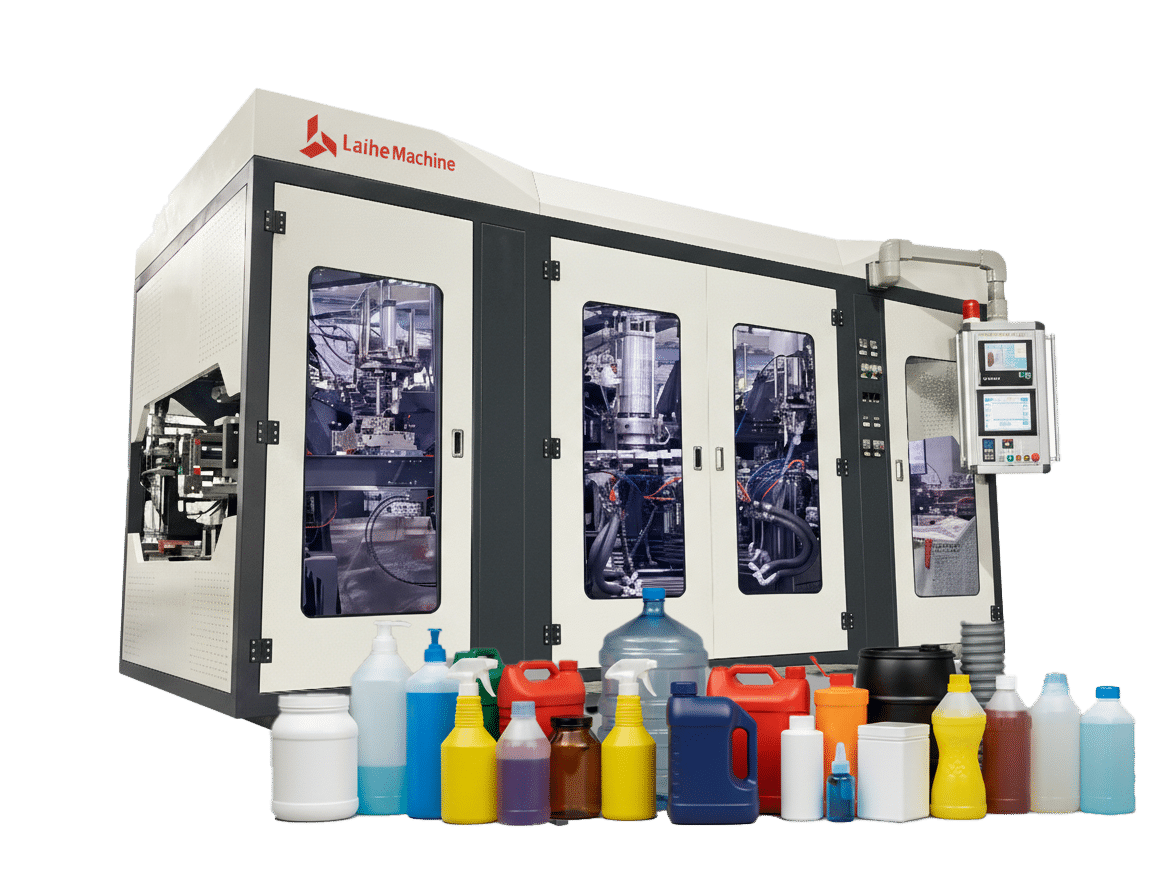
This is an extrusion blow molding machine with a closed safety cabinet and integrated operator control panel for automated bottle production.
First, let’s talk about the industry’s most versatile workhorse: Extrusion Soufflage.
What is Extrusion Blow Molding?
The easiest way to understand this process is to think of squeezing a tube of toothpaste.
It starts with melting plastic pellets in a heated barrel with a rotating screw. This molten plastic is then pushed, or extruded, downwards through a die to form a hollow tube of plastic. This tube is called a paraison.
Once the parison reaches the right length, a cooled mold closes around it, pinching the top end shut. A nozzle is then inserted into the pinched end, and compressed air is blown into the parison. This air pushes the soft plastic outwards against the cold walls of the mold, forcing it to take the mold’s shape. After a moment of cooling, the mold opens, and the finished part is ejected. The whole cycle then repeats.
What Products Are Best Made with this Technology?
Extrusion Soufflage is incredibly flexible, which is why it’s used for such a wide range of products.
- Suitable Materials: This process works fantastic with materials like High-Density Polyethylene (HDPE), Polypropylene (PP), and PVC. These plastics are known for their toughness and chemical resistance.
- Product Examples: This is the go-to method for items that don’t need to be crystal clear and often have complex shapes or handles. Think about:
- Plastic jerry cans and large industrial drums.
- Household chemical containers, like laundry detergent and shampoo bottles (a common shampoo bottle production line uses this).
- Children’s toys with hollow parts.
- Complex automotive parts blow molding, such as air ducts, reservoirs, and spoilers.
- Coolers and carrying cases.
At Leka Machine, our FORMA series is the perfect example of a versatile machine de moulage-soufflage par extrusion. It’s designed to be a reliable and flexible partner, capable of handling everything from small bottles to medium-sized jerry cans. For truly large-scale industrial products like chemical drums or automotive components, we have the série TITAN, which is built for strength and stability with very large containers.
Stretch Blow Molding Machine Suppliers

This stretch blow molding machine features enclosed service cabinets and a guarded molding area for forming plastic bottles.
Now, let’s look at the technology that gives us the crystal-clear bottles we see everywhere.
What is Stretch Blow Molding?
This process is a bit more refined and is typically done in two distinct stages, which is why it’s often called “two-step” processing.
First, a small, test-tube-shaped piece of plastic called a preform is created using moulage par injection. This preform already has the finished threads for the bottle cap.
In the second stage, these preforms are loaded into the Stretch Blow Molding machine. They are heated in an oven to soften the plastic to the perfect temperature. Then, they are transferred into the final bottle mold. Here, a rod stretches the preform vertically while high-pressure air is blown in, stretching it horizontally. This bi-axial stretching aligns the plastic molecules, which gives the final bottle superior strength and incredible clarity.
What Products Are Best Made with this Technology?
Stretch Blow Molding (moulage par soufflage) is all about performance and aesthetics, especially clarity.
- Suitable Materials: The undisputed king of this process is Polyethylene Terephthalate, or PET. This is the material used for nearly all water and soda bottles.
- Product Examples: If you need a container that is clear, strong, and has good gas barrier properties (to keep carbonation in, for example), this is your technology.
- Mineral water and soft drink bottles.
- Edible oil bottles.
- Wide-mouth jars for food products like peanut butter or pickles.
- Cosmetic and personal care containers.
For these kinds of applications, we developed specific machine lines. Our série BOTTLER is focused on the precise creation of high-value PET containers, like cosmetic bottles or uniquely shaped jars where appearance is critical. For high-volume production where speed is everything, like for water and beverage bottles, our série AQUA is optimized for maximum throughput and reliability.
Extrusion Blow Molding vs. Stretch Blow Molding (moulage par soufflage): How Do I Choose?
This is a fundamental question. Choosing the wrong process is a mistake you can’t afford to make. I’ve created a simple table to help you decide. This is the starting point for any conversation about a new machine.
| Fonctionnalité | Extrusion Soufflage | Stretch Blow Molding (moulage par soufflage) |
|---|---|---|
| Primary Materials | HDPE, PP, PVC, LDPE | PET |
| Product Shape | Excellent for complex, irregular shapes with handles. | Best for relatively symmetrical shapes like bottles and jars. |
| Clarté | Typically opaque or translucent. Not suitable for crystal-clear products. | Excellent, high-clarity results are a key advantage. |
| Applications typiques | Industrial containers, chemical drums, automotive parts, toys. | Beverage bottles, water bottles, food jars, cosmetic containers. |
| Handle Integration | Handles can be easily integrated into the single-mold design. | Handles are not possible in the standard process. |
| Contrôle de l'Épaisseur de Paroi | Very good control over wall thickness via parison programming. | Good, but more uniform. Less ability to vary thickness in specific areas. |
| Tooling (Mold) Cost | Generally lower, as only one mold (the blow mold) is needed. | Higher, as you need both an injection mold for the preform and a blow mold for the bottle. |
| Initial Machine Cost | Tends to be relatively lower for comparable output. | Tends to be relatively higher due to the two-stage process. |
The bottom line on how to make plastic bottles comes down to your material and final product needs. If you need to make a tough, opaque 20-liter HDPE drum, you need an machine de moulage-soufflage par extrusion. If you need to produce a clear, 500ml PET water bottle, you need a Stretch Blow Molding machine. It’s that fundamental.
Buyer’s Beware: 3 Common Mistakes to Avoid When Choosing a Supplier
Over the years, I’ve seen companies make the same handful of critical errors when buying a new machine. These mistakes don’t just cause headaches; they can cost hundreds of thousands of dollars in lost productivity and unexpected expenses over the life of the machine. I want you to avoid them.
Mistake #1: Focusing Only on the Initial Purchase Price
This is, by far, the biggest and most common trap. You get three quotes, and one is significantly cheaper than the others. It’s tempting to jump on it. But the purchase price is just the tip of the iceberg. The real cost of a machine is its Coût Total de Propriété (TCO).
TCO includes everything:
- Consommation d'énergie : A machine with an inefficient hydraulic system or older heating technology can cost you tens of thousands more in electricity over a few years compared to a modern, servo-hydraulic machine.
- Maintenance & Spare Parts: A cheaper machine is often built with lower-quality components. This means more frequent breakdowns and more money spent on replacement parts. What’s the cost of a new hydraulic valve or a PLC controller on the cheap machine versus the one built with premium, globally recognized brands?
- Downtime Costs: This is the silent killer of profitability. Every hour your machine is down is an hour you are not producing. If your production line is bottlenecked because of a cheap, unreliable machine, the cost of lost output can quickly dwarf any initial savings.
A slightly higher initial investment in a well-built machine from a reputable supplier will almost always result in a lower TCO and a much better return on your investment.
Mistake #2: Overlooking After-Sales Service and Technical Support
When you buy a machine, you’re also buying the support team behind it. A supplier who is great at sales but disappears after the machine is delivered is setting you up for failure. Before you sign anything, you need to think like a pessimist. What happens when something goes wrong?
A lack of strong after-sales support can turn a minor issue into a major disaster.
- Installation & Training: Will the supplier send an experienced engineer to properly install the machine and train your operators? Or will they just send you a manual and wish you luck?
- Troubleshooting: When you have a problem, how quickly can you get a qualified technician on the phone or via video call? Do they have the ability to perform remote diagnostics?
- Spare Parts: How long will it take to get a critical spare part? Does the supplier keep a stock of common components, or do they have to order them from a third party, adding weeks to your downtime?
I’ve heard horror stories of companies waiting a month for a simple replacement part because their supplier had no support infrastructure. That’s a month of lost production. Don’t let that be you.
Mistake #3: Selecting a Supplier Without Proven Case Studies
Talk is cheap. Any salesperson can promise you that their machine is the best. The real proof is in their track record. A reliable supplier should be able to provide you with concrete evidence that they have successfully built and installed machines similar to the one you need.
Don’t be afraid to ask for proof.
- Ask for specific case studies: “Can you show me a machine you’ve built for a customer producing 5-liter HDPE jerry cans, similar to our product?”
- Request videos: Ask for recent, unedited videos of the machine in operation, ideally running a product like yours at the quoted cycle time.
- Ask for references: A confident supplier with happy customers will not hesitate to let you speak with one of their existing clients.
If a supplier is vague, makes excuses, or can’t provide any real-world examples of their work, that is a major red flag. It likely means they are either new and inexperienced or they don’t have a history of successful projects. It’s a risk you don’t need to take.
How to Evaluate and Select Blow Molding Machine Suppliers: A 4-Step Checklist
Okay, you know which technology you need and what mistakes to avoid. Now it’s time to get practical. How do you actively find and vet potential suppliers? I recommend a structured, four-step approach. This is the process I would use if I were in your shoes.
Step 1: Supplier Background & Credibility Check
Before you even discuss machine specs, you need to know who you’re dealing with. The goal here is to filter out unqualified or risky companies early on.
- Manufacturer vs. Trader: This is a crucial distinction. Are you talking to the actual factory that builds the machine, or a trading company that is just a middleman? Working directly with a manufacturer, like Leka Machine, has huge advantages. You have direct access to their engineers, more control over customization, better pricing, and a clear line of communication for after-sales support. A trader adds a layer of complexity and cost.
- Company History & Experience: How long have they been in business? How many machines have they exported, and to which countries? A company with a long history of exporting to regions like Europe or North America understands the qualité standards and documentation requirements.
- Certifications & Standards: Look for internationally recognized certifications like ISO 9001 (for quality management) and CE (for safety standards in Europe). This shows a commitment to professional manufacturing processes.
- Factory Audit: The best way to judge a manufacturer is to see their factory. If you can, visit in person. If not, insist on a live, detailed video tour. Don’t just look at their showroom; ask to see the manufacturing floor, their CNC machining centers, their assembly area, and their parts warehouse. Pay attention to how organized and clean the facility is. A well-run factory is a good indicator of a well-built machine. A visit to the Leka Machine factory, for example, is something we always encourage.
Step 2: Technical Capability & Product Quality Assessment
Once you’ve confirmed a supplier is credible, it’s time to dive into the machine itself. This is where you separate the assemblers of cheap parts from the true engineering companies.
- Core Component Brands: A machine de moulage par soufflage is only as good as its weakest component. Ask for a detailed list of the brands used for critical parts.
- PLC and Electronics: Are they using trusted brands like Siemens or Mitsubishi?
- Hydraulics: Are the valves and pumps from recognized names like Yuken or Rexroth?
- Pneumatics: Are the components from a quality supplier like SMC or Festo?
A supplier who uses premium, globally-sourced components is investing in the reliability of their machine, which directly benefits you.
- Automation Level: Discuss your needs in detail. Do you need a fully automatic machine that includes in-mold labeling, automated deflashing, leak testing, and conveyors? Or is a semi-automatic machine a better fit for your budget and labor environment? A good supplier can explain the pros and cons of each level of automation for your specific project.
- Customization Capability: A great supplier doesn’t just sell you a machine off a spec sheet. They engineer a solution. Can they adjust the mold platen size to fit your existing molds? Can they program the control system to meet a specific requirement? For example, can they design a 5 litre blowing machine specifically for a unique container shape you have? This ability to provide custom blow molding solutions is a sign of a technically proficient partner.
- Case Studies Revisited: Now is the time to dig deeper. Look at their past projects. Do the machines look well-built and professionally wired? Are the final products high quality? This is your best window into the quality of their work.
Step 3: Service & Support System Review
A great machine with poor support is a bad investment. You need to thoroughly investigate a supplier’s entire service infrastructure before you commit.
- Pre-Sales Service: What happens before you even place an order? A good supplier should offer technical consultations, help with bottle design optimization, and even provide factory layout planning to ensure the machine will fit and operate efficiently in your space.
- After-Sales Service: Get specific details.
- Installation & Training: Who will do it? How long will it take? What is covered in the training?
- Warranty: How long is the warranty, and what exactly does it cover?
- Spare Parts: Do they provide a recommended spare parts list with the machine? How do you order parts, and what is the lead time?
- Remote Support: What is their system for remote troubleshooting? Can they diagnose problems over a video call or by connecting to the machine’s PLC?
- Delivery Time: A long delivery time can delay your entire project. Ask for a firm production schedule and delivery date. Some suppliers, especially in Europe, can have very long lead times. We’ve structured our operations at Leka Machine to offer a reliable delivery cycle of 60-90 days, which can be a significant competitive advantage for our clients.
Step 4: Pricing & Commercial Terms Analysis
Finally, you can talk about price. But now you’re doing it from an informed position, able to compare not just the number, but the total value being offered.
- Get a Detailed Quotation: A professional quotation should be many pages long and break everything down. It should clearly list the machine specifications, the brand of every major component, all included auxiliary equipment, the scope of services like installation, and the warranty terms.
- Beware the “Low-Price Trap”: If a quote seems too good to be true, it probably is. The supplier has cut corners somewhere. It could be in the quality of the steel, the brand of the electronics, or the level of after-sales support they plan to provide. A lower price often means higher risk. Analyze the quote carefully to understand what you’re actually getting for your money.
- Compare Apples to Apples: Use your checklist to create a comparison sheet for the different suppliers. Don’t just compare the final price. Compare their technical specifications, component brands, support systems, and delivery times. The supplier who offers the best overall value, not just the lowest price, is almost always the right choice when you’re looking for plastic blow molding machines for sale.
Global Market Insight: Why China is Your Best Choice?
When you start looking for suppliers, you’ll find manufacturers all over the world. Europe, particularly Germany, is known for high-end technology, but it comes with a very high price tag. North America has some excellent manufacturers, but they often focus on their large domestic market. Then there is Asia, and specifically, China.
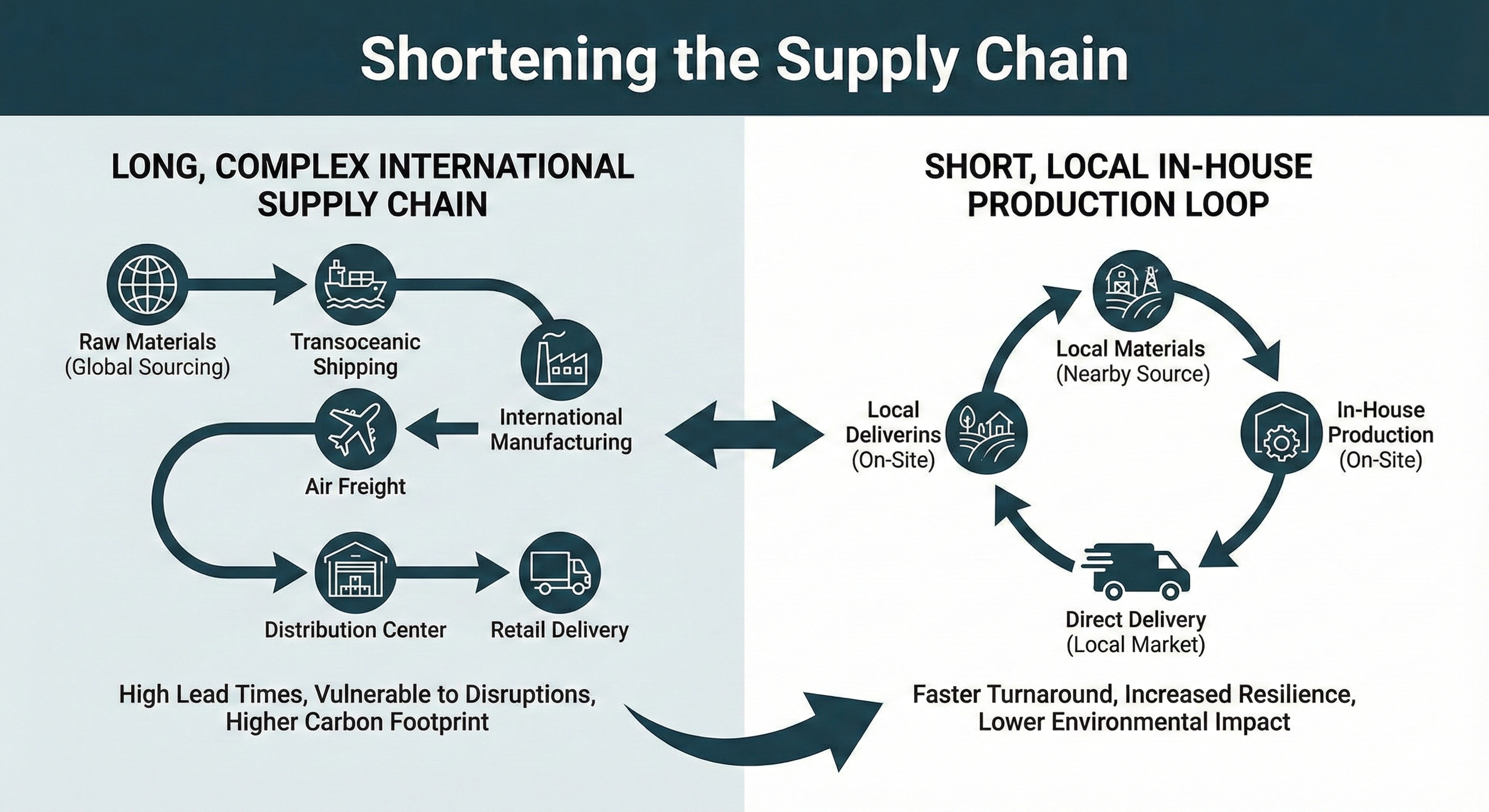
Over the past two decades, China has transformed from a low-cost manufacturing hub into the world’s most dominant and sophisticated industrial supply chain hub. For a buyer of blow molding machinery, this offers some incredible advantages that are hard to find anywhere else.
The Complete Ecosystem Advantage
The reason China can offer such compelling value is not just about labor costs anymore. It’s about the power of a highly integrated, massive, and competitive industrial ecosystem.
- One-Stop Supply Chain: Within a few hundred kilometers, Chinese manufacturers have access to everything they need. This includes high-quality steel for machine frames, world-class mold-making facilities, every conceivable electronic component, and advanced hydraulic and pneumatic parts. This proximity and integration dramatically reduce logistics costs and production time.
- Scale and Rapid Iteration: The sheer volume of machines produced in China is staggering. This massive scale lowers the cost of raw materials and components for everyone. More importantly, it creates an environment of intense competition and rapid innovation. Designs are constantly being improved, tested in real-world factories, and refined. The technology matures very, very quickly.
“Mature Technology” Meets “High ROI”
What this ecosystem creates for a global buyer is the perfect combination of quality and value. You are not buying experimental technology. You are buying machines that are based on mature, proven designs that have been refined over thousands of installations. The blow molding machines coming from top Chinese manufacturers today are stable, durable, and user-friendly, meeting international standards.
But you get this reliable technology at a fraction of the cost of a comparable European machine. This means your capital investment is lower, your break-even point is reached sooner, and your overall return on investment (ROI) is significantly higher.
Leka Machine: Using China’s Strengths to Serve Global Clients
It is precisely from within this powerful industrial ecosystem that a company like Leka Machine has grown. We are not just a factory; we are expert integrators of this entire supply chain. When you work with us, you are leveraging the full efficiency, cost-effectiveness, and technological advantage of the entire Chinese manufacturing base. We deliver this value to you in a single, reliable package.
This is what sets us apart:
- Focus and Specialization: We are specialists. We build both Extrusion Blow Molding and Stretch Blow Molding machines, and our team has deep expertise in both technologies.
- Complete Solutions: We provide a one-stop service. We can help with product design, we manufacture the molds, we build the machine, and we train your team to run the entire line.
- Reliable Delivery: We understand that time is money. Our streamlined process allows us to commit to a stable and predictable delivery window of 60-90 days.
- Global Experience: We have a vast network of clients around the world and a team that is experienced in handling international logistics and service.
- Professional Team: My role as a Technical Sales Manager, leading a team of experts, is to be your direct consultant, ensuring you get the right solution for your project.
In-Depth Analysis of Blow Molding Machine Prices: 2025 Market Guide
Let’s talk numbers. I believe in being straightforward about pricing. While every project is different and requires a custom quote, I can give you some realistic ballpark figures to help you with your initial budgeting. These are market averages you can expect to see in 2025.
Core Factors That Influence the Price
First, understand that the price of a machine can vary dramatically based on several key factors:
- Machine Type: As we discussed, a Stretch Blow Molding machine is often more mechanically complex than an Extrusion Blow Molding machine and may have a higher price for a similar output level.
- Capacity & Specifications: This is the biggest driver. A small machine for 100ml bottles is going to be far less expensive than a massive machine like our TITAN H1000L designed for 1000-liter containers. Clamping force, extruder size, and platen dimensions all have a major impact.
- Automation Level: A basic, semi-automatic machine will be the most affordable. As you add features like fully automated deflashing, leak testing, in-mold labeling, and downstream conveyors, the price will increase accordingly.
- Component Brands: A machine built with a full suite of Siemens electronics and Rexroth hydraulics will have a higher price than one built with lesser-known or domestic brands. However, this is an investment in reliability and ease of finding service parts globally.
- Customization Needs: If you require significant engineering modifications to the standard machine design, this will add to the cost.
Average Price Ranges for 2025 (For Reference Only)
Please remember, these prices are estimates for the machine only and do not include molds, auxiliary equipment, or shipping. They are intended to give you a general idea for planning purposes.
- Entry-Level / Small Machine de moulage par extrusion-soufflage (10ml – 2L):These are typically for small containers, cosmetic bottles, or simple shapes.Reference Price: $20,000 – $50,000 USD
- Mid-Size Fully Automatic Extrusion Soufflage Machine:This is the most common category, used for things like household chemical bottles, motor oil jugs, and 5-25L jerry cans. Our FORMA series fits well here.Reference Price: $50,000 – $150,000 USD
- High-Speed Fully Automatic Stretch Blow Molding Machine:These machines, like our série AQUA, are designed for high-volume production of PET water and beverage bottles. Their price is often related to their output, measured in bottles per hour (BPH).Reference Price: $80,000 – $300,000+ USD
Important Note: The mold is a separate and significant cost. A high-quality mold can range from a few thousand dollars to tens of thousands of dollars, depending on its complexity, size, and the number of cavities. Always be sure to budget for molds and auxiliary equipment in addition to the machine itself. For a precise, detailed quotation for your project, you should always contact a professional supplier like Leka Machine.
Frequently Asked Questions about Blow Molding Machine Suppliers
Q1: If I buy a machine from China, how can I be sure about the quality and after-sales service?
This is a very important and valid question. The key is to do your homework and partner with a reputable, direct manufacturer, not an anonymous trading company. Here’s how you protect yourself:
- Choose the Right Partner: Select a company with a long history of exporting to demanding markets like Europe and the Americas. Look for customer testimonials and case studies.
- Virtual Factory Tour: Insist on a live video tour of their facility. A professional company will be proud to show you their operations.
- Contract Terms: Make sure your purchase contract clearly specifies the brands of all major components, the full warranty terms, and the scope of after-sales support.
- Support Structure: Ask about their specific support model. At Leka Machine, for example, we often send an engineer to the customer’s site for installation and assembly, and we provide ongoing remote technical guidance for maintenance and troubleshooting.
Q2: How long does it usually take to get a machine delivered?
Delivery times can vary widely depending on the supplier and the complexity of the machine. A common range in the industry is between 60 and 120 days. Some European manufacturers can have lead times of 6 months or more. You need to get a firm delivery date in your contract. One of the advantages we focus on at Leka Machine is our efficient supply chain, which allows us to offer a standard, reliable delivery cycle of 60-90 days.
Q3: Besides the machine itself, what other auxiliary equipment do I need to buy?
A machine de moulage par soufflage cannot operate in a vacuum. You need a set of auxiliary equipment to support it. A professional supplier will help you configure a complete production line solution. This typically includes:
- Molds: You cannot make a product without a mold.
- Air Compressor: Provides the high-pressure air needed to blow the bottles.
- Water Chiller: Circulates cool water through the mold to solidify the plastic quickly. This is critical for fast cycle times.
- Material Loader: Automatically feeds plastic pellets from a hopper into the machine’s extruder.
- Crusher/Grinder: Used to grind up scrap plastic (from flash or rejected parts) so it can be recycled back into the production process.
Conclusion & Your Next Step
Making a Smart Investment Decision
Choosing a blow molding machine supplier is a major decision that will impact your business for years to come. It’s not just about buying a machine; it’s about making a smart, long-term investment. By focusing on the Total Cost of Ownership instead of just the initial price, thoroughly vetting your supplier’s technical capabilities and support systems, and avoiding the common pitfalls, you can confidently select a partner who will contribute to your success.
Remember the key steps: verify their credibility, assess their technical skill, review their support system, and then analyze the price for total value.
Start Your Project with a Free Production Line Analysis
Are you ready to improve your plastic production capabilities? The next step isn’t to just ask for a price list. The next step is to have a technical conversation.
Contact our expert team at Leka Machine. We’ll provide you with a free, no-obligation production line analysis. We’ll listen to your project goals, analyze your product requirements, and recommend a complete, customized equipment solution and a detailed quotation. Let us help you build a more efficient and profitable production line.
You can reach me and my team via our website at www.lekamachine.com or by emailing me directly at slany@lekamachine.com.
À propos de l'auteur
Slany Cheuang is the Technical Sales Manager at Leka Machine, with over 10 years of hands-on experience in the plastic blow molding industry. He is dedicated to helping global clients find the most efficient and cost-effective manufacturing solutions, guiding them through every step of the process from initial design to final production.

0 commentaires