
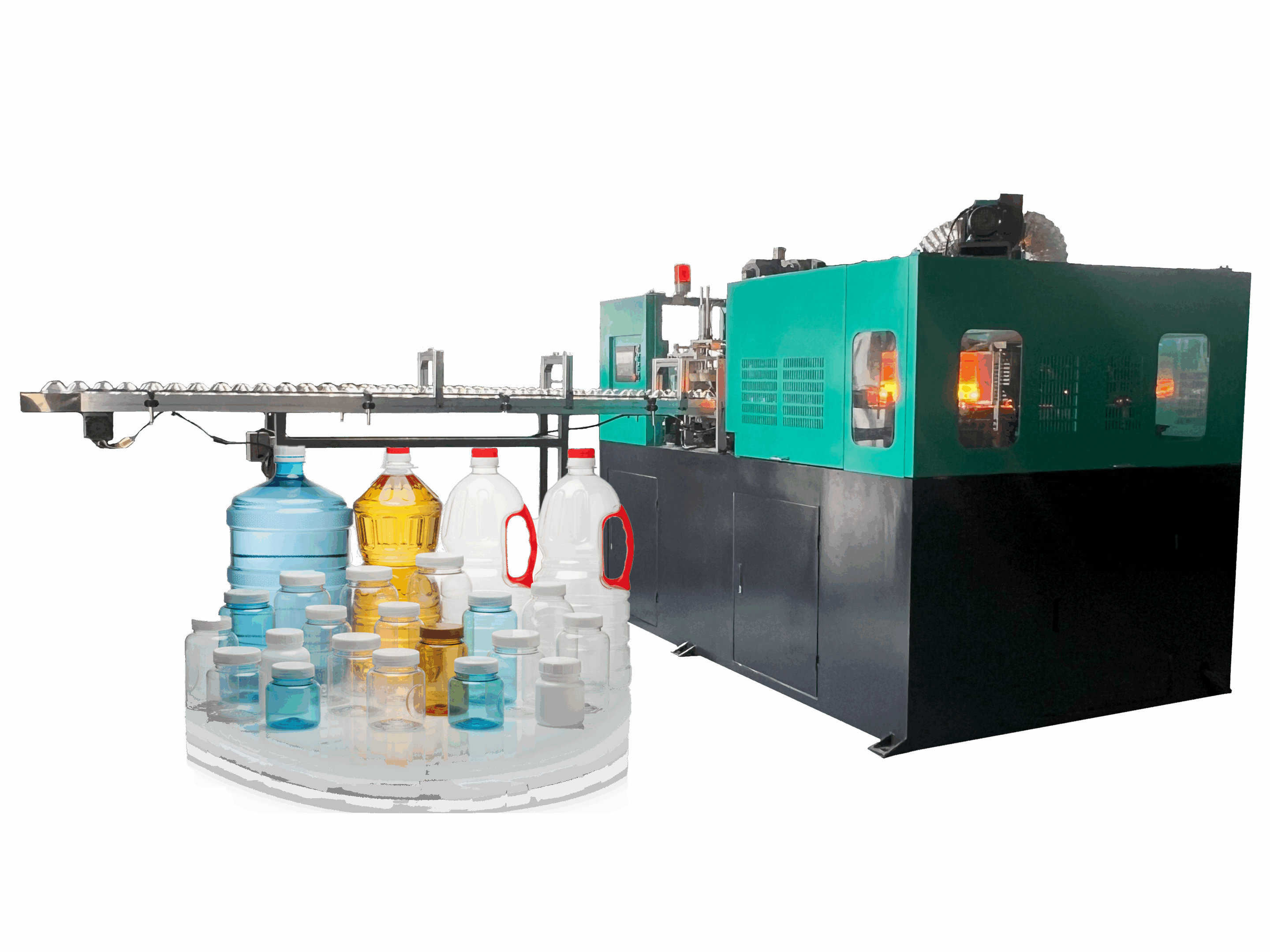
Guide ultime des machines de transformation des plastiques : De la matière première aux produits finis
Look around you right now. The device you’re reading this on, the pen on your desk, the dashboard of your car, the water bottle you’ll drink from later—our modern world is quite literally built from plastics. The global market for plastic processing machinery was valued at over $35 billion USD in 2024 and is expected to grow steadily. This isn’t just an industry; it’s the engine of modern production.
This guide is the culmination of my experience. I’m going to pull back the curtain and give you a complete tour of the world of plastic processing machinery. We won’t just skim the surface. We will go deep into the major machine types, break down how to choose the right one for your specific needs, compare the critical decision of buying new versus used, and even cover the essentials of safety and maintenance. My goal is to arm you with the knowledge to make a confident, informed, and profitable decision.
Table des matières
- Introduction: The Engine of Modern Manufacturing
- Part 1: The Fundamentals of Plastic Processing
- Part 2: Major Types of Plastic Processing Machinery
- Part 3: How to Choose the Right Plastic Processing Machine: A Buyer’s Guide
- Part 4: Operational Essentials: Safety, Maintenance, and Compliance
- Part 5: The Industry Ecosystem and Essential Resources
- Part 6: The Future of Plastic Processing: Trends to Watch
- Conclusion: Making a Smart Investment in Your Production Future
- À propos de l'auteur
- Foire aux questions (FAQ)
Part 1: The Fundamentals of Plastic Processing
Before we can talk about the machines, we have to understand the magic they perform. At its core, all plastic processing, no matter how complex the machine, boils down to a beautifully simple three-step principle that I call “Melt, Shape, Cool.”
How Plastic is Transformed: The Core Principle of Melt, Shape, Cool
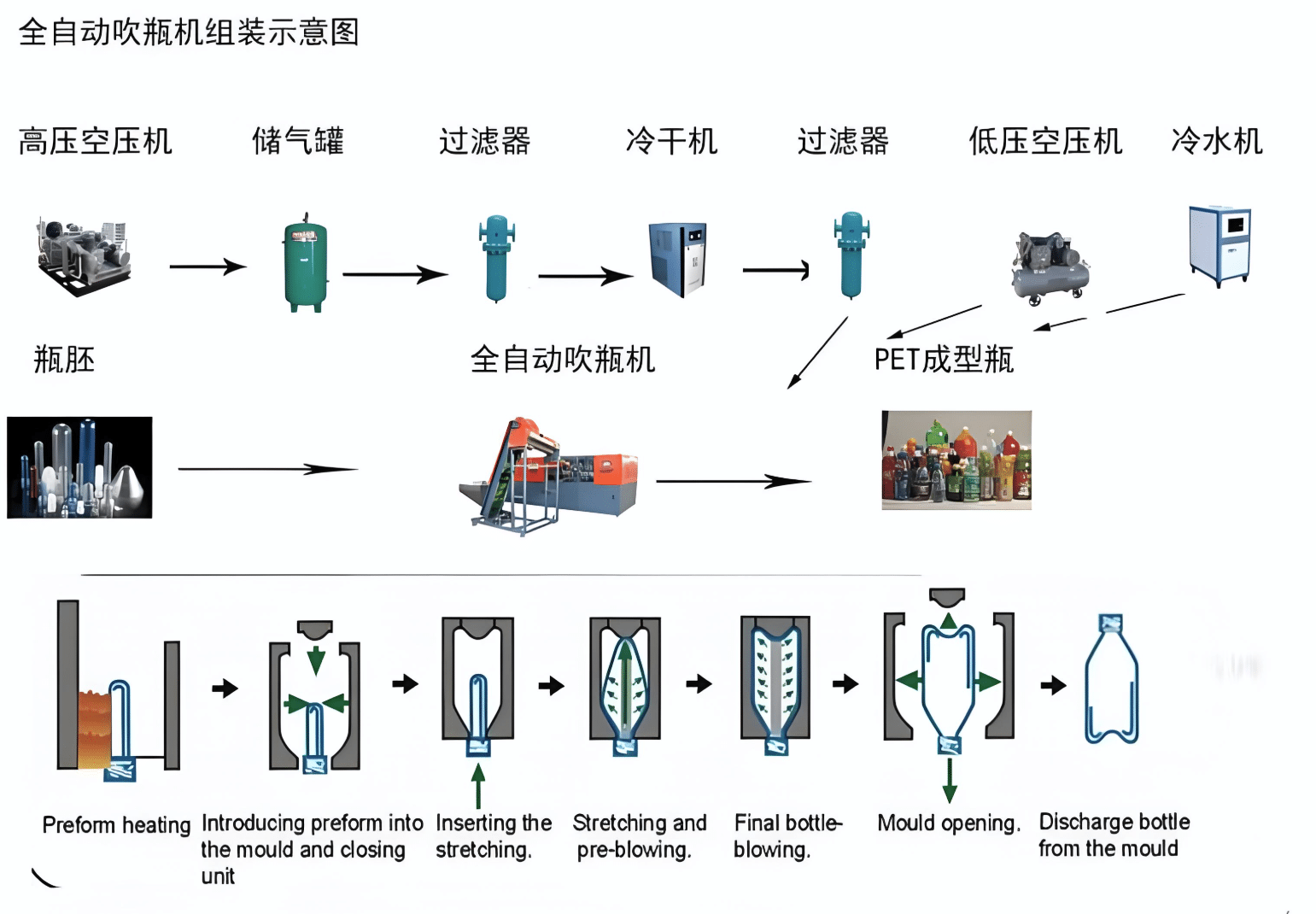
Flux de Travail de la Machine de Moulage par Soufflage
Imagine you’re baking a cake. You take your raw ingredients (flour, sugar, eggs) and mix them. That’s your raw plastic, which usually comes in the form of small pellets or granules.
- Melt: You put the cake batter in a hot oven. Similarly, we feed plastic pellets into a heated barrel. A large rotating screw pushes these pellets forward, and the combination of heat from heater bands and the friction from the screw’s movement melts them into a consistent, liquid-like state called “molten plastic” or “melt.”
- Shape: You pour the batter into a cake pan, which gives it its final form. In our world, this is the most critical step. We force this molten plastic—either by injecting it, pushing it, or blowing it—into a precisely engineered mold or through a die. This cavity is the negative space of the part we want to create.
- Cool: You take the cake out of the oven and let it cool to become a solid object. Likewise, the mold is cooled (usually with circulating water), allowing the plastic to solidify and harden into its final, durable shape. The part is then ejected, and the cycle begins again, sometimes in mere seconds.
A crucial detail to understand here is the type of plastic you’re working with. The vast majority of processes use Thermoplastics. Think of them like butter or candle wax. You can melt them, solidify them, and then melt them again. This property makes them highly recyclable. Common examples include PET (soda bottles), HDPE (milk jugs), PVC (pipes), and Polypropylene (containers and car parts).
Less common in high-volume processing are Thermosets. Think of these like the cake batter we mentioned. Once you bake it, you can’t un-bake it. A chemical reaction occurs (curing) that permanently sets the material’s shape. They are known for high strength and temperature resistance. Examples include epoxy, silicone, and polyurethane. The machine you choose must be compatible with the material your product demands.
Why is Choosing the Right Plastic Processing Machinery So Critical?
I cannot overstate this. Your choice of machinery is the single most important capital investment you will make. It’s the heart of your operation, and it directly dictates four key business outcomes:
- Product Quality & Consistency: The right machine will produce parts with incredible precision, down to the thousandth of an inch, every single time. The wrong machine will produce parts with flaws, inconsistent weights, and structural weaknesses, leading to customer rejection and brand damage.
- Production Speed & Efficiency (Cycle Time): In manufacturing, time is literally money. An injection molding machine might complete a cycle in 10 seconds, while a rotational molding machine could take 40 minutes. Choosing a process that doesn’t match your volume needs will either leave you unable to meet demand or with a cripplingly high cost-per-part.
- Operational Costs: This goes beyond the sticker price. A modern, all-electric machine might cost more upfront but can slash your energy bill by up to 50-70% compared to an older hydraulic machine. That’s a massive long-term saving.
- Return on Investment (ROI): Ultimately, it all comes down to this. The right machine, properly utilized, will pay for itself and become a profit center. The wrong one will bleed money through downtime, material waste, high labor costs, and rejected parts. It’s a decision that echoes on your balance sheet for years to come.
Part 2: Major Types of Plastic Processing Machinery
Now for the main event. Let’s walk through the workhorses of the industry. Each one is a specialized tool designed for a specific job. Using the wrong one is like trying to hammer a nail with a screwdriver—it might work, but it will be messy, inefficient, and the result will be poor.
1. Injection Molding Machines: For High-Volume, Complex Parts
If there’s one machine that’s the undisputed king of the plastics world, it’s the injection molding machine. It is the most versatile and widely used process, responsible for a staggering variety of the plastic items we use every day. If you have a solid, detailed plastic part, chances are it was injection molded.
How it Works
The process is a high-speed, high-pressure cycle.
- Clamping: A powerful hydraulic or electric mechanism closes the two halves of a steel mold, holding it shut with immense force (measured in tons).
- Injection: The screw inside the heated barrel pushes forward like a plunger, injecting a precise “shot” of molten plastic into the mold’s cavity at very high pressure, filling every tiny detail.
- Cooling: The plastic cools and solidifies inside the mold. This is often the longest part of the cycle.
- Ejection: The mold opens, and ejector pins push the finished part out, where it can be collected by a robot or dropped into a bin. The mold then closes, and the cycle repeats.
Key Components: The main parts are the clamping unit (which opens and closes the mold) and the injection unit (which melts and injects the plastic). The mold itself is the custom, precision-machined tool that defines the part’s shape.
Products Made: Lego bricks (the classic example of precision), bottle caps, phone cases, TV remote casings, car dashboards, medical syringes, electrical connectors, and complex engineering components.
| Avantages | Disadvantages |
|---|---|
| Unmatched Precision & Complexity: Can produce incredibly intricate and detailed parts. | High Initial Mold Cost: Molds are expensive, often costing tens of thousands of dollars or more. |
| Excellent for Mass Production: Once running, cycle times are extremely fast (seconds), leading to a very low cost per part. | Not Cost-Effective for Small Runs: The high mold cost is difficult to justify for low-volume production. |
| Low Labor Costs & High Automation: The process is easily automated with robotics. | Longer Setup Times: Changing a heavy mold and dialing in the process can take hours. |
| Wide Material Choice: Works with almost all thermoplastics. | Design Constraints: Some geometries (like undercuts) can add significant complexity and cost to the mold. |
Common Injection Molding Defects and How to Troubleshoot Them
In my experience, even the best setups can have issues. Knowing what to look for is key. Here are some of the most common defects I see on the factory floor.
| Défaut | Visual Cue | Common Causes |
|---|---|---|
| Flash | A thin layer of excess plastic escaping the mold cavity, usually along the parting line. | 1. Clamping force is too low. 2. Injection pressure or speed is too high. 3. The mold is worn or damaged. |
| Marques d'évier | Small craters or depressions on the surface, usually over thicker sections of the part. | 1. Inadequate holding pressure or time. 2. Cooling time is too short. 3. Melt temperature is too high. |
| Déformation | The part distorts or bends out of its intended shape after cooling. | 1. Non-uniform cooling in the mold. 2. Part ejected too hot. 3. Poor part design (e.g., non-uniform wall thickness). |
| Short Shot | The part is incomplete because the molten plastic didn’t fully fill the mold cavity. | 1. Insufficient shot size. 2. Injection pressure or speed is too low. 3. Blocked gates or vents in the mold. |
2. Extrusion Machinery: For Continuous Linear Shapes
If injection molding is about making individual things, extrusion is about making continuous lengths of a shape. The core analogy I always use is squeezing toothpaste from a tube. The shape of the tube’s opening (the die) determines the shape of the toothpaste ribbon that comes out.
How it Works
It’s a simpler and more continuous process than injection molding. Plastic pellets are fed into a heated barrel with a screw. The screw melts the plastic and pushes it steadily forward, forcing it through a shaped die at the end. The resulting continuous profile, called the “extrudate,” is then cooled (often in a water bath) and cut to length or spooled onto a roll.
Products Made: This process is for anything long and uniform in cross-section. Think pipes (PVC, PEX), window frames, vinyl siding, deck railings, rain gutters, drinking straws, and plastic films or bags (using a special circular die).
| Avantages | Disadvantages |
|---|---|
| High Production Volume: It’s a continuous process that can run 24/7, producing immense quantities of product. | Limited to Uniform Cross-Sections: You can’t create complex, multi-dimensional parts. |
| Low Tooling Cost: The die is much simpler and cheaper to make than a complex injection mold. | Post-Extrusion Finishing Often Needed: The product often needs to be cut, drilled, or assembled after it’s made. |
| Versatile for Different Profiles: A single extrusion line can make many different products just by changing the die. | Low Product Complexity: The parts are inherently simple in their geometry. |
Troubleshooting Common Extrusion Problems
Extrusion lines need constant monitoring. Here are a few issues that can pop up:
| Problème | Visual Cue | Common Causes |
|---|---|---|
| Melt Fracture | A rough, distorted, or wavy surface on the extrudate. | 1. The speed of the melt through the die is too high. 2. The melt temperature is too low, making the plastic too viscous. |
| Die Swell | The extrudate expands in size after exiting the die. (Some swell is normal, but excessive swell is a problem). | 1. Die geometry is incorrect (land length too short). 2. High melt elasticity of the specific polymer being used. |
| Surging | The output from the extruder fluctuates, causing variations in the product’s thickness or diameter. | 1. Inconsistent feeding of raw material from the hopper. 2. Worn screw or barrel. 3. Heater temperature fluctuations. |
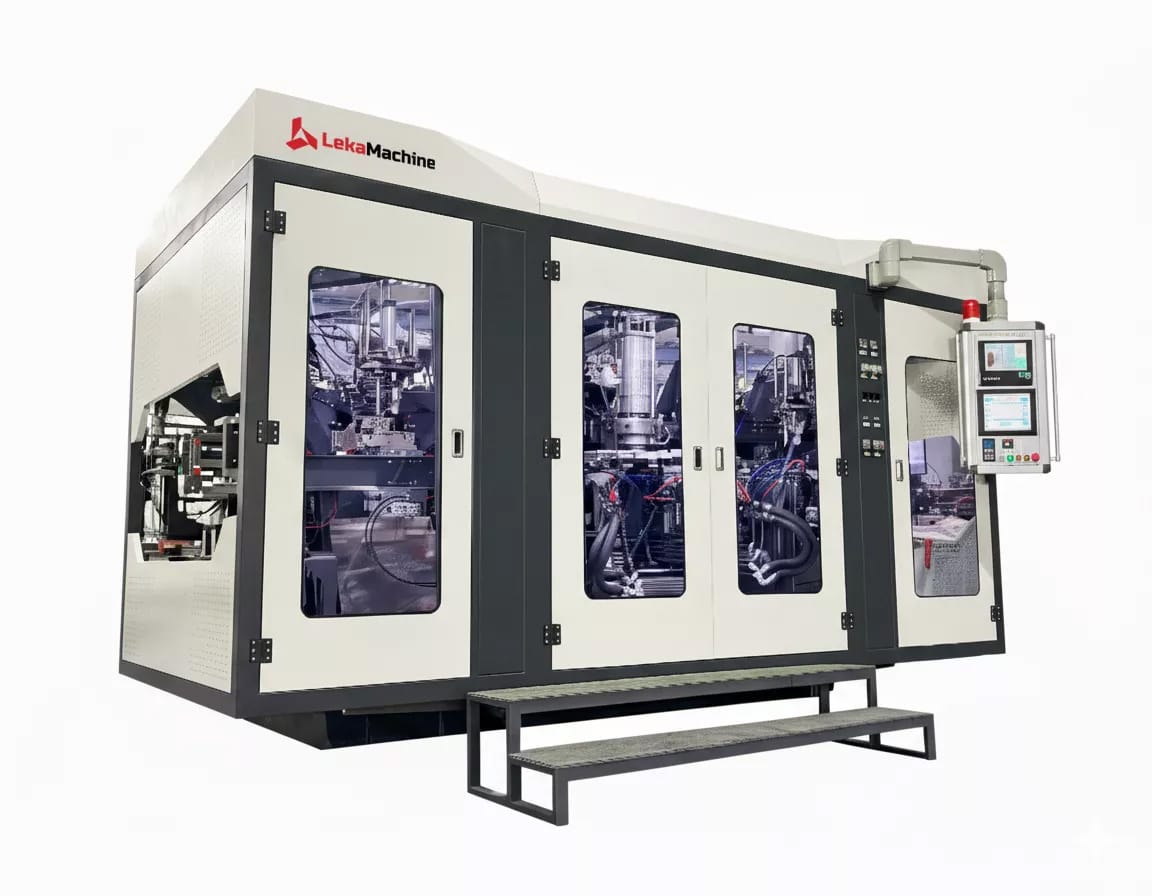
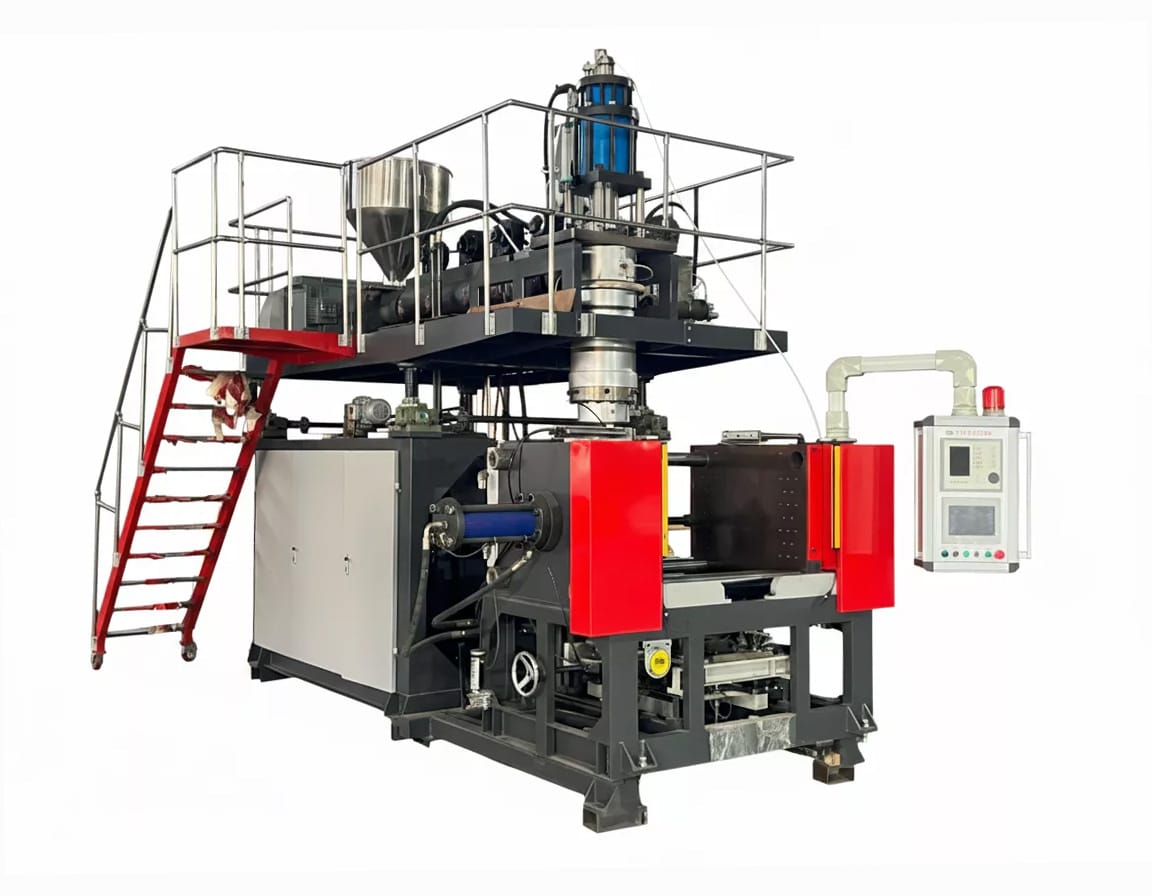
3. Blow Molding Machines: For Hollow Products
How do you think we get billions of perfectly uniform, thin-walled plastic bottles? The answer is blow molding, a brilliant process that’s like a high-tech version of glass blowing. If your product needs to be hollow and hold something (like a liquid, powder, or even just air), this is your process.
How it Works
- Create a Parison: First, the machine creates a hollow tube of molten plastic, called a “parison.” This is usually done with a small extruder.
- Capture in Mold: A two-part mold closes around the parison, pinching it shut at the bottom.
- Blow: A pin is inserted into the top of the parison, and compressed air is blown in, inflating the soft plastic like a balloon until it presses against the cold walls of the mold.
- Cool & Eject: The plastic cools and solidifies into the shape of the mold. The mold opens, and the finished hollow part is ejected.
Products Made: This is the go-to method for any hollow container. Water bottles, milk jugs, shampoo and detergent bottles, large drums and barrels, automotive fuel tanks, and hollow toys.
| Avantages | Disadvantages |
|---|---|
| Ideal for Hollow Parts: It’s the most efficient way to produce hollow objects at scale. | Limited to Hollow Shapes: It cannot produce solid parts. |
| Fast Production Cycles: The process is very fast, especially for small bottles. | Controlling Wall Thickness Can Be Tricky: Achieving perfectly uniform walls can be a challenge. |
| Low Tooling Costs: Molds are generally less expensive than high-pressure injection molds. | Material Waste (Flash): The process often creates excess material (flash) that needs to be trimmed off and recycled. |
Common Blow Molding Issues and Solutions
Wall thickness is the name of the game in blow molding. It’s where most problems arise.
| Problème | Visual Cue | Common Causes |
|---|---|---|
| Uneven Wall Thickness | The walls of the container are noticeably thicker in some areas and dangerously thin in others. | 1. Parison is not centered in the mold. 2. Inconsistent melt temperature causing sagging. 3. Air is leaking from the mold. |
| Holes or Ruptures | A hole in the finished part. | 1. Contamination in the raw plastic material. 2. The parison was too cold and stretched too far, causing it to tear. |
| Excessive Flash | A large amount of trimmed material, which is wasteful and slows down production. | 1. The mold halves are not closing properly. 2. Melt pressure is too high. |
4. Other Important Machinery Types You Should Know
- Thermoforming: This is a simpler process where a sheet of plastic is heated until it becomes pliable, then stretched over or into a mold and cooled. Think of the plastic clamshell packaging for berries, single-use coffee cup lids, and yogurt cups. It’s fantastic for thin-walled packaging.
- Rotational Molding (Rotomolding): For creating very large, hollow, and seamless parts, rotomolding is king. A plastic powder is placed inside a large metal mold. The mold is then heated and slowly rotated on two axes, allowing the powder to melt and coat the inside of the mold evenly. The result is incredibly strong, stress-free parts. Think large water storage tanks, kayaks, playground slides, and road cones.
- Plastic Recycling Machinery: This is a booming and critically important category. It’s not one machine but a system of machines. This includes shredders to break down waste, washing lines to clean it, and pelletizing extruders that melt the clean plastic flakes and turn them back into uniform raw material pellets that can be used to make new products.
Part 3: How to Choose the Right Plastic Processing Machine: A Buyer’s Guide
Alright, now that you understand the tools, let’s talk about how to pick the right one from the toolbox. When a client comes to me asking what machine to buy, I don’t start by talking about machines. I start by talking about their product. The product dictates the process, not the other way around. I’ve seen people buy a machine they got a “good deal” on, only to find it’s completely wrong for the part they need to make. That’s a catastrophic mistake.
Key Factors to Consider Before You Buy
Let’s break down the decision-making process into four critical pillars. You need a solid answer for each of these before you even think about talking to a sales rep.
- The Product: This is your north star.
- Geometry & Complexity: Is your part solid and intricate? Injection Molding. Is it hollow? Blow Molding. Is it long and uniform? Extrusion. Is it a massive, hollow tank? Rotational Molding. This is the first and most important cut.
- Size & Weight: The physical size of your part determines the size of the machine. For injection molding, this is measured in “clamping tonnage”—the force needed to hold the mold shut. A tiny electrical connector might need a 30-ton press, while a car bumper needs a 3,000-ton behemoth.
- Required Precision: Are you making a life-saving medical device with tolerances of a few microns, or a simple garden flower pot? The precision you need will dictate the quality (and cost) of the machine and mold you require.
- The Material: What plastic does your product need to be made from?Some materials like PVC are challenging to run and require specialized screws and barrels to prevent corrosion. High-temperature materials like PEEK or Ultem require machines capable of reaching and maintaining much higher temperatures. You must ensure the machine you’re considering is engineered to handle your specific polymer.
- Production Volume: How many parts do you need to make, and how fast?Are you making 10 million bottle caps a year or 500 kayaks? For 10 million parts, you need a high-speed, multi-cavity injection molding system. For 500 kayaks, a rotational molding setup is perfect. Mismatching volume is a recipe for financial disaster. Be realistic about your market demand.
- Budget: This is about more than just the machine’s price tag.You need to budget for the entire “cell”: the machine itself, the mold/die (which can be hugely expensive), auxiliary equipment (material dryers, chillers, grinders, robots), installation, shipping, and training for your staff. I always advise clients to budget for the total cost of ownership, not just the initial purchase price.
Get Our Free Machine Purchase Checklist! (PDF)
This process can be overwhelming. That’s why I’ve put together a comprehensive checklist that walks you through every question you need to ask—from part design and material specs to power requirements and maintenance needs. Don’t talk to a salesperson without it.
Should You Buy New or Used Plastic Processing Equipment?
This is one of the biggest debates, and frankly, there’s no single right answer. It completely depends on your budget, risk tolerance, and technical expertise. I’ve seen both strategies succeed and fail spectacularly.
Here’s a head-to-head comparison based on my experience:
| Facteur | Buying New Equipment | Buying Used Equipment |
|---|---|---|
| Coût initial | High. You’re paying a premium for the latest technology and a machine with zero wear and tear. | Significantly Lower. You can often get a capable machine for 30-60% of the cost of a new one. This is the primary driver for the used market. |
| Technologie | Cutting-Edge. You get the latest in energy efficiency (all-electric drives), smart controls (Industry 4.0), and automation. | Proven, but Dated. The machine might be a workhorse, but it will likely be less energy-efficient and lack modern data-tracking and self-diagnostic capabilities. |
| Warranty & Support | Comprehensive. The manufacturer provides a full warranty, technical support, training, and readily available parts. | None (“As-is, where-is”). You are on your own. There is no warranty. If it breaks the day after you install it, the repair bill is yours. |
| Délai d'exécution | Long. It can take anywhere from 3 to 12 months for a new machine to be built and delivered. | Immediate. You can often find a machine that is available to be shipped right away. |
| Risk | Low. The machine is guaranteed to work as specified out of the box. | High. You’re buying a machine with an unknown history. It could have hidden mechanical problems, electrical issues, or a worn-out screw and barrel. A thorough inspection by an expert is non-negotiable. |
My advice?
- Buy New if: You have the capital, your product requires the highest precision, you want maximum energy efficiency, and you cannot afford the risk of unexpected downtime.
- Buy Used if: Your budget is tight, you have a strong in-house technical team that can inspect and repair equipment, the technology for your product hasn’t changed much, and you’ve found a reputable dealer (like PlastiWin or others) who can vouch for the machine’s condition.
How Much Does Plastic Processing Machinery Cost?
This is the million-dollar question—sometimes literally. There’s no simple “price list.” The cost is highly dependent on type, size, brand, and features. A machine from a top-tier German or Japanese brand will cost significantly more than one from a reputable Taiwanese or Chinese manufacturer.
However, to give you a rough ballpark, here are some very general estimates. Please, use these for preliminary budgeting only!
| Machine Type | Size | Estimated New Price Range (USD) | Estimated Used Price Range (USD) |
|---|---|---|---|
| Moulage par injection | Small (50-150 Ton) | $50,000 – $150,000 | $15,000 – $60,000 |
| Moulage par injection | Medium (300-500 Ton) | $180,000 – $400,000 | $50,000 – $120,000 |
| Extrudeuse | Small (2.5 inch / 65mm) | $60,000 – $150,000 | $20,000 – $60,000 |
| Moulage par soufflage | Small Bottle Machine | $80,000 – $250,000 | $30,000 – $90,000 |
Remember the hidden costs! Auxiliary equipment can easily add another 20-50% to the total cost. Don’t get caught by surprise.
Part 4: Operational Essentials: Safety, Maintenance, and Compliance
Let me be blunt: there is no room for compromise on safety. These are powerful, heavy industrial machines that operate at high temperatures and extreme pressures. A beautiful, efficient production line means nothing if your people aren’t safe. Building a culture of safety and proactive maintenance from day one is essential.
Critical Safety Protocols for Operating Plastic Machinery
- Personal Protective Equipment (PPE): At a minimum, this means safety glasses with side shields and heat-resistant gloves. Depending on the noise level, hearing protection may also be necessary.
- Lockout/Tagout (LOTO): This is arguably the most important safety procedure in any factory. Before anyone performs maintenance or enters a machine’s operational area, the machine must be completely de-energized (electrical, hydraulic, pneumatic) and locked out, with a tag indicating who is working on it. This prevents accidental startup and has saved countless lives.
- High Temperature & Pressure Awareness: Molten plastic can be over 400°F (200°C), and hydraulic systems can operate at over 2,000 PSI. Leaks can cause severe burns or injection injuries. All operators must be trained to respect these hazards.
- Machine Guarding: All safety guards, gates, and emergency stop buttons must be in place and functioning perfectly. Never, ever bypass a safety feature to “speed things up.” It’s a direct path to tragedy.
A Basic Maintenance Checklist to Maximize Machine Lifespan
A well-maintained machine is a reliable and profitable machine. Neglect is its worst enemy. Here is the basic weekly checklist I recommend for every press on your floor:
- Check Fluid Levels: Inspect hydraulic oil levels and look for any leaks around hoses and fittings.
- Lubricate: Ensure all grease points on the clamping mechanism and other moving parts are properly lubricated according to the manufacturer’s schedule.
- Cleanliness: Keep the area around the machine clean and free of oil, water, and plastic pellets. A clean machine is easier to inspect for problems.
- Check Heater Bands: Verify that all temperature zones on the barrel are heating correctly.
- Inspect Safety Features: Physically test the emergency stop buttons and ensure all safety gates are functioning and interlocked.
- Listen: Sometimes the first sign of a problem is a new or unusual noise—a squeal, a clank, a hiss. Train your operators to report anything out of the ordinary immediately.
Understanding Industry Standards and Compliance (e.g., ISO, CE)
When you’re looking at machinery, especially from international sources, you’ll see certification marks. Two of the most important are:
- CE Marking: This indicates that a machine sold within the European Economic Area meets the EU’s high safety, health, and environmental protection requirements. It’s a strong indicator of a well-designed and safe machine.
- ISO 9001: This is a certification for the manufacturer’s quality management system. It doesn’t certify the machine itself, but it shows that the company has robust processes in place for design, production, and quality control, which is a very good sign.
Part 5: The Industry Ecosystem and Essential Resources
You’re not alone on this journey. A rich ecosystem of manufacturers, suppliers, and publications exists to support the industry.
Leading Manufacturers and Brands to Know
The landscape of manufacturers is vast, but they generally fall into a few tiers.
- Premium European & Japanese Brands: (e.g., Arburg, Engel, KraussMaffei, Sumitomo Demag, Nissei). Known for cutting-edge technology, incredible precision, and reliability—with a premium price tag to match.
- North American Brands: (e.g., Milacron, Husky, UBE). Strong players with a long history, particularly in specific market segments like packaging and large tonnage machines.
- Value-Oriented Asian Brands: (e.g., Haitian, Yizumi, Chen Hsong). These brands, particularly from China and Taiwan, have made enormous strides in quality and now offer incredible value. Haitian is, by volume, the largest seller of injection molding machines in the world.
Where to Find More Information: Magazines and Catalogs
To stay current, you need to read. My go-to resources are:
- Industry Magazines: Publications like Plastics Machinery & Manufacturing et le Plastics Technology are invaluable for news on new technologies, market trends, and expert columns.
- Catalogs & Parts: If you need parts or auxiliary equipment, companies like Plastic Process Equipment, Inc. (PPE) offer extensive catalogs. For specific machine parts, the best way to find a PDF catalog is to search Google for
"[Brand Name] [Machine Model] parts catalog PDF".
Part 6: The Future of Plastic Processing: Trends to Watch
This industry never stands still. Three massive trends are shaping our future right now.
- Sustainability & Circular Economy: This is the biggest one. The push for sustainability is driving innovation in two areas:
- Efficacité énergétique : All-electric machines are replacing hydraulic ones, dramatically reducing power consumption.
- Recycling: There’s huge investment in more sophisticated recycling machinery and processes to create a “circular economy” where plastic waste is efficiently turned back into high-quality raw materials. The ability to process recycled content is becoming a standard feature on new machines.
- Industry 4.0 & Automation: The “smart factory” is here. Machines are now equipped with sensors that monitor their own health and performance in real-time. They can predict when a part is about to fail, automatically adjust parameters to maintain quality, and communicate with a central factory management system. This leads to less downtime, higher quality, and more data-driven decision-making.
- Additive Manufacturing (3D Printing): While not a direct replacement for high-volume processes like injection molding, 3D printing is a revolutionary complementary technology. It’s used for rapid prototyping (to test a design before cutting an expensive steel mold), creating custom jigs and fixtures for the factory floor, and for low-volume production of highly complex parts.
Conclusion: Making a Smart Investment in Your Production Future
We have covered a tremendous amount of ground. We’ve gone from the basic “Melt, Shape, Cool” principle to the intricacies of troubleshooting common defects, the financial calculus of buying new versus used, and the future of the smart factory.
If there’s one thing I want you to take away from this guide, it’s this: choosing your plastic processing machinery is not just a technical decision; it’s a foundational business strategy. The choices you make will directly impact your product’s quality, your operational efficiency, and your company’s profitability for the next decade or more.
Do your homework. Understand your product inside and out. Be realistic about your budget and your volume needs. And never, ever compromise on safety and maintenance. The right machine, in the hands of a well-trained team, isn’t just a piece of capital equipment—it’s a license to print money.
Ready to find the right machine for your project? Contact our experts today for a free, one-on-one needs analysis. We’ll help you navigate the options and build the perfect production solution.
Foire aux questions (FAQ)
Q1: What is the most common type of plastic processing machine?
R : By a significant margin, the injection molding machine is the most common and versatile. Its ability to produce a massive variety of complex, solid plastic parts with high precision and incredible speed makes it the backbone of the industry, used for everything from tiny medical components to large automotive panels.
Q2: How much does a small plastic injection molding machine cost?
R : The price varies greatly by brand, features, and condition, but as a general guideline, a new, small machine (in the 50 to 150-ton range) can cost anywhere from $50,000 to $150,000 USD. A reliable used machine in the same size range could be found for $15,000 to $60,000. Remember to budget for auxiliary equipment and installation on top of this price.
Q3: Can I make money with a plastic recycling machine?
R : Absolutely. A plastic recycling business can be very profitable, but its success depends on two key factors: securing a consistent, low-cost supply of clean plastic waste, and having a ready market of buyers for your recycled pellets. The machinery itself—shredders, washing lines, and pelletizers—is a significant investment, so a solid business plan is essential.
Q4: What’s the main difference between injection molding and extrusion?
R : The simplest way to think about it is in the output. Injection molding creates discrete, individual parts in a cyclical process (like a phone case). Extrusion creates continuous, long shapes in a non-stop process (like a pipe or a window frame). You choose one or the other based entirely on the geometry of your final product.
Q5: Where can I find used plastic processing machinery for sale?
R : You can find used equipment through several channels. Specialized dealers and online marketplaces like PlastiWin are a great place to start as they often inspect and sometimes refurbish the machines. You can also look at industrial equipment auctions and liquidations, or even purchase directly from factories that are upgrading their production lines. I always recommend hiring an independent technician to inspect any used machine before you purchase.


0 commentaires